Greece is a country of 6,000 islands scattered across two seas, and the fastest way to see more than one of them in a week is to fly. This seven-day loop uses short domestic hops to link the marble monuments of Athens with a volcanic caldera and a Minoan palace, leaving the long ferry crossings for another trip.
Days 1–2: Athens — the Acropolis and the Ancient Core
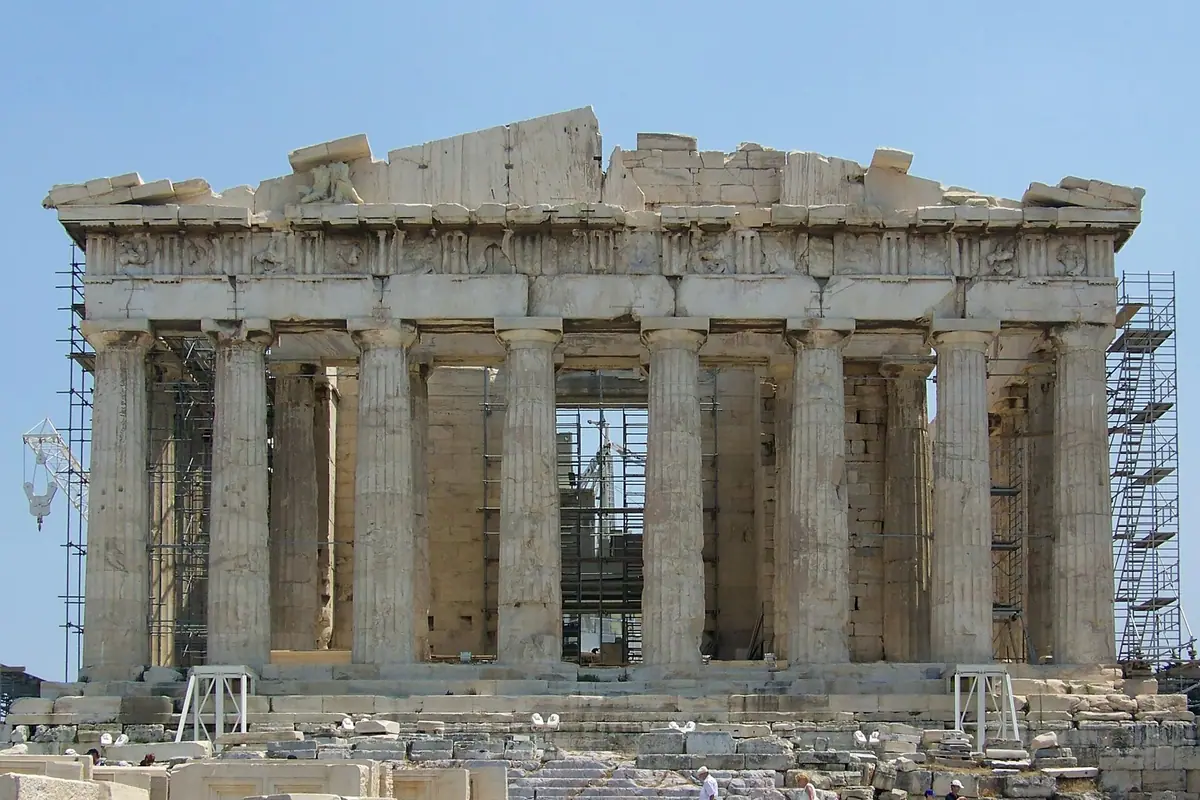
Start where the country starts: the Acropolis. Climb through the Propylaea gateway shortly after the site opens in the morning, before the heat and the coach groups arrive, and you will have the Parthenon's columns almost to yourself for a few minutes. Walk the full plateau — the Erechtheion with its Caryatid porch, the Temple of Athena Nike on its jutting bastion, and the panorama stretching to Lycabettus Hill and out to the Saronic Gulf. Afterwards, the Acropolis Museum at the foot of the rock puts the story in order, with the Parthenon frieze, the smiling Kore statues, and glass floors looking down onto an excavated ancient neighbourhood.
Spend the afternoon in Plaka and Anafiotika, the whitewashed Cycladic-style lanes tucked directly beneath the Acropolis' north wall, then drift into Monastiraki for the flea market, Hadrian's Library and the Roman Agora with its octagonal Tower of the Winds. Dinner belongs in Psiri, where the tavernas fill up late and the grill smoke hangs over the square. If you have energy left, the changing of the guard at Syntagma Square happens on the hour and is worth the ten minutes.
Give your second day to the lower city and its museums. Walk the Temple of Olympian Zeus, pass under Hadrian's Arch, and continue to the Panathenaic Stadium, the horseshoe of white marble where the modern Olympic story began. The National Archaeological Museum is the essential stop — the gold Mask of Agamemnon, the Antikythera mechanism and the bronze Artemision Jockey reward a slow two hours. Finish with sunset from Lycabettus Hill, or take a half-day run down the coast road to Cape Sounion, where the Temple of Poseidon stands on a cliff above the Aegean.
Day 3: Fly to Santorini — Caldera, Fira and Oia
The flight from Athens to Santorini takes around 40 minutes, which is roughly the time it takes to get through the airport at either end. You land at Thira airport beside Kamari, on the flat eastern side of the island, and the famous caldera only reveals itself as the road climbs to Fira. Check into a cave room on the rim if your budget stretches, or stay in Karterados or Kamari and walk in for the views — the caldera is a public spectacle, not a private one.
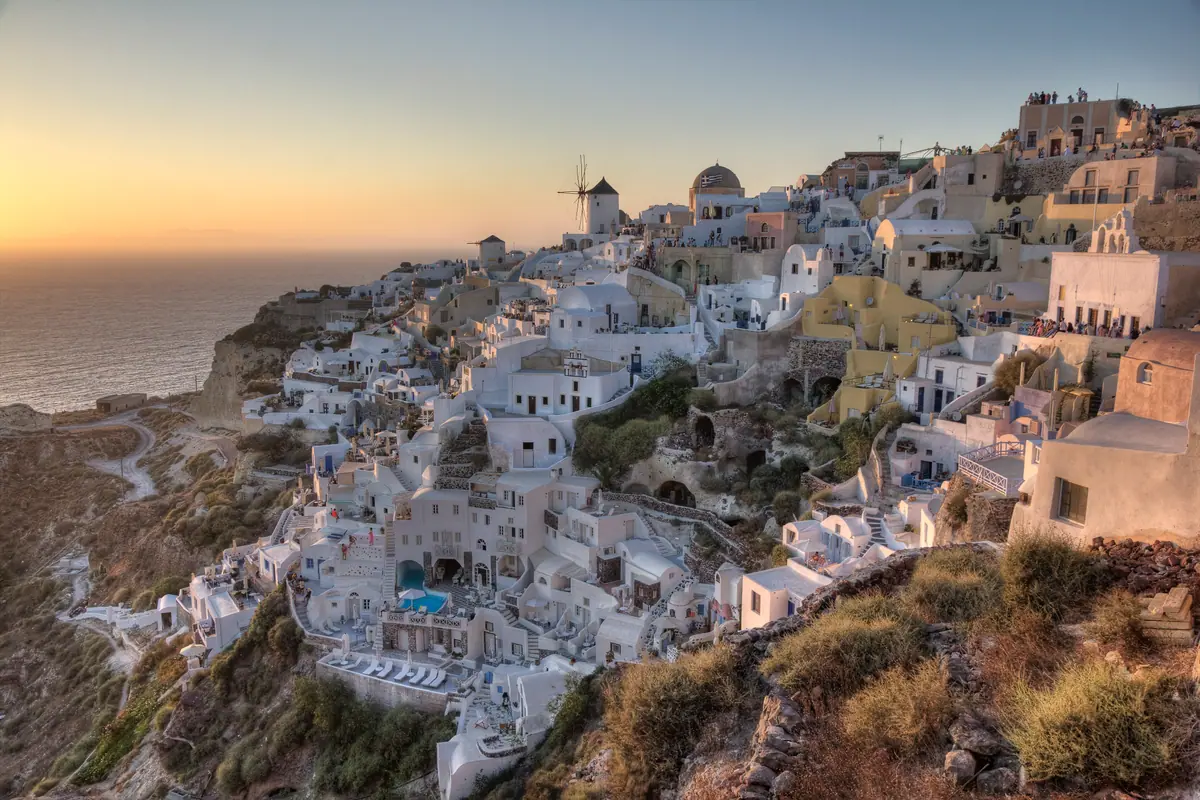
Spend the afternoon walking the rim path from Fira through Firostefani to Imerovigli, three kilometres of whitewashed chapels, bougainvillea and plunge pools perched above a 300-metre drop to the sea. The rock of Skaros, a Venetian fortress ruin on a promontory below Imerovigli, is the best free viewpoint on the island. If you fancy the walk, the 580-odd steps from Fira down to the old port are a sweat in summer; the cable car is the saner option, and donkeys still make the climb for those who want the old-fashioned version.
Oia, at the northern tip, is where everyone wants to be at sunset. Arrive at least two hours early, claim a spot near the castle ruins, and accept that you will share it with a few thousand people. The reward is the light turning the blue domes and the caldera cliffs the colour of embers. Afterwards, walk or take a boat down to Ammoudi Bay for grilled octopus at the water's edge — a much better memory than the crowd on the wall.
Day 4: Santorini's Deeper Cuts — Akrotiri, Red Beach and Ancient Thera
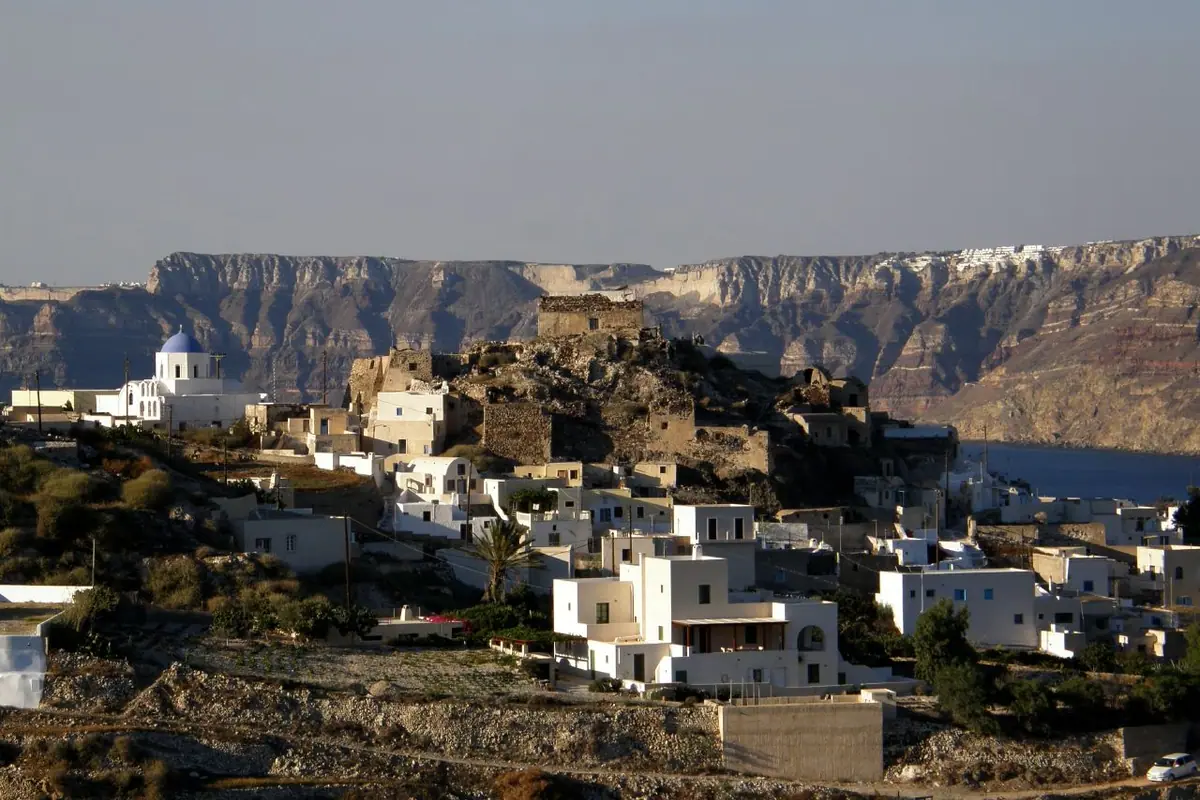
Santorini is not only a sunset. Head south to Akrotiri, a Bronze Age town buried by volcanic ash in the middle of the second millennium BC and preserved under a vast modern roof. You walk down wooden walkways between three-storey houses, stone staircases and storage jars, and the frescoes recovered here — the Spring fresco, the Boxing Boys — are in the Museum of Prehistoric Thera back in Fira. It is the closest thing in Greece to a Bronze Age Pompeii, and it is quietly astonishing.
Nearby, the Red Beach gets its colour from iron-rich cliffs that crumble into the sea, best viewed from the path above and best reached early before the crowds and the rockfall warnings. Continue around the southern cape to Perissa and Kamari for black-sand swimming, and climb the winding road above Kamari to Ancient Thera, a Greco-Roman city on the ridge of Mesa Vouna with theatres, temples and inscriptions facing both coasts. Pyrgos and Megalochori, inland villages of vaulted lanes and bell towers, make good late-afternoon stops, and the vineyards on the island's volcanic soil produce an Assyrtiko well worth a tasting at one of the clifftop wineries near Pyrgos.
Day 5: Fly to Crete — Knossos and Heraklion
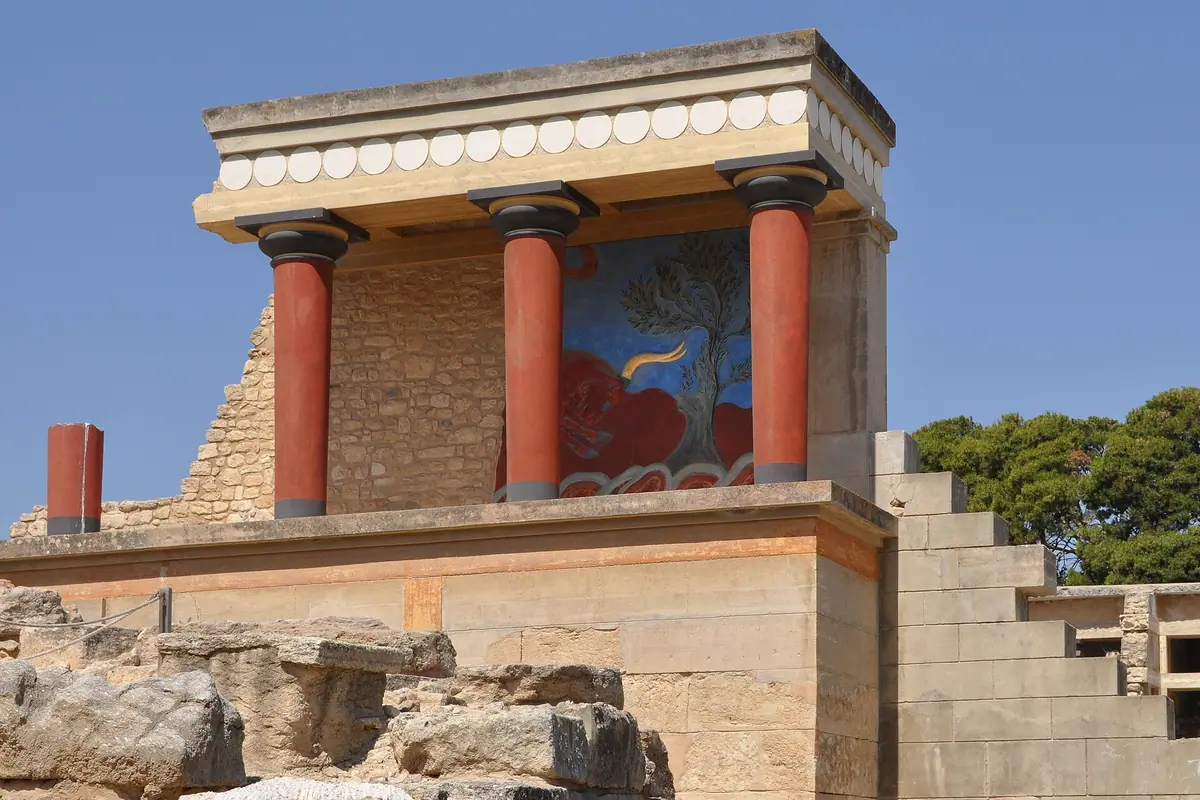
In the high season there are direct flights from Santorini to Heraklion in around 40 minutes; outside it, you connect through Athens or take a fast ferry across the Cretan Sea. Either way, land in Heraklion and go straight to Knossos, just outside the city, where the Minoan palace sprawls across a hillside of reconstructed red columns, the Throne Room, the Grand Staircase and the bull-leaping frescoes that gave the site its legend of the labyrinth. Hire a guide or read up beforehand — the concrete restorations are controversial, but the scale of a 4,000-year-old palace is unmistakable.
Back in town, the Heraklion Archaeological Museum holds the originals: the Phaistos Disc, the Bull-Leaping Fresco, the Snake Goddess figurines. It is one of the great museums of Greece, and an hour here sharpens everything you just saw at the palace. The rest of the day belongs to the city itself — the Venetian walls and the Koules Fortress guarding the old harbour, the Morosini Fountain on Lion Square, the market street of 1866 and the long seafront promenade where Cretan families walk off their dinner.
Eat properly tonight. Crete takes its food seriously: dakos with tomatoes and mizithra, snails if you are brave, lamb with stamnagathi greens, and raki that arrives whether or not you asked for it.
Days 6–7: Chania, the Venetian Harbour and the Flight Home
Cross the island west by car or coach — about two and a half hours to Chania, with a worthwhile stop in Rethymno to see its Venetian Fortezza and Ottoman minarets. Chania's old town is the prettiest in Crete: a horseshoe harbour ringed by Venetian arsenals, the domed mosque of the Janissaries, and the Egyptian Lighthouse at the end of the breakwater, lit gold at sunset. Wander the back lanes of Splantzia and Topanas, eat bougatsa for breakfast, and let the day dissolve in the harbour tavernas.
If you want one grand Cretan excursion, this is the day for it. Boat trips run from Kissamos to the Balos lagoon and the island of Gramvousa; Elafonissi offers pink-tinged sand and shallow turquoise water; and the Samaria Gorge, a 16-kilometre walk through a towering limestone canyon, runs roughly May to October and takes most of a day. All three need an early start and a full day — choose one, not two.
On your final morning, fly from Chania back to Athens in about an hour and connect onward. If your flight home leaves late, keep the afternoon for the Ancient Agora and the Temple of Hephaestus, or squeeze in a last plate of souvlaki in Monastiraki before heading to the airport and the end of a week that covered three thousand years in seven days.
Making the Flights and the Season Work for You
Athens is the hub of Greek domestic aviation, and most inter-island routes — including Santorini to Crete — operate only in the warmer half of the year, roughly from late spring to early autumn. Outside those months, expect to route back through Athens rather than fly point-to-point, and check schedules as soon as your dates are fixed, because seats on the small propeller aircraft that serve the islands sell out first. Arrive at least 90 minutes before departure, and pack light: cabin allowances on these short hops are tighter than on the big jets.
Ferries remain the flexible alternative. The fast catamaran from Santorini to Heraklion takes about two hours, and island-to-island crossings such as Naxos to Paros are short and cheap. Ferries carry more luggage, run year-round on the main lines, and turn a transfer into a scenic event — but they are weather-dependent, so never book a ferry on the same day as an international flight home.
For timing, aim for late April to mid-June or September to mid-October. The sea is warm enough to swim, the light is long, the archaeological sites are bearable, and prices dip outside the July–August peak, when heat, crowds and the meltemi winds all arrive together. Winter is quiet and cheap but many island hotels and tavernas close, and flights thin out dramatically. If you have extra days, the obvious add-ons are Mykonos with its windmills, Little Venice and the sacred island of Delos; Rhodes with the Palace of the Grand Master and the Acropolis of Lindos; or a mainland detour to the monasteries of Meteora and the ruins of Delphi.
Frequently asked questions
When is the best time to visit Greece for a one-week island-hopping itinerary?
Late April to mid-June and September to mid-October are ideal: warm sea, comfortable temperatures for archaeological sites, fewer crowds and more available flights. July and August bring intense heat, peak prices and the meltemi winds that can disrupt ferry schedules, while winter sees many island hotels close and domestic routes reduced.
Can you fly directly between Greek islands?
Sometimes, but mostly in the high season. Routes such as Santorini to Heraklion in Crete run directly in summer, and a handful of other island pairs are linked seasonally. Outside those months, almost everything connects through Athens, which adds a few hours but keeps schedules reliable.
Is it better to fly or take a ferry between the islands?
Flights win on time — Santorini to Crete is about 40 minutes in the air against roughly two hours by fast ferry — and they are less affected by weather. Ferries are cheaper, carry unlimited luggage, run year-round on the main lines and are the only practical option for short hops like Naxos to Paros.
How many days do you need in Athens?
Two full days covers the essentials: the Acropolis and its museum, Plaka and Monastiraki, the Ancient Agora, the Temple of Olympian Zeus, the Panathenaic Stadium and the National Archaeological Museum. Add a third if you want a day trip to Cape Sounion, Delphi or the Peloponnese sites.
Do you need to rent a car on Santorini and Crete?
In Santorini, buses, taxis and the odd ATV will get you between Fira, Oia, Akrotiri and the beaches, though a car makes the southern sites much easier. In Crete, a car is close to essential if you want Chania, Knossos, Balos and the gorges on your own schedule rather than a coach tour's.
Sort the rest of your trip
Everything for Greece, in one place
Stay in Greece
Hotels, guesthouses and apartments — compared in one search.
Search hotels
Transfer in Greece
Private driver waiting on arrival — no queues, no surprises.
Book a transfer
Travel insurance
Medical cover, delays and lost baggage — sorted before you go.
Get coveredMore guides in Greece
Greek Food, Culture and Local Experiences: A Tour of Greece Worth Taking

Where to Stay in Greece: Hotels by Region and the Must-See Sights Nearby

One Week in Greece by Plane: Athens, Santorini and Crete Itinerary

Best Activities in Greece: From the Acropolis to the Santorini Caldera

Top Things to Do in Greece: Must-See Landmarks and Islands