Uzbekistan is one of the rare countries where your hotel window can frame a turquoise-tiled minaret at dawn and a Silk Road bazaar at dusk. Because its great cities sit hundreds of kilometres apart, where you sleep shapes what you actually see — a rooftop in Bukhara and a courtyard in Samarkand are not interchangeable. This guide walks through the cities worth basing in, the landmarks that anchor each one, and the practical details that decide whether your stay feels effortless or exhausting.
Why Uzbekistan Rewards a Little Hotel Planning
Uzbekistan's tourist map is essentially a spine of legendary cities strung along the old caravan routes: Tashkent in the east, then Samarkand, then Bukhara, then Khiva far to the west near the desert edge of Khorezm. They are linked by fast trains and long drives, not by short hops, so most visitors pick three or four bases rather than one. That makes accommodation more than a bed: choosing a hotel near the Registan in Samarkand or inside Khiva's walls transforms a checklist of monuments into something you can walk through at the hours when it is at its best.
The range of places to sleep is broader than many first-timers expect. There are monumental Soviet-era hotels that look like set pieces from another era, sleek new city properties in Tashkent, beautifully restored merchant houses with inner courtyards, and family-run guesthouses where breakfast arrives on a low table under a grapevine. Standards are generally solid and prices are moderate by European standards, but the atmosphere varies enormously between a generic block on a ring road and a nine-room house in an old quarter.
Season matters to your choice too. Spring and autumn are glorious, with warm days and cool evenings; July and August push past 40°C in Bukhara and Khiva, when a shaded courtyard, a pool and a location within walking distance of the sights are worth far more than marble in the lobby. Winter is cold but clear, and rooms in the historic centres are quieter and cheaper than at any other time.
Tashkent: Modern Comforts in the Capital
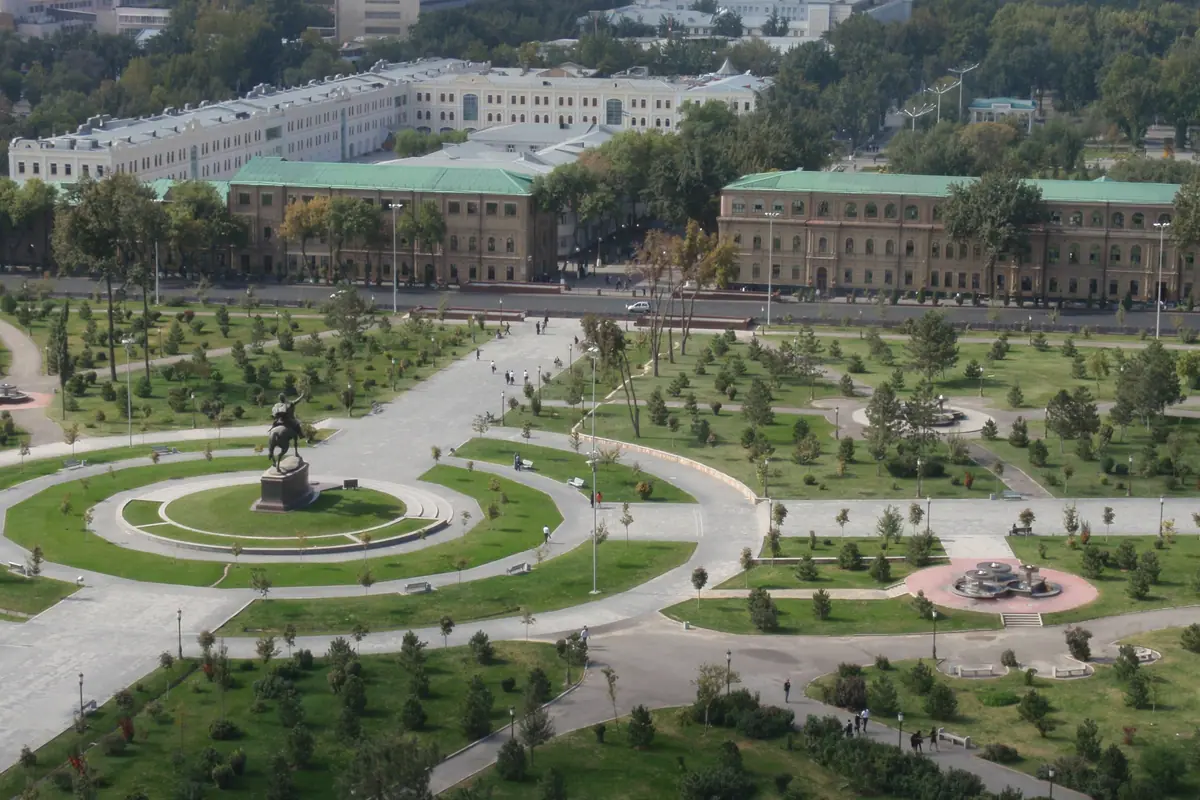
Tashkent is where most journeys begin, and it is a genuine city rather than a museum piece — wide, green, and full of fountains and Soviet modernism. The natural anchor for hotels is Amir Timur Square, where an equestrian statue of the conqueror faces the flamboyant opera house and a vast, sun-shaded hotel building with a facade of patterned concrete panels that has become a landmark in its own right. The surrounding streets hold the largest concentration of international-standard rooms, plus cafés and a metro station within a few minutes' walk.
Elsewhere, look at properties near the ornate metro stops, which are attractions in themselves — the space-themed Kosmonavtlar station and the vaulted Alisher Navoi station are worth riding to even if you are not staying nearby. From the centre it is easy to reach Chorsu Bazaar, the great blue-domed market where spice pyramids and dried fruit stalls spill across a plaza, and the Hazrati Imam complex, home to tile-clad madrasas, a handsome modern mosque and a celebrated early Quran manuscript attributed to the caliph Uthman. The Minor Mosque, white and gold beside a canal, is another short taxi ride away.
Practically, two or three nights in Tashkent is plenty for most trips, and the airport sits only fifteen to twenty minutes from the central hotel district. If you land after midnight, prioritise a hotel with a staffed twenty-four-hour desk over a charming small guesthouse that locks its gate at eleven; if you are heading straight out on the morning train, a room near the main station will save you an anxious dawn dash.
Samarkand: Sleeping Beside the Registan
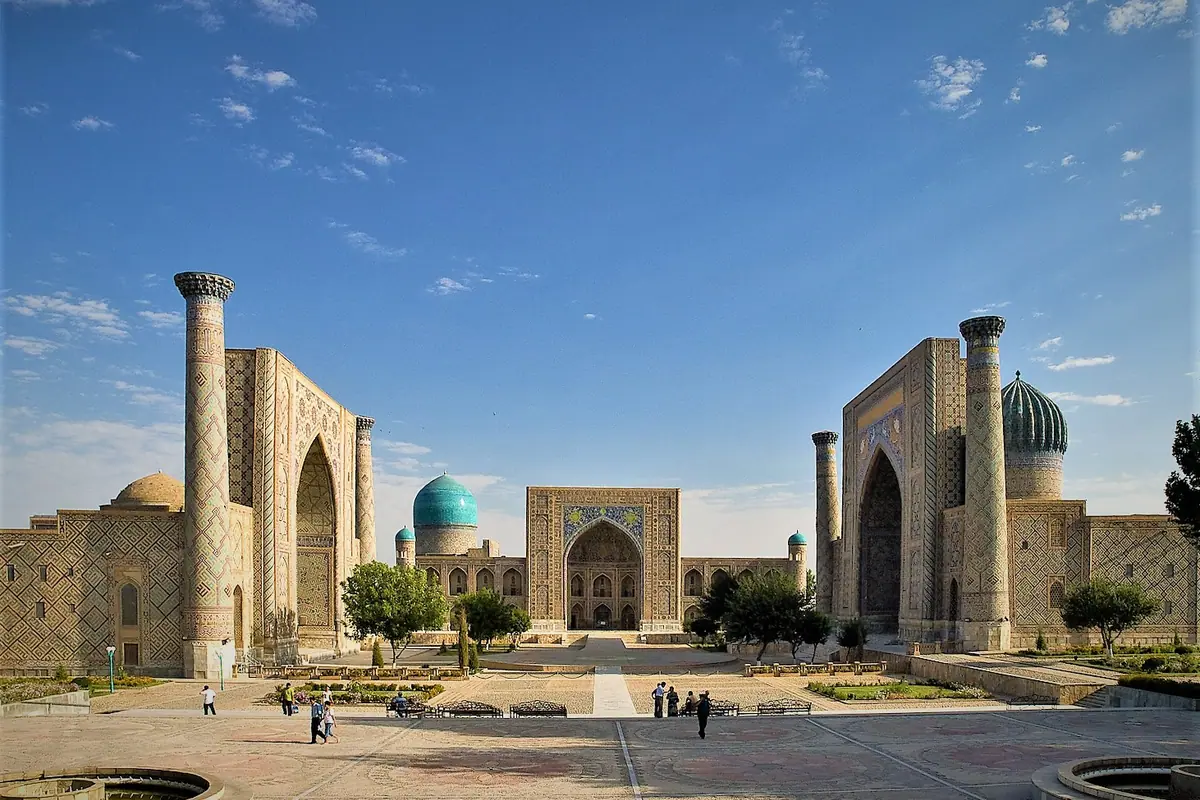
Samarkand is the showpiece, and nothing prepares you for the Registan — a vast square flanked by three madrasas, the Ulugh Beg, the Sher-Dor with its tiger mosaics, and the gilded Tilya-Kori. Hotels within a ten- or fifteen-minute walk of it let you catch the ensemble twice in a day: early, before the tour groups and the heat, and again after sunset when the floodlights come on and the square empties. That single decision often matters more to a visitor's memory of Samarkand than the thread count of the sheets.
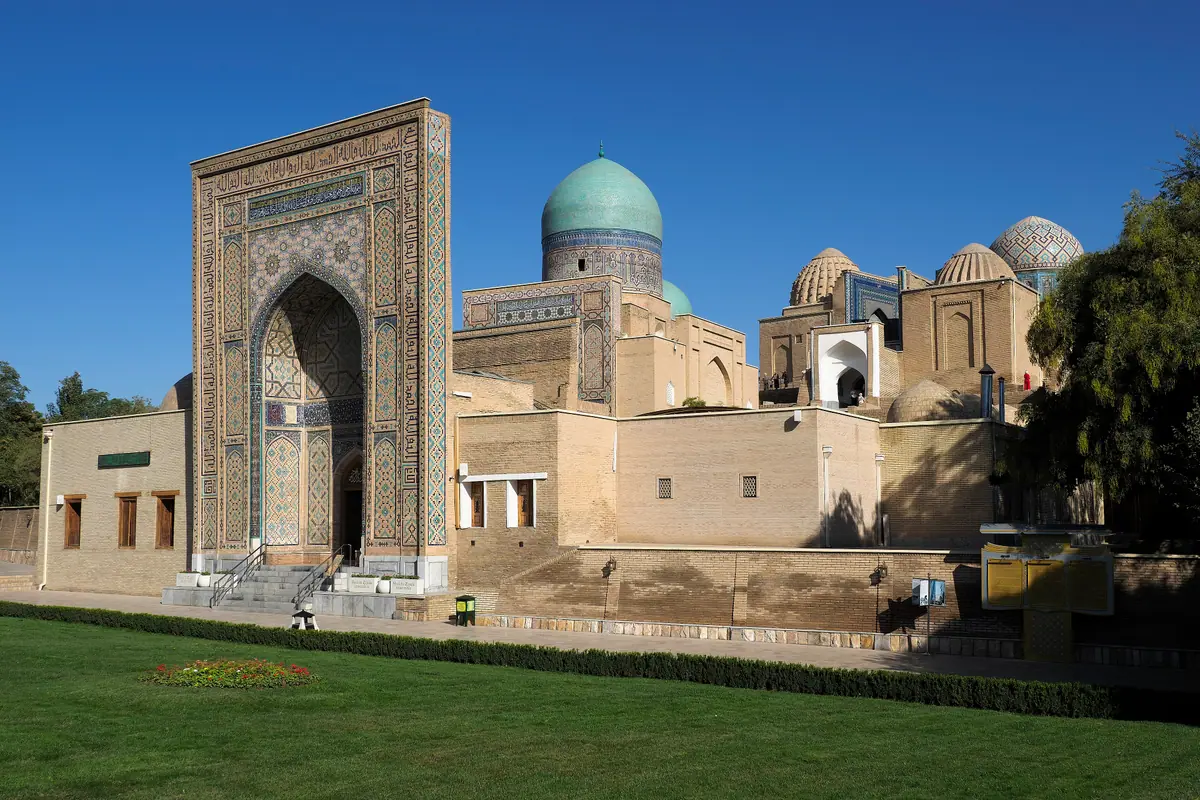
The rest of the city rewards the same approach. The Gur-e-Amir mausoleum, with its ribbed azure dome over Timur's tomb, sits a short drive away; the enormous Bibi-Khanym Mosque faces a busy bazaar street; and the Shah-i-Zinda necropolis — a lane of more than twenty tiled mausoleums — is at its most atmospheric in the first hour after opening. Add the hilltop Ulugh Beg Observatory, Siab Bazaar for bread and dried apricots, and the excavated ancient settlement site that gives the city its depth.
As for where to sleep, Samarkand's best rooms are often in restored merchant houses with courtyards, carved wooden doors and rooftop terraces facing the domes. Boutique properties cluster around the Registan and along the lanes toward Shah-i-Zinda, while larger modern hotels occupy the newer districts ten minutes' drive out. Ask specifically for a courtyard-facing room: some otherwise lovely old houses sit on fast roads, and street noise at 6am is a real annoyance. Two or three nights is the comfortable minimum.
Bukhara: Courtyard Guesthouses in the Old City
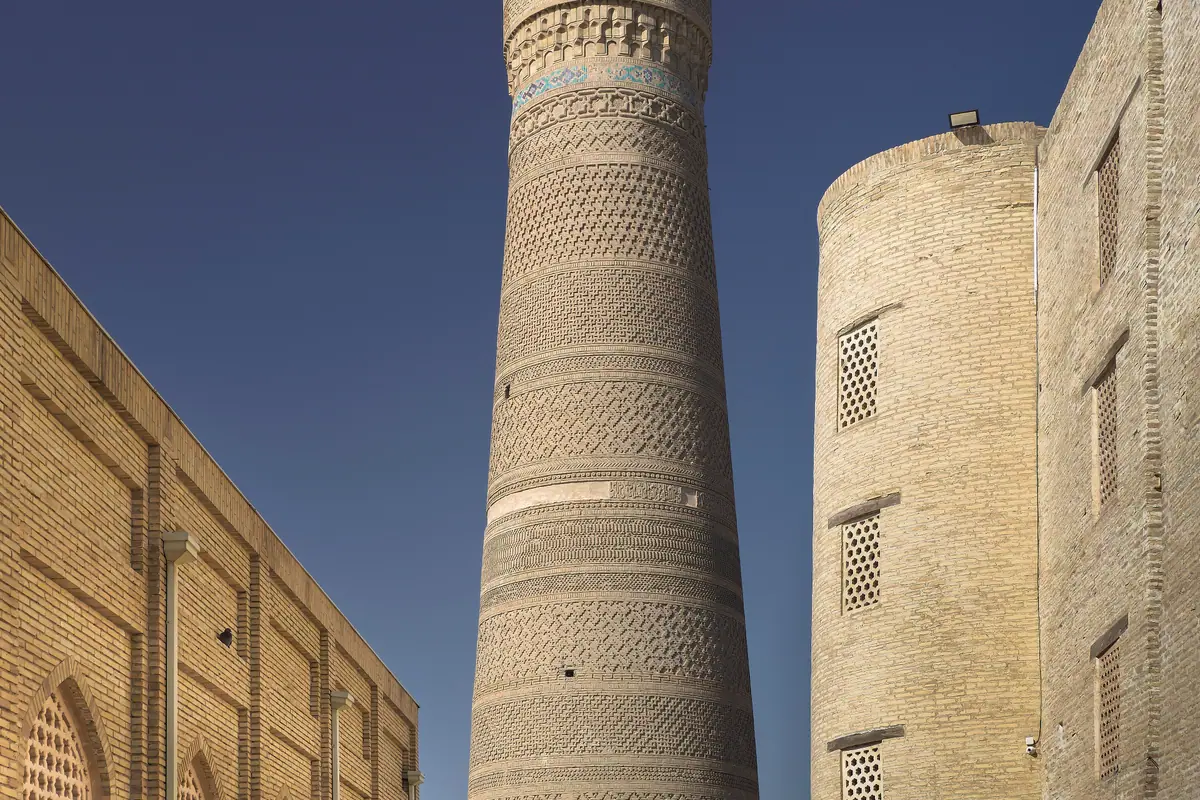
Bukhara feels like a living town that happens to be a museum, and its scale is perfect for a two-night stay on foot. The heart of the old city is the Lyabi-Hauz ensemble, a stone-lined pond shaded by ancient mulberry trees and ringed with madrasas, teahouses and benches where older men play chess in the afternoon. Ten minutes' walk away stands the Poi Kalyan complex: the soaring Kalyan Minaret, the vast Kalyan Mosque and the still-active Mir-i-Arab Madrasa facing each other across a courtyard that glows at dusk.
Beyond those two anchors lie the Ark Fortress, a walled town within the town; the delicate Bolo Hauz Mosque with its twenty slender wooden columns; the four oddly turreted domes of Chor Minor; and the covered trading domes where jewellers, hatters and money changers once worked by trade. Slightly outside the centre, the summer palace of the last emirs offers a startling contrast of mirrored halls and peacock-painted ceilings.
The best hotels here are small courtyard guesthouses, often family-run, tucked into lanes so narrow that taxis stop at the corner. Book one with a rooftop terrace if you can — several look straight at the Kalyan Minaret, and breakfast above the rooftops is the memory most visitors carry home. Stay inside the old city rather than in the modern outskirts; the whole point of Bukhara is stepping out of your door into the fourteenth century. Spring and autumn fill up weeks in advance, so reserve early if your dates fall in April, May, September or October.
Khiva: Staying Inside the Walls of Ichan Kala
Khiva is the most theatrical of the Silk Road cities because the whole historic core, Ichan Kala, is enclosed by mud-brick walls and entered through gates. Sleeping inside those walls is a different experience from visiting on a day trip: in the late afternoon the coaches leave, the souvenir stalls fold up, and you can walk the lanes past the stubby turquoise Kalta Minor minaret and the towering Islam Khodja Minaret in near silence. Climb the latter's narrow spiral staircase if your legs allow — the view over the blue domes and the desert horizon is the finest in western Uzbekistan.
Inside the walls you will also find the Juma Mosque with its forest of carved wooden pillars, some centuries old; the Tosh-Hauli Palace with its blue-tiled harem courtyard; the Kunya-Ark citadel with its mint and watchtower; and the Pakhlavan Mahmud Mausoleum, its dome sheathed in deep blue tiles. A complete circuit of the walls takes about an hour on foot, best done an hour before sunset when the light turns the brickwork to gold.
Accommodation here is mostly small, family-run and atmospheric, sometimes occupying a restored madrasa or a merchant's house with a plunge pool in the courtyard. Rooms are simple rather than luxurious, and capacity is limited, so book well ahead for spring and autumn; summer visitors should insist on air conditioning and a shady courtyard. Two nights lets you see Khiva properly and recover from the journey, since the nearest railhead and airport are in Urgench, roughly thirty-five kilometres away, reachable by taxi or shared car.
Practical Details: Seasons, Trains and Booking Your Uzbek Hotel
The sweet spots for a hotel-based trip are mid-April to early June and September to late October, when days are warm, evenings need a light jacket and courtyards are pleasant at any hour. July and August are fierce, especially in Bukhara and Khiva, where you will want to be indoors between noon and four; winter brings crisp light, snow on the Khiva walls, low prices and some closed restaurants. Navruz, around 21 March, is a joyful national holiday but also a busy travel period, so book accommodation months ahead if you plan to be there.
Distances are the other thing to plan around. The high-speed train links Tashkent and Samarkand in about two hours and continues toward Bukhara in roughly another two, and tickets on popular morning departures sell out days in advance — book as soon as your dates are fixed and choose a hotel within walking distance of the station rather than relying on rush-hour traffic. Khiva is reached via Urgench by air or by a long shared taxi from Bukhara, so allow a half day for the transfer and do not schedule an early flight the next morning.
A few smaller customs make hotel life easier. Carry cash in local som for guesthouses, since cards are accepted in bigger city hotels but not always in family-run houses; keep the small registration slips your hotel gives you, as they are still occasionally requested. Breakfast is almost always included and usually generous — bread, jam, eggs, dried fruit and endless tea. Learning a few words of Uzbek or Russian for greetings and thanks goes a long way, and a modest tip for porters and drivers is appreciated but never demanded. Finally, when you compare listings, check the map rather than the description: in Uzbekistan, 'old city' and 'city centre' are sometimes two very different places.
Frequently asked questions
Which Uzbek city should I use as my main base?
Most travellers base themselves in three: Samarkand for the Registan and Timurid monuments, Bukhara for its walkable old city, and Khiva for the walled Ichan Kala. Tashkent works best as a one- or two-night arrival and departure stop. Trying to cover all four in under a week means spending your holiday on trains.
Are hotels in Uzbekistan expensive?
No — accommodation is one of the country's pleasures. Family-run guesthouses with courtyard breakfasts are very affordable, and even well-appointed boutique hotels in the historic centres cost far less than comparable rooms in Western Europe. Prices rise in April, May, September and October, and during the Navruz holidays.
Can I actually stay inside Khiva's walled city?
Yes. Several small hotels and guesthouses sit inside the Ichan Kala walls, which is the whole reason to overnight in Khiva rather than visit on a day trip. Capacity is limited, so reserve months ahead for spring and autumn, and ask whether your room has air conditioning if you are travelling in summer.
What is the best time of year to book an Uzbek hotel?
Aim for mid-April to early June or September to late October, and book two to three months ahead if your trip falls in those windows — the best courtyard guesthouses in Bukhara and Khiva sell out first. Summer bookings are easier but you will want a pool or strong air conditioning, while winter offers the cheapest rates and the quietest monuments.
Should I pay for Uzbek hotels in cash or by card?
Larger hotels in Tashkent and Samarkand generally accept cards, but many guesthouses and smaller old-city properties prefer cash in local som. Carry enough for a few nights, use ATMs in the bigger cities to top up, and keep any registration slips your hotel provides in case they are requested later.
Plan it — hotels in Uzbekistan
Live search, booked directly with trusted providers.
Sort the rest of your trip
Everything for Uzbekistan, in one place
Transfer in Uzbekistan
Private driver waiting on arrival — no queues, no surprises.
Book a transfer
Things to do in Uzbekistan
Skip-the-line tickets, guided tours and standout experiences.
See experiences
Stay online in Uzbekistan
Travel eSIM — data the moment you land, no roaming bills.
Get an eSIM