Uzbekistan is the Silk Road made visible: turquoise domes stacked above bazaars, mud-brick fortresses fading into desert, and a chain of oasis cities that have traded, argued and prayed for two thousand years. Travel between them and you move through one of the most coherent, rewarding routes in all of Asia.
Samarkand: The Blue-Tiled Heart of the Silk Road
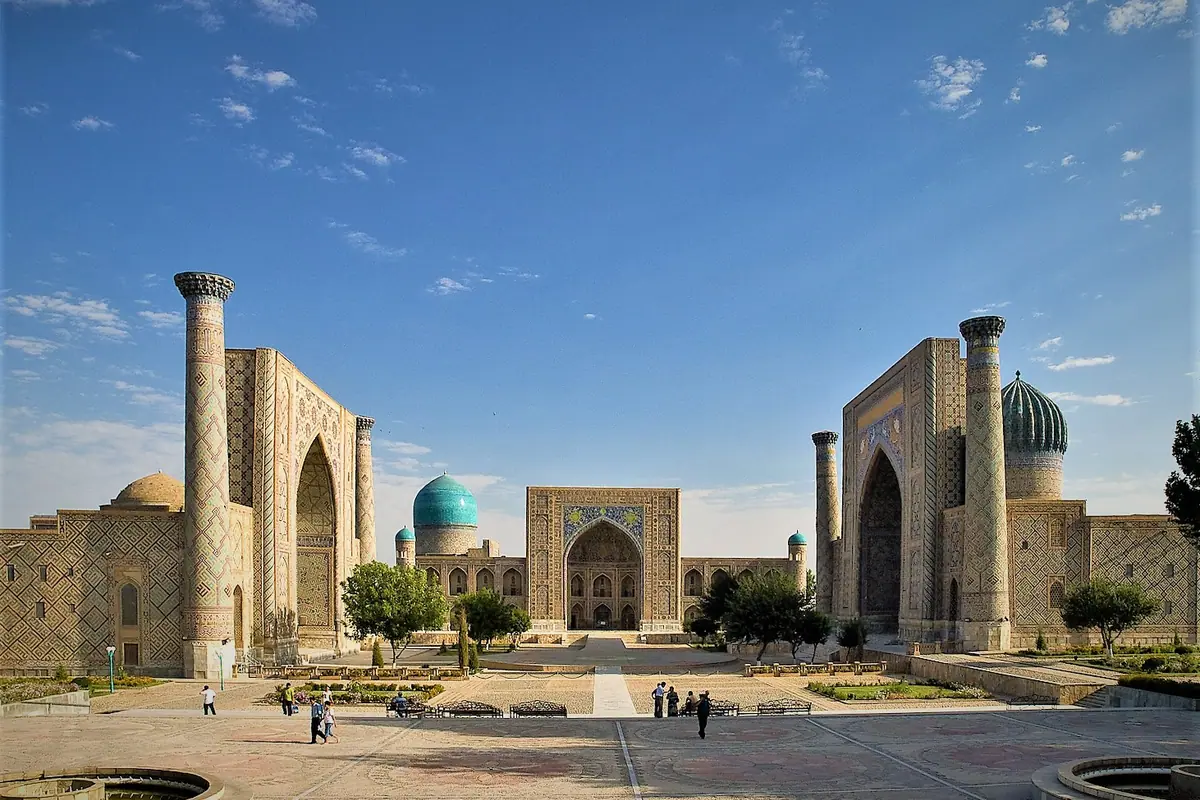
No other place in Central Asia delivers the sheer shock of scale that Samarkand does. The Registan, a trio of madrasas arranged around one vast square, is the city's showpiece: the Ulugh Beg Madrasa on the west, the Tilya-Kori and Sher-Dor madrasas facing it, their portals tiled in lapis, cobalt and gold. Come early in the morning for the softest light and near-empty courtyards, then return after dusk when the facades are floodlit — the square reads completely differently at night.
A fifteen-minute walk northeast brings you to Shah-i-Zinda, a narrow avenue of more than twenty mausoleums climbing a low hill. It is the most intimate site in the country: you shuffle between tomb chambers, each with a different tile pattern, past pilgrims visiting the shrine said to belong to the cousin of the Prophet. Below it, the Bibi-Khanym Mosque — once among the largest in the Islamic world — leans and looms, its enormous blue dome held together by twentieth-century restoration.
Round the day off at the Gur-e-Amir, the fluted-domed mausoleum of Timur, which directly inspired later Mughal tombs, and at the small Ulugh Beg Observatory, where the fifteenth-century ruler-astronomer calculated the length of the year with startling precision. Two full days in Samarkand is ideal; three if you want to add the Silk Road-era murals at Afrasiab and the pottery workshops on the city's edge.
Bukhara: A Living Museum You Actually Walk Through
Bukhara is not a set of monuments behind glass — it is a functioning town of around 250,000 people that happens to contain a near-perfect medieval core. Everything orbits the Po-i-Kalyan complex: the Kalyan Minaret, a 46-metre brick tower so admired that even Genghis Khan ordered it spared, the Kalyan Mosque, and the Mir-i-Arab Madrasa opposite, still an active seminary. The minaret is off-limits to climbers, but the views of its banded brickwork from the surrounding lanes are the city's signature image.
Northwest of the complex, the Ark Fortress has been the seat of Bukhara's rulers for well over a thousand years; inside its walls you can see the coronation courtyard, the mosque and the museum rooms that once housed the emir's treasury. Nearby, the Ismail Samani Mausoleum, a ninth-century cube of basket-weave brickwork, is the oldest surviving monument in the region and arguably the most beautiful piece of architecture in Uzbekistan.
Leave time for the softer corners: the Lyab-i Hauz, a stone-lined pond ringed by mulberry trees, teahouses and the seventeenth-century Kukeldash Madrasa, is where locals and travellers end their evenings; the four blue-capped towers of Chor Minor sit in a quiet residential lane; and the Sitorai Mohi Xosa summer palace, a short drive out of town, mixes Russian decorative taste with Central Asian craft. Plan at least two days, and stay inside the old town if you can — Bukhara rewards aimless wandering more than any other city here.
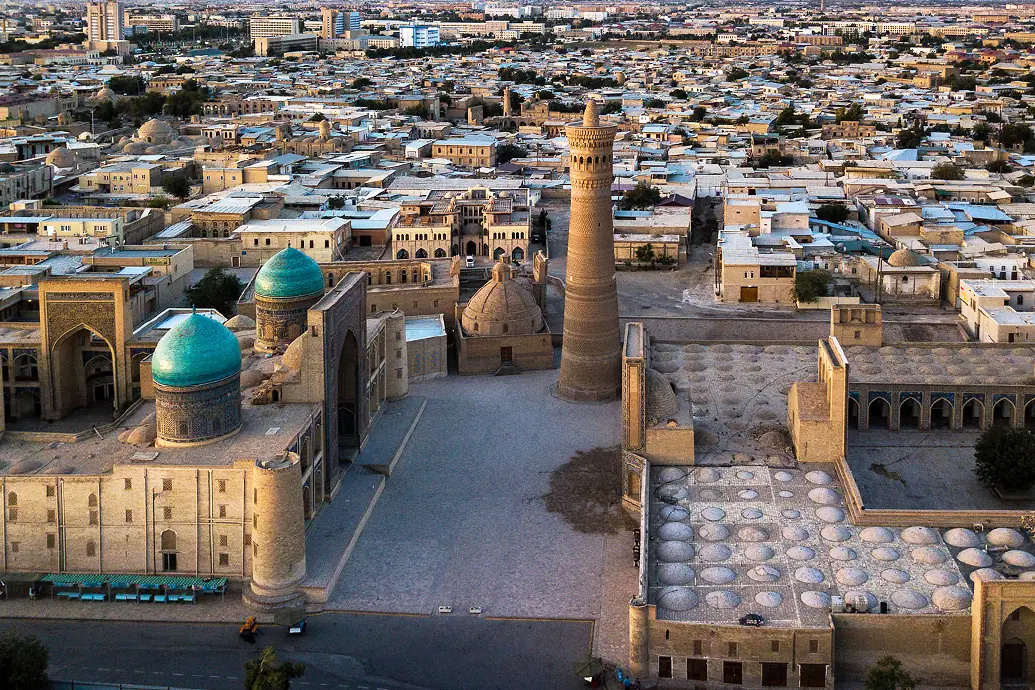
Khiva: The Walled City of Itchan Kala
Khiva feels like an open-air film set, and that is largely because its inner town, Itchan Kala, is a UNESCO-listed walled city you can walk end to end in twenty minutes. Enter through the West Gate and you are immediately under the Kalta Minor, a fat, half-finished turquoise minaret stopped in mid-construction in the 1850s — it was meant to be the tallest in the Islamic world. From there, the Islam Khodja Minaret rises far higher and is climbable via a tight spiral staircase for the best panorama in the city.
Highlights inside the walls include the Kunya-Ark, the khans' fortified palace with its throne room and watchtower; the Tosh-Hovli Palace, famous for its carved wooden columns and tiled courtyards; the Juma Mosque, whose roof is held up by more than 200 carved elm pillars; and the Pahlavan Mahmud Mausoleum, its dome sheathed in shimmering blue tiles. Because Khiva is compact, one long day covers the essentials and two days lets you slow down.
There is a bonus to sleeping inside Itchan Kala: after the day-trippers leave, the alleyways empty out and you get the city almost to yourself, with lamps lighting the domes. Note that Khiva sits far west of the other cities, so most travellers reach it by overnight train from Tashkent or by a long shared-taxi drive from Bukhara across the Kyzylkum Desert — the drive itself, past the Amu Darya river, is part of the experience.
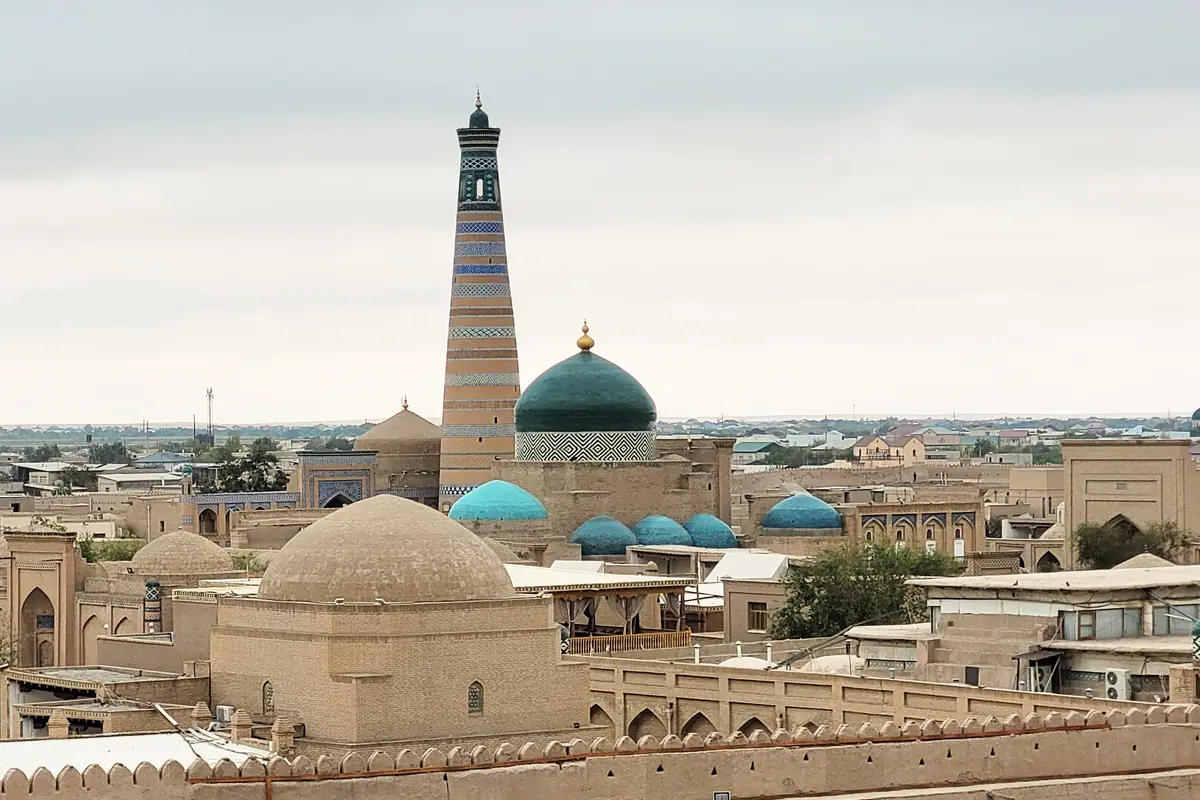
Tashkent: Bazaars, Metro Art and a Modern Capital
Tashkent is the arrival point for most visitors and deserves more than a transit night. Its must-see is the Chorsu Bazaar, a vast domed market where vendors sell pyramids of dried fruit, nuts, spices, non bread stamped with patterns, and mountains of seasonal melons in late summer. It is loud, photogenic and completely authentic — go in the morning when produce is freshest.
The old city also holds the Hazrati Imam complex, home to one of the world's oldest surviving Qur'an manuscripts and to a cluster of mosques and madrasas around a quiet courtyard. Elsewhere, the Soviet-era metro system is a sight in its own right: several central stations are decorated with chandeliers, marble and ceramic reliefs, and a single fare lets you tour them. Above ground, Amir Timur Square and the neighbouring Broadway pedestrian street are the city's main meeting points, while the Museum of Applied Arts offers a compact lesson in Uzbek ceramics, carving and embroidery.
Tashkent is also where the country's high-speed rail network begins, making it the natural first stop before heading southwest to Samarkand and Bukhara. Give it one full day if you are pressed, two if you want to add the fine arts museum or hunt for Soviet mosaics down the side streets.
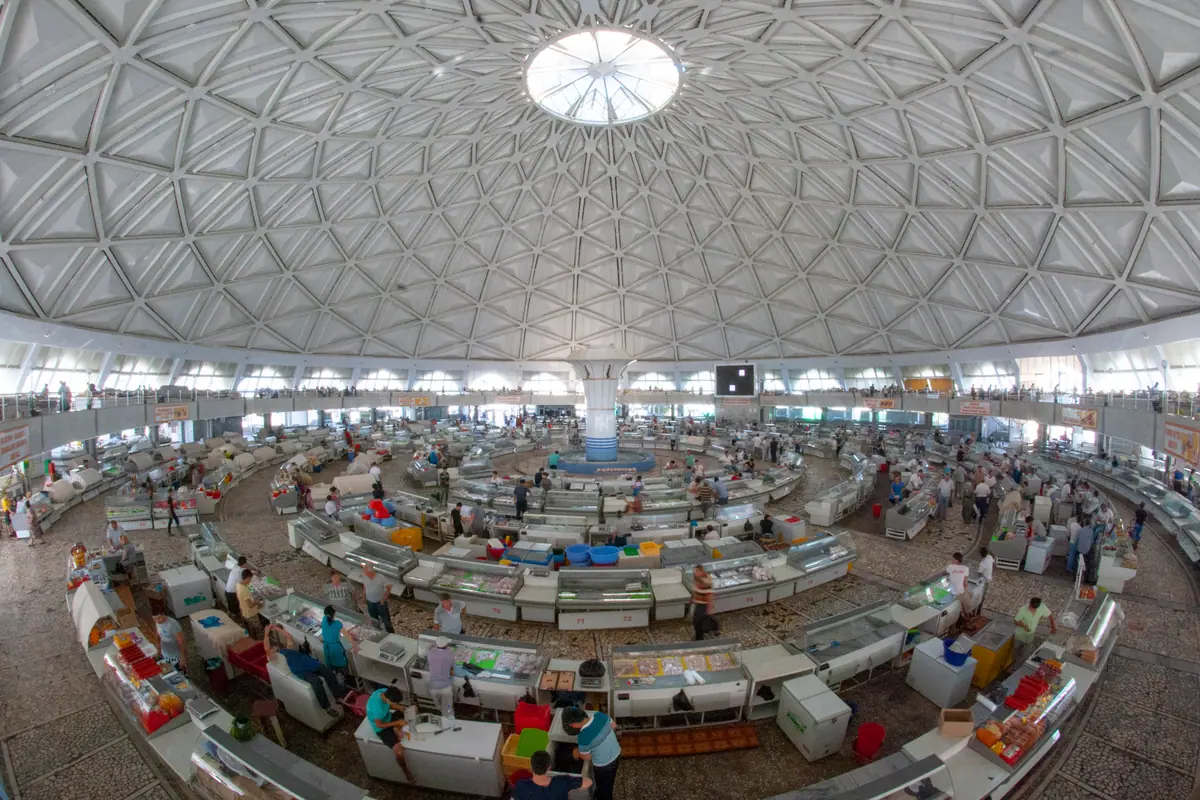
Beyond the Silk Road: Deserts, the Aral Sea and the Fergana Valley
Uzbekistan's most surprising places lie outside the famous trio. In the far northwest, in the Karakalpakstan region, the town of Nukus holds one of the world's great collections of avant-garde Russian painting, assembled in the most unlikely setting imaginable. From there, a day trip reaches Moynaq, a former fishing port left stranded far from the water, with a rusting fleet of ships sitting on what is now dry seabed — a haunting, unforgettable sight.
South of Nukus, the desert holds the ruins of ancient Khorezm: the mud-brick fortresses of Ayaz Qala, Toprak Qala and Kzyl Qala rise out of bare earth, some more than two thousand years old. Visiting requires a hired car and a full day, ideally in spring or autumn when the heat is bearable. This region gets very few tourists — expect rough roads and total silence.
In the east, the Fergana Valley offers a softer counterpoint: the silk workshops of Margilan, where you can watch ikat being dyed and woven on wooden looms, and the ceramics studios of Rishtan, known for its deep blue-and-turquoise glazes. Closer to Tashkent, the Chimgan mountains give you hiking, chairlifts and even winter skiing within a two-hour drive, while Lake Aydarkul and the Nurata mountains suit a night in a yurt camp.
When to Go and How to Move Between Them
Spring (April to early June) and autumn (September to late October) are the seasons to aim for: daytime temperatures sit comfortably in the low twenties to high twenties Celsius, the desert is not punishing, and Samarkand, Bukhara and Khiva are at their most walkable. July and August are genuinely hot, with Tashkent and Bukhara regularly exceeding 40°C, so plan sightseeing for early mornings and late afternoons and drink far more water than you think you need. Winter is cold and can bring snow, but it is also quiet, cheap and photogenic under grey skies.
Getting around is easier than most first-timers expect. High-speed trains link Tashkent, Samarkand and Bukhara in a few hours, with bookings opening weeks ahead and selling out in peak season; shared taxis fill the gaps and are the standard way to reach Khiva or the Fergana Valley. Within cities, taxis are cheap and plentiful, and most old-town cores are small enough to cover entirely on foot.
Practical etiquette helps: dress modestly at religious sites, cover shoulders and knees, and ask before photographing people. Learn a few words of Uzbek or Russian — greetings go a long way — and carry some cash, since smaller towns and bazaars are not always card-friendly. Allow a minimum of eight days for the classic route from Tashkent to Khiva, and two weeks if you want the Aral Sea and Fergana as well.
Frequently asked questions
What are the absolute must-see places in Uzbekistan for a first visit?
The classic circuit covers Samarkand (Registan, Shah-i-Zinda, Gur-e-Amir, Bibi-Khanym Mosque), Bukhara (Po-i-Kalyan, the Ark Fortress, Lyab-i Hauz) and Khiva (the walled Itchan Kala). Tashkent's Chorsu Bazaar and Hazrati Imam complex are worth a day at the start or end. With more time, add the Aral Sea region around Moynaq and Nukus, or the Fergana Valley for silk and ceramics.
How many days do I need in Uzbekistan?
Eight to ten days is enough for Tashkent, Samarkand, Bukhara and Khiva at a reasonable pace, with two nights in each of the three Silk Road cities. Two weeks lets you add the Aral Sea and Karakalpakstan, a yurt stay near Lake Aydarkul, or the Fergana Valley without rushing.
What is the best time of year to visit?
April to early June and September to October offer the best balance of comfortable temperatures and clear skies. Summers are very hot — often above 40°C in Bukhara and Khiva — while winter is cold, snowy in places and much quieter. If you plan to visit the desert fortresses or the Aral Sea, spring and autumn are strongly preferable.
Is Uzbekistan easy to travel around independently?
Yes. High-speed trains connect Tashkent, Samarkand and Bukhara, and shared taxis cover routes the trains do not, including Khiva. Book train tickets well ahead in peak season. Cities are walkable, taxis are inexpensive, and English is common in hotels and among younger guides, though Uzbek or Russian helps in smaller towns and bazaars.
What should I pack and how should I behave at religious sites?
Pack layers for cool mornings and hot afternoons, sun protection, comfortable walking shoes for cobbled lanes, and a scarf or light cover-up. At mosques, madrasas and mausoleums, dress modestly with shoulders and knees covered, and women should cover their hair inside active religious buildings. Ask permission before photographing people, and always carry some cash for markets and small vendors.
Plan it — experiences in Uzbekistan
Live search, booked directly with trusted providers.
Sort the rest of your trip
Everything for Uzbekistan, in one place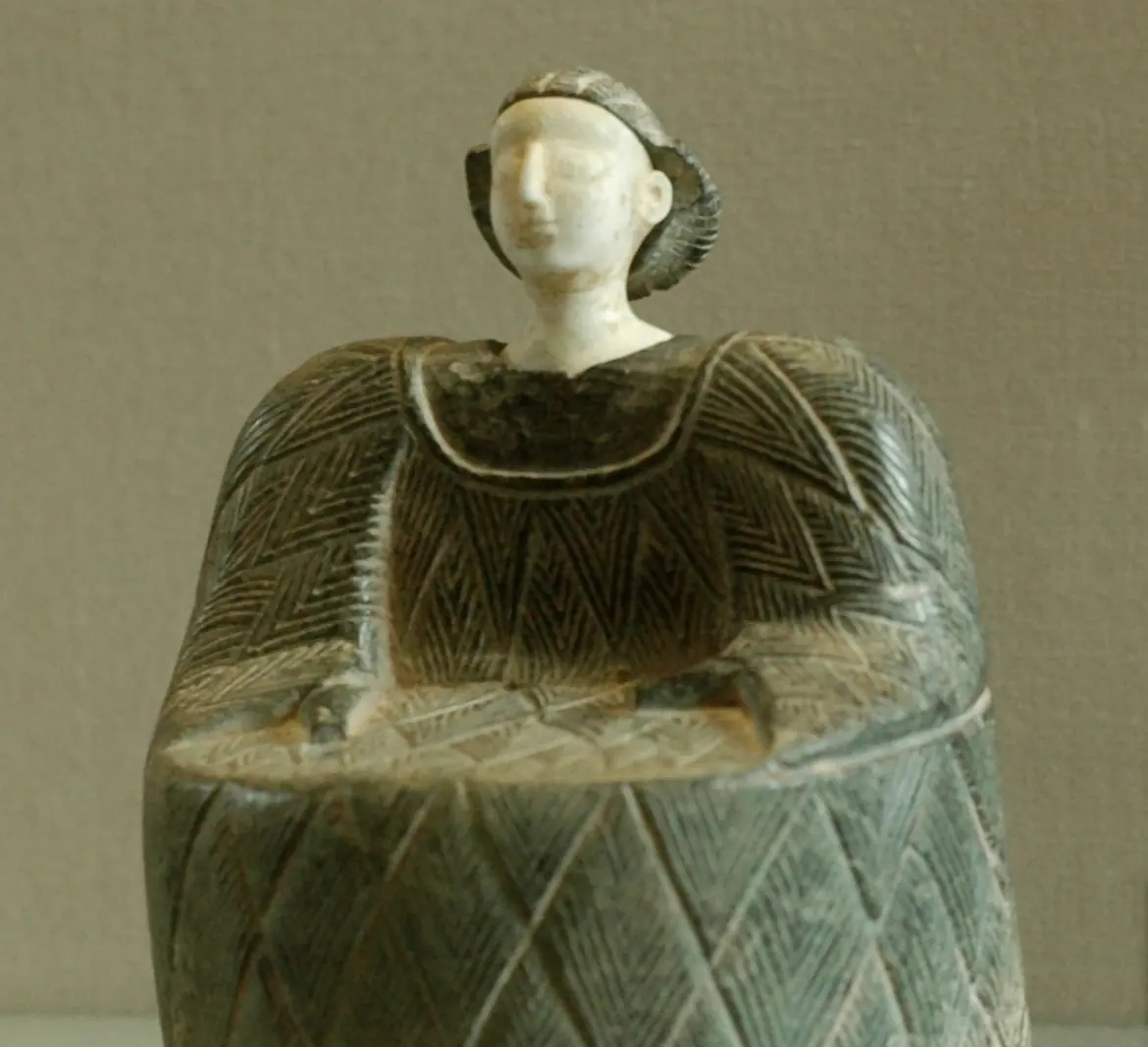
Stay in Uzbekistan
Hotels, guesthouses and apartments — compared in one search.
Search hotels
Transfer in Uzbekistan
Private driver waiting on arrival — no queues, no surprises.
Book a transfer
Stay online in Uzbekistan
Travel eSIM — data the moment you land, no roaming bills.
Get an eSIM