Uzbekistan is the Silk Road at its most tangible: turquoise domes, mud-brick fortresses, and tea houses where conversation outlasts the afternoon. A good tour here is part monument-hunting, part eating — and mostly letting a courtyard, a bazaar or a bread oven slow you down. This guide covers the sights you must not miss, the flavours worth travelling for, and how to move through it all with a local's rhythm.
Why Uzbekistan Rewards the Curious Traveller
This is a country built for slow, layered travel. The classic circuit runs Tashkent to Samarkand, Bukhara and Khiva — roughly 8 to 12 days at a comfortable pace, with a high-speed rail link connecting the capital to Samarkand and Bukhara, and a longer desert journey or overnight train on to Khiva. Add three or four extra days for the Fergana Valley in the east or the Aral Sea region in the far west, and you have a trip that shifts from imperial architecture to post-Soviet market life to stark, haunting wilderness.
Timing matters enormously. Late April to early June and September to late October bring warm, clear days and comfortable evenings; this is when the light is best on the tiled facades and the bazaars are at their most sociable. July and August routinely climb past 40°C in Bukhara and Khiva, so sightseeing collapses into early mornings and long, shaded lunches. Winter is genuinely cold and sometimes snowy, but the monuments are empty, guesthouses are quiet, and Samarkand under a dusting of snow is one of the region's great secrets.
Structure your days around the heat and the light. Mornings are for the big monuments, afternoons for bazaars, workshops and tea houses, evenings for courtyards and rooftop dinners. Resist the urge to chain six sights together — the pleasure here is in lingering, and in the small encounters you only get when you sit still.
The Silk Road Icons You Cannot Miss
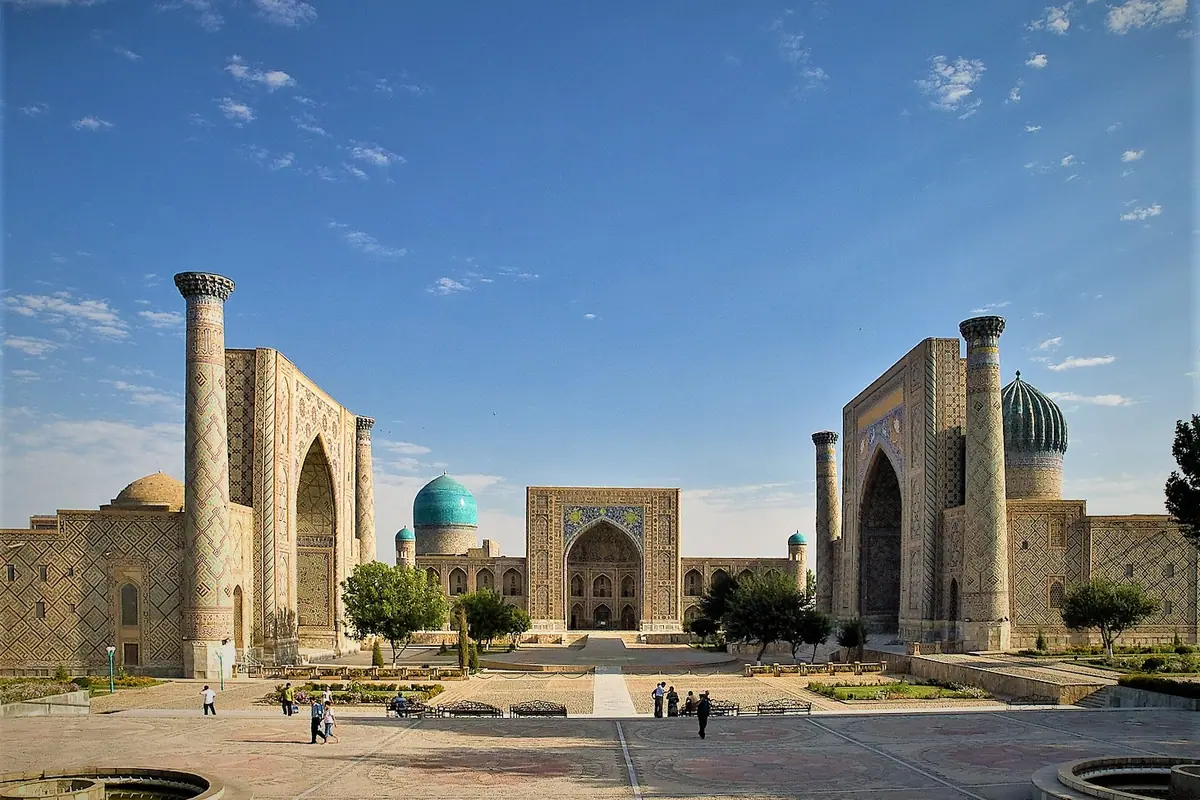
Samarkand is the anchor. Registan Square, framed by three madrasahs with soaring portals and mosaic so dense it looks woven, is the single image most travellers carry home — allow a full morning, and return at dusk when the tiles glow amber. Nearby, Gur-e-Amir, the mausoleum of Timur, glitters with gold leaf beneath a fluted azure dome, while the vast Bibi-Khanym Mosque opposite the bazaar shows both the ambition and the fragility of the era. Walk the narrow lane of Shah-i-Zinda, a hillside alley of more than twenty tiled tombs, and you will understand why people call it the most beautiful cemetery in the world.
Bukhara trades Samarkand's scale for intimacy. The Poi Kalyan complex, dominated by the Kalyan Minaret that Genghis Khan supposedly spared, sits at the centre of a web of lanes where you can wander for hours. The Ark Fortress, the domed trading streets around Lyab-i Hauz, the delicate Chor Minor gatehouse and the ninth-century Samanid Mausoleum are all within walking distance of each other — a rarity in Central Asia.
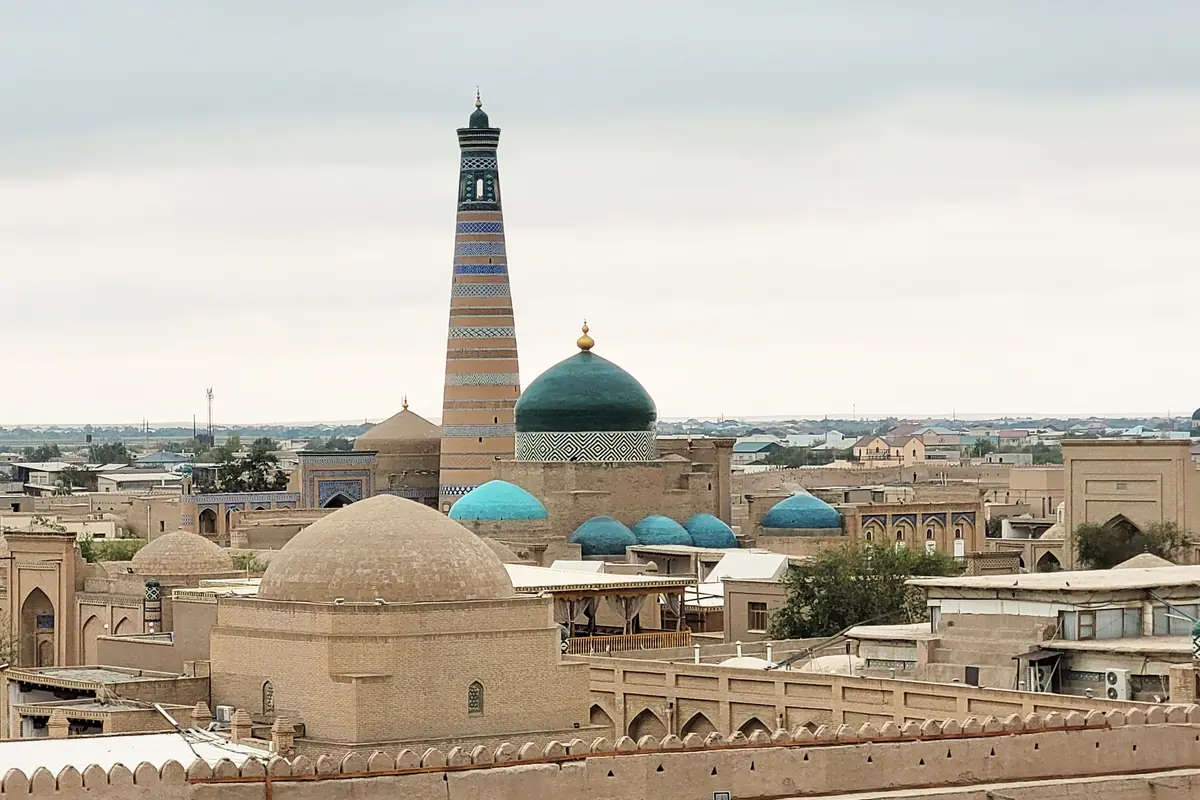
Khiva is the finale: the walled Itchan Kala, a complete museum city you can cross on foot in twenty minutes but should give a full day. Climb the Islam Khodja Minaret for the roofscape, and step inside the Juma Mosque, where over two hundred carved wooden pillars hold up the gloom. In the south, Shahrisabz holds the ruins of Timur's colossal Ak-Saray Palace, and Tashkent's Hazrati Imam Complex gives you a beautifully restored introduction to the country's Islamic architecture before you even leave the capital.
Eating Like a Local: Plov, Bazaars and Tea-House Rituals
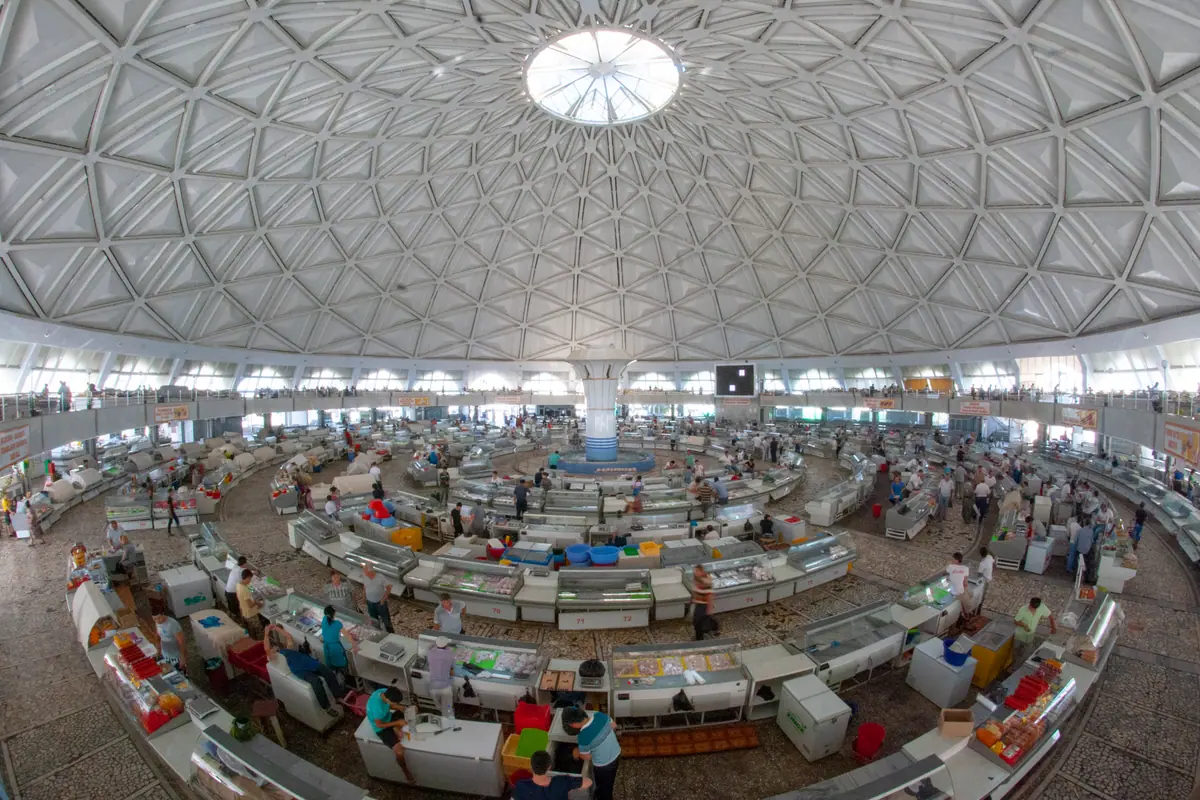
Uzbek food is generous, hand-made and deeply regional. Plov — rice cooked in a kazan with lamb, carrots, chickpeas and cumin — is the national dish and a morning affair; in Tashkent, head to Chorsu Bazaar and watch the oshpaz, the master cooks, work their enormous pans before the city has properly woken up. Each region claims its own version: Bukhara's is lighter and often crowned with horse sausage, Samarkand's is layered and aromatic, Fergana's is cooked with rice that stays impossibly separate.
Beyond plov there is a whole repertoire to work through. Tandyr-baked samsa with flaky crusts, hand-pulled lagman noodles in broth, steamed manti, slow-braised dimlama and peppery shurpa are all staples of everyday tables. Bread — non — is sacred: never place it upside down, never throw it away, always break it with your hands and share. Round lepyoshka stamped in the centre, sometimes baked with onion or meat, is the constant accompaniment.
Drink tea the way it is poured here: green tea, kok choy, in small bowls, refilled constantly. A chaikhana is not a café but a social institution, and sitting in one for an hour — ideally on a tapchan, a raised wooden platform with cushions — is one of the best-value experiences in the country. Finish with halva, chak-chak, dried fruit and nuts from the bazaar, or suzma and ayran to cut the richness. Vegetarians are looked after kindly, though it helps to explain clearly; the salads, pumpkin dishes and fresh herbs are excellent.
Craft and Culture: Silk, Ceramics and Courtyard Life
Uzbekistan's crafts are alive, not museum pieces. In the Fergana Valley around Margilan, silk is still spun, dyed and hand-woven into atlas and adras — the shimmering ikat cloth whose blurred patterns are made by resist-dyeing the threads before they ever reach the loom. Visiting a workshop and watching a patterned fabric emerge from a warp of plain threads is one of the most satisfying half-days a traveller can spend.
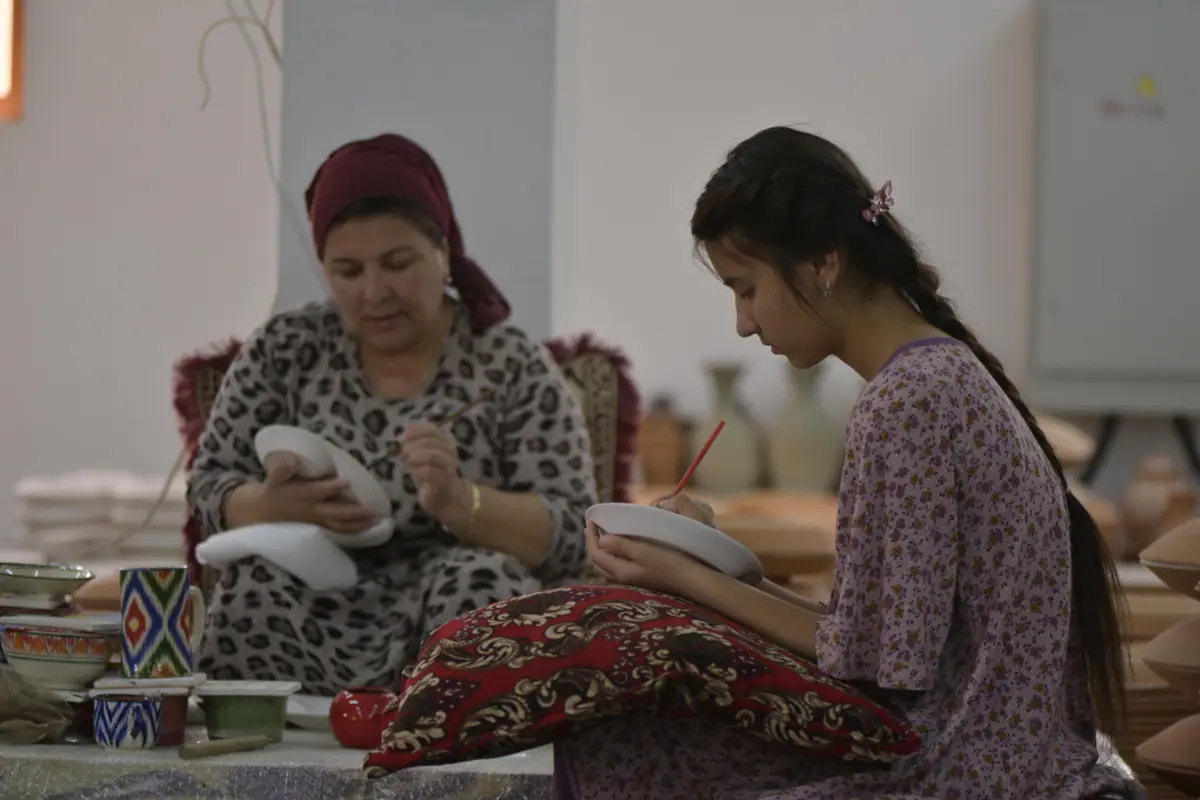
In Rishton, pottery is a family trade, with bowls and plates glazed in the blues and turquoises that echo the tiled domes, then fired in clay kilns. Bukhara is known for gold embroidery and fine metalwork, Khiva for wood carving and hand-knotted carpets, and Chust for the square black-and-white doppi skullcaps worn across the region. Suzanis — large embroidered wall hangings in pomegranate reds and indigos — turn up in bazaars everywhere, and buying one from the embroiderer herself is worth the detour.
Underneath all of it is the mahalla, the traditional neighbourhood, and its courtyard culture. Life happens outdoors: bread baked in a communal tandyr, grapes on a trellis above the table, children running between gates, elders drinking tea in the shade. Being invited in for tea or a plate of plov is common; accept, bring something small from the bazaar, and take your shoes off at the door.
Off the Classic Route: Fergana, Nukus and the Aral Sea
The Fergana Valley rewards those who push east. Kokand's Palace of Khudayar Khan is a riot of blue tiles and painted ceilings, surrounded by courtyards that give a sense of how the khanate lived. Margilan and Rishton supply the silk and ceramics, while the valley's food — think apricots, pomegranates, melons in season and some of the country's most refined cooking — justifies the journey on its own. It is a conservative, deeply hospitable region, best explored with a driver and a flexible itinerary.
Far to the west, Karakalpakstan offers something entirely different. Nukus holds a remarkable collection of early twentieth-century avant-garde painting, assembled against the grain of Soviet cultural policy and now displayed in a pale, purpose-built museum — a genuinely unexpected highlight. Beyond it lies Moynaq, where rusting fishing trawlers sit on sand where the Aral Sea used to be, a landscape that is bleak, unforgettable and best visited with an overnight stop rather than a rushed day trip.
Etiquette, Seasons and Sensible Logistics
Uzbek hospitality is genuine but formal in small ways worth learning. Greet with a handshake and a smile, right hand on the heart; use your right hand to give and receive. Accept tea even if you only sip it, and let your host refill — a half-full bowl is fine. Dress modestly around mosques and in rural areas, with shoulders and knees covered, and carry a light scarf. Always ask before photographing people, especially in mahallas and at markets, and avoid photographing anything military or at border zones.
Getting around is easier than most first-timers expect. The high-speed rail line between Tashkent, Samarkand and Bukhara is comfortable and should be booked a week or more ahead in spring and autumn, when it fills fast. Shared taxis and domestic flights cover the longer desert legs. Carry cash in local som for markets, workshops and small guesthouses, and keep a stash of small notes; cards work in city hotels and larger restaurants but not in a village chaikhana.
Plan your visit around Navruz, the spring new year on 21 March, when sumalak — a sweet wheat-sprout pudding stirred for hours — is cooked in courtyards and the whole country seems to be outdoors. Foreign visitors are warmly included in the celebrations. Otherwise, aim for May or September, pack layers for cool mornings and hot afternoons, bring slip-on shoes for repeated entry into mosques and homes, and leave a day unplanned at the end. That spare day tends to become the one you remember.
Frequently asked questions
How many days do I need for an Uzbekistan tour?
Eight to ten days covers the classic Tashkent–Samarkand–Bukhara–Khiva route comfortably, with two nights in each major city. Add three to four days if you want the Fergana Valley or the Aral Sea region around Nukus and Moynaq. Anything under a week means spending most of your time in transit.
What is the best time of year to visit Uzbekistan?
April to early June and September to late October offer the best combination of comfortable temperatures, clear light and lively bazaars. July and August are punishingly hot in Bukhara and Khiva, often above 40°C, while winter is cold but beautifully quiet and ideal if you want the monuments largely to yourself.
What food should I try first in Uzbekistan?
Start with plov at a busy morning plov house or at Chorsu Bazaar in Tashkent, then work through samsa from a tandyr oven, hand-pulled lagman, steamed manti and shurpa. Always try the local bread, non, and drink green tea in a chaikhana. In season, the melons and apricots are exceptional.
Is Uzbekistan suitable for first-time or solo travellers?
Yes. It is generally safe, the rail network is straightforward, and hospitality is strong. English is limited outside hotels and larger restaurants, so learning a few phrases in Uzbek or Russian helps enormously. Solo travellers find it easy to join shared taxis and day tours locally.
What should I pack and wear for an Uzbekistan tour?
Pack light, modest clothing that covers shoulders and knees, a scarf for mosques and rural areas, a sun hat and sunglasses, and slip-on shoes since you will remove them often. Layers matter for cool mornings and hot afternoons, and a small day bag is useful for bazaar purchases and tea-house stops.
Sort the rest of your trip
Everything for Uzbekistan, in one place
Stay in Uzbekistan
Hotels, guesthouses and apartments — compared in one search.
Search hotels
Transfer in Uzbekistan
Private driver waiting on arrival — no queues, no surprises.
Book a transfer
Stay online in Uzbekistan
Travel eSIM — data the moment you land, no roaming bills.
Get an eSIMMore guides in Uzbekistan
Best Time to Visit Uzbekistan: Seasons, Weather and When to Book Hotels
Top Things to Do in Uzbekistan: Silk Road Landmarks You Shouldn't Miss
Uzbekistan in One Week by Flight: Tashkent, Khiva, Bukhara and Samarkand
Where to Stay in Uzbekistan: Hotels and Must-See Sights in Samarkand, Bukhara and Khiva