Uzbekistan is the place where the Silk Road stops being a history-book phrase and turns into turquoise tilework you can touch, bazaars that still smell of melon and cumin, and walled cities glowing at dusk. Four of its monuments rank among the most beautiful buildings on earth, and between them lie deserts, mountain villages and a high-speed rail line that makes the whole country feel refreshingly easy.
Samarkand: The Registan and the Blue-Tiled Heart of the Silk Road
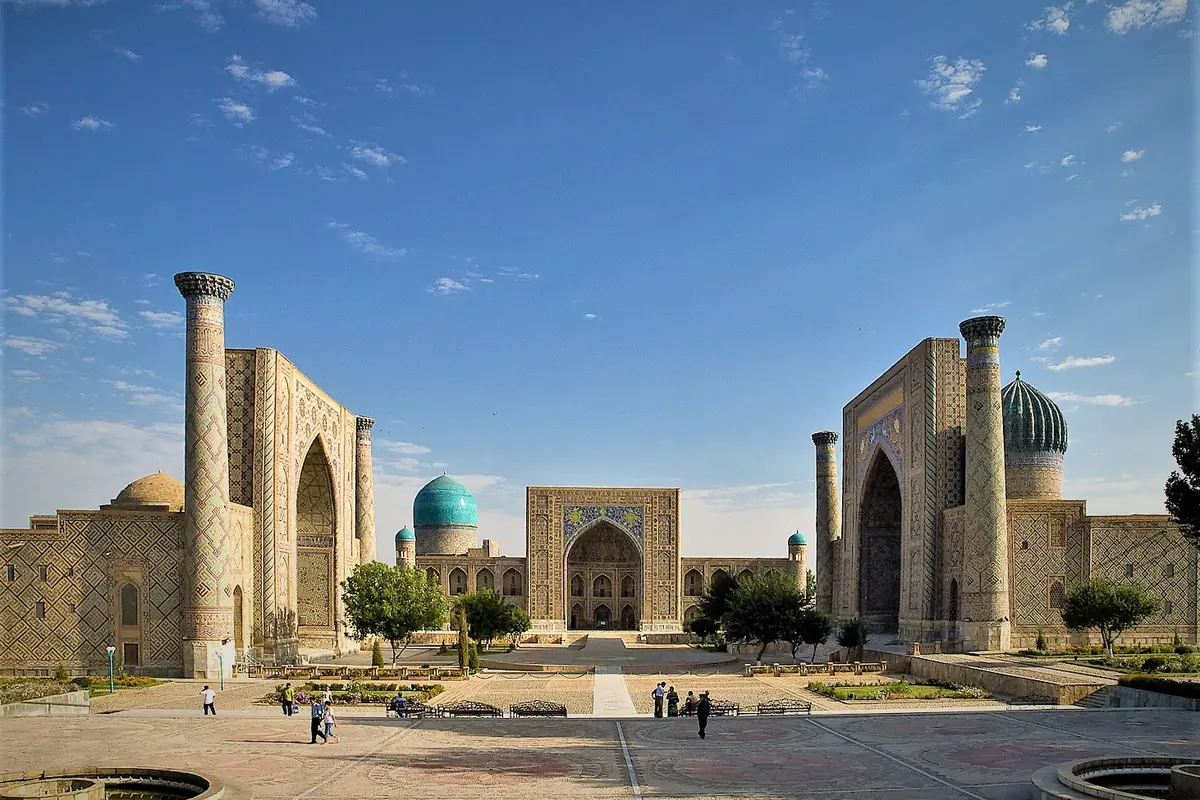
Everything begins at the Registan, a vast square framed by three madrasahs — the Ulugh Beg, the Sher-Dor with its famously rebellious tiger mosaics, and the gilded Tilya-Kori. Arrive at opening time to have the courtyards almost to yourself, then return an hour before sunset when the tilework turns the colour of a lit sapphire. Evening illumination and occasional light-and-sound performances make a third visit worthwhile, and the square is a ten-minute stroll from most of the city's guesthouses.
Beyond the Registan, the monuments come in clusters. The Gur-e-Amir mausoleum, capped by a fluted azure dome, holds the tomb of Timur and is small enough to see in half an hour but intricate enough to linger in. The enormous Bibi-Khanym Mosque, once among the largest in the Islamic world, stands across town near the bustling Siab Bazaar, where you can buy warm non bread stamped with a pattern and a fistful of dried apricots. The Shah-i-Zinda necropolis, a lane of more than twenty mausoleums climbing a hill, is many travellers' favourite spot in the entire country — go early, when the morning light rakes across the blue and violet glaze.
Allow two full days. On the second, add the Ulugh Beg Observatory, where the 15th-century astronomer measured the year to within seconds, and the Afrasiab Museum with its faded but fascinating 7th-century murals. If you have time, drive twenty minutes out to the Konigil paper mill, where silk-and-mulberry paper is still beaten by hand in a water-powered workshop, and to Hazrat Khizr Mosque for the best panorama over the Bibi-Khanym complex.
Bukhara: A Living Medieval City You Can Walk End to End
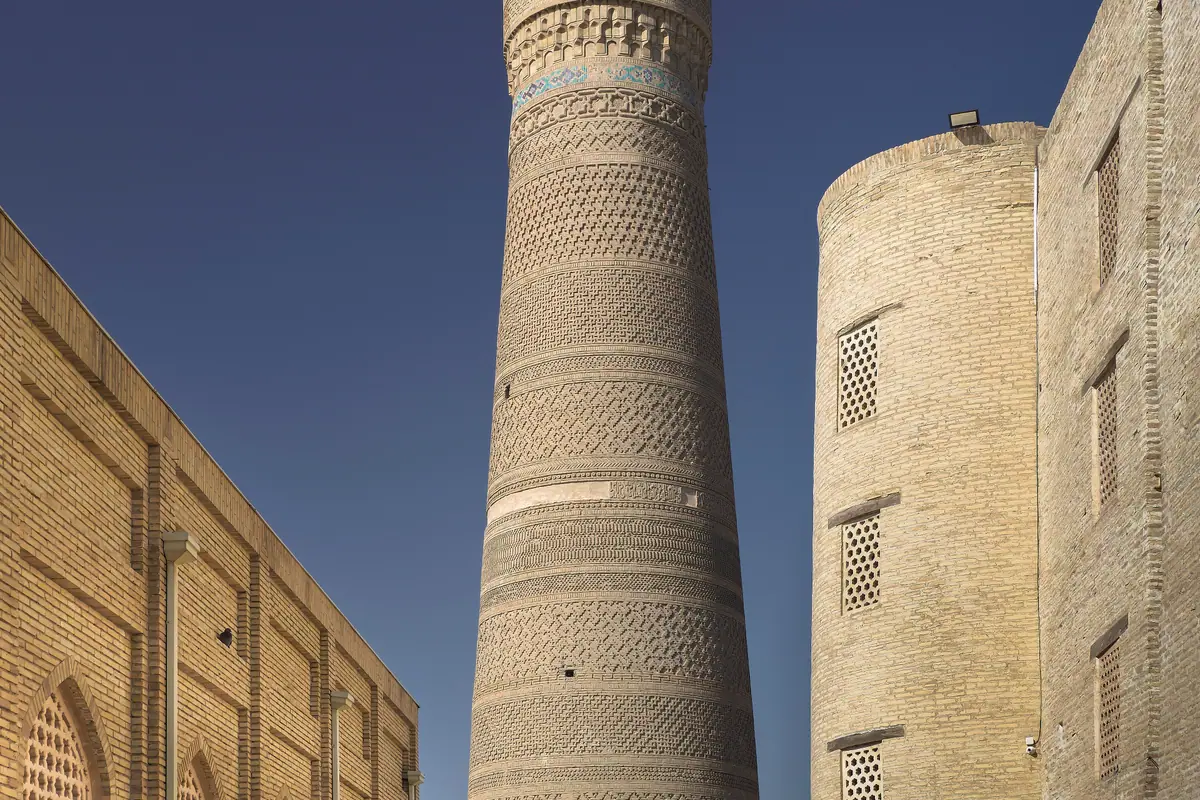
Samarkand is monumental; Bukhara is habitable. Its old town is a dense, flat maze of mud-brick lanes where people actually live, and almost every walk ends at the Poi Kalyan complex — the 47-metre Kalyan Minaret that so impressed Genghis Khan he ordered it spared, the Kalyan Mosque, and the Mir-i-Arab Madrasah facing it across a small square. Photograph it in slanting late-afternoon light, then walk three minutes to the Lyab-i Hauz, a stone-lined pool shaded by ancient mulberry trees and ringed with cafés where you can drink green tea for an hour without anyone hurrying you.
The rest of the city unspools on foot. The Ark Fortress, a walled citadel with a ramp wide enough for a chariot, contains museums and a throne room; the Samanid Mausoleum, a perfect brick cube from the 9th century, is the oldest surviving monument in Central Asia. Look for the four blue domes of Chor Minor at the edge of the old town, wander the surviving trading domes where jewellers and carpet sellers still work, and visit the Chor-Bakr necropolis or the summer palace of Sitorai Mohi Xosa just outside town, with its mirrored White Hall and peacock garden.
Two days is enough for the highlights; three lets you slow down. Bukhara also rewards the small stuff — a session in an old hammom bathhouse, a puppet workshop, a courtyard dinner of plov and shurpa. Most sights sit within a 20-minute walk of each other, so you rarely need transport once you have dropped your bags.
Khiva's Itchan Kala: A Walled City Straight Out of a Fairytale
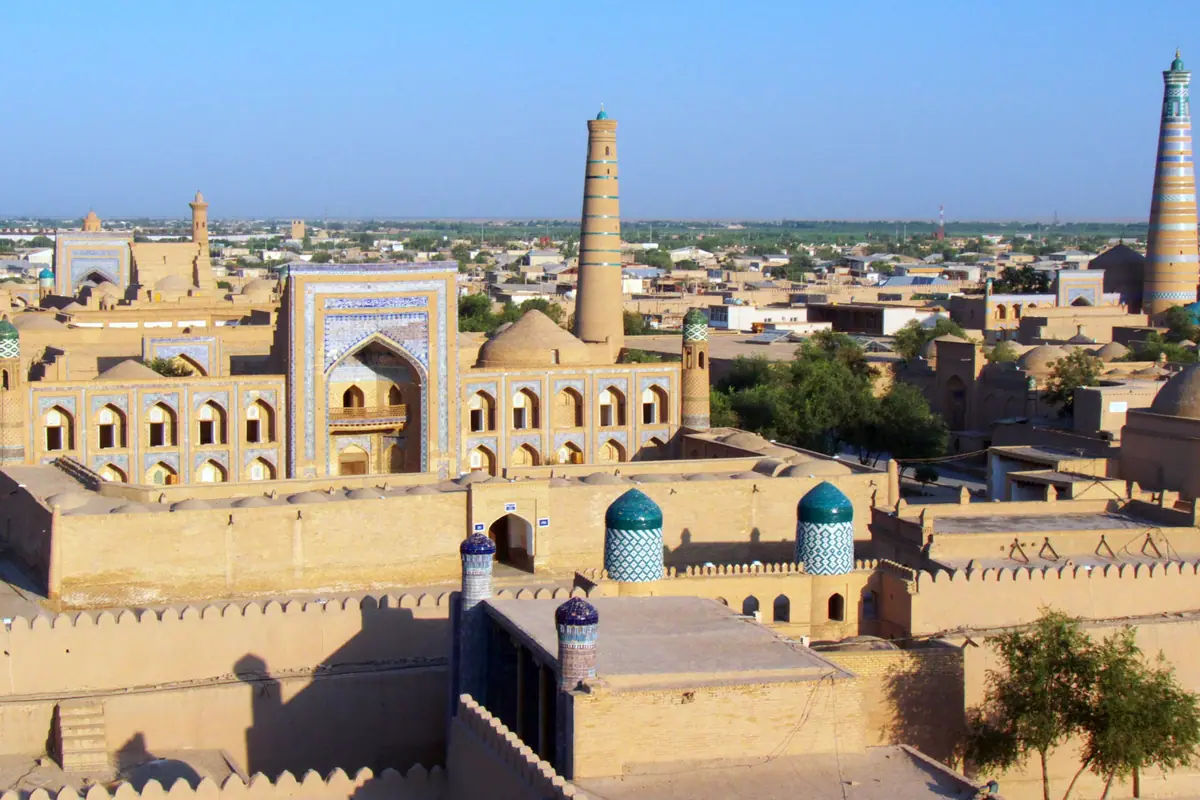
Khiva is the one Silk Road city where you step through a gate and are simply inside it. The Itchan Kala, an inner town enclosed by mud-brick walls, is a UNESCO-listed open-air museum that is also inhabited, with around fifty monuments packed into a space you can cross in fifteen minutes. The stubby, vividly tiled Kalta Minor minaret greets you near the western gate; the Islam Khodja Minaret, the tallest in the country at roughly 57 metres, offers a narrow spiral climb and a rooftop view over a sea of turquoise domes.
Don't miss the Juma Mosque, supported by more than 200 carved elm columns (some dating back a thousand years), the Tosh-Hovli Palace with its carved wooden ceilings and blue-tiled harem courtyard, and the Kunya-Ark citadel for the classic postcard view. In the evening, walk the ramparts at sunset and then eat in one of the family-run courtyards inside the walls — plov, lagman and pumpkin samsa, with no traffic noise anywhere.
Because Khiva is smaller, one full day plus a night covers it comfortably. Staying inside the walls is worth the small premium: the day-trippers leave by late afternoon and you get the lanes almost to yourself. From here, the more adventurous push north into the desert to Moynaq, where rusting fishing trawlers sit on the sand of a vanished sea — a sobering, unforgettable half-day journey.
Tashkent: Metro Palaces, Bazaars and the Modern Capital
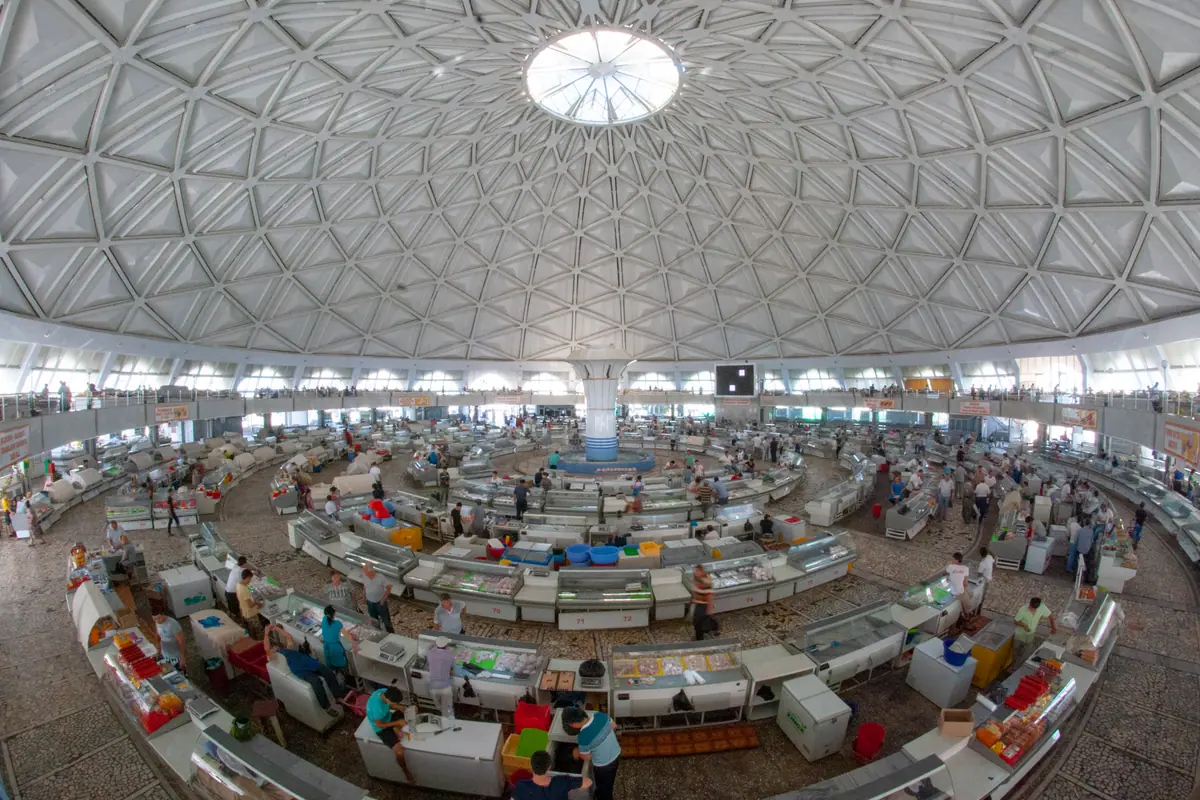
Most trips start in Tashkent, and it deserves more than a transit night. The Hazrati Imam complex holds one of the world's oldest surviving Qur'an manuscripts and a cluster of handsome mosques and madrasahs, while the Chorsu Bazaar under its huge turquoise dome is the city's sensory overload in the best way — mountains of dried fruit, pyramids of spices, tubs of fresh pickles and a whole floor devoted to meat and steaming plov. Come hungry, and go on a weekend morning when it is at full volume.
The city's metro is an attraction in its own right: several Soviet-era stations are decorated with chandeliers, marble, ceramics and mosaic ceilings for the price of a single ride. Above ground, Amir Timur Square anchors the modern centre, with the Museum of Applied Arts and the ornate Alisher Navoi Opera and Ballet Theatre nearby — an evening performance in the latter is one of Central Asia's great bargains.
Give Tashkent two nights at the start or end of your trip. Use it to adjust to the time zone, buy a local SIM card, sort out cash and train tickets, and eat your first proper plov at a busy chaikhana. The airport is close to the centre, so an early departure costs you very little sleep.
Beyond the Classic Three: Shahrisabz, Termez and the Fergana Valley
Once the Samarkand–Bukhara–Khiva triangle is done, the country opens up. Shahrisabz, Timur's birthplace and a two-hour drive over a mountain pass south of Samarkand, is home to the colossal ruined gate of the Ak-Saray Palace — its surviving arch once soared more than 40 metres — plus the quiet Dorut Tilavat complex. It works well as a long day trip or an overnight on the way toward Termez in the far south, where Buddhist stupas, monastery ruins and the Al-Termizi shrine tell a completely different chapter of the region's story.
In the east, the Fergana Valley is the country's artisan heartland: Rishtan for blue-and-turquoise ceramics, Margilan for silk workshops where you can watch cocoons unwind into thread. This is also Uzbekistan at its greenest and most agricultural — mulberry orchards, cotton fields and tea houses with no tourists in sight.
For landscape, head to the Nuratau Mountains and Lake Aydarkul for yurt stays, camel rides and desert sunsets, or to the Chimgan and Charvak area outside Tashkent for hiking in summer and skiing in winter. None of these are hard to arrange locally, but distances are long and shared taxis are the norm — build in more time than the map suggests.
When to Go, How Long to Stay and How to Get Around
Spring and autumn are the sweet spots. April to early June brings mild days, blooming apricot trees and markets overflowing with fruit; September and October offer warm, dry, golden light with the crowds thinned out. July and August are genuinely punishing in Bukhara and Khiva, where temperatures can push past 40°C, and winter is cold with occasional snow on the domes — atmospheric and quiet, but some family guesthouses close. Whatever the season, sightseeing is best in the first three hours after opening and again after 4pm.
The classic route is a loop of Tashkent, Samarkand, Bukhara and Khiva, and a comfortable minimum is seven to ten days. High-speed trains link Tashkent, Samarkand and Bukhara in a few hours, with seats selling out days ahead in peak season, so reserve as soon as your dates are fixed; Khiva is reached by a slower train or by road from Urgench. Domestic flights cut out long desert drives if you are short on time.
A few practicalities make everything smoother: carry some cash, since card readers are patchy outside big-city hotels; dress modestly for mosques and shrines, with shoulders and knees covered and a scarf handy for women; drink bottled water; and expect English to be limited outside the tourism trade, so a handful of Russian or Uzbek phrases earns genuine warmth. Tipping is welcome but never aggressive, and bargaining is expected in bazaars — always with a smile.
Frequently asked questions
How many days do I need in Uzbekistan?
Seven to ten days covers Tashkent, Samarkand, Bukhara and Khiva at a comfortable pace, with two days each in Samarkand and Bukhara and one full day in Khiva. Add three or four more days if you want Shahrisabz, the Fergana Valley, the Aral Sea region or mountain stays near Lake Aydarkul.
What is the best time of year to visit Uzbekistan?
April to early June and September to October are ideal, with mild temperatures and good light for photography. July and August are very hot in Bukhara and Khiva, often above 40°C, while winter is cold and quiet — some monuments are magical in snow, but a few guesthouses close.
How do you travel between Tashkent, Samarkand, Bukhara and Khiva?
High-speed trains connect Tashkent, Samarkand and Bukhara in a few hours and are the most comfortable option; book well ahead in spring and autumn. Khiva is served by slower rail services or by road from Urgench, and short domestic flights help if your itinerary is tight.
Is Uzbekistan safe and easy for first-time visitors?
Yes — street crime is low, tourist areas are well patrolled, and independent travel is straightforward. The main challenges are language barriers outside the tourism trade, cash-only payments in smaller places, and long distances between cities, so plan transport in advance.
What should I wear and how should I behave at religious sites?
Cover shoulders and knees, and carry a light scarf for women at active mosques and shrines; remove shoes where indicated. Photography is usually welcome, but ask before photographing people, and avoid visiting during prayer times at working mosques.
Plan it — experiences in Uzbekistan
Live search, booked directly with trusted providers.
Sort the rest of your trip
Everything for Uzbekistan, in one place
Stay in Uzbekistan
Hotels, guesthouses and apartments — compared in one search.
Search hotels
Transfer in Uzbekistan
Private driver waiting on arrival — no queues, no surprises.
Book a transfer
Stay online in Uzbekistan
Travel eSIM — data the moment you land, no roaming bills.
Get an eSIMMore guides in Uzbekistan
Best Time to Visit Uzbekistan: Seasons, Weather and When to Book Hotels
Uzbekistan in One Week by Flight: Tashkent, Khiva, Bukhara and Samarkand
Where to Stay in Uzbekistan: Hotels and Must-See Sights in Samarkand, Bukhara and Khiva