Turkmenistan is the quietest of the Central Asian republics and the strangest to travel through: a white-marble capital of monuments built for the record books, a burning desert crater that glows all night, and Silk Road cities whose mud-brick walls have been melting back into the Karakum for centuries. Visas are fiddly, distances are long, and you will almost certainly move around with a guide — which is precisely why so much of the country still feels undiscovered.
Ashgabat: A Marble Capital Built for the Record Books
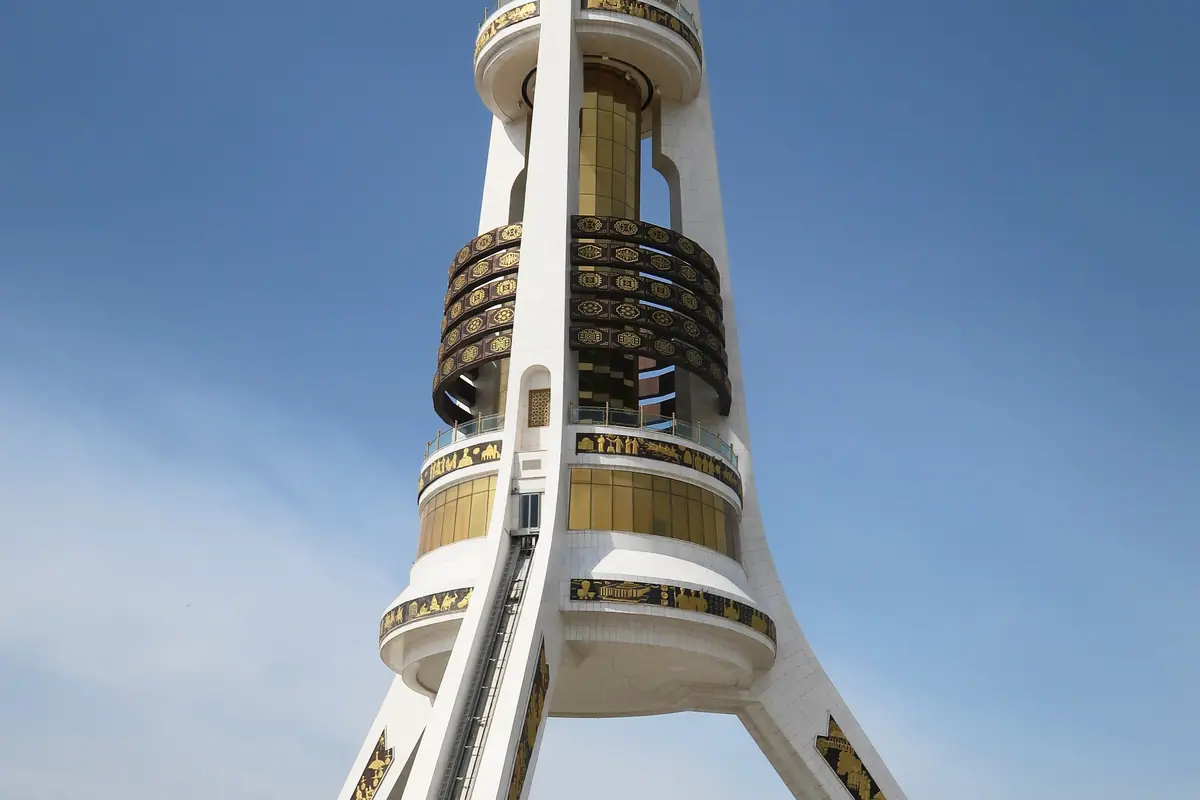
Ashgabat announces itself the moment you leave the airport: wide, spotless boulevards lined with white marble facades, fountains, and monuments that seem to have been designed to break records rather than to be lived beside. The Independence Monument rises on columns topped with gilded figures, while the Neutrality Monument — a three-legged arch carrying a gold statue of the country's first president — stands in the foothills above the city. The Alem Cultural and Entertainment Centre holds an enormous indoor Ferris wheel, and the national flagpole, at 133 metres, was for a time the tallest in the world. It is a city of spectacle, and a half-day simply driving between the set pieces is one of the country's genuine experiences.
Down at ground level, Ashgabat is more human than the skyline suggests. The Ruhy Mosque at Gypjak, the first president's home village about eight kilometres out of town, has a vast prayer hall and is one of the largest mosques in Central Asia, while the Ertugrul Gazi Mosque in the centre is a working neighbourhood place of worship. The carpet museum houses hundreds of antique Turkmen weavings, each one identifying its tribe through pattern, and the main state museums cover everything from Parthian ivories to the country's improbable modern architecture. For atmosphere, head to the Altyn Asyr bazaar — still called Tolkuchka by everyone — which fills with carpets, silver jewellery, livestock and melons on Sundays, or the smaller Russian bazaar downtown for flatbread, dried fruit and endless bowls of green tea.
Give Ashgabat two full days, and start early: the heat builds fast from May onwards. Museums keep short and changeable hours, so let your guide confirm them in advance. Dress modestly, leave the camera in your bag around government buildings, police and the airport, and carry your passport at all times — roadside checks are routine. Bring cash in local manat; cards work in smart hotels and almost nowhere else.
Darvaza: Camping Next to the 'Door to Hell'
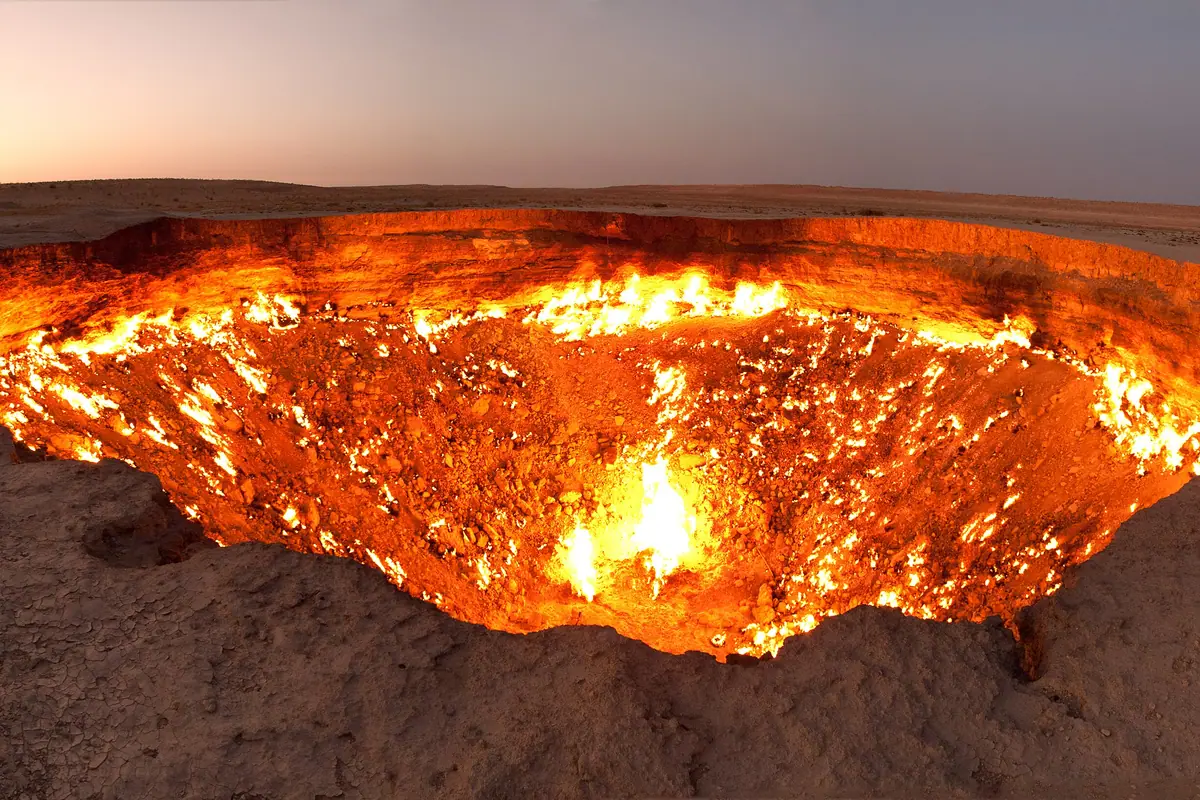
About 260 kilometres north of Ashgabat, on the road towards Dashoguz, a hole in the Karakum Desert has been on fire since 1971, when a drilling operation collapsed into a gas cavern and the escaping methane was set alight. The Darvaza crater — the 'Door to Hell' to everyone who visits — is roughly 60 to 70 metres across and 20 metres deep, and the glow is visible for kilometres across flat, empty ground. Stand on the rim at dusk as the light fades and the flames take over from the sun; if the wind shifts, the whole pit roars like a furnace.
Nearly every visitor stays overnight, because the crater is at its most dramatic in the dark and again at sunrise. Simple yurt camps and tented camps sit within walking distance, and dinner is usually grilled meat, bread and tea in the open, with the orange light flickering on the horizon. On the way in or out, guides usually stop at the two companion craters: one bubbling grey mud, the other filled with water that reflects the sky. The whole area is an active gas field, so follow your guide's route exactly.
There is no railing and the rim crumbles — keep well back, watch children closely, and never step onto cracked, warm ground. The travel window is narrow: April to May and September to October are comfortable, while summer days push past 40°C and winter nights drop well below freezing. Even in spring, desert nights can fall close to zero, so pack a head torch, a windproof layer, a scarf for the dust and more water than you think you need.
Ancient Merv and Old Nisa: Two World Heritage Chapters of the Silk Road
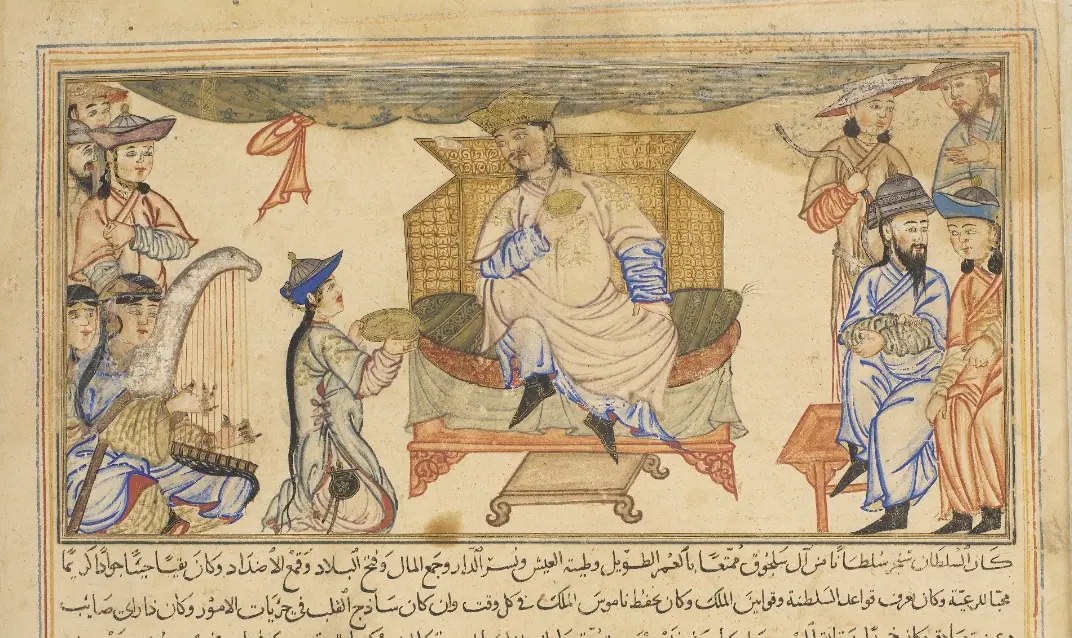
Ancient Merv, near the city of Mary around 370 kilometres east of Ashgabat, is one of the great archaeological landscapes of Asia — a sprawl of walled cities built on top of each other across four thousand years. Walk the ramparts of Erk Kala and Gyaur Kala, cross the vast medieval Sultan Kala with its ruined walls, and stand beneath the Sultan Sanjar Mausoleum, a 12th-century brick dome of astonishing size and elegance. Nearby, the Great and Little Kyz Kala — corrugated mud-brick fortresses that have survived a thousand years of wind — are the most photographed ruins on the site. Merv was a Silk Road metropolis until the Mongol armies sacked it in 1221, and the emptiness today is part of its power.
In Mary itself, the regional museum displays finds from the surrounding desert, including material from Gonur Depe, a Bronze Age oasis settlement further north that yielded temples, tombs and elaborate grave goods from a civilisation that traded across the region long before the Silk Road existed. Excavation there continues, and visiting is a specialist detour rather than a casual stop.
Old Nisa is far easier to reach: a Parthian fortress about 18 kilometres west of Ashgabat, occupied from the 3rd century BC, with a ceremonial 'Square House', storerooms and wine cellars that produced the ivory drinking horns now regarded as treasures of ancient art. New Nisa sits just alongside. Merv is a dawn start — there is almost no shade across the site — while Nisa works well as a half-day trip from the capital. In both places, carry water, a hat and sun cream, and wear closed shoes on the broken ground.
Kunya-Urgench and the Northern Desert Gateways
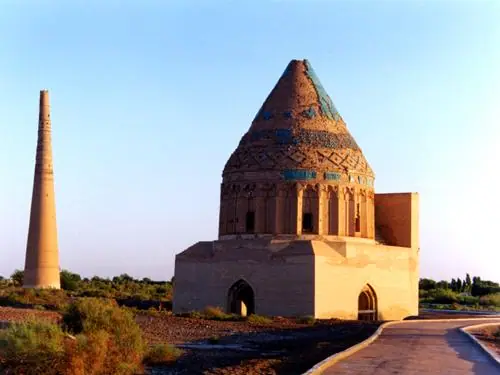
In Turkmenistan's far north, near the town of Dashoguz, the ruins of Kunya-Urgench mark the old capital of Khorezm — a Silk Road power whose monuments survived both the shifting of the Amu Darya river and the wrath of Timur at the end of the 14th century. The Kutlug Timur Minaret still climbs around 60 metres, one of the tallest minarets of its era, and the Turabek Khanum Mausoleum is covered inside and out in tilework that shifts through turquoise, blue and white as the light moves. The Sultan Tekesh Mausoleum and the tomb of the Sufi teacher Najm al-Din Kubra complete the group. For most travellers this is the northern highlight of the country, and the site is quiet enough that you may have it entirely to yourself.
Getting there is part of the adventure. The road from Ashgabat runs roughly 550 kilometres through the Karakum, past Darvaza, or you can take a short internal flight to Dashoguz and drive out from there. Because the ruins sit close to the Uzbek border, expect checkpoints and, in some zones, permits arranged in advance through your operator. Photography restrictions near border installations are strict and enforced.
Time your visit for early morning or late afternoon, when the low sun pulls detail out of the brickwork and the desert wind drops. Between the sites, the north is melon country in late summer, and the local kitchens serve a hearty variation of plov with mutton and carrots that tastes nothing like the version you will eat in the capital.
The Caspian Coast: Avaza, Yangykala Canyon and Turkmenbashi
In the west, the Caspian Sea meets a country that barely uses its own coastline. Avaza, the purpose-built resort zone outside the port city of Turkmenbashi, is a strip of wide, pale beaches, palms, fountains and hotels that stay almost empty outside the brief summer peak. The sea is genuinely warm from July to September, and because so few people come, a morning swim here feels like a private stretch of coast. Turkmenbashi itself is a working harbour town with a ferry link across the Caspian, and the drive out from Ashgabat takes the best part of a day, so most visitors fly.
Inland from Balkanabat lies the country's most surprising natural sight: Yangykala Canyon, a series of pastel ravines carved out of cream, pink and ochre chalk and nicknamed the 'fire fortresses' for the way the cliffs blaze at sunset. There are no facilities, no railings and no shade — this is strictly a four-wheel-drive excursion with a guide and a full tank of fuel. Spring brings a flush of green and wildflowers to the plateau; by midsummer the canyon floor is furnace-hot and best avoided in the middle of the day.
Combine the two into a western loop: canyon at sunrise, Caspian beach in the afternoon, and a night in Avaza before flying back. Bring strong sun protection and windproof layers — the Caspian coast is breezy year-round — and note that alcohol, while available in resort hotels, is not something to carry openly around town.
Kopet Dag Villages, Kow Ata and the Akhal-Teke Horse
The mountains south-west of Ashgabat hide one of the country's oddest attractions. Kow Ata is an underground lake inside a limestone cave in the Kopet Dag, reached by descending a long, dimly lit staircase into a warm, humid chamber where the water holds around 35°C all year and bats skim overhead. The mineral-heavy water smells faintly of sulphur and is reputed to cure everything from rheumatism to bad skin. Allow around two hours for the visit, take a torch, wear shoes with grip for the wet steps, and keep a firm hand on the rail.
Further into the foothills, the village of Nokhur is home to a community with its own dialect and customs, famous for a cemetery where gravestones are marked by carved wooden pillars and juniper posts rather than conventional headstones. It is a place of stone houses, orchards and embroidery, and the surrounding valleys are excellent walking country in spring, when the slopes fill with wildflowers.
The other essential Kopet Dag encounter is the Akhal-Teke, the slender, metallic-coated desert horse that is a national symbol and, by local reckoning, the oldest cultivated breed in the world. Stud farms around Ashgabat and Gokdepe welcome visitors by arrangement and stage short displays of the breed's famous smooth gait. Late April brings a national horse festival, while Gokdepe itself, about 45 kilometres north-west of the capital, has a fortress and mosque marking a notorious 19th-century battle. Round the day off with palow, manty, dograma and lagman in a family-run dining room, and August melons that locals will insist, correctly, are the finest anywhere.
Frequently asked questions
Do I need a visa and a guide to visit Turkmenistan?
Almost all visitors need a visa, and the usual route is a letter of invitation arranged in advance through a licensed local operator, with the visa then issued on arrival at Ashgabat airport for many nationalities. Travel outside the capital is generally accompanied, and certain border regions and restricted zones require extra permits arranged before you arrive. Start the paperwork at least four to six weeks ahead.
When is the best time to visit Turkmenistan?
Mid-March to May and September to early November are comfortably the best months. Spring brings wildflowers to the Kopet Dag and mild desert nights, while autumn keeps days warm and evenings cool — ideal for camping at Darvaza. Summer is punishing, with desert temperatures past 40°C, and winter nights at the crater drop below freezing even though days can be bright and pleasant.
How many days do I need?
Five to seven days covers Ashgabat, the Darvaza crater and the Parthian fortress of Old Nisa, with time to spare for the bazaars. Add three or four days for Ancient Merv in the east, and a further three to four if you want the northern ruins at Kunya-Urgench or the Caspian coast at Avaza. Rushed itineraries here mean a lot of hard driving.
Can I travel around Turkmenistan independently?
Realistically, no. Expect registration formalities, roadside checkpoints, restricted zones and escorted movement between regions, all of which are far easier to handle through an operator. That said, you usually get free time in Ashgabat to wander the bazaars, parks and cafés on your own.
What should I know about money, dress and photography?
Bring cash — manat for daily spending and clean, unmarked hard-currency notes to exchange — because cards are accepted only in a handful of large hotels. Dress modestly, especially in rural areas and around mosques, and cover shoulders and knees. Never photograph government buildings, airports, military installations, border posts or police officers, and always ask before photographing people in villages.
Plan it — experiences in Turkmenistan
Live search, booked directly with trusted providers.
Sort the rest of your trip
Everything for Turkmenistan, in one place
Stay in Turkmenistan
Hotels, guesthouses and apartments — compared in one search.
Search hotels
Transfer in Turkmenistan
Private driver waiting on arrival — no queues, no surprises.
Book a transfer
Stay online in Turkmenistan
Travel eSIM — data the moment you land, no roaming bills.
Get an eSIM