Turkmenistan is the quiet giant of Central Asia: four-fifths of it is Karakum Desert, yet it holds Silk Road cities that once rivalled Baghdad, a burning gas crater that glows all night, and a capital rebuilt in white marble. Almost everything worth seeing lies along a rough line from the Caspian Sea to the Amu Darya, connected by short domestic flights, slow trains and long desert drives.
Ashgabat: A Capital Carved in White Marble
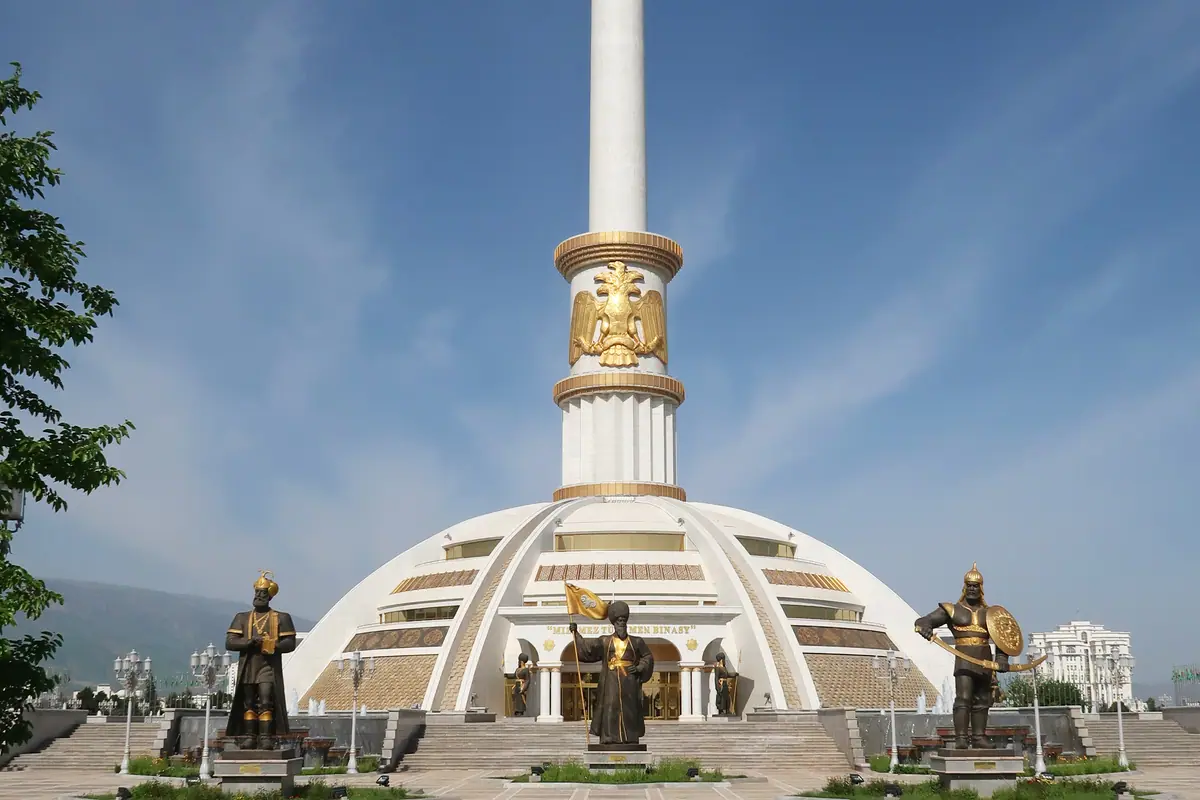
Ashgabat is unlike any other city in the region — a grid of white marble facades, gilt domes and improbably tall flagpoles, laid out after the devastating 1948 earthquake flattened the old mud-brick town. Start at Independence Square, where the Independence Monument rises above a colonnade of statues, then walk the wide boulevards toward the Arch of Neutrality, a 75-metre three-legged tower topped with a golden figure that once rotated to follow the sun. In the south of the city, the Alem Cultural and Entertainment Centre encloses a giant Ferris wheel inside a glazed, star-shaped shell — ride it at dusk for the best view over the white rooftops to the Kopet Dag mountains.
Museums here are surprisingly strong. The National Museum of Turkmenistan covers the Parthian and Seljuk past, while the Carpet Museum displays one of the largest hand-knotted carpets ever made, alongside antique tribal weavings and the tools used to dye them. Nearby, the Wedding Palace, known as Bagt Koshgi, is a tiered white building with a golden globe on top where couples pose for photographs on the steps. Allow a full day, and expect to be waved away from photographing government buildings — guards are serious about it.
For a dose of real life, head to the Russian Bazaar for dried fruit, flatbread and pickles, or time your visit to a Sunday and go out to the vast Altyn Asyr bazaar on the city's edge, where camels, sheep, carpets and car parts change hands in a sprawling open-air maze. Two days in Ashgabat is about right: one for monuments and museums, one for markets and the Akhal-Teke horse stables on the outskirts, where the country's famously slender, metallic-coated horses are trained.
Day Trips from the Capital: Old Nisa, Kow Ata and Nokhur
Within an hour or two of Ashgabat you can stand in a Parthian fortress, swim in a warm underground lake and eat lunch in a mountain village. Old Nisa, about 18 kilometres southwest of the city, was a royal stronghold of the Parthian Empire from the third century BC onward, and its thick mud-brick ramparts, pillared halls and wine-store ruins are still legible after two thousand years. The neighbouring mound of New Nisa is larger and rougher; together they make a half-day outing with a decent breeze and almost no shade, so go early and carry water.
At Bakharden, roughly 60 kilometres west, a staircase drops into a limestone cavern where a warm, faintly sulphurous lake fills the chamber floor. The water sits at around 35–37°C year-round, which makes Kow Ata a pleasure in cool spring and autumn and a slightly steamy experience in summer. Bring a towel, expect to swim by torchlight with bats overhead, and treat the changing facilities as basic.
Further southwest, the road climbs into the Kopet Dag foothills to Nokhur, a village of stone houses and walnut groves whose tribal cemetery is famous for grave markers topped with carved wooden posts crowned by the horns of mountain rams. Women here wear long red-and-multicoloured dresses with heavy silver jewellery, and a few families welcome visitors for tea and home-cooked food. On the way back, stop at the white-and-gold Geok Depe mosque, a vast modern shrine built on the site of a nineteenth-century battle — a sobering, beautiful place that most visitors see only through a car window.
Darvaza Gas Crater and the Karakum Desert
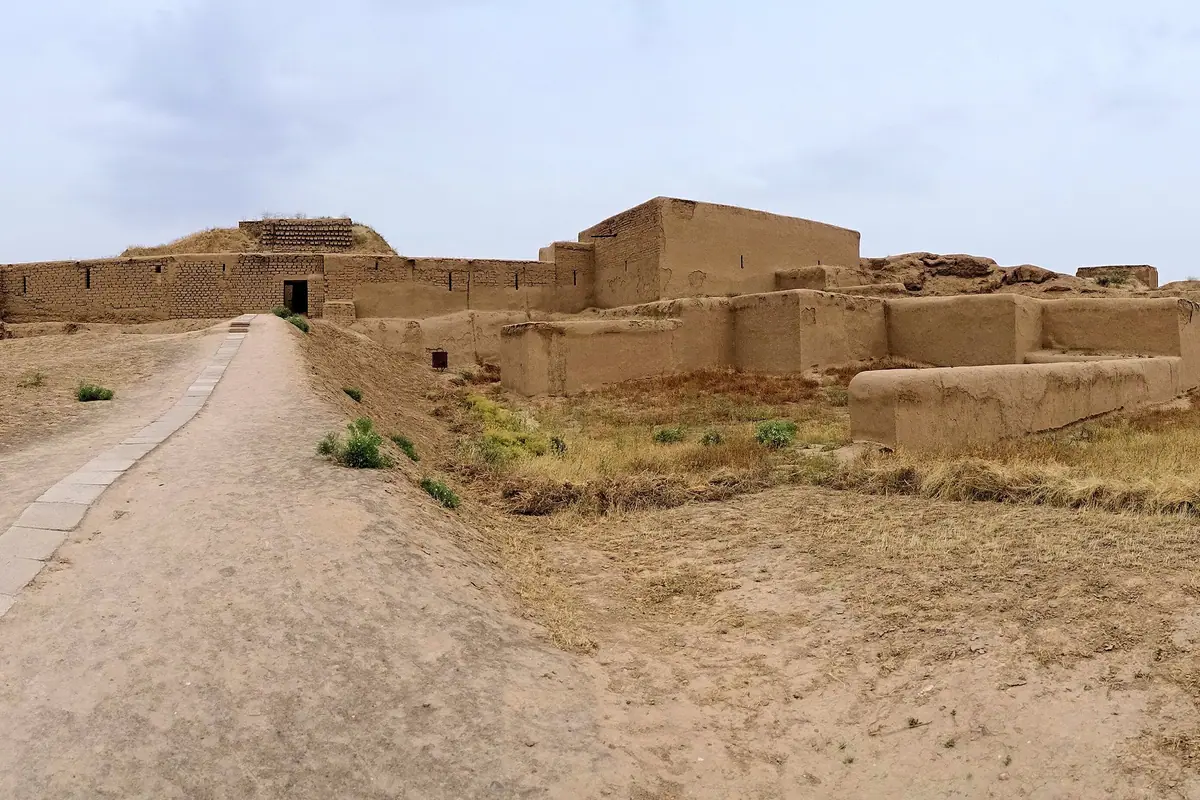
The Darvaza gas crater — widely nicknamed the Gates of Hell — is the single image that pulls most travellers to Turkmenistan. Some 260 kilometres north of Ashgabat, a collapsed cavern has been burning since Soviet drilling in 1971 accidentally opened a pocket of natural gas; the flames have never gone out. By day it looks like a scorched bowl in the sand; at night the whole rim glows orange and the heat hits your face before you see the fire. There are no railings and no lighting, so keep well back from the crumbling edge and follow your driver's lead.
Almost everyone visits as an overnight trip: a four-hour drive north through desert, arriving late afternoon, dinner cooked at a camp of yurts and tents nearby, then a second look at the crater after dark before sleeping. Nights in the Karakum can be bitterly cold from November to March and still cool in spring and autumn, so pack a warm layer and a head torch. The crater is at its most photographable at dusk and just before sunrise, when the flames are clearly visible against a dim sky.
Darvaza pairs naturally with the desert itself. On the way you pass dune fields, camel herds, the small settlement of Erbent and occasionally a shepherd's camp; some itineraries continue north toward Dashoguz or loop west to the Caspian. Try to avoid July and August, when daytime temperatures in the Karakum routinely pass 40°C and the dust haze softens the view. October, November, March and April give the best combination of clear air, bearable heat and long, dark evenings.
Ancient Merv: The Greatest Silk Road Oasis
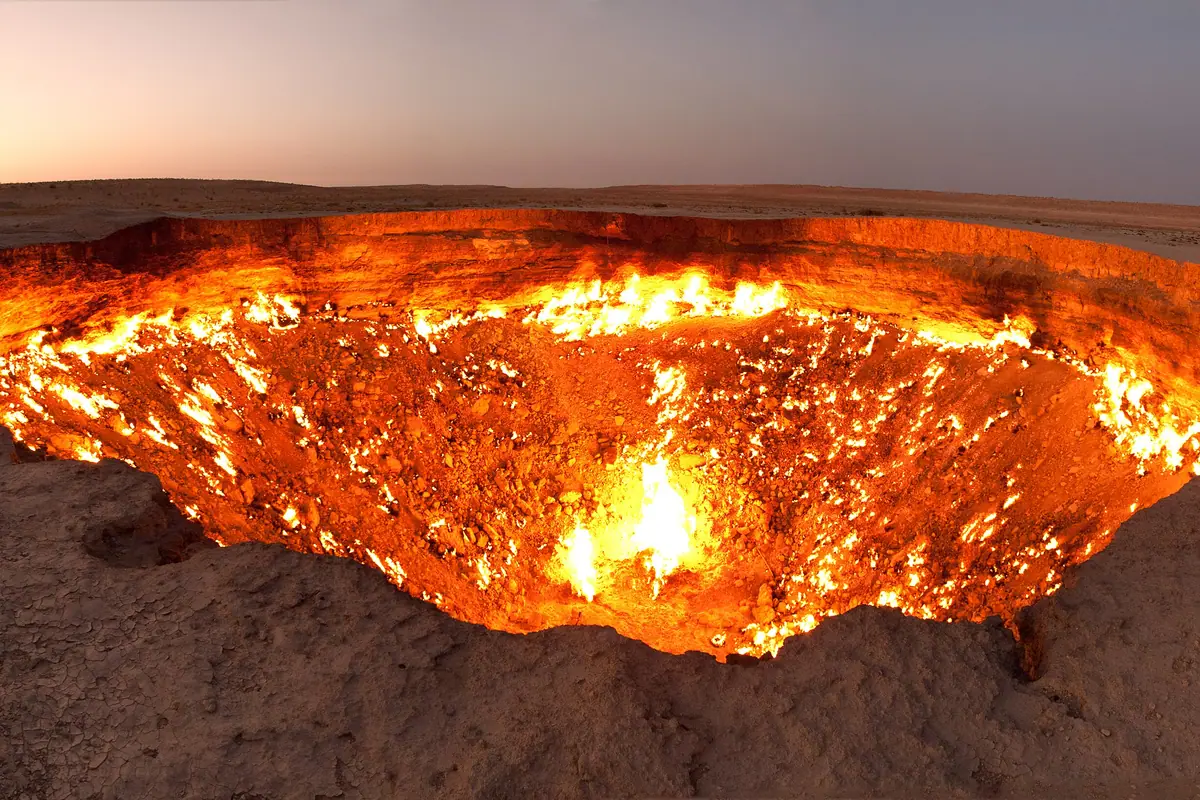
Merv, beside the modern city of Mary in the southeast, is the most rewarding archaeological site in the country. Successive cities were built here over more than two millennia: Erk Kala from the sixth century BC, Gyaur Kala with its long mud walls, and medieval Sultan Kala, which grew into one of the largest cities in the world before the Mongols destroyed it in 1221. The site is protected as a state historical and archaeological reserve, and it is genuinely vast — you need a vehicle to move between the separate mounds rather than walking.
The star is the Mausoleum of Sultan Sanjar, a soaring eleventh-century brick cube with an interior that seems to breathe, its walls still carrying traces of carved plaster and a frieze. Nearby stands the Great Kyz Kala, a fortified manor house with corrugated walls so finely modelled that photographers mistake it for something far more recent. The smaller Kyz Kala, several mausoleums and the ruined ice house at Sultan Kala's edge are easy to add if you have a few hours.
Merv sits about half an hour from Mary, reachable by a short domestic flight from Ashgabat or a long but scenic train ride. Give it three to four hours minimum — five if you want to linger — and go at sunrise or in the two hours before sunset, when the mud walls turn gold and the heat finally breaks. There is almost no shade and no food on site, so bring water, a hat and something to eat. March to May and September to early November are the only months when a full day out here is comfortable.
Konye-Urgench: The Northern Silk Road Capital
In the far north, near Dashoguz and the border with Uzbekistan, Konye-Urgench was the capital of the Khorezm empire until Genghis Khan's armies razed it in 1221. What survives is a scattering of monuments across flat, dusty ground: the Kutlug Timur Minaret, a tapered brick tower more than 60 metres high, the Mausoleum of Turabek-Khanum with one of the most intricate mosaic-tiled ceilings in Central Asia, and the austere brick tombs of Sultan Tekesh and Il-Arslan. The minaret is the tallest monument of its kind surviving from that era, and it leans very slightly, which gives photographs a strange tilt.
Give yourself two to three hours here, plus the drive from Dashoguz — about 90 minutes each way. The site has a small entrance area and very little else: no cafés, no shade, no labels in English on many structures, which is exactly why a guide who can read the architecture is worth the expense. Combine the visit with the lively Dashoguz bazaar, where Afghan and Turkmen traders sell melons, kurt (dried yoghurt balls) and cheap cotton textiles.
Northwestern Turkmenistan is colder than the rest of the country in winter, with frost and occasional snow from December to February, and blazing in July. April and May are ideal, when the desert blooms briefly and the light is soft. Many travellers reach Konye-Urgench overland from Khiva or Nukus in Uzbekistan, which is straightforward if your visa and permits are arranged in advance; do not assume you can simply turn up at a remote border post without paperwork.
Beyond the Crowds: Koytendag, Yangykala and the Caspian Coast
For a country with so few visitors, Turkmenistan hides some magnificent wild corners. Koytendag in the far east, on the border with Uzbekistan and Afghanistan, is a plateau of limestone gorges where a trail above Khodjapil village leads to a slab of rock stamped with dozens of three-toed dinosaur footprints. The surrounding reserve holds the Kainargen cave system, deep canyons and the Umbar Dere waterfall, best seen in April and May when snowmelt fills it. This is permit territory: visits are arranged in advance through local operators, involve 4x4s and homestays, and need at least three or four days.
In the west, near Balkanabat, the Yangykala Canyon is a wall of layered red, pink, white and ochre cliffs above a dry riverbed — the closest thing in Central Asia to a painted desert. It is roughly a four-hour drive from Turkmenbashi, and the only sensible way to see it is to camp overnight so you catch both sunset and sunrise; there are no facilities whatsoever. Combine it with Gozli Ata, a pilgrimage site with a hillside cemetery that overlooks the canyon country.
Finish on the Caspian at Awaza, a purpose-built resort strip near Turkmenbashi with a long pale beach, hotels on the sand and warm, shallow water from June to September. It is quiet, slightly surreal and a complete change of register after weeks of desert and ruins — and a good place to swim, eat Caspian sturgeon-style fish dishes and let the dust settle. Domestic flights connect Turkmenbashi with Ashgabat in under two hours, which makes an open-jaw route from capital to coast easy to plan.
Frequently asked questions
How many days do you need to see Turkmenistan?
Seven to ten days covers the highlights comfortably: two days in Ashgabat, one overnight at the Darvaza gas crater, one or two days for Ancient Merv from Mary, a day trip north to Konye-Urgench, and a day or two on the Caspian coast. Add three or four days if you want Koytendag or the Yangykala Canyon, since both require 4x4 transport and permits.
Do I need a guide, and can I travel independently?
Most foreign visitors need a visa arranged in advance, usually with an invitation letter from a local travel company, and are expected to travel with an organised itinerary or a registered guide. Several regions — including the eastern border area around Koytendag, parts of the Iranian border zone and some Caspian sites — require an extra permit. Travelling with a driver-guide is the norm and removes almost all of the logistical friction.
When is the best time to visit Turkmenistan?
April, May, September, October and early November are the sweet spots: warm days, cool nights and clear light. July and August bring punishing heat of 40°C and more across the Karakum, while December to February is cold in Ashgabat and genuinely freezing in the north around Dashoguz. Spring is also when the desert briefly turns green and the mountain waterfalls run.
Is the Darvaza gas crater still burning?
Yes. The crater has been alight since 1971 and continues to burn, though the size of the flames varies with gas pressure and wind. It is most dramatic after dark and around dawn. There are no barriers or safety lighting, so stay well back from the rim, keep children close and never walk around the edge at night.
What should I know about money, dress and photography?
Carry cash — cards are accepted only in a few large hotels in Ashgabat, and there are no reliable ATMs outside the capital. Dress modestly, covering shoulders and knees, particularly in villages and at religious sites. Ask before photographing people, and never photograph government buildings, airports, border posts or military installations; guards will ask you to delete images.
Plan it — experiences in Turkmenistan
Live search, booked directly with trusted providers.
Sort the rest of your trip
Everything for Turkmenistan, in one place
Stay in Turkmenistan
Hotels, guesthouses and apartments — compared in one search.
Search hotels
Transfer in Turkmenistan
Private driver waiting on arrival — no queues, no surprises.
Book a transfer
Stay online in Turkmenistan
Travel eSIM — data the moment you land, no roaming bills.
Get an eSIM