Trinidad and Tobago is two islands with two entirely different personalities: a bustling, food-obsessed, carnival-hearted Trinidad where mangrove swamps glow scarlet at dusk, and a slower, rainforest-cloaked Tobago where the sandbar you stand on is surrounded by open sea. Between them they pack in a natural asphalt lake, the oldest protected rainforest in the Western Hemisphere, and some of the finest street food in the Caribbean.
Port of Spain and the Northern Range: Where Every Visit Begins
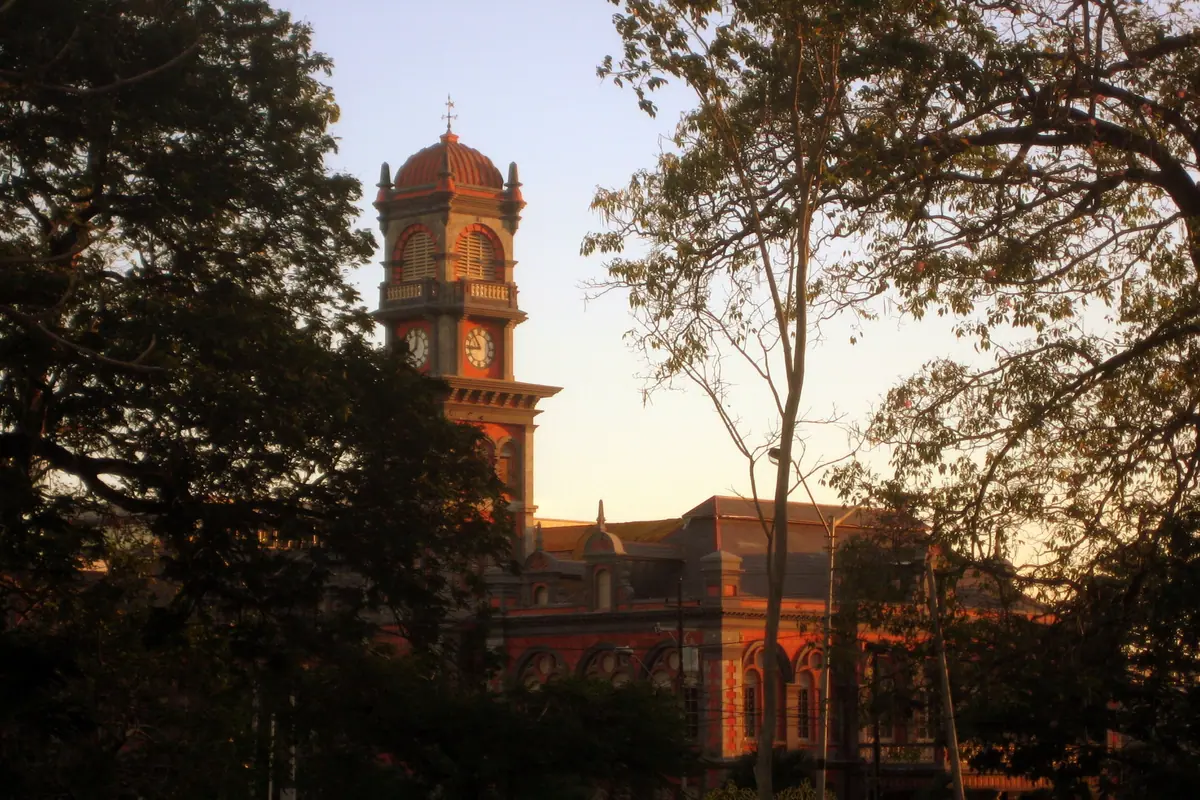
Most journeys start in Port of Spain, and the city rewards a full day of wandering. Queen's Park Savannah is the city's green lung — around 260 acres of open grass and cricket pitches ringed by a one-way road that locals treat as a jogging track at dawn and a racetrack at rush hour. On the savannah's western edge, Maraval Road holds the Magnificent Seven, a row of wildly ornate colonial-era mansions built between the 1880s and 1900s, including the turreted, candy-striped Stollmeyer's Castle, the wedding-cake facade of Whitehall, and the crumbling romanticism of Mille Fleurs and Roomor. The best free way to see them is a slow walk with a cold coconut water in hand.
Immediately south, the Royal Botanic Gardens were laid out in the early 19th century and remain one of the oldest of their kind in the region — a shaded grid of palms, cannonball trees and samaan giants, with the Emperor Valley Zoo next door if you are travelling with children. For the finest view in the city, drive or taxi up to Fort George, a British-era fortification perched above St. James with cannon still pointing out over the Gulf of Paria; on clear days you can see the hills of Venezuela across the water.
Just outside the city in Tunapuna, the hilltop Mount St. Benedict Abbey has watched over the surrounding plains since the early 20th century and welcomes visitors to its quiet gardens and lookout. In the Arima Valley beyond, the forested slopes of the Northern Range shelter some of the easiest tropical birding you will ever do, with tanagers, motmots and trogons showing up metres from the road.
Maracas Bay and the North Coast Road
The drive from Port of Spain to Maracas Bay is one of the Caribbean's great short road trips: roughly 45 minutes of switchbacks over the Northern Range, with the forest pressing in on both sides and the sea appearing all at once below you. Maracas Beach itself is a proper ocean beach — a long curve of grey-gold sand, serious surf, and lifeguards on weekends. Its fame, though, rests on bake and shark: a fried dough pocket stuffed with grilled shark, doused in tamarind, garlic, pepper and chadon beni sauces from a row of beachfront stalls. Order one before you even take your shoes off.
Keep going east and the coast gets quieter and wilder. Las Cuevas Bay is a gentler, crescent-shaped alternative popular with families, while Tyrico and Blanchisseuse sit further along a road that narrows into rainforest. Hikers use Blanchisseuse as the trailhead for the Paria Waterfall trek — a demanding but unforgettable few hours of river crossings and mud that ends at a waterfall and a deserted beach.
West of the city, the Chaguaramas peninsula offers a completely different day out: Macqueripe Bay for a sheltered swim, a waterfront boardwalk for sunset, and boat trips out to the islands known locally as Down the Islands. The Gasparee Caves on Gaspar Grande island are a highlight — a limestone cavern with a tidal pool inside that glows an improbable blue-green when the light is right.
The Pitch Lake, Temple in the Sea and Caroni Swamp
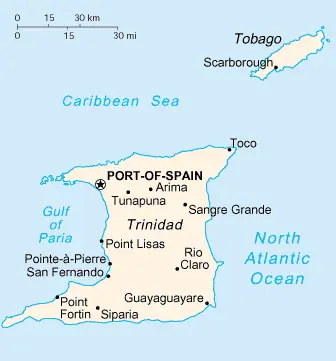
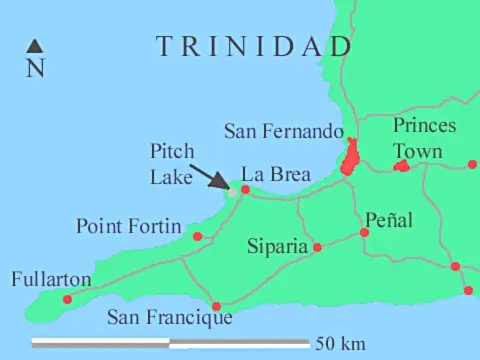
Central and southern Trinidad hold the island's strangest and most spiritual sights. The Pitch Lake at La Brea is the largest natural deposit of asphalt on earth — a black, gently rippling expanse of around 100 acres where you can walk on a surface that is technically liquid, deep enough in places to swallow a cathedral. Guides lead you across it to pools of rainwater that reflect the sky and to spots where gas bubbles up through the crust; bring closed shoes you don't mind ruining. It has been mined since the 19th century, and legend says Sir Walter Raleigh used its tar to caulk his ships.
Nearby in Carapichaima, the 85-foot Hanuman Murti statue at the Dattatreya Yoga Centre is visible for miles across the cane fields, and the surrounding gardens make a peaceful stop. A short drive away at Waterloo, the Temple in the Sea is exactly what it sounds like: a small, brightly painted Hindu temple built on a man-made island offshore, constructed single-handedly by an indentured labourer who was refused land on the mainland. It is one of the most photographed spots in the country, especially at sunset.
Closer to Port of Spain, the Caroni Bird Sanctuary is a 40-square-mile maze of mangrove channels that erupts at dusk when thousands of scarlet ibis fly in to roost, turning the sky red. Boat tours last around two hours and run in the late afternoon; bring insect repellent and a telephoto lens. Further east, the vast freshwater Nariva Swamp protects red howler monkeys, manatees and an extraordinary bird count.
Tobago's West Coast: Pigeon Point, Buccoo Reef and the Nylon Pool
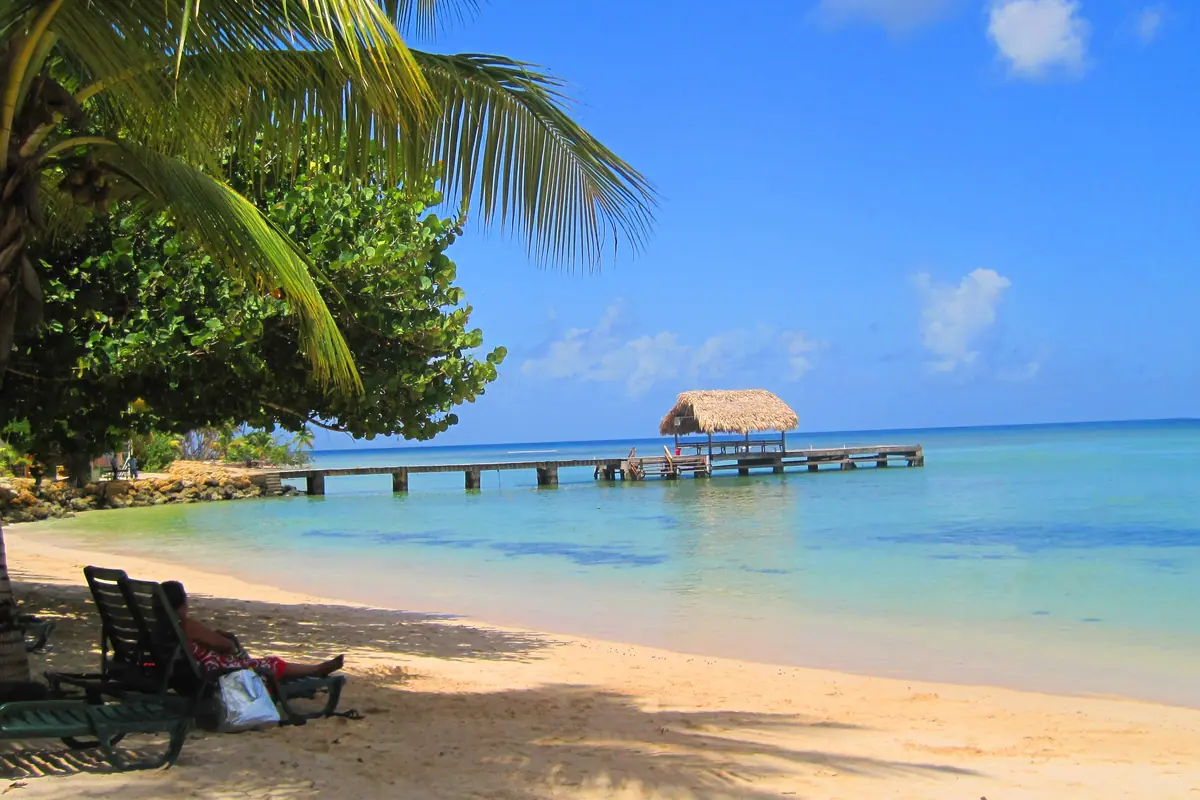
Tobago is only 25 miles long, but its west coast contains some of the most photographed water in the Caribbean. Pigeon Point Heritage Park is the postcard: a thatched jetty jutting into water so clear it looks colour-graded, with powder-white sand and shallow, bath-warm swimming. There is a modest entry fee and a couple of beach bars, and it is worth arriving early before the day-trippers.
Just offshore, Buccoo Reef is a protected marine park where glass-bottom boats and snorkelling trips run from nearby Store Bay. The star attraction is the Nylon Pool — a sandbar in the middle of the sea where the water is only waist-deep and startlingly transparent. It is a genuinely odd, lovely experience to stand in the ocean with nothing but horizon around you.
Back on land, Buccoo village hosts the famous Sunday School, a weekly open-air street party of steelpan, soca and grilled food that has been running for decades — go hungry and stay late. At Easter, the village also stages its long-running goat races, one of the island's quirkiest traditions. Further north along the coast, Turtle Beach on Great Courland Bay is a major leatherback nesting site between March and August, when guided night walks let you watch females haul themselves ashore to lay eggs.
Main Ridge Rainforest, Argyle Falls and the East End
Tobago's east end is where the island shows its wild side. The Main Ridge Forest Reserve, gazetted in 1776, is the oldest legally protected rainforest reserve in the Western Hemisphere, covering roughly 10,000 acres of ridgeline that catches the trade winds and waters the whole island. Trails such as Gilpin Trace are gentle enough for casual walkers but deliver serious wildlife: blue-backed manakins, motmots, and the white-tailed sabrewing hummingbird found almost nowhere else on earth. Go with a local guide early in the morning for the best birdsong.
Near Roxborough, Argyle Falls tumbles about 175 feet over three tiers into a pool you can swim in — a short, steep walk from the road and one of the island's most rewarding half-day trips. From the fishing village of Speyside, boats cross to Little Tobago, a seabird sanctuary where red-billed tropicbirds wheel above the cliffs and where birds of paradise were once introduced; the snorkelling below is excellent. Divers rate the surrounding reefs among the best in the southern Caribbean.
The windward coast is also home to Tobago's most atmospheric villages. Charlotteville, at the island's northeastern tip, has a working harbour and the tiny, near-perfect Pirate's Bay a 20-minute walk over the headland. Englishman's Bay, Castara, Parlatuvier and Bloody Bay are all small, palm-backed coves where fishing boats outnumber sun loungers. In Scarborough, the island's capital, Fort King George dates to the 1770s and offers sweeping views over the bay along with a small museum of Tobagonian history.
Festivals, Food and When to Go
Timing your trip matters enormously here. The dry season runs roughly from January to May, with the most reliable sunshine and the highest prices; the rainy season from June to December brings short, heavy showers and lush green hills rather than all-day downpours, though hurricane risk peaks from August to October. Carnival — the Monday and Tuesday before Ash Wednesday — is Trinidad's defining event, a months-long build-up of steelpan competitions, calypso and soca that culminates in two days of costumed street parades. Divali in October or November lights up homes and temples with thousands of tiny clay deyas, particularly around Chaguanas and the Temple in the Sea, while Phagwa (Holi) and the Hosay commemorations bring their own colour and drumming.
The food alone justifies the flight. Start with doubles — two soft turmeric-scented bara filled with curried chana and pepper — eaten standing up for breakfast. Move on to roti stuffed with curry goat or chicken, bake and shark at Maracas, callaloo soup, pelau, geera pork, souse, and Tobago's crab and dumpling, a messy, magnificent dish best eaten with your hands at a roadside shack. Finish with coconut water straight from the nut and a bar of locally made cocoa.
For logistics: Piarco International Airport serves Trinidad and A.N.R. Robinson International Airport serves Tobago. The ferry between Port of Spain and Scarborough takes around two and a half to three hours, while the short hop by plane takes under half an hour. Driving is on the left, Trinidad's roads are busy and best tackled with a local's confidence, and Tobago really does reward a rental car. A week split as three to four days in Trinidad and three to four in Tobago covers the highlights without rushing.
Frequently asked questions
How many days do you need in Trinidad and Tobago?
Seven to ten days is ideal. Give Trinidad three to four days for Port of Spain, Maracas Bay, the Caroni Bird Sanctuary and a day trip to the Pitch Lake or Nariva Swamp, then take the ferry or a short flight to Tobago for three to four more days of beaches, reef snorkelling and the Main Ridge rainforest.
When is the best time to visit Trinidad and Tobago?
January to May is the dry season, with the most reliable sunshine and the best beach conditions — though it is also the busiest and priciest period. June to December is greener and cheaper, with short heavy showers, and carries a higher hurricane risk from August to October. Turtle nesting on Tobago's north and west coasts peaks between March and August.
Should I visit Trinidad, Tobago, or both?
Both. Trinidad is bigger, busier and more culturally layered — carnival, street food, mangrove swamps, Hindu temples and an asphalt lake. Tobago is smaller, slower and more scenic, with coral reefs, rainforest and quiet fishing villages. They are less than half an hour apart by air.
Do I need to rent a car in Trinidad and Tobago?
In Tobago, strongly recommended — many of the best beaches and waterfall trails are poorly served by public transport. In Trinidad, a car helps for the Pitch Lake, Nariva and the north coast, but Port of Spain itself is easier tackled on foot, by taxi or with a local driver. Remember that driving is on the left-hand side.
What food should I not miss in Trinidad and Tobago?
Doubles for breakfast, curry goat or chicken roti for lunch, and bake and shark at Maracas Beach. Also look for callaloo soup, pelau, geera pork, souse, and Tobago's crab and dumpling. Wash it down with fresh coconut water or locally made cocoa tea.
Plan it — experiences in Trinidad and Tobago
Live search, booked directly with trusted providers.
Sort the rest of your trip
Everything for Trinidad and Tobago, in one place
Stay in Trinidad and Tobago
Hotels, guesthouses and apartments — compared in one search.
Search hotels
Transfer in Trinidad and Tobago
Private driver waiting on arrival — no queues, no surprises.
Book a transfer
Stay online in Trinidad and Tobago
Travel eSIM — data the moment you land, no roaming bills.
Get an eSIM