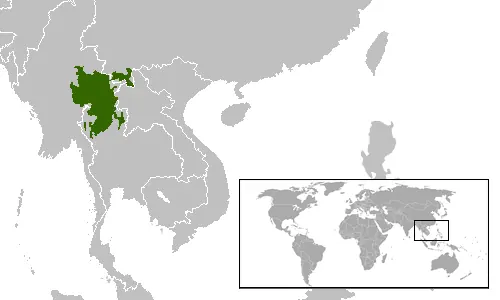
Thailand is long and lean, stretched over 1,600 kilometres from the misty mountains of the north to the limestone islands of the Andaman Sea, and a one-week trip only works if you let the aeroplanes do the heavy lifting. Fly the spine of the country — Bangkok to Chiang Mai to the southern coast — and you trade long overnight buses for three short hops, waking up each morning somewhere entirely different.
Why Flying Is the Only Way to See Three Thailands in Seven Days
A week is a genuinely tight window in Thailand, and the country's domestic network is what makes an ambitious route realistic. Bangkok's two airports — Suvarnabhumi for most international arrivals and full-service domestic departures, Don Mueang largely for the low-cost carriers — feed a web of hops that take roughly an hour and fifteen minutes to Chiang Mai in the north, and about the same from Chiang Mai down to Krabi or Phuket in the south. Without flying, that same triangle swallows two nights in overnight trains and buses. With flying, it costs you three half-mornings of airport time and leaves you five full days of actual travel.
The trade-off is that you should build your week around two bases rather than four. The classic shape is Bangkok for two nights, Chiang Mai for two, then a flight south to Krabi or Phuket for the final stretch — a clean north-south line that never doubles back. Resist the urge to add Chiang Rai, Koh Samui and Ayutthaya as well; every extra flight adds an airport transfer, a check-in queue and a wasted afternoon. On domestic routes, budget carriers typically allow around 20 kilograms of checked baggage, so pack light and expect to pay extra for anything heavier.
Timing matters more than almost anything else. November to February brings cool, dry, breezy weather across most of the country — the single best window for this itinerary, and also the busiest and priciest. March and April turn the north hot and hazy during the agricultural burning season, which can blunt the mountain views around Chiang Mai. May to October is the green season: lush landscapes, lower rates, dramatic afternoon downpours, and rougher Andaman seas that close the Similan Islands from around mid-May to mid-October and shut Maya Bay for part of the monsoon.

Days 1–2: Bangkok's Grand Palace, Wat Pho and the Chao Phraya River
Start in the historic heart of the capital, on the island of Rattanakosin, where the density of must-see monuments is almost absurd. The Grand Palace and the Temple of the Emerald Buddha (Wat Phra Kaew) open around 8:30 in the morning, and arriving at the gate early is the difference between gliding through gilded halls and shuffling shoulder-to-shoulder in 35-degree heat. Dress respectfully — shoulders and knees covered for everyone, and no sarongs-as-shorts improvisation — then walk ten minutes south to Wat Pho, home to the enormous reclining Buddha and the country's most famous massage school, where you can book a traditional rub-down in the shaded courtyard.
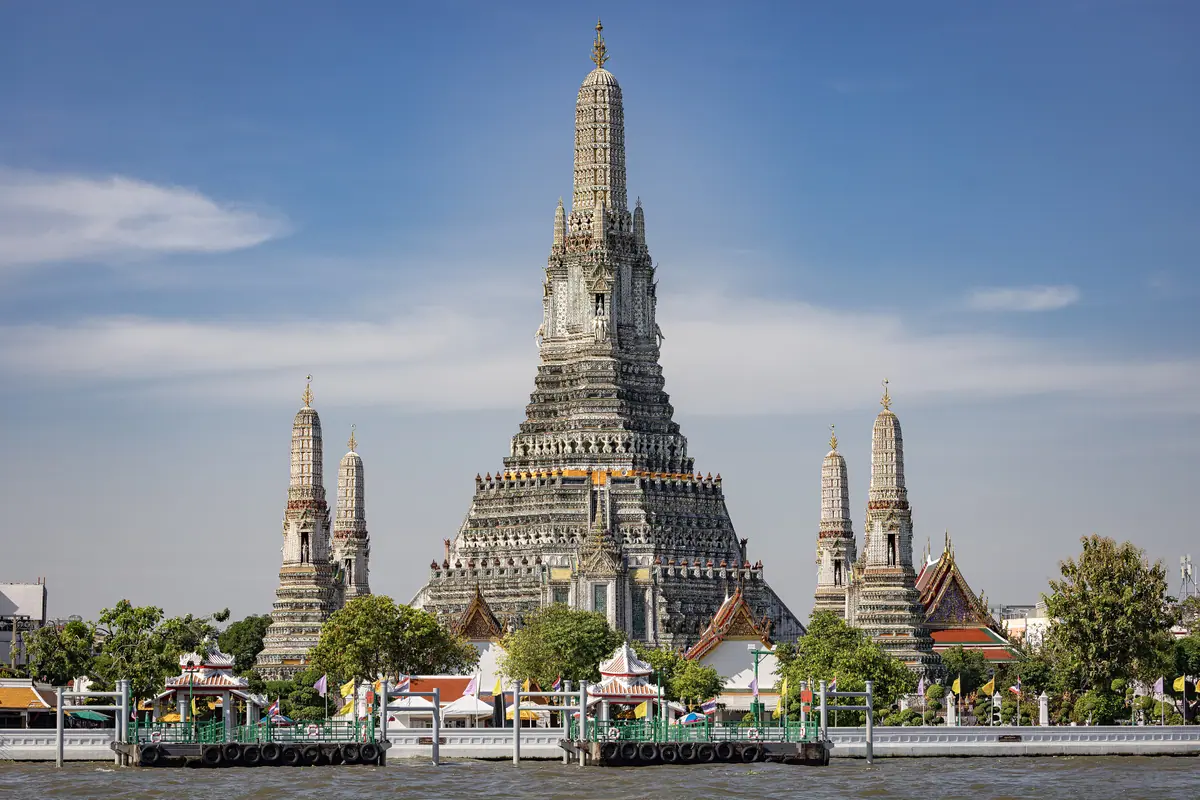
Cross the Chao Phraya by the cheap public ferry to Wat Arun, the Temple of Dawn, whose porcelain-encrusted spire is best climbed in the late afternoon when the light softens and the river turns gold. From there, a riverboat ride is the most pleasant transport in Bangkok: hop on and off at Tha Chang, Tha Tien and the flower market at Pak Khlong Talat, where jasmine garlands sell by the armful. If your visit lands on a weekend, save a few hours for Chatuchak Weekend Market, a labyrinth of thousands of stalls that is one of the world's great market experiences — go early, go with a plan, and know that leaving is harder than arriving.
Food is the other essential Bangkok attraction. Street stalls around Yaowarat in Chinatown fire up after dark for grilled seafood and charred noodles, while the area around the Old Town serves up everything from boat noodles to mango sticky rice. For something quieter, the Jim Thompson House, a cluster of traditional teak buildings filled with Southeast Asian art, offers a cool, green counterpoint to the temple circuit, and the surrounding lanes hide excellent coffee. Two nights is enough for the greatest hits if you start early and use the river instead of the roads, which can seize up completely between 4pm and 7pm.
Day 3: Fly North to Chiang Mai, Doi Suthep and the Old City
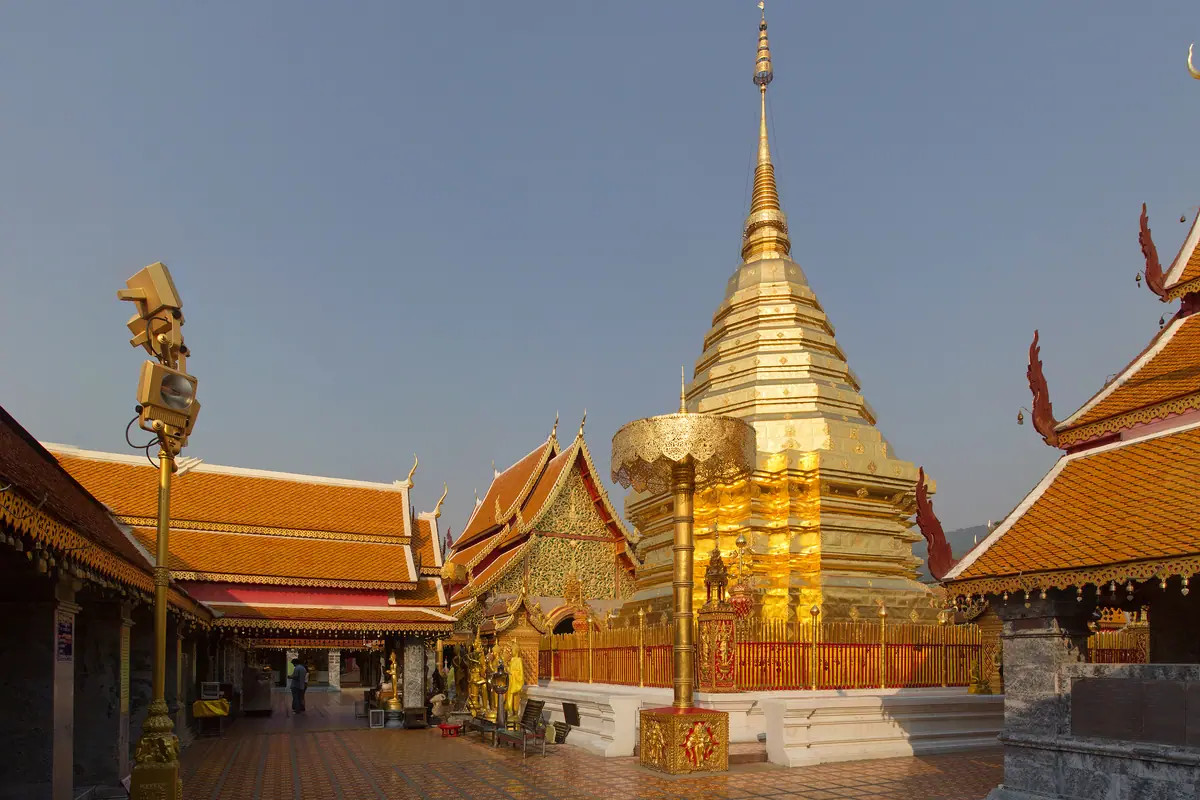
Take a morning flight from Bangkok to Chiang Mai — barely over an hour in the air — and you land in a completely different country: cooler air, forested hills, and a walled old city ringed by a moat. Drop your bags and head straight up the mountain to Wat Phra That Doi Suthep, the golden temple that watches over the city from roughly 1,000 metres up a winding road. Climb the 306-step naga staircase, and time your visit for late afternoon so the gilded chedi catches the sun and the whole Ping Valley spreads out below in a blue haze.
Back down in the Old City, wander between Wat Chedi Luang, with its colossal ruined brick stupa, and Wat Phra Singh, whose Lanna-style halls are among the finest in the north. The old city gates — especially Tha Phae Gate — are the natural meeting point for evenings, with the Sunday Walking Street market stretching down Ratchadamnoen Road, filling temple courtyards with crafts, curries and folk music. The night bazaar along Chang Klan Road runs every evening, and the riverside lanes and the Nimmanhaemin district handle the city's excellent northern Thai restaurants, where khao soi and sai ua sausage should be your first orders.
Chiang Mai rewards an unhurried pace, but it is also the launch pad for the region's big-ticket days out. If you can stretch your stay to two nights, consider a day trip north to the White Temple at Chiang Rai, an unearthly white-and-mirror complex about three hours away by road, or a morning at an ethical elephant sanctuary in the Mae Sa Valley, where observation-only visits replace the old riding model. Book those in advance during the December-to-February high season, when the good ones fill up days ahead.
Day 4: Doi Inthanon, Waterfalls and the Highest Point in Thailand
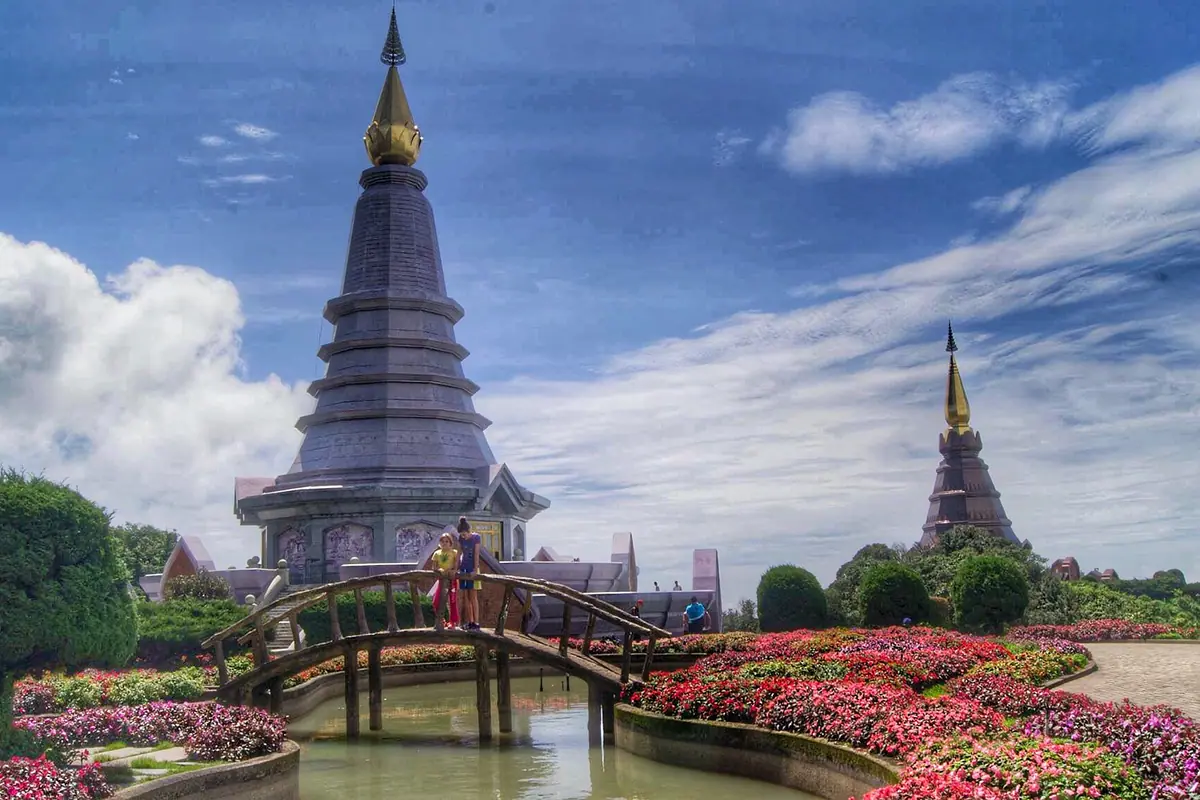
Use your second full northern day for the mountains. Doi Inthanon, the country's highest peak at 2,565 metres, sits about two hours southwest of the city and delivers a climate you would not expect in Thailand — bring a light jacket, because mornings here can dip close to freezing in the cool season. Near the summit, the twin royal pagodas of the King and Queen stand in a cloud forest of lichen-draped trees, and the boardwalk through the bog at Ang Ka Luang is a genuinely strange, beautiful little ecosystem of orchids and moss.
The drive up is half the pleasure: the Wachirathan and Siriphum waterfalls are thundering in the rainy months and graceful in the dry, and the surrounding slopes are dotted with Hmong and Karen villages, coffee farms and roadside stalls selling strawberries and grilled corn. Many travellers do this as a guided day tour with a driver, which makes sense given the winding roads and the language barrier at the park gates. Alternatively, trade the mountain for a half-day of Thai cooking, a morning of temple-hopping by bicycle, or a session at one of the city's respected massage training schools.
One caution for the northern leg: from roughly February into April, smoke from agricultural burning can build in the valleys and reduce the famous views, and air quality can be poor for days at a time. If clear mountain scenery is a priority, aim for November, December or January — and consider reversing the itinerary if you are travelling in the shoulder months, spending your days in the south and keeping the north to a shorter visit.
Days 5–6: Fly South to Krabi, Railay Beach and the Phi Phi Islands
From Chiang Mai, a direct flight of around two hours drops you into Krabi, the gateway to the Andaman's most photogenic coastline. Base yourself in Ao Nang or, better, on Railay Beach, a peninsula cut off from the mainland by limestone cliffs and reachable only by longtail boat — the arrival alone, motoring past vertical walls of rock and hanging jungle, justifies the extra effort. Above the beach, the Phra Nang Cave and the viewpoint trail give you the postcard panorama of Krabi's islands scattered across the bay.
Dedicate one full day to the water. The Phi Phi Islands, including the famous Maya Bay, are typically reached on a speedboat or longtail day trip, with snorkelling stops in clear shallows and a stop at Phi Phi Don's viewpoint if the schedule allows. Boat capacity at Maya Bay is tightly controlled these days, and the bay closes to visitors for part of the monsoon, so check the season before committing. Phang Nga Bay, with its sea caves, kayak tunnels, floating villages and the karst islet known as James Bond Island, is the other great day out and works better in mixed weather than the open-sea crossings.
If you would rather stay on solid ground, Krabi's interior delivers. Wat Tham Suea, the Tiger Cave Temple, is reached by a punishing but memorable climb of 1,260 steps to a golden summit with a 360-degree view. Inland, the Emerald Pool and the Krabi Hot Springs sit in the middle of a protected forest and make an easy half-day circuit. Note that afternoon monsoon showers from May to October are usually short and spectacular rather than trip-ruining, but the sea can be genuinely rough — pick your boat operator carefully and never board a vessel that looks overloaded.
Day 7: The Flight Home — Connections, Transfers and Last-Minute Wisdom
Most travellers fly back to Bangkok before the long-haul leg home, and the one thing that ruins a good week is a stingy connection. If your international departure is from Suvarnabhumi but your domestic flight arrives at Don Mueang, allow at least four hours between them: the two airports sit on opposite sides of the city, and the transfer by taxi on the tollway takes anywhere from 45 minutes to well over an hour in traffic. It is far calmer to fly into the same airport you leave from, even if it costs a little more.
Use the last day deliberately rather than treating it as dead time. A late-afternoon departure leaves room for a final temple, a long breakfast, and a proper Thai massage, while a red-eye flight home means you can spend the entire day at the beach and shower at the airport. If your final day happens to be a Saturday or Sunday, Chatuchak Weekend Market makes a satisfying last stop, and the riverside piers are a pleasant place to watch the city go by before you head out. Keep a few hundred baht in cash for taxis and small meals, and pack your liquids and electronics for easy access, since security queues at Bangkok's airports can be long in the peak winter months.
Finally, book your domestic flights early if you are travelling around the New Year, Chinese New Year, Songkran in mid-April, or the December-to-February high season — the cheap seats on the popular Bangkok–Chiang Mai and Bangkok–Krabi routes vanish fast, and fares climb steeply in the final fortnight. Keep your itinerary to two bases, book one morning flight per transfer, and a week in Thailand will feel twice as long as the calendar suggests.
Frequently asked questions
How many internal flights do I need for a one-week Thailand itinerary?
Three is the sweet spot: Bangkok to Chiang Mai, Chiang Mai to Krabi or Phuket, and then a return to Bangkok for your international flight. Each hop takes roughly one to two hours in the air, so you lose about half a day per transfer once airport time is included. Fewer flights means more depth; more flights means more time in terminals.
What is the best time of year to do this route?
November to February is the strongest window, with cool, dry weather in the north and calm, clear seas in the Andaman. December and January are the busiest and most expensive. March and April bring heat and northern smoke haze, while May to October is the green season — cheaper and lush, with short heavy showers and rougher southern seas that close some islands.
Should I fly or take the overnight train from Bangkok to Chiang Mai?
The flight takes about 75 minutes; the overnight train takes roughly 12 to 13 hours. The train is romantic and saves a night's accommodation, but in a seven-day trip it costs you a full day of sightseeing. Fly north and spend your nights in Chiang Mai rather than in a sleeper carriage.
How long should I allow between Bangkok's two airports?
Plan on at least four hours if you are connecting between Suvarnabhumi and Don Mueang. The drive across the city on the tollway takes 45 minutes in light traffic and can stretch past 90 minutes in the evening rush. Whenever possible, book domestic and international flights through the same airport.
Is one week enough to see both the north and the beaches?
Yes, if you keep it to two bases and accept that you will only skim the surface. Two nights in Bangkok, two in Chiang Mai and two or three on the Andaman coast is a realistic rhythm. Trying to add a third region, such as Chiang Rai or Koh Samui, usually means spending your holiday in transit rather than in Thailand.
Sort the rest of your trip
Everything for Thailand, in one place
Stay in Thailand
Hotels, guesthouses and apartments — compared in one search.
Search hotels
Transfer in Thailand
Private driver waiting on arrival — no queues, no surprises.
Book a transfer
Travel insurance
Medical cover, delays and lost baggage — sorted before you go.
Get coveredMore guides in Thailand
Thailand Food and Culture Guide: Temples, Street Kitchens and Local Life
Best Places to Visit in Thailand: Temples, Islands and Ancient Capitals
Top Things to Do in Thailand: Must-See Landmarks, Temples and Islands