Switzerland is small enough to cross in a day yet tall enough to make you feel weightless — and the quickest way to understand that is to fly in, then keep looking down from cable cars, cogwheel trains and a paraglider. This week-long route starts at Zurich, ends at Geneva, and threads the Alps between them without ever wasting a morning on backtracking.
Day 1: Touch Down in Zurich and Meet the Alps from Uetliberg
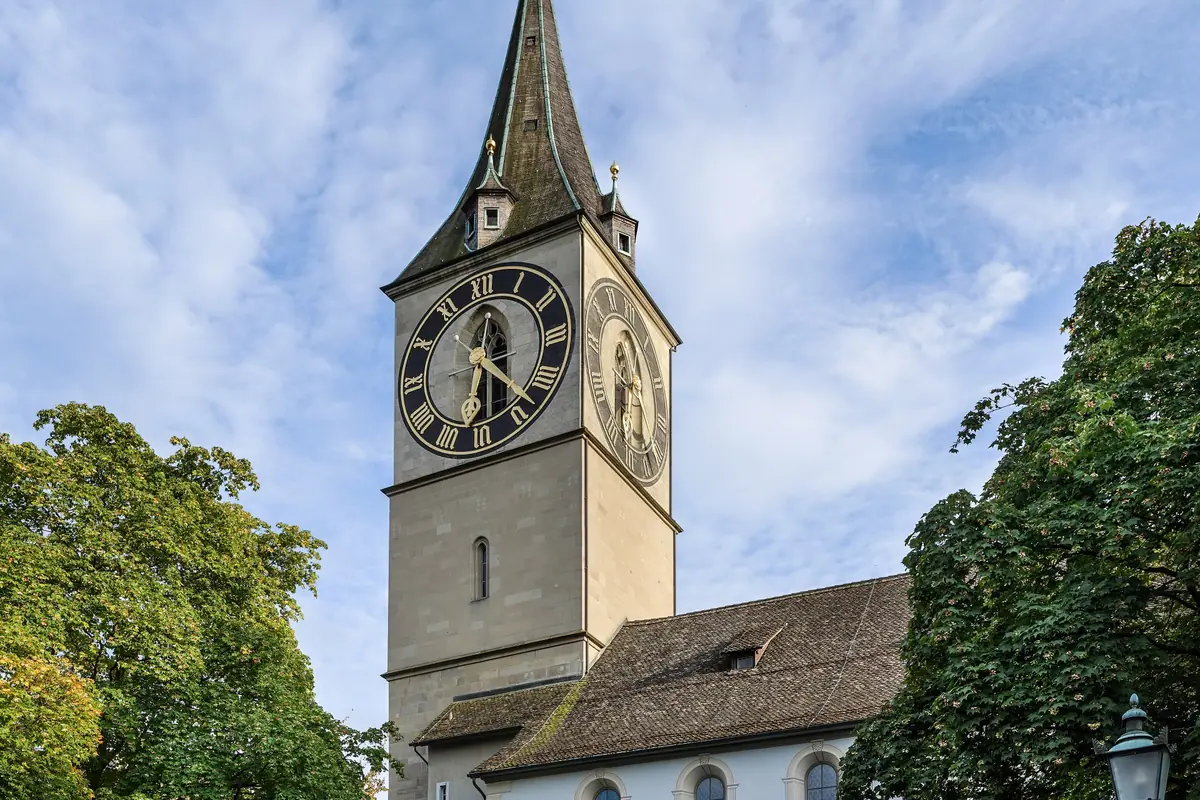
Most long-haul and European flights land at Zurich, and the payoff is that the airport sits barely ten minutes by train from the central station. Drop your bags, then walk the old town: the twin Romanesque towers of the Grossmünster, the stained-glass windows of the Fraumünster, and the shady terrace of the Lindenhof, where Romans once kept a customs post and locals now play chess above the river. Down on the Limmat, swimmers drift past medieval facades in summer, which tells you most of what you need to know about this city's relationship with cold water.
Book your arrival deliberately: fly into Zurich and out of Geneva (an open-jaw ticket) so the week runs in one direction. Internal hops exist — Zurich to Geneva takes about an hour in the air — but the train does the same trip city-centre to city-centre in roughly two hours forty, and you get lunch and lake views instead of a security queue.
Spend the late afternoon riding the little railway up the Uetliberg, the 871-metre hill on Zurich's shoulder. The 25-minute climb ends at a lookout over the city, the lake and, on clear days, a serrated line of snow that includes the Eiger and the Jungfrau. It's the perfect orientation: you see the whole week ahead of you at once.
Days 2–3: Lucerne, Mount Pilatus and a Lake That Looks Painted
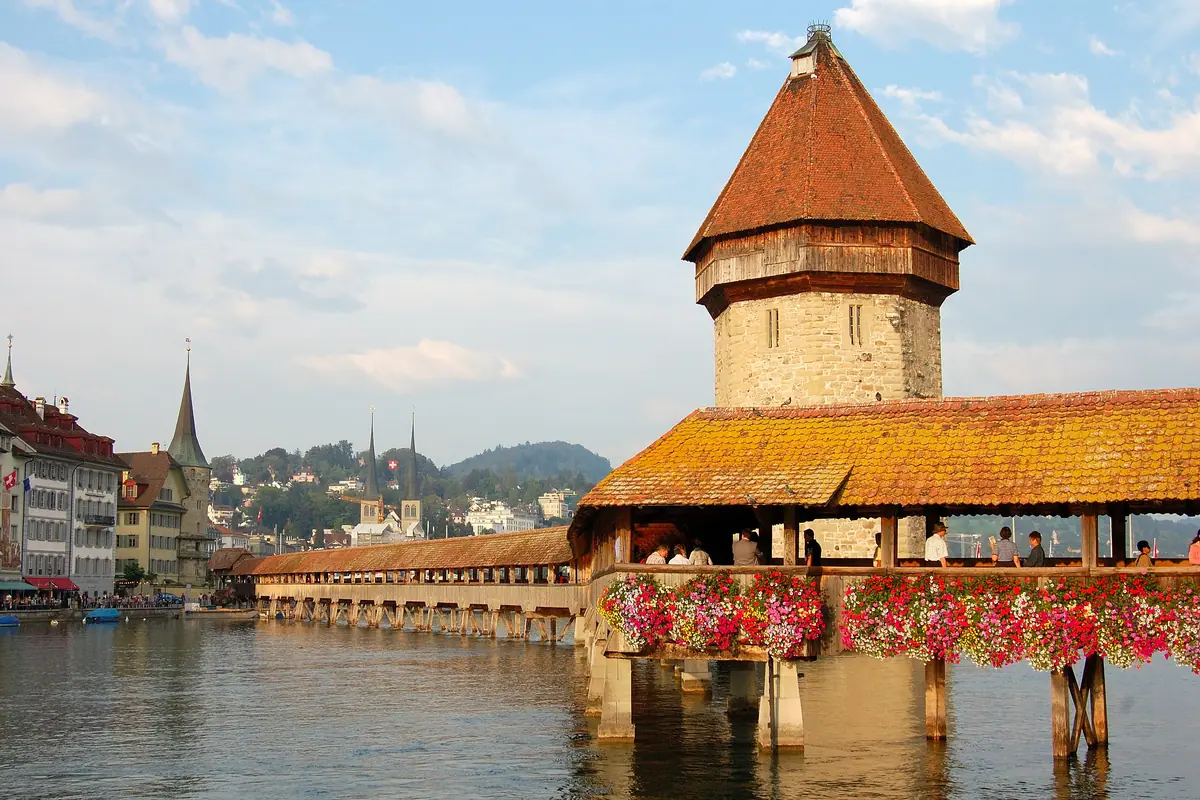
An hour south by rail, Lucerne packs its postcard into a few hundred metres: the Kapellbrücke, one of Europe's oldest covered wooden bridges, with its painted roof panels, the octagonal Water Tower rising from the river beside it, and the weeping Lion Monument carved into a sandstone cliff to honour Swiss guards who died in Paris in 1792. Walk the medieval ramparts of the Museggmauer for rooftop views, then take a lake steamer out towards the mountains — the boats are part of the public transport network here, which is a very Swiss kind of generosity.
From Alpnachstad, a cogwheel railway hauls you up Mount Pilatus at a gradient that reaches 48 percent, the steepest in the world. The summit ridge at over 2,100 metres looks across Lake Lucerne to the Rigi and the Titlis, and if you time it right you'll be above a sea of cloud while the valleys stay grey below. Come back down the other side by gondola via Fräkmüntegg, where a summer toboggan run and a rope park keep the descent from feeling like an anticlimax.
The cogwheel line runs roughly May to November; outside those months the cableways still operate from Kriens, and the summit becomes a snowshoe and sledding destination. If you have a spare half-day, the Rigi offers gentler, broader views and a steam-era charm, while the Titlis adds a rotating cable car and a cliff walk suspended at nearly 3,000 metres.
Day 4: Into the Bernese Oberland — Lauterbrunnen and the Jungfraujoch
Ride south over the Brünig Pass to Interlaken, a town squeezed onto the narrow neck of land between Lake Thun and Lake Brienz — blue on both sides, which is exactly what the name promises. Fifteen minutes further up the valley is Lauterbrunnen, a glacial trench whose walls are strung with waterfalls, including the near-300-metre Staubbach Falls that thins into mist before it lands. Base yourself here or in car-free Wengen or Mürren, where the only traffic is the occasional electric taxi and the sound of cowbells.
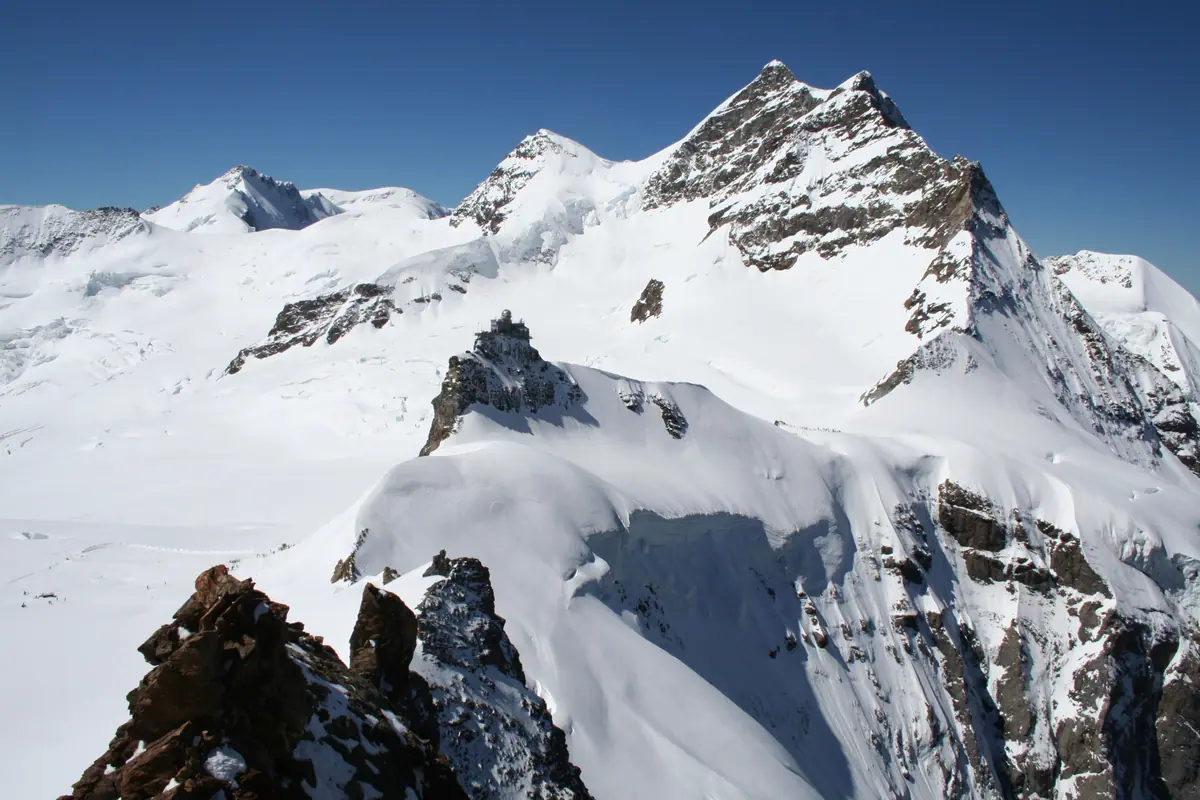
The headline excursion is the Jungfraujoch, at 3,454 metres the highest railway station in Europe and nicknamed the Top of Europe. From Kleine Scheidegg the train burrows through the Eiger for seven kilometres, pausing at picture windows cut into the rock face, before emerging at a saddle between the Mönch and the Jungfrau. Up top: the Sphinx observatory, an Ice Palace tunneled into the glacier, and a terrace staring straight at the Aletsch Glacier, the longest ice stream in the Alps.
It is expensive and it is crowded, so go early, buy a timed ticket in peak season, and check the summit webcam before committing — cloud can swallow the whole thing. On the way down, stop at Kleine Scheidegg for an easy traverse beneath the north face of the Eiger. Across the valley, the Schilthorn's revolving summit restaurant at 2,970 metres offers a cheaper, quieter panorama and a Bond-film pedigree.
Day 5: A Morning in the Air, Then Bern's Clock Tower and Old Town
This is the day to actually fly. Tandem paragliding flights launch from the meadows above Interlaken and Beatenberg, and a 15-to-20-minute descent over Lake Thun, with the Jungfrau on your shoulder, is the single most memorable half-hour of most people's Swiss week. Conditions are best from late morning to early afternoon, when thermals are working but the wind is still kind; flights run roughly April through October, weather permitting.
If you'd rather have an engine, helicopter sightseeing lifts off from the Bernese Oberland and from Bern-Belp for circuits over the Eiger, Mönch and Jungfrau, or down the deep-cut valleys of the Oberland. Book a window seat on the right for the Eiger and left for the Jungfrau massif — and expect the pilot to bank politely so both sides get their photographs. Flights are short, typically 20 to 45 minutes, and grounded in strong wind or low cloud.
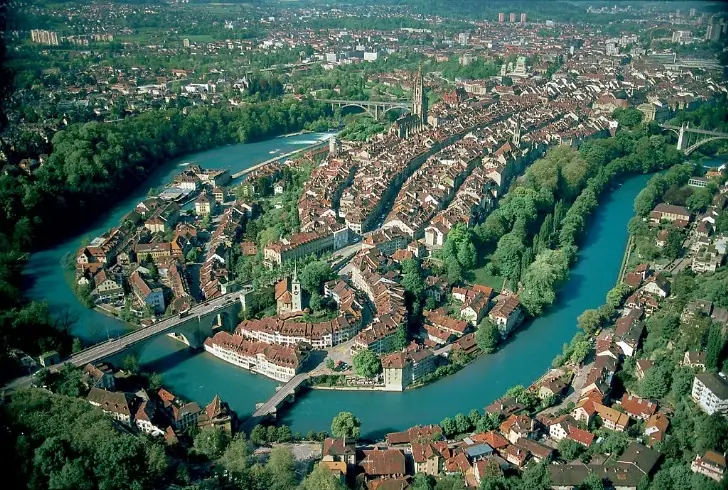
Bank the afternoon in Bern, the federal capital and a UNESCO-listed old town of arcaded sandstone. Stand beneath the Zytglogge, the medieval clock tower whose painted figures perform a mechanical dance a few minutes before every hour, climb the Münster's tower for the best rooftops in the city, and walk down to the BärenPark on the river bend where the city's heraldic bears live. The Rosengarten above the Aare gives you the classic sunset shot of the whole peninsula.
Day 6: Zermatt, the Gornergrat Railway and the Matterhorn
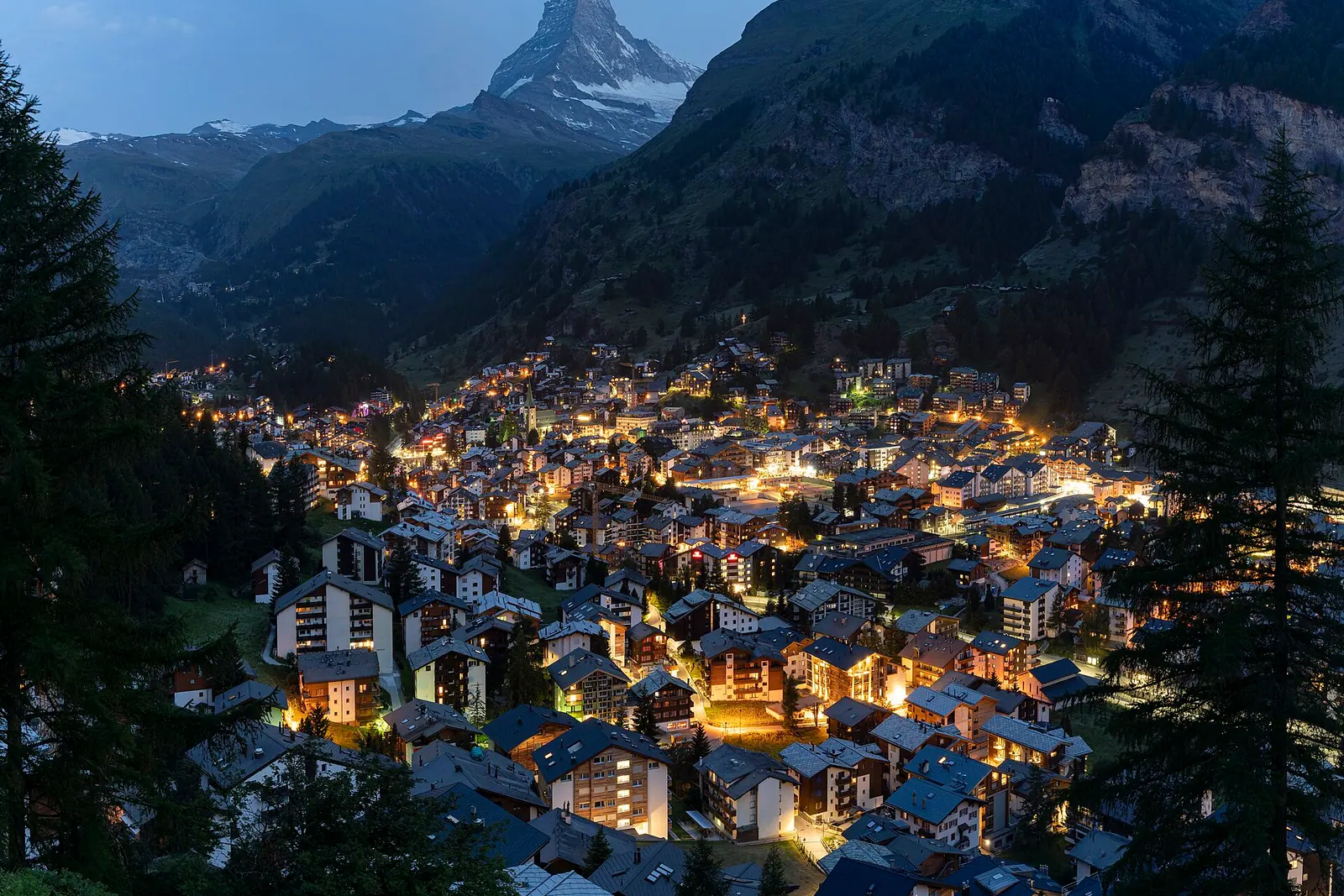
Head south through the Lötschberg corridor to Zermatt, a car-free village of timber chalets at 1,620 metres where electric carts and horse-drawn sleighs do the work of taxis. The Matterhorn appears on the approach and never quite leaves your field of view again — 4,478 metres of near-symmetrical rock, unmistakable even in silhouette.
Ride the Gornergrat railway, Europe's highest open-air cogwheel line, up to 3,089 metres for the definitive view: the Matterhorn dead ahead, the Monte Rosa massif to the left, and the Gorner Glacier pouring away below. Alternatively, the cable car to the Matterhorn Glacier Paradise tops out at 3,883 metres, the highest cable-car station in Europe, with a glacier palace carved into the ice and year-round skiing. Neither is cheap; both are worth one clear morning.
Walkers should take the easy Five Lakes trail from Trockener Steg, where five small tarns each hold a perfect reflection of the peak, or the gentler path from Riffelberg down to Riffelalp. If you want the panorama without the altitude, the eight-hour scenic rail journey linking Zermatt with St. Moritz crosses the Oberalp Pass and is one of the great train rides anywhere — a rest day that still delivers the Alps.
Day 7: Geneva, the Jet d'Eau and the Flight Home
The final leg runs down the Rhône valley to Geneva in under four hours, dropping from glacier country to vineyards and lakeside suburbs in a single morning. Leave your bags at the station, then walk the old town: the cobbled lanes around St. Pierre Cathedral, the terraces of the Bourg-de-Four square, and the long Reformation Wall with its four-metre statues in the park below.
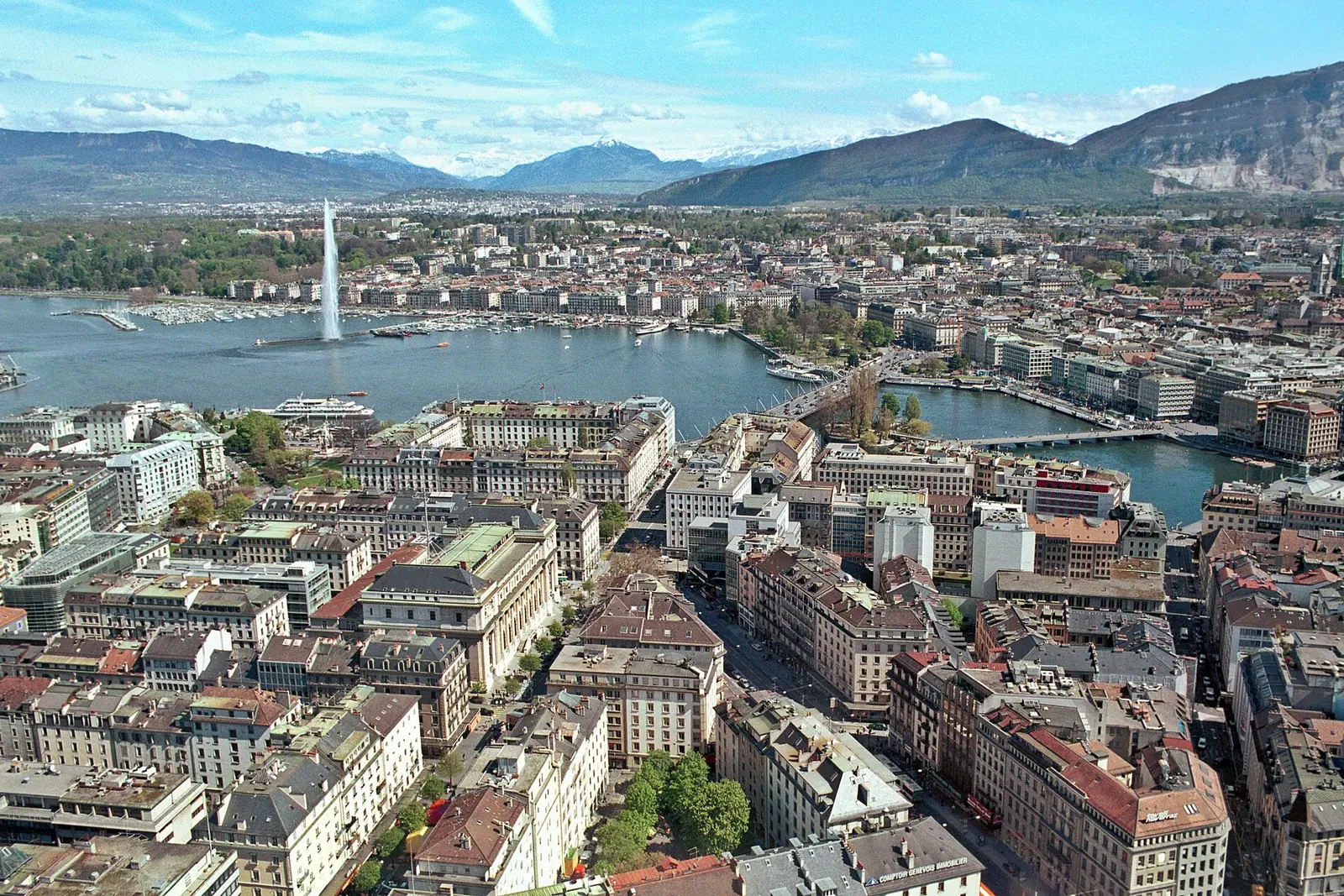
Finish on the lakefront, where the Jet d'Eau fires 500 litres of water a second some 140 metres into the air — visible from the air on your approach and, on a windy day, a fine way to get an unplanned shower. In summer you can swim from the Bains des Pâquis or take a short cruise towards the French shore and back; in winter the same promenade is a brisk, beautiful walk with Mont Blanc usually showing at the far end of the water.
Geneva airport is barely ten minutes from the centre and handles the widest range of long-haul departures in the country, which is why this route ends here rather than doubling back. Arrive two hours ahead in summer, allow for the fact that the airport straddles the French border, and take one last look north at the Alps from the departure lounge.
Frequently asked questions
Should I fly between Swiss cities or take the train?
Take the train. No journey in this itinerary is longer than four hours by rail, and trains run station-to-station in the centre of town, so Zurich to Geneva is faster door-to-door by rail than by air once you add transfers and security. Domestic flying makes sense mainly for reaching a connecting hub on your way home — save your airborne budget for paragliding or a helicopter circuit over the Alps, which gives you views no scheduled flight can.
What is the best time of year for this one-week itinerary?
Late June to mid-September is the safest all-round window: every cable car and cogwheel line is running, the high trails are clear of snow, and the lakes are warm enough to swim. Late September and early October bring golden larches, thinner crowds and crisp air, though the odd early snowfall can close high paths. December to March is for skiers and snowshoeing. November is the awkward month — many mountain lifts close for maintenance and resort villages go quiet.
Do I need to book the Jungfraujoch and Gornergrat in advance?
In July and August, yes — buy a timed ticket for a morning slot, ideally the first or second departure, before the groups arrive and before afternoon cloud builds. In shoulder season you can usually decide the day before, once you can read the forecast. Either way, check the summit webcams on the morning itself; a clear valley can sit beneath a fogged-in peak, and there is no refund for weather.
How should I handle the altitude at the Jungfraujoch?
At 3,454 metres the air holds roughly two-thirds of the oxygen you are used to at sea level. Ascend in stages if you can — a night at Kleine Scheidegg or Wengen helps — move slowly once you are up, drink plenty of water, skip alcohol and heavy meals, and limit yourself to two or three hours at the top. Headache, breathlessness and queasiness are the usual warning signs; if they build, ride back down, which solves the problem quickly.
Can I do this week without renting a car?
Easily — and you should. Postbuses reach almost every valley, cable cars and funiculars are treated as part of the public network, and the key mountain villages such as Wengen, Mürren and Zermatt are car-free by law. A national rail pass covering trains, boats, city transport and many mountain lifts usually pays for itself within a few days. Regional passes or half-fare cards are worth comparing if you are only covering part of the route.
Plan it — flights in Switzerland
Live search, booked directly with trusted providers.
Sort the rest of your trip
Everything for Switzerland, in one place
Stay in Switzerland
Hotels, guesthouses and apartments — compared in one search.
Search hotels
Transfer in Switzerland
Private driver waiting on arrival — no queues, no surprises.
Book a transfer
Travel insurance
Medical cover, delays and lost baggage — sorted before you go.
Get coveredMore guides in Switzerland
Best Time to Visit Switzerland: A Season-by-Season Hotel Guide
Best Places to Visit in Switzerland: Alpine Adventures and Iconic Landmarks
Switzerland Tour Guide: Food, Culture and Local Experiences
Best Time to Visit Geneva: A Season-by-Season Guide to Weather, Events and Hotel Rooms