Jordan packs an entire ancient world into a country you can cross in a day: Roman colonnades, a rose-red city carved into sandstone, desert camps under impossible stars and a salt lake so dense you cannot sink. Where you sleep shapes how much of it you actually see, so choose your bases as carefully as you choose your sights.
Amman: The Capital Base Most Trips Begin With
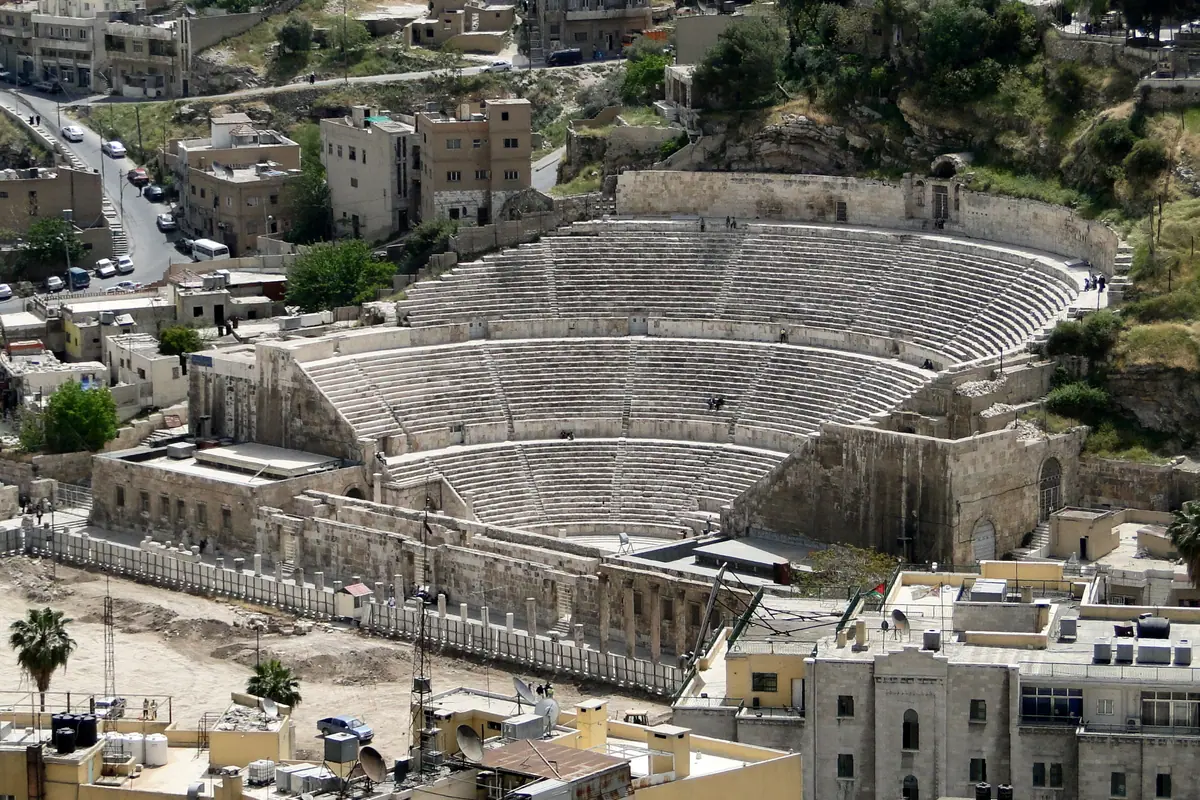
Amman is a city of hills and layers, and almost every Jordan itinerary starts here. Downtown, known locally as Al-Balad, is the historic core: the Roman Theatre still holds crowds on summer evenings, and a short climb brings you to the Citadel on Jabal al-Qal'a, where the Temple of Hercules columns and the Umayyad Palace stand over the city. Rainbow Street in Jabal Amman, with its restored stone houses and cafés, and the gallery-lined lanes of Jabal Al-Weibdeh are where boutique guesthouses cluster, while the newer districts of Abdoun and Sweifieh suit travellers who want larger, quieter international-style hotels with parking and pools.
For a first visit, staying two or three nights downtown or in Jabal Amman beats an airport-area hotel every time: you can walk to the Jordan Museum, the Grand Husseini Mosque and the gold souk, and eat your way through knafeh and falafel stands after dark. Day trips radiate outward easily — Jerash is under an hour north, Madaba and Mount Nebo around 45 minutes west, and the Dead Sea roughly an hour from the western edge of the city.
Expect a wide range: simple budget rooms with shared bathrooms downtown, mid-range business hotels with reliable Wi-Fi in Shmeisani, and design-conscious guesthouses in the older neighbourhoods. The airport sits around 35–45 minutes south of the centre depending on traffic, so build that into arrival plans rather than booking a room beside the terminal.
Petra and Wadi Musa: Sleeping Beside the Rose-Red City
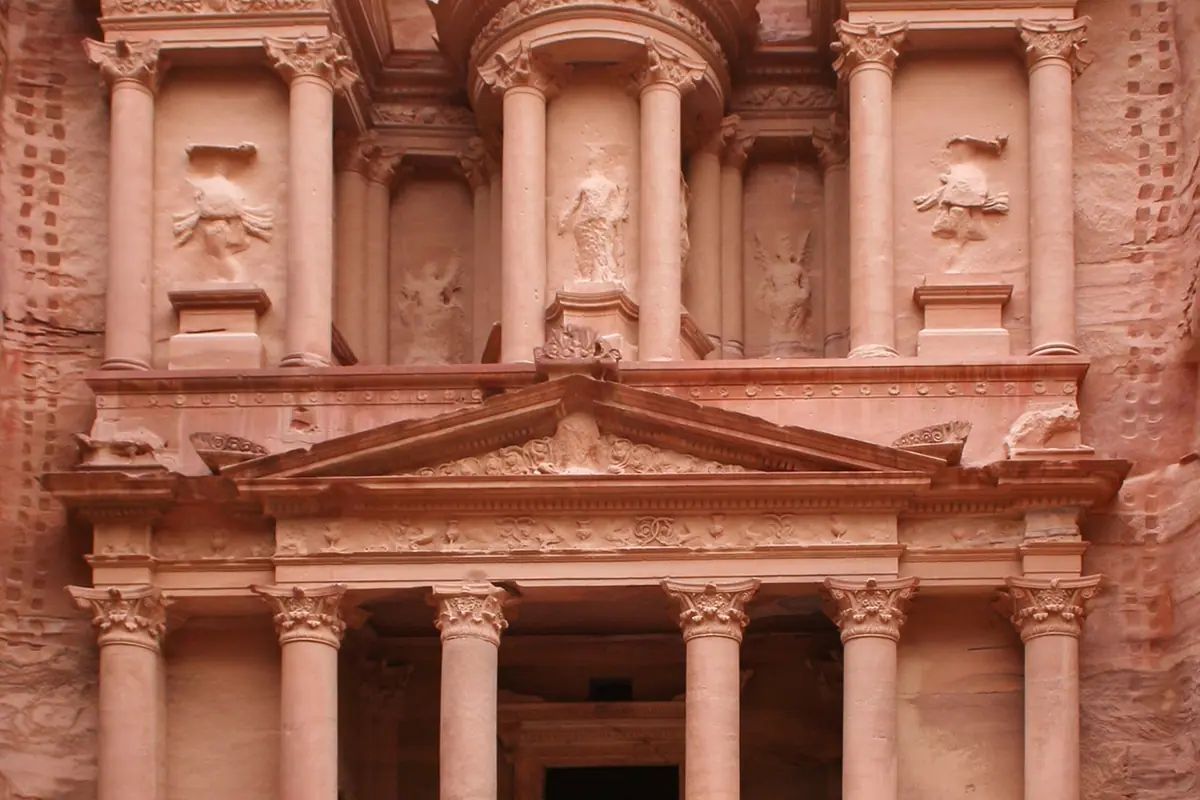
Petra is the reason many people come to Jordan, and there is no town inside the archaeological park — everyone stays in Wadi Musa, the gateway village that tumbles down the hillside above the visitor centre. The classic walk begins at the Siq, a chasm barely a few metres wide that opens onto Al-Khazneh, the Treasury, its facade glowing pink in early light. Beyond it lie the Street of Facades, the Royal Tombs, the High Place of Sacrifice and the long climb of roughly 800 steps to Ad-Deir, the Monastery, which rewards the effort with a scale that dwarfs the Treasury itself.
Give Petra two days if you possibly can. One day is a rushed march; two lets you see the Monastery, walk to the Urn Tomb for sunset and return for Petra by Night, when the Siq and Treasury plaza are lit by hundreds of candles — a genuinely different experience from daylight. Accommodation ranges from backpacker hostels five minutes from the gate to cave-style boutique hotels carved into the rock face in neighbouring Little Petra, with most mid-range options strung along the main road into Wadi Musa.
Staying within walking distance of the entrance is worth the small premium: gates open around 6am, and arriving at that hour means you reach the Treasury before the tour groups. Carry more water than you think you need, wear shoes with grip for the carved staircases, and remember that the national tourist pass covers a day's entry to Petra and the other major sites, which simplifies everything.
Aqaba: Red Sea Resorts and Winter Sun
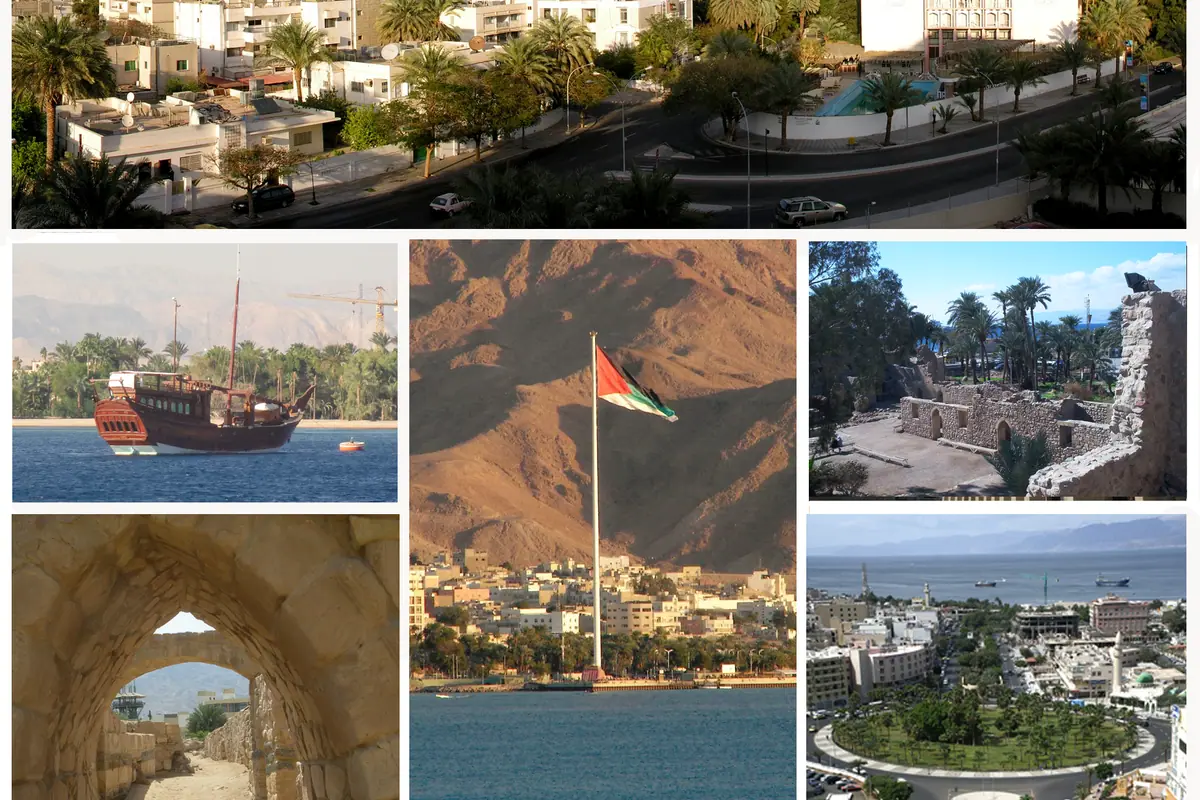
Aqaba is Jordan's seaside escape, a relaxed port city at the top of the Red Sea where the mountains of four countries meet the water. The compact centre holds the Mamluk-era Aqaba Fort and the archaeological museum, the waterfront promenade, and one of the tallest flagpoles in the world, while the resort strip stretches south along the coast towards Tala Bay with private beaches and dive-friendly jetties. The Ayla Oasis marina district has turned a stretch of lagoon into a walkable area of cafés and low-rise hotels.
This is the country's diving and snorkelling hub. The Aqaba Marine Park protects some of the healthiest coral in the northern Red Sea, with sites like the Japanese Garden's coral pinnacles and the Cedar Pride, a deliberately sunk freighter now covered in soft corals. Dive centres line the beach road, and even non-divers can snorkel from the shore in clear, bath-warm water. Winter is the secret: while Amman shivers and Petra freezes at dawn, Aqaba serves reliable sun from November through March.
Choose a downtown hotel if you want markets, cheap seafood and easy taxis; choose the southern beach resorts if you want a pool, a private shoreline and nothing else to do. Wadi Rum is about an hour's drive north and Petra around two hours, which makes Aqaba a sensible final stop — fly out from its airport or drive back to Amman on the Desert Highway.
The Dead Sea and Wadi Rum: Two Kinds of Desert
The Dead Sea is the lowest point on the surface of the Earth, roughly 430 metres below sea level, and the resorts along its eastern shore exist for one strange pleasure: floating. The water is so saline that swimming is impossible and sinking is not, and the mineral mud is smeared on limbs with ritual enthusiasm. Sunrise and sunset over the hazy Judaean hills are the best hours; the middle of the day is punishingly hot from June to August. Nearby, the Zara Ma'in hot springs tumble down a canyon, and the Wadi Mujib gorge trail, usually open from April to October, involves wading and scrambling through a slot canyon to a waterfall.
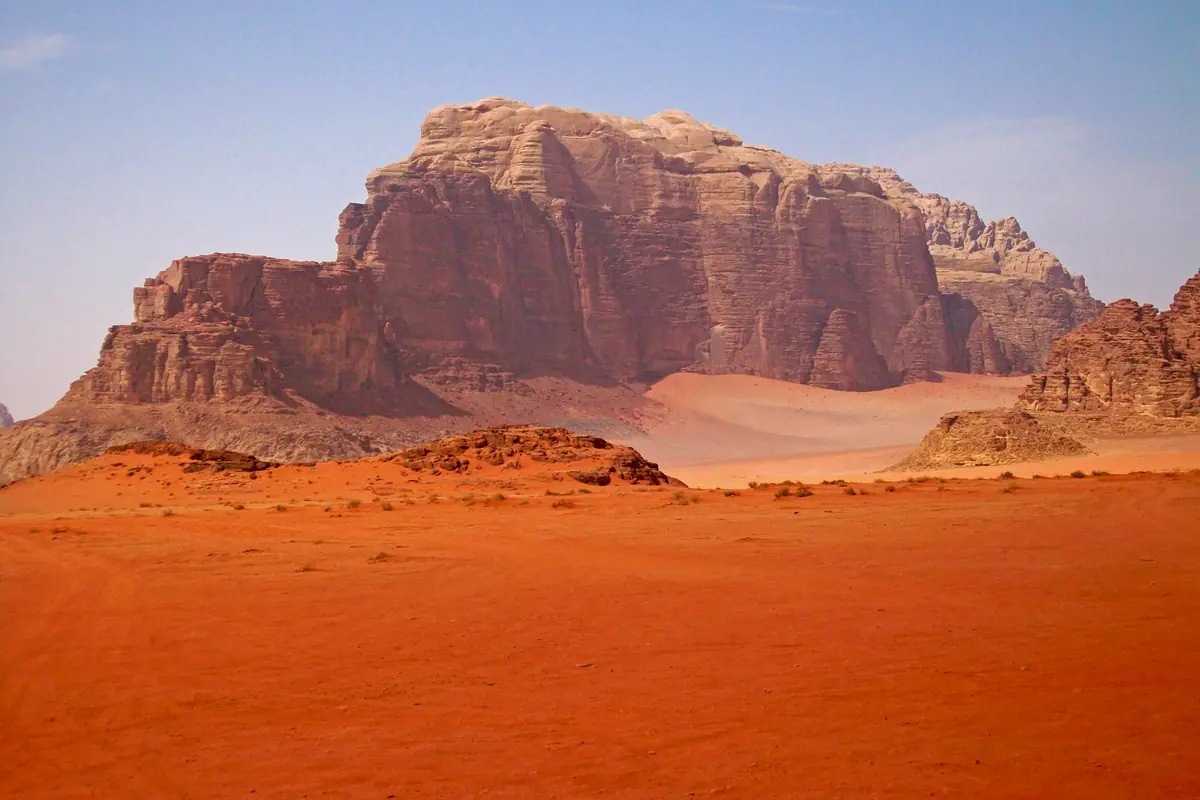
South of the Dead Sea, Wadi Rum is a protected desert of sandstone massifs and sand valleys so otherworldly that it has stood in for Mars on screen. Highlights include Lawrence's Spring, the Nabataean inscriptions and narrow passage of Khazali Canyon, the Burdah Rock Bridge, and Jebel Umm ad Dami, Jordan's highest peak. Almost everyone stays overnight in a desert camp — from simple Bedouin goat-hair tents with shared bathrooms to bubble domes with panoramic windows — and the stargazing is the real attraction.
Camps fill fast in spring and autumn, so book well ahead and confirm whether transport from the visitor centre is included, since you cannot drive yourself into the protected area. Nights are cold from November to March even when days are warm, so pack a fleece. Most travellers pair Wadi Rum with Petra, an hour and a half away, or with Aqaba.
Jerash, Madaba and the King's Highway: Historic Stopovers
North of Amman, Jerash is one of the best-preserved Roman provincial cities anywhere, and it deserves a night nearby rather than a hurried half-day. Walk through Hadrian's Arch to the vast Oval Plaza, follow the colonnaded Cardo Maximus, and climb to the Temple of Artemis and the hippodrome. Staying in Amman and day-tripping works, but a small hotel in Jerash or Ajloun lets you enter at opening time and combine it with Ajloun Castle, a 12th-century fortress on a wooded hill, and Umm Qais, where Gadara's basalt ruins look out over the Yarmouk valley.
West of Amman, Madaba is famous for the mosaic map of the Holy Land in St. George's Church and for the Church of the Apostles, and its guesthouses make a pleasant, low-key base. From there it is a short drive to Mount Nebo, the ridge from which Moses is said to have viewed the promised land, and to Bethany Beyond the Jordan, the baptism site on the river. Continuing south along the King's Highway brings you to Karak Castle and Shobak Castle, two Crusader strongholds, and to the Dana Biosphere Reserve, where an eco-lodge perches above a dramatic rift valley.
This route is the reason to hire a car or a driver rather than rely on the main highway: the King's Highway is slower, winding and far more beautiful, and it strings together the castles, canyons and mosaic towns that most rushed itineraries skip entirely.
When to Go and How to Book
Spring, from March to May, and autumn, from September to November, are the sweet spots: mild days, cold-but-tolerable nights in the desert, wildflowers in the north and comfortable walking in Petra. Summer pushes Petra and the Jordan Valley past 35°C, which means dawn starts and long afternoons by a pool. Winter brings rain and occasional snow to Amman and biting wind in Petra, but it is prime season on the Red Sea and pleasant at the Dead Sea. Ramadan shifts restaurant hours and can close some smaller cafés during the day, though hotels operate normally.
Book Petra and Wadi Rum accommodation first, especially for spring and autumn weekends, when Dead Sea and Aqaba resorts spike on Friday nights — midweek stays are cheaper and calmer. In Wadi Musa, rooms near the gate disappear early; in Wadi Rum, the popular camps are often full months ahead.
Budget for tipping, carry small notes, and dress modestly away from resort beaches. Distances are short on paper but the roads are slow: Amman to Petra is around three hours, Petra to Wadi Rum an hour and a half, Wadi Rum to Aqaba one hour. A seven- to eight-day trip covering Amman, Jerash, Petra, Wadi Rum and either the Dead Sea or Aqaba is the classic shape — and choosing your hotels well is what makes it feel unhurried.
Frequently asked questions
Where should I stay in Jordan for a first visit?
Base yourself in Amman for two or three nights to see the Citadel, Roman Theatre and Jordan Museum, then move south: two nights in Wadi Musa for Petra, one or two nights in a Wadi Rum desert camp, and finish at the Dead Sea or Aqaba. Staying in one city and day-tripping to Petra is exhausting and misses Petra by Night.
How many days do you need in Jordan?
Seven to eight days covers Amman, Jerash, Madaba, Petra, Wadi Rum and either the Dead Sea or Aqaba without rushing. If you only have four or five days, cut the north and concentrate on Amman, Petra and Wadi Rum.
Is it better to stay in Petra or Wadi Musa?
They are the same destination — Petra is the archaeological park and Wadi Musa is the town at its entrance. Choose a hotel within walking distance of the visitor centre if you want to enter at the 6am opening, or further up the hill for quieter rooms and valley views.
Should I stay at the Dead Sea or in Aqaba?
The Dead Sea is for a single floating-and-mud experience, best in a resort with a private shoreline and ideally booked for a weeknight. Aqaba suits longer stays, with warm winter sun, coral reefs, dive centres and a walkable town centre.
Do I need to book Wadi Rum camps in advance?
Yes, particularly from March to May and September to November, when the best desert camps sell out weeks or months ahead. Confirm in advance whether your camp includes jeep transport from the visitor centre, since private vehicles are not allowed inside the protected area.
Sort the rest of your trip
Everything for Jordan, in one place
Transfer in Jordan
Private driver waiting on arrival — no queues, no surprises.
Book a transfer
Things to do in Jordan
Skip-the-line tickets, guided tours and standout experiences.
See experiences
Stay online in Jordan
Travel eSIM — data the moment you land, no roaming bills.
Get an eSIMMore guides in Jordan
One Week in Jordan: The Ideal 7-Day Itinerary from Amman to the Red Sea
Top Things to Do in Jordan: Petra, Wadi Rum, the Dead Sea and Beyond
Best Time to Visit Jordan: Seasons, Weather and Where to Stay
Touring Jordan: A Food, Culture and Local Experiences Guide