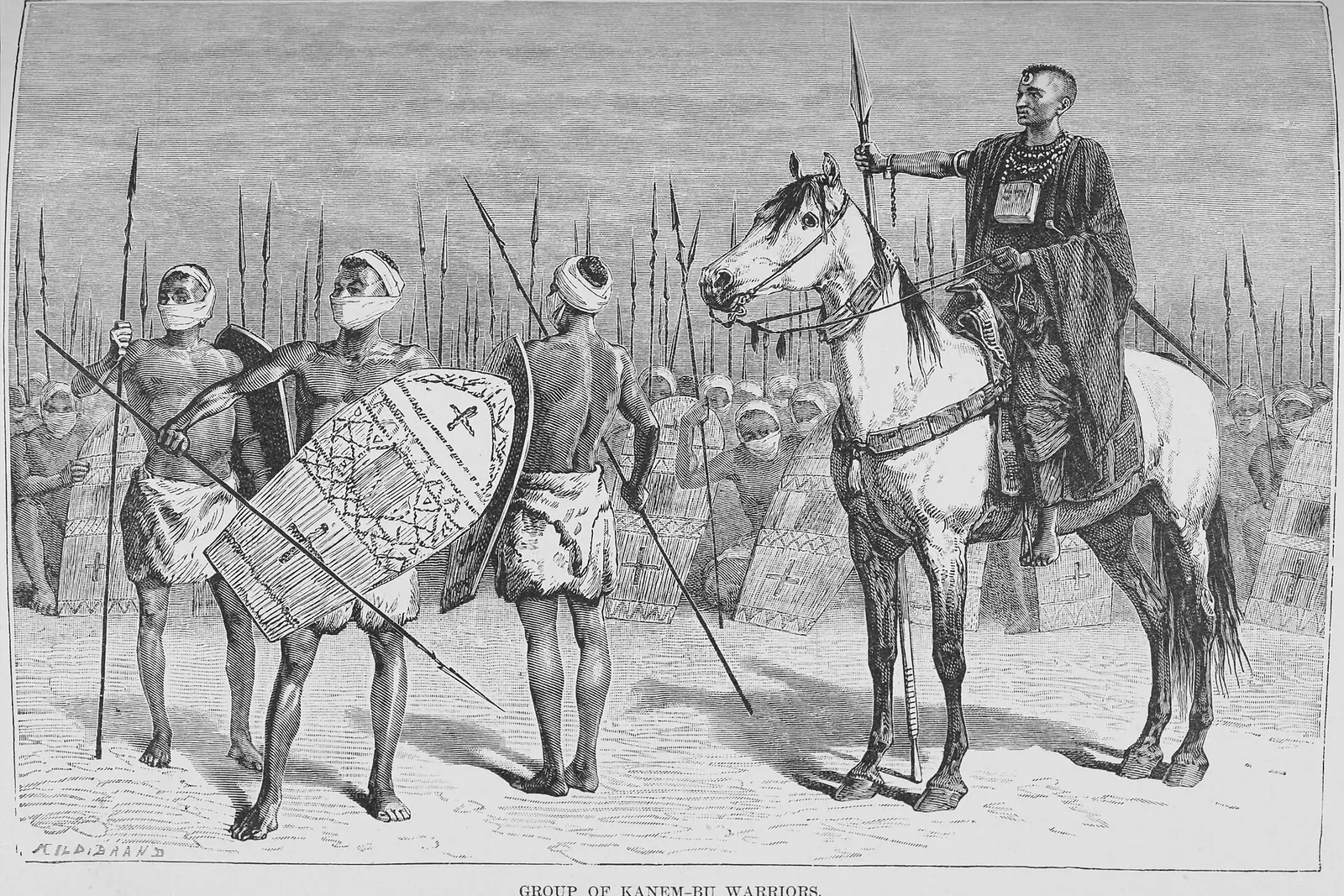
Chad is not a country you ease into — you fly into it, and the scale hits you from the air: a vast sweep of Sahel, sand and sandstone with a ribbon of green stitched along the Chari River. A week here is a relay of short hops, early starts and enormous horizons, from the noise of N'Djamena to the rock cathedrals of the Ennedi and the improbable blue of the Ounianga Lakes.
Days 1–2: Landing in N'Djamena and Learning the Rhythm
Almost every journey into Chad begins at N'Djamena International Airport, a low, hot strip of tarmac on the edge of the capital where the heat rises off the ground even at seven in the morning. Have your yellow fever certificate ready, keep a printed copy of your visa, and change money on arrival — the Central African franc is a cash economy, and outside the capital cards are close to useless. Give yourself the first day to acclimatise: drink far more water than you think you need, and treat the afternoon as lost to jet lag rather than fighting it.
N'Djamena itself rewards a slow half-day. Walk or ride along Avenue Charles de Gaulle, where the city's commercial life spills onto the pavements, then duck into the National Museum of Chad for its collection of Sao terracotta figures, musical instruments and tribal weaponry. The Grande Mosquée and the Cathédrale Notre-Dame de la Paix stand within a few minutes of each other, a reminder of how this city sits at the seam of the Sahel and the Christian south. The Grand Marché is the real theatre — mounds of dried okra, bolts of indigo cloth, tailors working treadle machines in the open air.
Save your first evening for the Chari River, which slides past the city's western edge where it merges with the Logone. Fishermen pole narrow pirogues out into the current at dusk, and the light goes copper behind them. Use day two for logistics as much as sightseeing: this is where permits and letters of authorisation for travel beyond the capital get organised, where you confirm your onward charter, and where you stock up on sunscreen, batteries and a wide-brimmed hat. A short detour to the pottery village of Gaoui, north-east of the city, fills an afternoon nicely if your flight east leaves the following morning.
Day 3: Flying East to Abéché, Gateway to the Desert
The flight from N'Djamena to Abéché takes roughly two hours in a light aircraft, and it is one of the great aerial transitions in Africa. You lift off over the green floodplain of the Chari, cross a belt of thorn scrub where villages cluster around seasonal water, and then watch the land turn the colour of biscuit as the Sahel gives way to sand. If you fly in the early morning, the air is still and the horizon is a hard, clean line.
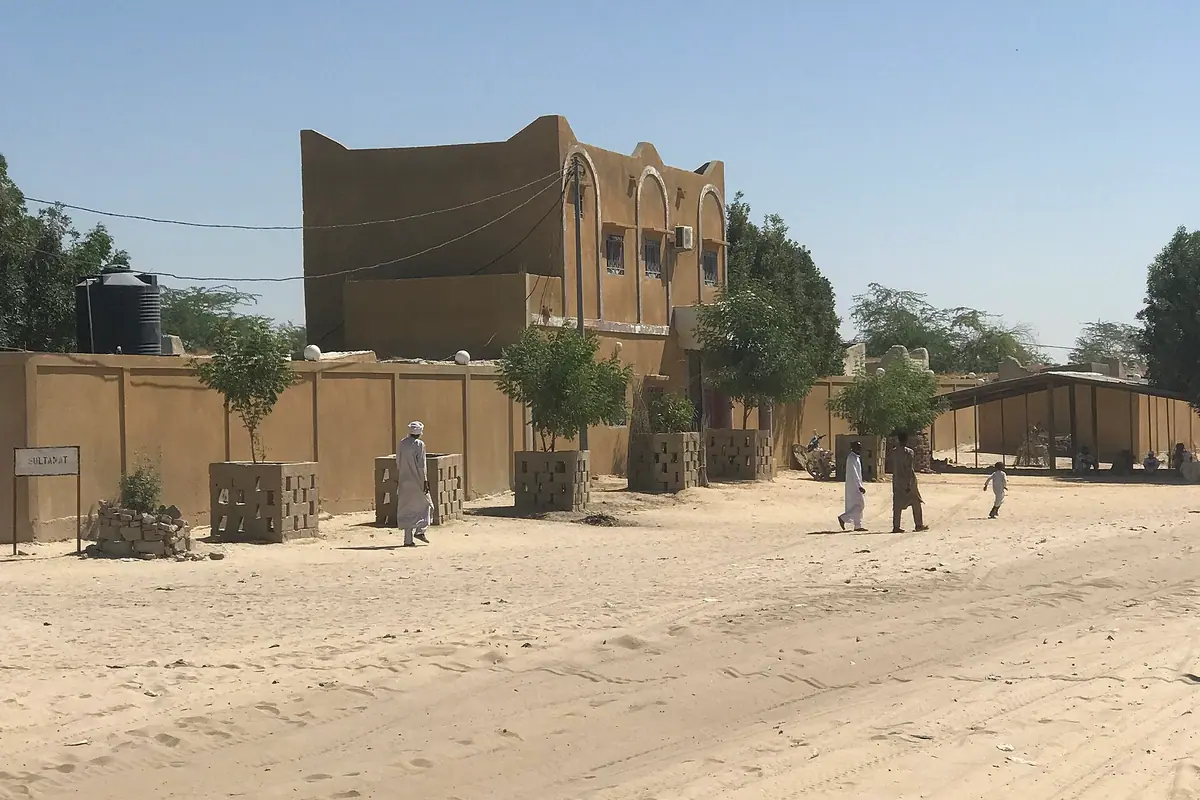
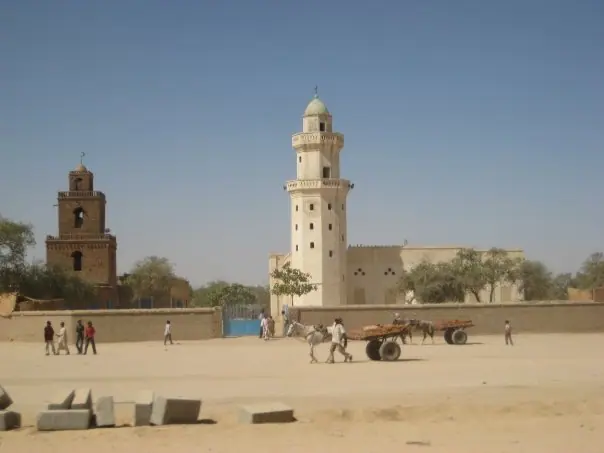
Abéché was once the capital of the Ouaddaï Sultanate, a staging post on the pilgrim and trade routes running east towards Sudan, and it still feels like a frontier town. The Sultan's palace is the obvious landmark — a mud-brick complex with conical towers, still occupied and still the ceremonial heart of the town. Nearby, the market is the best place in Chad to watch camel caravans unload: salt, dates, dried meat and sacks of gum arabic changing hands in a low murmur of Chadian Arabic. There is also a small regional museum with finds from the Ouaddaï kings' tombs.
Plan Abéché as a single overnight, not a destination in itself. The afternoon is for resting, checking your desert provisions and meeting your guide and drivers if you are continuing overland to the Ennedi. Nights here are noticeably cooler than the capital, and the harmattan wind, which blows dust down from the north between December and February, can turn the sky a milky white — beautiful in photographs, but bring a scarf for your lungs and a spare lens cloth.
Days 4–5: The Ennedi Massif — Sandstone Cathedrals and Desert Crocodiles
The Ennedi Massif is the reason many travellers come to Chad at all: a plateau of eroded sandstone rising from the sand, its cliffs carved into towers, arches and amphitheatres that look man-made until you get close. The most famous single feature is the Aloba Arch, a span so wide and high that it dwarfs anything you have seen in a photograph — you approach it on foot across flat sand and hear your own footsteps for an hour before you reach the shadow beneath it. Base yourself in or near Fada, the region's small administrative town, and travel by four-wheel drive with a licensed guide.
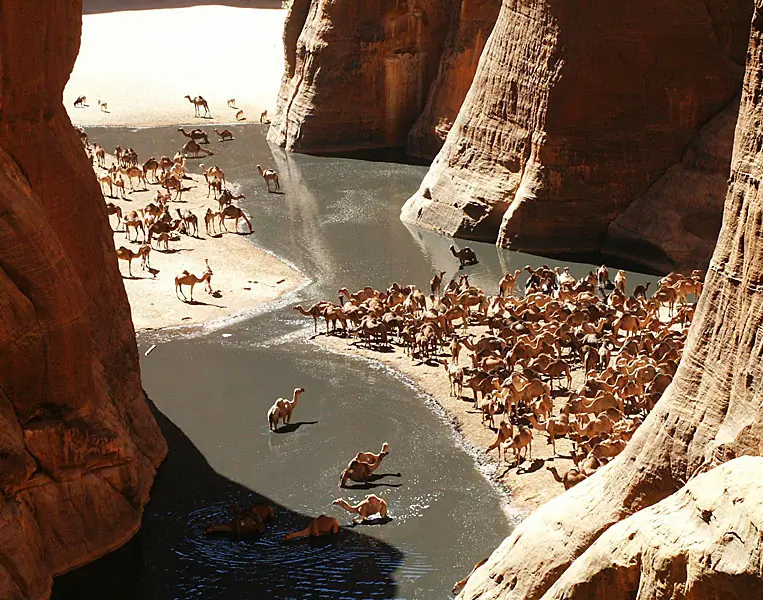
Two days is a tight but workable taste. Spend the first on the arch and the surrounding canyons, and the second on the Guelta d'Archei, a deep, permanent pool wedged between cliff walls where a small population of Nile crocodiles has somehow survived for millennia, sharing the water with grazing camels in the afternoon heat. In between, the rock art is astonishing: the painted shelters of Manda Guéli, with their ochre herds and human figures, and the engraved cattle and stylised women of the Niola Doa panels, thought to be thousands of years old and among the most distinctive in the Sahara.
The season matters enormously here. The window runs from roughly November to February, when daytime temperatures sit comfortably in the twenties and lows at night can approach freezing, so pack a fleece and a proper sleeping bag. From March onwards the heat becomes punishing, and by the rainy months the tracks become unreliable. Even in the cool season, expect long, bumpy drives, fine dust in everything, and nights of extraordinary silence and stars. There are no hotels in the conventional sense — you camp, you eat simply, and you go to bed early.
Day 6: The Ounianga Lakes — Water in the Middle of the Sahara
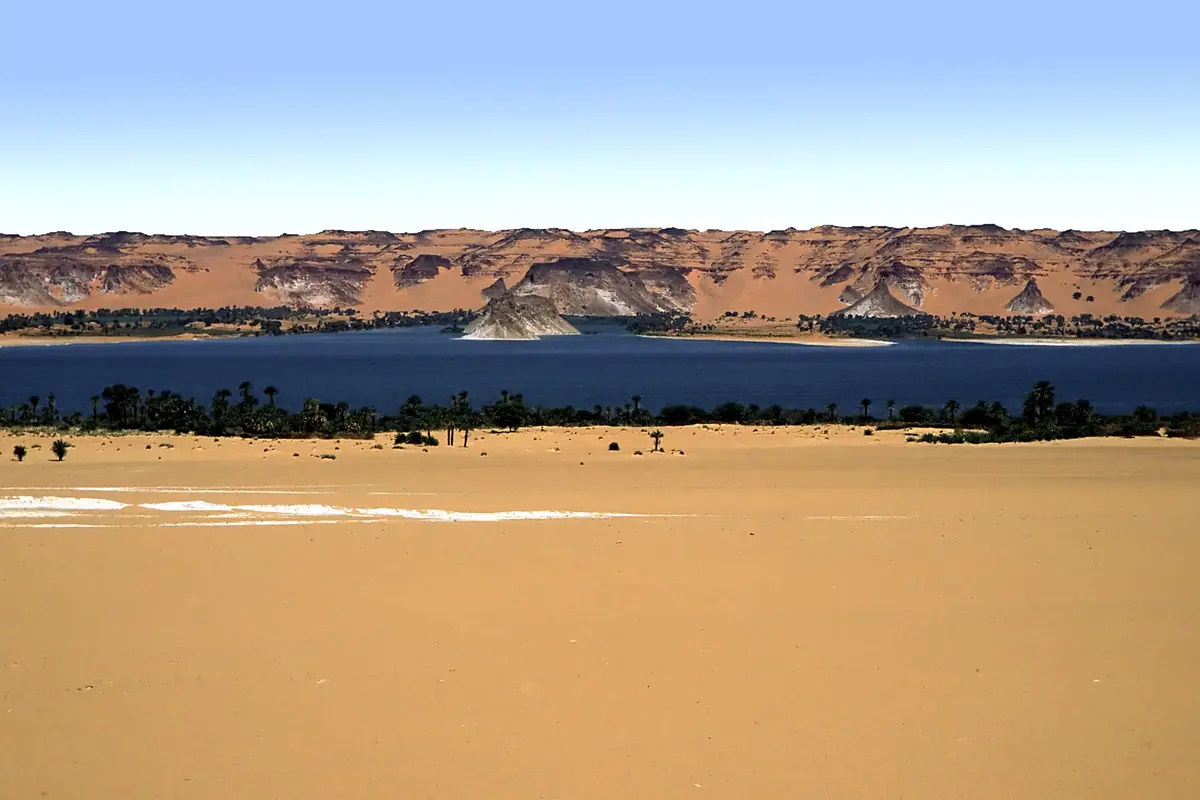
Nothing prepares you for the Ounianga Lakes. After hours of driving or a short onward flight north-west from the Ennedi, the dunes open and there they are: a chain of lakes lying in a depression of the Borkou, fed underground by ancient fossil water in a place that receives almost no rain. The largest, Lac Ounianga Kebir, is saline and startlingly blue; its neighbour, Lac Ounianga Sérir, is fresh, fringed with reeds and tamarisk, and shallow enough to wade into. Together with smaller basins such as Lac Teli and Lac Yoa, they are the remains of a single vast prehistoric lake, and the whole chain is recognised as a World Heritage-listed landscape.
The practical reality is simple: you arrive, you swim, you eat a late lunch in the shade of a shelter, and you sit still. Birds work the reedbeds, small fish flicker in the shallows, and the contrast between the water and the surrounding erg is almost hallucinatory. Nights here are cold in winter and the stars are absurdly bright. Accommodation is basic camp-style, so bring a headlamp, toilet paper and a sense of humour about washing.
Getting to Ounianga is the trickiest leg of the week. Scheduled services are thin, so most visitors either charter a light aircraft from Fada or N'Djamena or commit to a long, rough drive that eats a full day each way. If your week is tight, fly in for the night and fly out in the morning; if you have flex, give the lakes two nights and let the pace drop.
Day 7: Zakouma National Park or the Shores of Lake Chad
If you want wildlife rather than rock, the final day belongs to Zakouma National Park in the south-east, reachable by charter flight from N'Djamena in around an hour and a half. Zakouma is one of the last strongholds of elephants in the Sahel and has rebuilt from a very low base over the past two decades; it also holds Kordofan giraffe, buffalo, Lelwel's hartebeest, warthog and a superb bird list. The park is closed during the rains, roughly from June to November, and the best game viewing falls between January and April, when the land dries and animals concentrate around the remaining water. Mornings and late afternoons are for game drives; the middle of the day is for sipping something cold under a tree.
If Zakouma's season does not align with your dates, take the western alternative instead: Lake Chad, reached from the town of Bol. The lake is a maze of open water, reed islands and floating vegetation, fished by communities who live on its shifting shores, and its birdlife is excellent. Lake Fitri, closer to N'Djamena and designated as a protected wetland, makes a shorter substitute if you are short on time — a long day trip rather than an overnight.
Whichever you choose, build a buffer into your last day. Domestic flying in Chad is not a matter of checking an app; schedules shift, aircraft get reassigned, and seats on charters are sometimes bumped by cargo or by official passengers. Aim to be back in N'Djamena the night before your international departure rather than the same day, and treat any unplanned delay as part of the trip rather than a catastrophe.
The Practicalities of Flying and Travelling Around Chad
Chad's domestic air network is sparse and changeable. A handful of scheduled services connect the main towns, but for the Ennedi, the Ounianga Lakes and Zakouma you will almost certainly be on a chartered light aircraft arranged through a local operator, often bundled with vehicles, guides and camping equipment. Baggage allowances on these aircraft are strict — usually 15 to 20 kilograms in soft bags — and fuel stops are common on longer legs. Flights leave early, partly to catch calm air and partly because desert airfields become furnaces by mid-morning.
On documents, expect to arrange a visa in advance and to carry a yellow fever certificate, which is checked on arrival. Vaccinations for hepatitis A, typhoid and meningitis are commonly recommended, and malaria prophylaxis is sensible throughout, especially in the south during and after the rains. Travel outside the capital, particularly in the north and east, generally requires permits and a licensed guide, and conditions can change quickly; check your own government's travel advice and, more importantly, talk to a reputable local operator about the current situation on the ground before you commit to a route.
Finally, a word on timing and kit. The most comfortable months across most of the country are November to February, when the north is cool and the south is dry; March to May is brutally hot almost everywhere, and June to September brings rain to the southern half. Carry cash in Central African francs, since ATMs outside N'Djamena are scarce and unreliable. Pack loose long sleeves for sun and insects, a scarf for harmattan dust, sturdy boots, a headlamp and more memory cards than you think you need. French and Arabic will carry you a long way; a few greetings in Chadian Arabic will carry you further, and asking before you photograph people is both polite and expected.
Frequently asked questions
How do you cover so much ground in Chad in one week?
By flying. Long road journeys between N'Djamena, Abéché, the Ennedi and the Ounianga Lakes can swallow entire days, so a one-week trip realistically relies on a mix of scheduled domestic flights where they exist and chartered light aircraft for the desert legs, with four-wheel drives for the final stretches. Book charters well ahead through a local operator and accept that schedules may shift.
What is the best time of year to visit Chad?
November to February is the sweet spot: the north is cool enough for desert camping and the south is dry. Zakouma National Park is generally open from around November to May, with January to April best for wildlife as water sources shrink. Avoid March to May if you can, when temperatures soar, and expect rain across the southern half from June to September.
Do I need a visa and vaccinations for Chad?
Yes — most visitors need a visa arranged before arrival, and a yellow fever vaccination certificate is checked at the airport. Hepatitis A, typhoid and meningitis vaccinations are commonly recommended, and malaria prophylaxis is advisable throughout the country. Requirements change, so confirm the current rules with the nearest Chadian embassy before booking flights.
Is it safe to travel independently in Chad?
Independent travel is limited. Areas outside N'Djamena, especially in the north and east, generally require permits and a licensed guide, and some regions can be off-limits at short notice. Travelling with an established local operator, keeping to planned routes and checking your government's current travel advice is the sensible approach — this is not a country for improvised solo desert trips.
How much time do the Ennedi Massif and the Ounianga Lakes really need?
More than most itineraries allow. Two days in the Ennedi gives you the Aloba Arch, the Guelta d'Archei and a taste of the rock art, but four or five days is where the massif opens up properly. The Ounianga Lakes can be done as one night if you fly in and out, but two nights lets you slow down. If you have only a week, expect to choose between the deep desert and Zakouma rather than doing both justice.