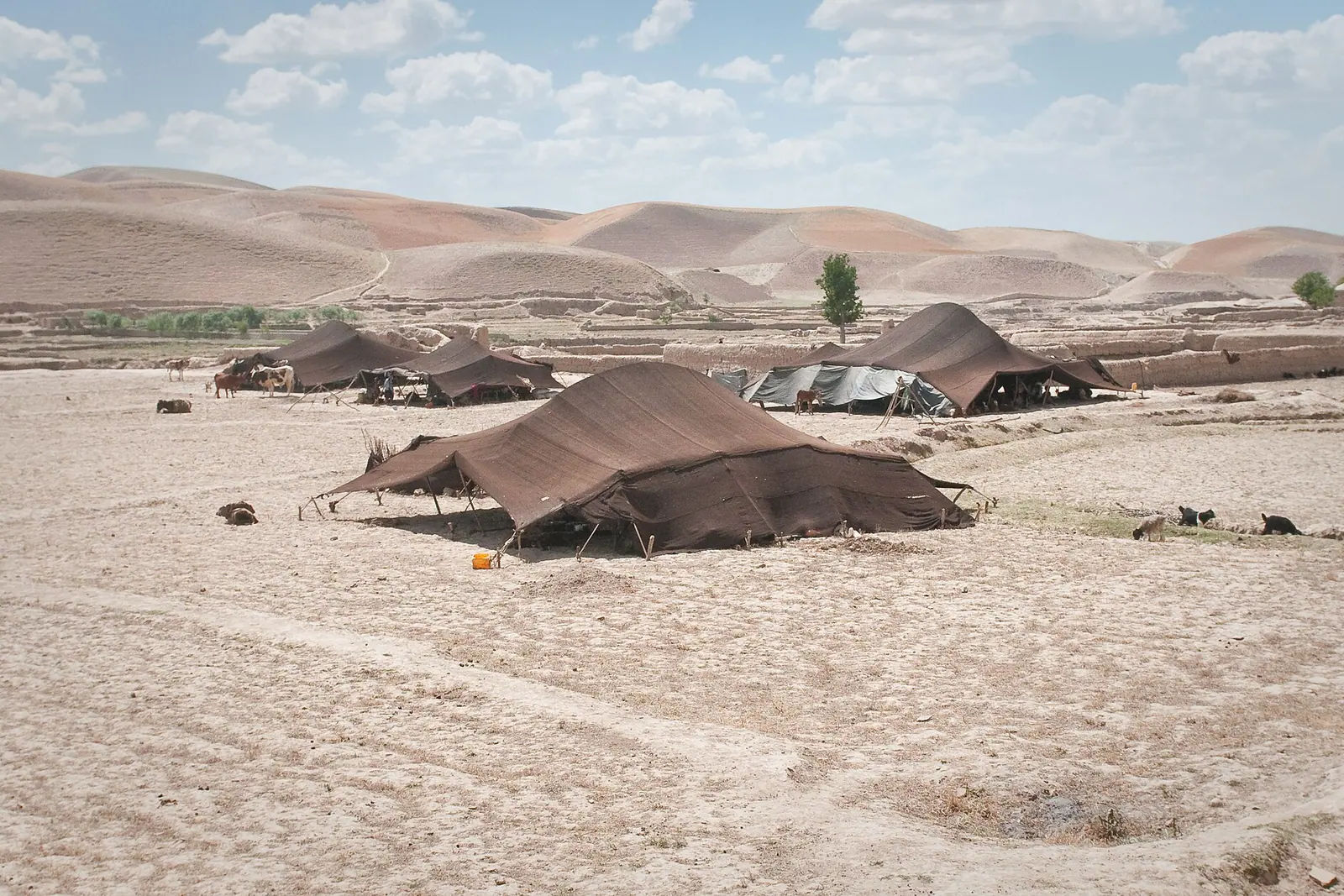
Afghanistan holds some of the most startling landscapes and architecture in Asia: lapis-blue lakes cupped between bare mountains, the empty cliff niches where giant Buddhas once stood, and Timurid minarets tiled like jewellery. This guide covers the country's essential landmarks — Band-e Amir, Bamyan, Herat, Mazar-i-Sharif, Kabul and the Minaret of Jam — together with the seasons, distances and precautions that come with them.
Band-e Amir: Afghanistan's Blue Heart
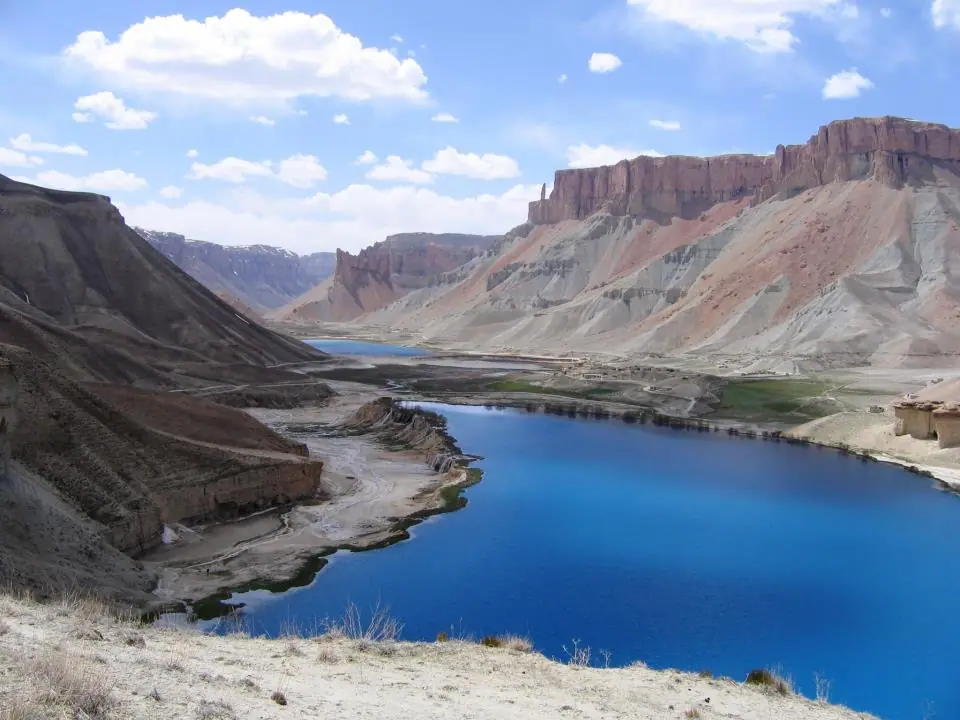
Ringed by pale cliffs in the Hindu Kush foothills of Bamyan province, Band-e Amir is a chain of six lakes whose colour defies description — ink-blue in shadow, bright turquoise where sun strikes the travertine dams that hold each basin in place. Band-e Haibat, the 'Dam of Awe', is the largest, its natural barrier looking poured rather than grown; beyond it lie Band-e Zulfiqar, Band-e Panir, Band-e Pudina and Band-e Gholaman, each separated by a ridge you can walk in twenty minutes.
It was declared Afghanistan's first national park, and for Afghans it is the classic summer escape: families arrive with carpets and picnic pots, rowing boats cross Band-e Haibat, and tea sellers work the shoreline. Foreign visitors pay a modest entry fee and usually check in at the small ranger post. The lakes sit at roughly 2,900 metres, so nights are cold even in August; the water is bracing, the light at sunset is extraordinary, and the silence after the day-trippers leave is the real luxury.
Reaching Band-e Amir takes three to four hours by road from Bamyan town through the Yakawlang valley, and much longer from Kabul; surfaces are rough in places and a high-clearance vehicle with a local driver is the sensible choice. Late June to early September is the window — snow closes the approach in winter and spring melt can turn tracks to mud. Accommodation is basic, so bring cash, a head torch and warm layers.
Bamyan: Cliffs, Citadels and the Ghosts of the Buddhas
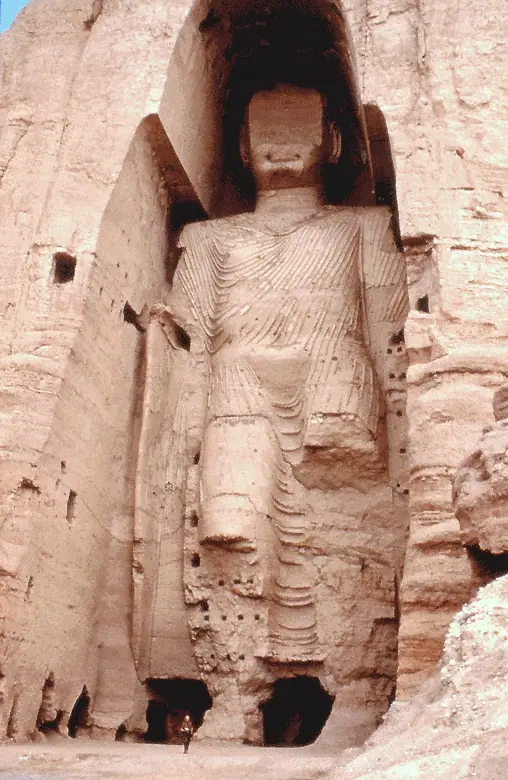
Bamyan lies at about 2,500 metres in a wide, windswept valley that was once a wealthy staging post on the Silk Road, and its fame rests on the cliff running along the northern edge of town. Two colossal Buddhas were carved into that rock in the sixth century and stood until their destruction in 2001; the empty niches remain, immense and strangely eloquent, with cave monasteries behind them still holding traces of faded paint and fragments of the statues kept in a small site museum.
Above the valley, Shahr-e Gholghola — the 'City of Screams' — spills across a hilltop in a maze of mud-brick walls, and the climb rewards you with the finest view of the whole basin. At the eastern end, Shahr-e Zuhak, the 'Red City', clings to a crumbling ridge, its fortifications eroded into fangs. Both are best visited early or late in the day, when the light is soft and the wind has dropped.
Allow three or four days. Dragon Valley, a short drive east, hides a ridged rock formation locals call the dragon and a small shrine at its base; the Foladi valley offers waterfalls and walking; and the town itself has a bazaar, potato fields and a growing handful of guesthouses. May to October brings sharp blue skies and cold nights; winter buries the valley in snow and closes the passes.
Herat: The Citadel and the Blue Minarets
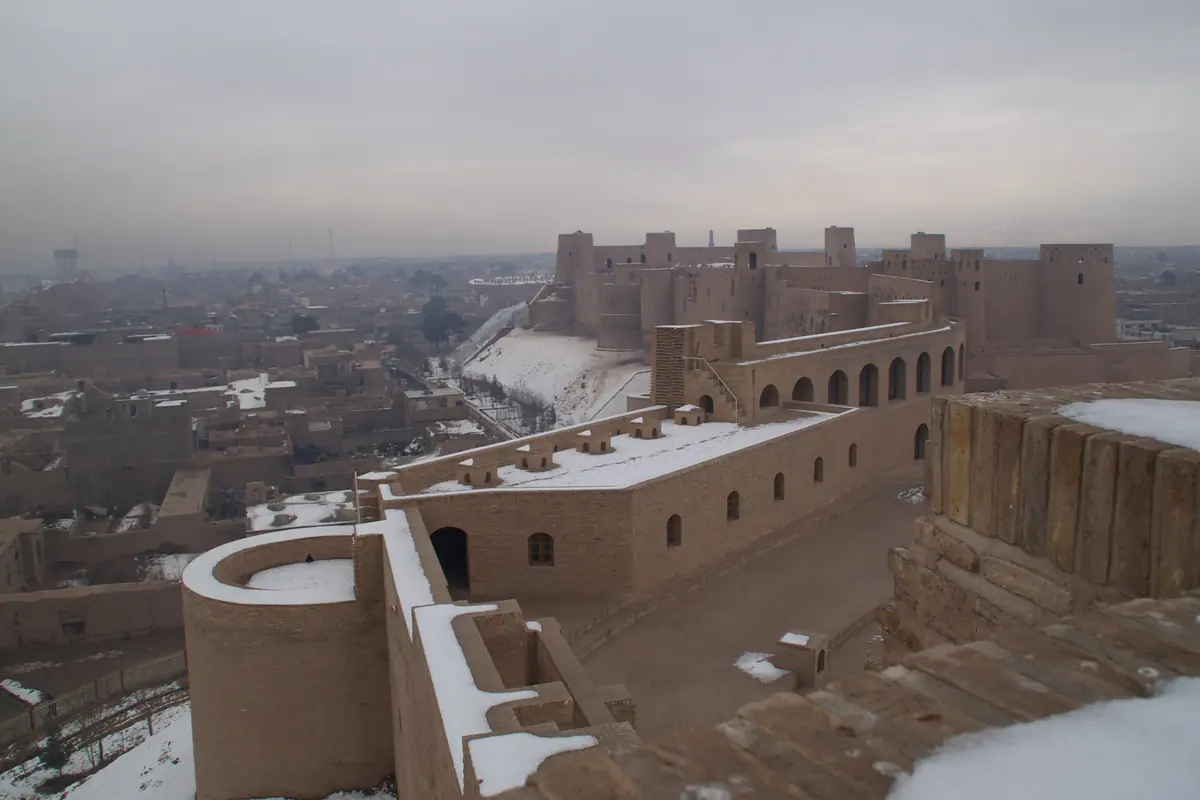
In the far west, close to the Iranian border, Herat was the jewel of the Timurid empire and still feels like a city of scholars and craftsmen. Qala Ikhtyaruddin, the citadel, rises on its artificial mound at the edge of the old town, its baked-brick ramparts and towers rebuilt after decades of neglect; inside are courtyards, a small museum and views across a skyline of domes and minarets.
The Jami Masjid, Herat's Friday Mosque, is the city's masterpiece: a vast courtyard, arcades of blue and turquoise tilework, and a portal so intricately patterned that it takes a moment to register the scale. A short walk away, the Musalla complex preserves a handful of minarets from Gawharshad Begum's fifteenth-century ensemble — survivors of a far larger foundation — while the shrine at Gazurgah, dedicated to the poet Ansari, sits in gardens just outside the city.
Herat is also a working city, and its bazaars are why many travellers linger: silk, saffron from surrounding fields, carpets, dried fruit and glass. March and April are loveliest, with mild days and blossom; summer is punishingly hot, often well above 35°C; autumn is dry, clear and kind. Two or three days covers the sights, with half a day more for the bazaars and a walk along the old walls.
Mazar-i-Sharif, Balkh and the Northern Plains
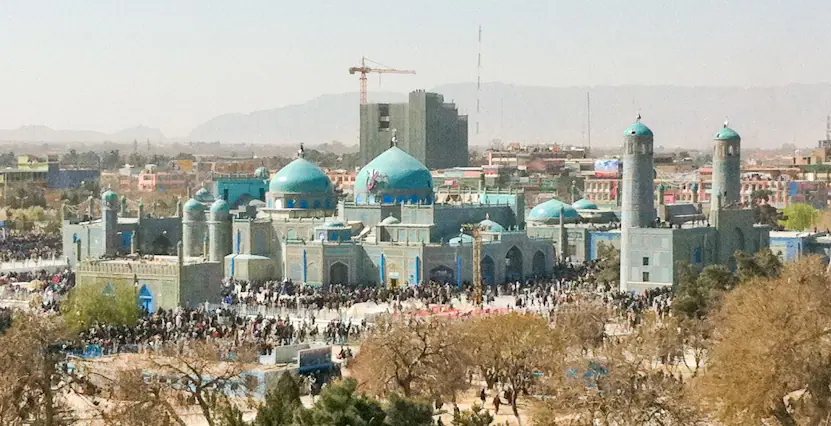
Mazar-i-Sharif's great shrine, the Rawza of Ali, is the most recognisable building in Afghanistan: a blue-tiled complex of domes, minarets and a garden courtyard where white pigeons strut between pilgrims. Non-Muslim visitors generally view it from the courtyard rather than the inner sanctuary, which is privilege enough; the tilework in low afternoon light is extraordinary.
Nowruz, the spring new year, is when the shrine's banner is raised and the city fills with pilgrims, picnics and music — one of the great spectacles of the Afghan year. Twenty kilometres away, Balkh is quiet and half-ruined, but this was Bactra, the 'Mother of Cities'; you can still trace the old walls, the great mosque, the shrine of the poet Rabia Balkhi and the Buddhist stupa known as Top-e Rustam.
Mazar makes a comfortable base, with the widest range of hotels in the north and flights linking it to Kabul, Herat and Kandahar. The classic approach from Kabul runs over the Salang Pass and through its long tunnel — a spectacular drive that snow can close in winter. Further south along the highway, Ghazni keeps the brick minarets of Mas'ud III and Bahram Shah and the tomb of Mahmud of Ghazni, while Kandahar holds the Shrine of the Cloak and the mausoleum of Ahmad Shah Durrani.
Kabul: Gardens, Palaces and a Living Old City
Kabul sprawls at 1,790 metres between bare mountains, and its finest hour is late afternoon in Bagh-e Babur, the terraced garden laid out by the first Mughal emperor. Steps climb the hillside to his simple marble tomb, restored after years of careful conservation; there is a small mosque, rose beds and a view over the city that makes the traffic below seem very distant.
On the southwestern edge of the capital, Darul Aman Palace is a battered but still imposing 1920s landmark, its facade rebuilt and its setting oddly grand; the National Museum of Afghanistan nearby holds a collection spanning the Silk Road centuries, with pieces recovered and restored after decades of loss. West of town, Lake Qargha and the Paghman valley are where Kabulis go for a weekend picnic, and both make easy half-day trips.
In the old city, the bazaars along the Kabul river — Mandawi above all — sell everything from spices to spare parts, and the blue-domed Pul-e Khishti mosque anchors a district whose layout has barely changed in centuries. Altitude means crisp spring and autumn days, cold winters with snow, and hot, dry summers. Allow two or three days, and expect checkpoints, heavy traffic and the need for a flexible plan.
The Far Reaches: Jam, the Wakhan and the Panjshir
The Minaret of Jam, deep in Ghor province where the Hari Rud and Jam Rud meet, is the country's most haunting monument: a 65-metre tower of baked brick from the twelfth century, banded with geometric relief and a ribbon of blue tile inscription, standing alone in a canyon. Reaching it is a serious undertaking — a long, rough drive from Herat or Chaghcharan, river crossings that flood after rain, and accommodation that amounts to village guesthouses.
In the far northeast, the Wakhan Corridor runs between the Pamirs and the Hindu Kush towards China, a high, empty world of stone, glacier melt and summer pastures where Kyrgyz herders live. Beyond Sarhad-e Broghil you travel on foot or by pony; the season is short, roughly June to September, and permits plus a trusted local guide are essential. Closer to Kabul, the Panjshir valley offers mulberry orchards, a rushing river, mountain viewpoints and the tomb of Ahmad Shah Massoud at Bazarak — an easy drive on a good day.
None of this is ordinary tourism. Independent travel is not advisable anywhere in the country, several provinces are effectively off-limits, and unexploded ordnance remains a genuine hazard in rural areas. The realistic approach is a small, well-connected local operator, a guide who knows the checkpoints, conservative dress — women should expect to cover their hair — and abundant patience. Roads are slow, hotels are simple outside the main cities, card payments are rare, and conditions change quickly, so build slack into every itinerary.
Frequently asked questions
Is it safe to travel in Afghanistan right now?
Most governments advise against all travel, and independent tourist travel is not advisable. Kidnapping, roadside hazards and unexploded ordnance are real risks, some provinces are off-limits, and rules for women are restrictive. Anyone going should do so with a reputable local operator, not alone.
When is the best time to visit Afghanistan?
April to June and September to October suit Kabul, Bamyan and Herat. Band-e Amir is best from late June to early September, the Wakhan from June to September. Winter brings snow, and the Salang Pass tunnel can close.
Do I need a visa and a guide?
Yes to both. Visas are arranged in advance through an embassy, usually with an in-country sponsor, and a licensed local guide is effectively essential. Expect permits for the national park and for the Wakhan, and be ready for frequent checkpoints.
How much time do I need, and how do you get around?
Two to three weeks covers a Kabul–Bamyan–Band-e Amir loop with Herat or the northern cities. Domestic flights link Kabul, Herat, Mazar-i-Sharif and Kandahar; road journeys are slow, with Kabul to Bamyan typically four to six hours.
What should I know about local customs?
Dress modestly, cover your head if you are a woman, and ask before photographing people, shrines or anything official. Alcohol is banned, Friday is the main day of rest, and cash in local currency or clean dollar notes is far more useful than cards.
Plan it — experiences in Afghanistan
Live search, booked directly with trusted providers.
Sort the rest of your trip
Everything for Afghanistan, in one place
Stay in Afghanistan
Hotels, guesthouses and apartments — compared in one search.
Search hotels
Transfer in Afghanistan
Private driver waiting on arrival — no queues, no surprises.
Book a transfer
Stay online in Afghanistan
Travel eSIM — data the moment you land, no roaming bills.
Get an eSIMMore guides in Afghanistan
Best Time to Visit Afghanistan: Seasons, Hotels and Must-See Sights
Touring Afghanistan: Food, Culture and the Sights You Should Not Miss
Top Things to Do in Afghanistan: Band-e-Amir, Bamyan and the Great Landmarks
Flying Through Afghanistan: A One-Week Air Itinerary to Kabul, Bamiyan, Mazar-i-Sharif and Herat