Slovakia is small enough to cross in a day and rich enough to keep you busy for two weeks: a Danube-side capital with a castle on a rock, a dense scatter of hilltop ruins and fairy-tale chateaux, and an alpine range of glacial lakes that genuinely earns the word dramatic. Add limestone gorges you climb with chains and ladders, ice caves that stay frozen in August, and medieval mining towns that UNESCO got to first.
Bratislava: Castle Hill, the Old Town and the Danube
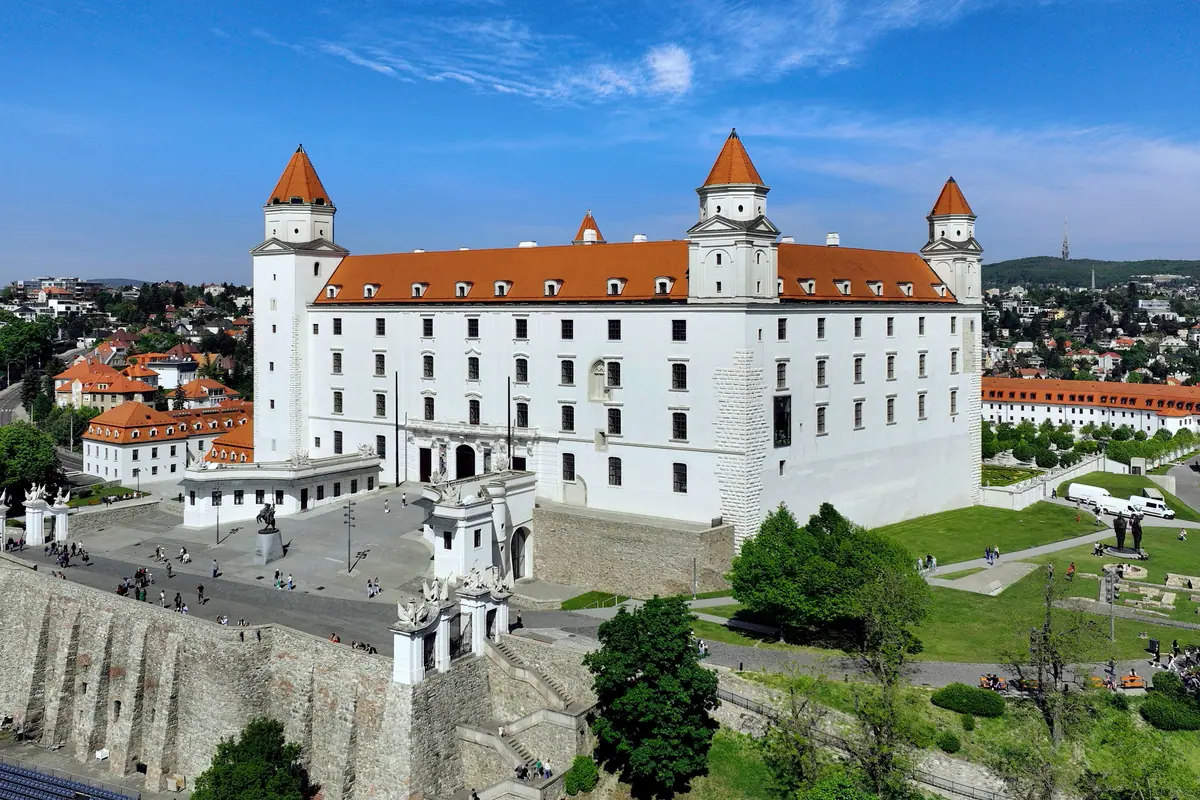
Bratislava Castle crowns a rocky spur above the Danube, its white walls and four corner towers visible from much of the city. Inside are history exhibits and a terrace that frames the red roofs of the Old Town; on a clear day Austria stretches west along the river. Below, cobbled lanes lead down through Michael's Gate — the last surviving medieval gate, with a weapons collection in its tower — to Hlavné námestie, the main square, and the pink Primate's Palace.
St Martin's Cathedral, where Hungarian monarchs were once crowned, sits just inside the old fortifications, its spire topped by a gilded replica of the coronation crown. On the Danube embankment, the SNP Bridge's flying-saucer observation deck lifts you roughly 95 metres above the water, and river cruises depart from the same stretch. Twenty minutes upstream by bus or car, Devín Castle balances on a cliff where the Morava meets the Danube — go late afternoon for the light.
The historic core is genuinely walkable, and two or three hours covers the essentials; double it if you add castle interiors and a long coffee stop. May, June and September are the sweet spots, while December brings Christmas markets to the squares and snow dusting the castle hill. Trams and trolleybuses fill the gaps, and once you have made the climb to the castle, most of the centre is flat.
Castles and Chateaux: Spiš, Orava, Bojnice and Trenčín
Spiš Castle is the one that stops people mid-sentence. Spread across a hilltop above the village of Spišské Podhradie, its sprawling walls enclose one of the largest castle complexes in central Europe, with a lower ward, a Romanesque palace and long views over the Spiš countryside. It forms part of a UNESCO listing that also takes in the cathedral town of Spišská Kapitula and the little church at Žehra with its medieval frescoes. Allow two to three hours and wear shoes with grip.
Orava Castle is arguably even more photogenic, stacked on a limestone crag above the Orava river at Oravský Podzámok, its terraces reached by steep stairways. Bojnice Castle plays the fairy tale outright: a turreted chateau with a moat, a landscaped park and a zoo beside it. Trenčín Castle lords it over the Váh valley, with a Roman inscription carved into the rock below it recording a legion's stay.
Timing matters. Many castles close their interiors from November to March, reopening at weekends or fully from April, and summer hours are usually daily from around 9am to 5 or 6pm with last entry an hour before closing. Driving is the easiest way to link them, though trains to Žilina and Poprad plus local buses get you close. Smaller gems worth a detour include Beckov, Strečno, Betliar Manor and the riverside ruins at Devín.
The High Tatras: Alpine Trails Above the Treeline
The High Tatras are Slovakia's alpine heart: a compact granite range of glacial lakes, dwarf pine and bare rock, the highest in the Carpathians. Štrbské Pleso is the classic starting point, with a level circuit around its tarn, while an hour or so uphill on foot brings you to Popradské Pleso, the postcard lake. From Tatranská Lomnica, a cable car climbs via Skalnaté Pleso to Lomnický štít at 2,634 metres, where the view runs clear across to Poland.
Serious walkers aim for Rysy on the Polish border at 2,503 metres, a long and rocky day from Štrbské Pleso. Gerlachovský štít, the country's highest at 2,655 metres, is only reachable with a certified mountain guide. Above roughly 1,500 to 1,800 metres, marked trails close from 1 November until mid-June. Afternoon thunderstorms are a summer ritual, so start early, carry layers and rain gear, and never assume the weather will hold.
Mountain huts serve goulash, cabbage soup and tea, and make sensible turnaround points. Base yourself in Poprad, Starý Smokovec or Tatranská Lomnica; a small electric railway links the resort villages and beats driving and parking hands down. Give yourself three or four days for two or three proper hikes — or swap summer boots for skis at Jasná in the Low Tatras between December and March.

Slovak Paradise, Ice Caves and the World Beneath
Slovenský raj — Slovak Paradise — is a national park where the trails themselves are the attraction: ladders, chains, wooden footbridges and waterfalls threading narrow limestone gorges. The Suchá Belá gorge and the Prielom Hornádu canyon are the best-known routes, and both involve real scrambling, so gloves help and one-way systems mean you should study the route before setting off. Allow four to six hours for a full circuit, start early in summer to avoid queues at the ladders, and note that gorge routes close in winter and after heavy rain.
Underneath the country lies another world. Dobšinská Ice Cave holds thick year-round ice and stays close to freezing inside even in August, so bring a jacket. In the Low Tatras, Demänovská jaskyňa slobody and Demänovská ľadová jaskyňa are guided show caves, and the rare aragonite formations at Ochtinská are unlike anything else in Europe. Belianska Cave, near Tatranská Lomnica, is the easiest to reach from the Tatras.
Cave tours generally run 30 to 60 minutes and keep modest hours, often closing on Mondays or from November to March; check locally and arrive early on summer weekends. Above ground, the Pieniny mountains along the Polish border offer traditional wooden-raft trips through the Dunajec gorge from roughly April to October, while Zádielska tiesňava in the Slovak Karst is a gentler gorge walk that suits families.
UNESCO Towns: Banská Štiavnica, Levoča and Bardejov
Banská Štiavnica is the connoisseur's choice: a former silver-mining town folded into a volcanic caldera, with an Old Castle, a New Castle, the Holy Trinity column on its sloping square and an open-air mining museum where you walk into the shafts. Above the town, reservoirs built centuries ago to power the mines now double as swimming lakes in summer. Give it a full day and stay overnight — the evening quiet is half the charm.
Levoča keeps its medieval walls and one of Europe's finest late-Gothic churches, St James's, whose towering wooden altar by Master Paul fills the chancel. Bardejov's square is so unspoiled it looks staged, ringed by burgher houses and the basilica of St Egidius, with a small Jewish suburb a few minutes' walk away. Košice, the second city, has the country's largest church, St Elisabeth Cathedral, on a long pedestrian boulevard with a musical fountain.
Add Vlkolínec, a preserved village of log houses near Ružomberok, and the Carpathian wooden churches scattered through the east, with Hronsek and Kežmarok among the most striking. Trains link the main towns comfortably, and historic cores are small enough to walk in one or two hours — though Banská Štiavnica, Bardejov and Košice each deserve longer. Guesthouses inside the old towns are usually characterful and cheap by western European standards.
Food, Folk Culture and When to Go
Slovak food is mountain fuel. Bryndzové halušky — potato dumplings folded through sheep's cheese and topped with bacon — is the national dish, followed by strapačky with cabbage, kapustnica sour cabbage soup at Christmas, lokše potato pancakes and fried cheese with tartare sauce. In the west, the Small Carpathian wine route runs through Pezinok and Modra, with cellars open for tasting; the Tokaj region in the southeast makes sweet white wines, and craft breweries keep appearing in Bratislava and Žilina.
Folk culture here is alive rather than preserved in aspic. The Východná festival in early July and the Detva folk festival are the big ones, with costumes, bagpipes, fujara flutes and dancing, while Easter and Christmas bring markets, decorated eggs and heavy seasonal cooking. Bratislava's Christmas markets fill Hlavné námestie and Františkánske námestie through December, and Košice does something similar along its main street.
May, June and September to early October give the best balance of weather, opening hours and elbow room. July and August are hot in the valleys, crowded in the Tatras and pricier at the resorts; winter is for skiing, spa towns and castle exteriors rather than castle museums. A week is a fair minimum — Bratislava, the Tatras and one UNESCO town — while ten days lets you add castle country, the caves and Košice.
Frequently asked questions
How many days do you need in Slovakia?
Five to seven days is a solid first trip: two in Bratislava, two or three in the High Tatras, and a day in a UNESCO town such as Banská Štiavnica or Levoča. With ten days you can properly loop in Spiš Castle, the Slovak Paradise gorges, the ice caves and Košice without rushing.
When is the best time to visit the High Tatras?
Late June to September for high trails, when huts are open and the weather is most stable. Marked routes above roughly 1,500 to 1,800 metres close from 1 November to mid-June. Winter shifts the focus to skiing at Jasná in the Low Tatras and to cross-country trails around Štrbské Pleso.
Do you need a car to get around Slovakia?
Not for Bratislava, Košice or the Tatras, which are well served by trains, the resort electric railway and buses. A car genuinely helps for Spiš Castle, Bojnice, the scattered cave systems and the Slovak Paradise trailheads, where public connections are slower and less frequent, especially at weekends.
What should I eat and drink in Slovakia?
Start with bryndzové halušky, then try kapustnica, lokše, strapačky and fried cheese with tartare sauce. For drinks, look to the Small Carpathian wine route around Pezinok and Modra, sweet Tokaj wines from the southeast, and the growing number of craft breweries in Bratislava and Žilina.
Are Slovakia's caves and gorges open year-round?
Most show caves run from around April or May to October, often closed on Mondays, and a few open only in the warmest months. The gorge routes in Slovak Paradise shut in winter and after heavy rain because of ice and flooding. Always check opening days locally before travelling, and bring warm layers for ice caves.
Plan it — experiences in Slovakia
Live search, booked directly with trusted providers.
Sort the rest of your trip
Everything for Slovakia, in one place
Stay in Slovakia
Hotels, guesthouses and apartments — compared in one search.
Search hotels
Transfer in Slovakia
Private driver waiting on arrival — no queues, no surprises.
Book a transfer
Stay online in Slovakia
Travel eSIM — data the moment you land, no roaming bills.
Get an eSIMMore guides in Slovakia
Where to Stay in Slovakia: Hotels and Must-See Sights from Bratislava to the High Tatras
Slovakia Food, Culture and Local Experiences: A Tour Through Kolibas, Castles and Wine Cellars
One-Week Slovakia Itinerary: Bratislava, Castle Country and the High Tatras