Seychelles is 115 islands scattered across the Indian Ocean, where granite boulders the size of houses tumble into water so clear it looks lit from below. Between the palm forests and the coral atolls, there is far more here than a beach holiday — though the beaches alone would justify the journey.
Anse Source d'Argent and the Granite Coast of La Digue
Anse Source d'Argent is the image most people carry of Seychelles before they arrive: pale sand, shallow turquoise water, and weathered granite blocks arranged as if deliberately. It sits on La Digue, reached by bicycle from the harbour village of La Passe along a flat road that passes through L'Union Estate, where a modest entry fee covers the old copra sheds and vanilla plantation. Go early — by mid-morning the light flattens and the sand loses its glow; late afternoon brings the best colour but also the day-trippers. Low tide opens up rock pools and lets you walk much further along the sand.
La Digue rewards slow travel, since almost everything is within a 20-minute cycle ride. Anse Severe faces west and is the best place on the island to watch the sun drop into the sea, while Grand Anse and Petite Anse are dramatic but have strong currents and no shade — swimming is not wise there. The serious walkers' prize is Anse Marron, reached only on a guided route over the rocks from Grand Anse, timed strictly around the tide. Inland, the Veuve Reserve protects a small patch of forest that shelters the Seychelles black paradise flycatcher, one of the rarest birds in the country.
Vallée de Mai: The Prehistoric Forest of Praslin
In the middle of Praslin lies Vallée de Mai, a surviving fragment of the palm forest that once covered the ancient southern continent of Gondwana. It is World Heritage-listed, and the moment you step under the canopy the reason is obvious: coco de mer palms tower overhead, their enormous fan-shaped fronds blocking out the sky. The coco de mer produces the largest and heaviest seed in the plant kingdom, a strange double-lobed nut that has fuelled legends for centuries. The marked loops take anywhere from 45 minutes to two hours depending on how often you stop.
The forest is also the last stronghold of the Seychelles black parrot, a dusky, slow-moving bird whose call carries through the valley. Mornings are cooler and far better for wildlife, and the humidity builds relentlessly by early afternoon. Nearby, Fond Ferdinand offers a similar landscape on a larger, quieter reserve with a steep climb to a panoramic ridge — a good alternative if the main valley is crowded. Most visitors pair either reserve with a stop at Anse Lazio, a broad crescent of granite and white sand at the island's northern tip, or Anse Georgette, a secluded beach that must be booked ahead because access crosses private grounds.
Morne Seychellois National Park and Mahe's Coastal Trails
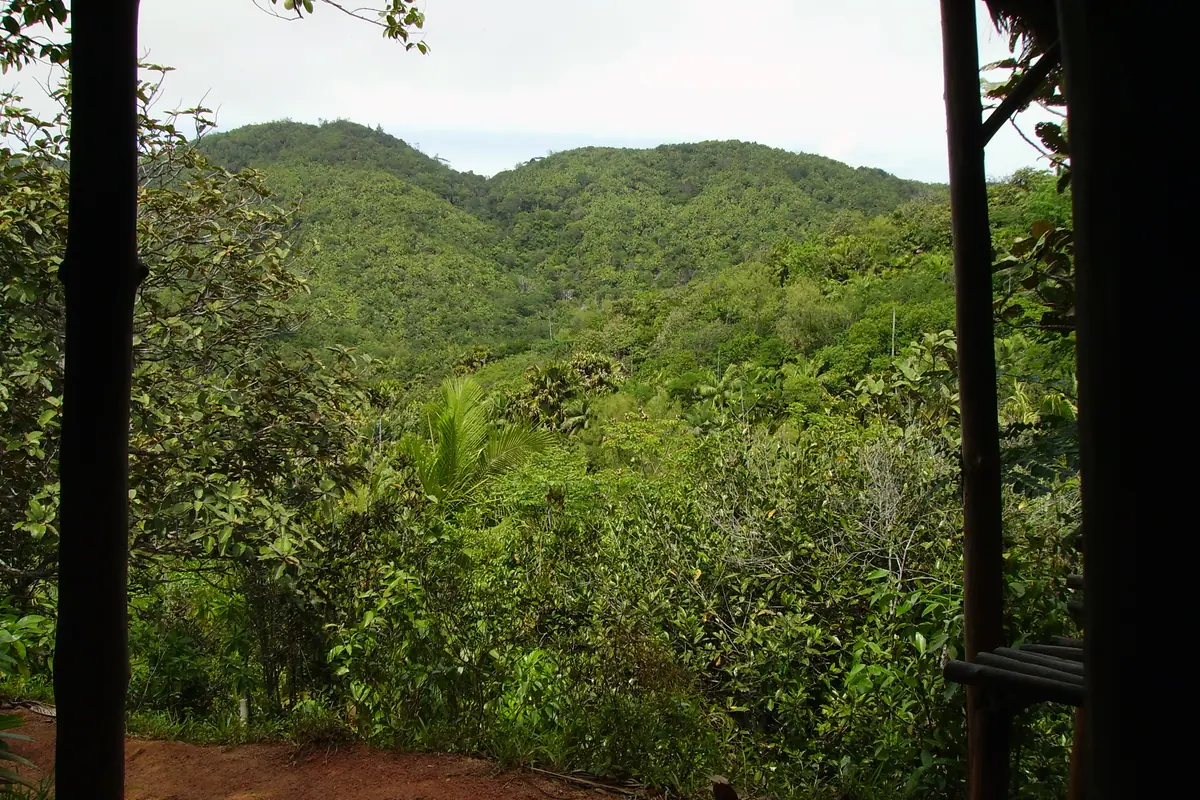
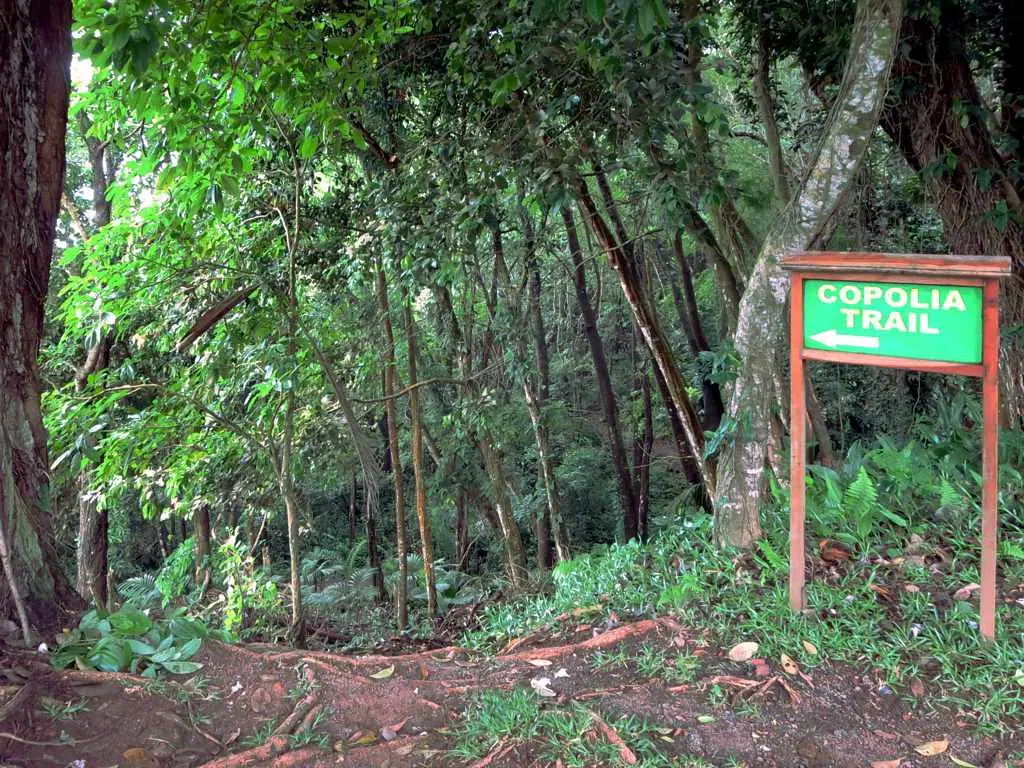
Morne Seychellois National Park covers roughly a fifth of Mahé, protecting mist forest, cinnamon groves and the island's highest ridge. The Copolia Trail is the most rewarding half-day walk: a steep 45-minute climb on a granite path that opens onto a bare rock plateau with sweeping views over Victoria, the harbour and the islands of the marine park beyond. Carnivorous pitcher plants cling to the slopes here, and the summit is a fine picnic spot before the afternoon cloud rolls in.
Other options suit different energy levels. The Morne Blanc trail climbs through dense forest to a lookout above the old tea terraces, the Trois Frères trail leads to a rocky outcrop above Victoria, and the Anse Major trail is a gentler coastal path from Danzil that ends at a small, road-free beach reached only on foot or by boat. High on the hillside above the west coast sits Mission Lodge, the stone ruins of a 19th-century school for the children of liberated slaves, with one of the finest panoramas on the island.
Victoria: One of the World's Smallest Capitals
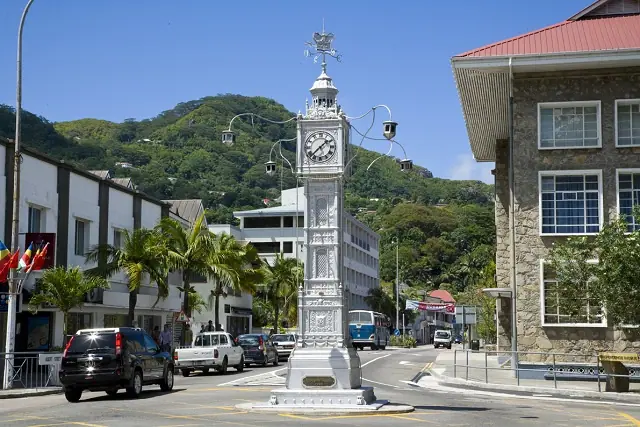
Victoria is compact enough to explore on foot in a morning, and it is worth doing so before retreating to the coast. The Sir Selwyn Selwyn-Clarke Market is the heart of the city, a covered hall where fishermen stack job fish and snapper on ice while vendors sell cinnamon bark, vanilla pods, breadfruit and bilimbi. Saturday mornings are the liveliest. Just outside stands the Victoria Clock Tower, a slim cast-iron landmark from the early 1900s that has become the city's meeting point, surrounded by low colonial-era buildings with wooden balconies.
A short walk inland brings you to the Seychelles National Botanical Gardens, where coco de mer palms, spice trees and endemic orchids grow alongside a pond busy with giant tortoises and fruit bats. Nearby are the Immaculate Conception Cathedral and a brightly painted Hindu temple whose carved tower stands out against the tropical skyline. If you have time left, the small natural history collections and the old Bel Air cemetery, with its weathered tombs, add context to the islands' layered Creole, French and British history.
Wildlife Islands: Curieuse, Cousin, Aride and Aldabra
Seychelles is as much an archipelago for wildlife as for beaches. Curieuse, a short boat hop from Praslin, is home to free-roaming Aldabra giant tortoises that wander the trails and the beach, plus mangrove boardwalks and the ochre-walled Doctor's House on the far shore. Cousin Island, a protected reserve, hosts vast seabird colonies and is one of the most important nesting sites for hawksbill turtles in the region, with nesting peaking between October and February. Aride, further north, is smaller and wilder still, with seabirds, endemic plants and no permanent residents.
Closer to Victoria, the Ste Anne Marine National Park spreads across a cluster of islands — Ste Anne, Cerf, Long, Round and Moyenne — where the reef shallows make for easy snorkelling. Moyenne is the quirkiest of them, a tiny island with tortoises, walking paths and the grave of the man who spent decades replanting it. Further afield, Bird Island fills with sooty terns in the breeding season, and the remote Aldabra Atoll — World Heritage-listed and reachable only by expedition vessel, with landing permission required in advance — shelters well over a hundred thousand giant tortoises. It is one of the great conservation spectacles on earth, and the reason Seychelles' outer islands matter far beyond their size.
When to Go, How to Island-Hop and What to Expect
The islands sit in a warm tropical climate all year, with temperatures typically between 24°C and 31°C. The northwest monsoon from November to March brings heat, humidity and short heavy showers, but also calm seas. The southeast trade winds from May to September deliver drier, breezier and slightly cooler weather, though they stir up seaweed on some east-facing beaches. The sweet spots are the transition months of April–May and October–November, when the water is calmest and underwater visibility is at its best for diving and snorkelling.
Getting around is straightforward once you accept the pace. Scheduled ferries link Mahé with Praslin in about an hour, continuing to La Digue; short flights cover the same route much faster. Hire cars work well on Mahé and Praslin — driving is on the left — while La Digue runs almost entirely on bicycles and ox-carts. A comfortable ten days lets you base yourself on Mahé, Praslin and La Digue with a day trip to Curieuse or Cousin, and booking accommodation well ahead is wise for the Christmas and Easter periods. Bring reef-safe sunscreen, cash in local rupees for small shops and market stalls, and a light rain shell whatever the forecast says.
Frequently asked questions
How many days do you need in Seychelles?
Ten days is a good target. That gives you time on Mahé for Victoria and the mountain trails, three or four nights on Praslin for the Vallée de Mai and Anse Lazio, and two nights on La Digue for Anse Source d'Argent. Seven days works if you limit yourself to two islands; anything under five means a lot of time in transit.
When is the best time to visit Seychelles?
April to May and October to November offer the calmest seas, lightest winds and clearest water. December to March is hot and humid with passing downpours, and June to September is drier and breezier but can be choppier on exposed coasts. Visibility for diving tends to peak in the transition months.
Which islands should a first-time visitor choose?
Mahé, Praslin and La Digue cover the essentials: the capital and national park on Mahé, the Vallée de Mai and Anse Lazio on Praslin, and the granite beaches and bicycle lanes of La Digue. Add a day trip to Curieuse or Cousin for tortoises and seabirds if you want wildlife without committing to a remote outer island.
Do you need a car in Seychelles?
On Mahé and Praslin, yes — a small hire car makes the beaches and trailheads much easier to reach, and driving is on the left. La Digue is tiny and flat, so most people rent bicycles instead. Between islands, scheduled ferries and short flights do the work for you.
What should you pack for Seychelles?
Light, quick-drying clothing, reef-safe sunscreen, sturdy shoes for granite trails, insect repellent for forest walks and a light rain jacket for sudden showers. Bring cash in local rupees for markets and small vendors, and note that many beaches have limited shade, so a hat and plenty of water are essential.
Plan it — experiences in Seychelles
Live search, booked directly with trusted providers.
Sort the rest of your trip
Everything for Seychelles, in one place
Stay in Seychelles
Hotels, guesthouses and apartments — compared in one search.
Search hotels
Transfer in Seychelles
Private driver waiting on arrival — no queues, no surprises.
Book a transfer
Stay online in Seychelles
Travel eSIM — data the moment you land, no roaming bills.
Get an eSIMMore guides in Seychelles
Hotels in Seychelles: Where to Stay on Mahé, Praslin and La Digue
Seychelles Island-Hopping Itinerary: One Week by Air, Ferry and Bicycle
Best Time to Visit the Seychelles: Weather, Beaches and When to Book Your Hotel