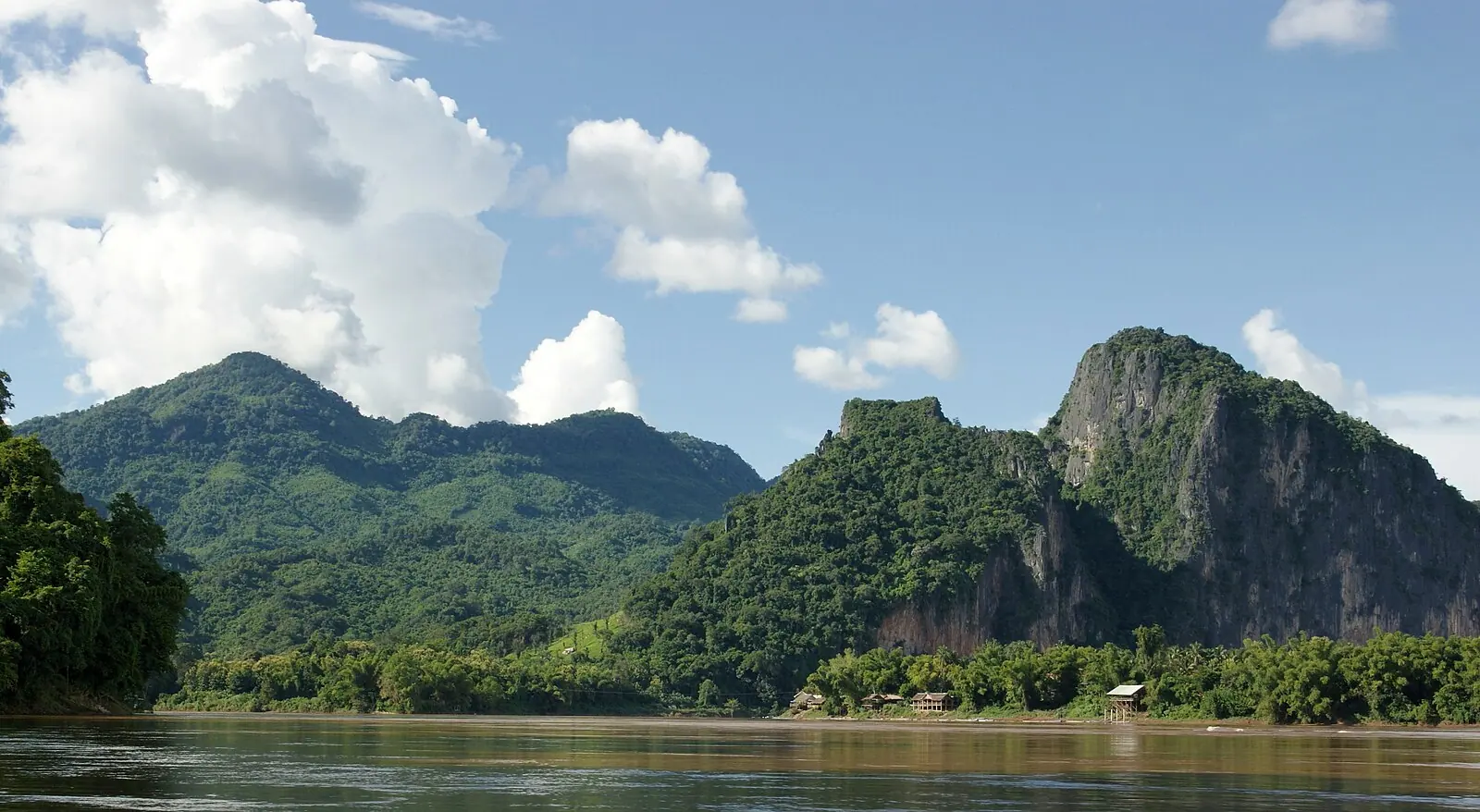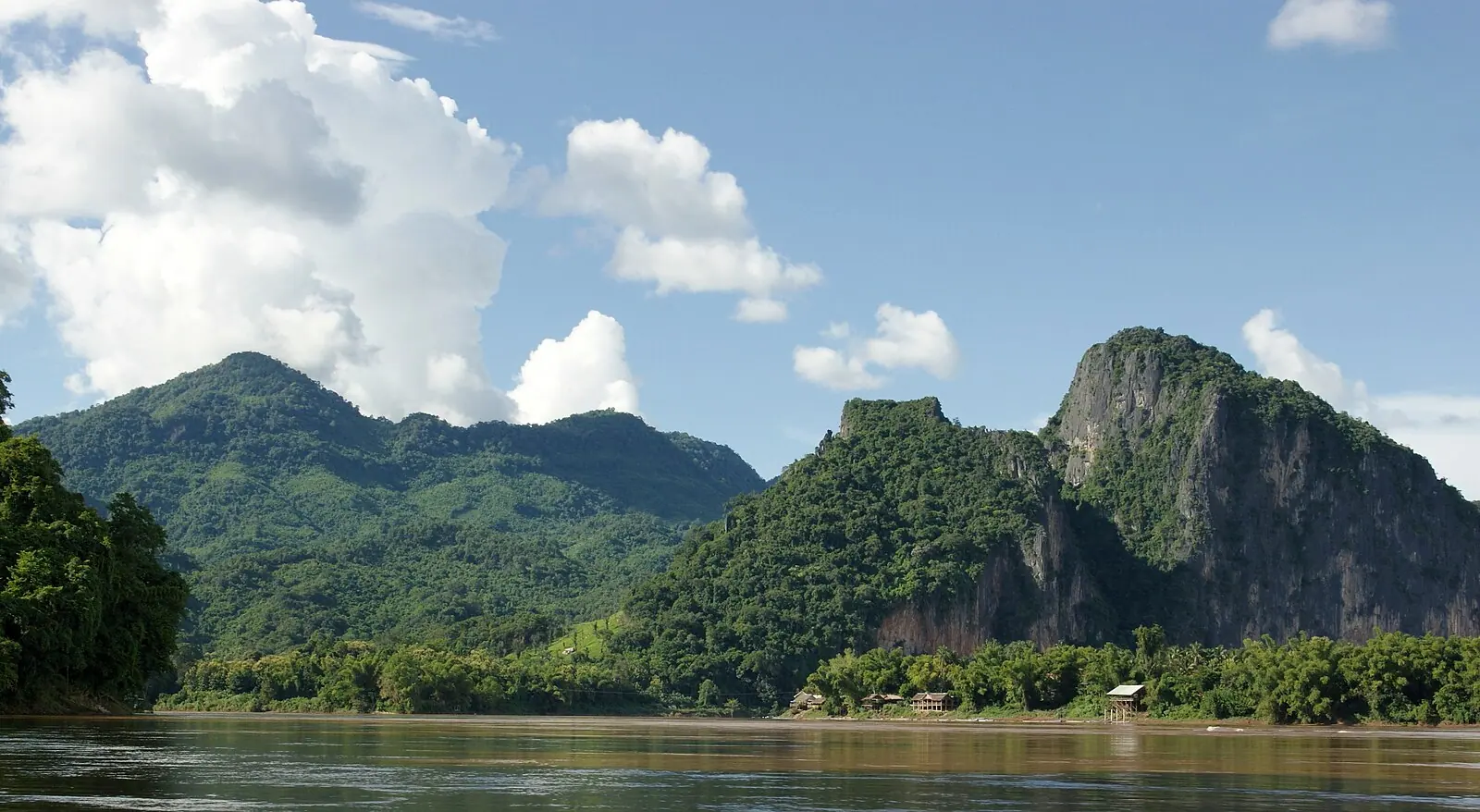
Laos slips by at the speed of the Mekong — slow, brown-gold and impossible to hurry. Between gilded temple roofs, limestone towers and a plateau of prehistoric stone jars, this is Southeast Asia without the crowds, where the reward for travelling a little further is a country that still feels quietly undiscovered.
Luang Prabang: The Temple Town That Anchors Every Laos Journey
Set on the narrow peninsula where the Khan River slides into the Mekong, Luang Prabang is the country's spiritual heart and its most elegant town. Thirty-odd wats crowd the lanes, and the finest of them all, Wat Xieng Thong, is a low-roofed masterpiece of dark timber and gold stencil work, its walls covered in glass-mosaic trees and its funeral carriage house glittering in the courtyard. A short walk away, the former Royal Palace Museum holds royal regalia and Lao religious art, and the teak-fronted Wat Mai Suwannaphumaham sits just downhill from the night market. Budget two to three full days here at minimum — more if you plan to day-trip out to the waterfalls and caves.
Climb Mount Phousi in the late afternoon for the town's defining view: 328 steps up a stairway lined with frangipani and broken Buddhas, then a panorama of orange temple roofs, the two rivers and the karst hills beyond. Stay for sunset, when the Mekong turns copper and the monks' chanting drifts up from below. Mornings belong to the alms-giving procession, when lines of robed monks walk the streets collecting sticky rice from kneeling residents — if you watch, do it respectfully: keep your distance, stay silent, dress covered, and never block the procession with a camera.
The town is also the best place in Laos to eat. Sitting down at a wooden table for a bowl of khao soi — the local noodle soup thick with pork and tomato — is as much a Luang Prabang ritual as the temples. Afterwards, browse the night market for hand-woven silk and mulberry-paper lanterns, then finish with a glass of rice whisky on a Mekong-facing balcony.
Kuang Si Falls, Pak Ou Caves and the Slow Boat on the Mekong
About 30 kilometres south of Luang Prabang, Kuang Si Falls spills down a series of terraces into pools of unreal milky turquoise, cold enough to make you gasp and clear enough to see the bottom. Go early — by mid-morning the lower pools fill up — and walk the full trail to the top tier, passing a rescue centre for rescued Asiatic black bears on the way in. Combine it with a stop at Tad Sae, a softer, wide-set waterfall reached by a short boat crossing, which is particularly good in the wet months when the flow is at its peak.
North of town, the Pak Ou Caves sit in a limestone cliff at the point where the Ou River meets the Mekong, roughly two hours upstream by longtail boat. The lower cave, Tham Ting, is the more atmospheric of the two and is packed with thousands of Buddha images in every size and posture, many of them worn smooth by damp and incense. Boat trips usually stop at riverside villages on the way, where you can watch rice whisky being distilled and sample the local brew — a strong, fiery spirit that is best sipped, not gulped.
For a slower arrival, take the two-day slow boat from the northern border down the Mekong to Luang Prabang, with a night in the tiny river town of Pakbeng along the way. It is uncomfortable, occasionally cramped, and one of the great travel experiences in Southeast Asia: hour after hour of green hills, buffalo on the sandbanks, fishermen casting nets and children waving from the shore. Alternatively, the express railway now links the northern towns with Vientiane, cutting a full day of winding mountain road into a couple of smooth hours.
Vientiane: Stupas, Arches and a Quiet Capital
Vientiane is one of the sleepiest capitals in Asia, which is exactly its charm. Its national symbol, Pha That Luang, is a vast gilded stupa rising in a closed square of cloisters, best seen in the low light of late afternoon when the gold goes molten. Nearby, Patuxai — the Lao answer to a triumphal arch, decorated with concrete kinnari figures and lotus towers — can be climbed for a rooftop view down a long avenue towards the stupa. Between them, Wat Si Saket is the city's oldest surviving temple and holds thousands of small Buddha images tucked into the walls of its cloister.
Twenty-five kilometres out of town on the riverbank, the Buddha Park is a surreal sculpture garden of over 200 concrete Hindu and Buddhist figures, including a bulbous pumpkin-shaped structure you can climb into through a demon's mouth and a giant reclining Buddha that stretches the length of the lawn. Allow two unhurried days in the capital: one for the temples and the arch, one for the park and the riverside.
Do not skip the quieter corners. A small, sobering exhibition near the city centre explains the country's ongoing legacy of unexploded ordnance and the work being done to clear it — invaluable context before heading to the northeast. In the evening, the Mekong promenade fills with families, aerobics classes and food stalls; sit on a mat by the water with a grilled river fish and watch the sun drop towards Thailand on the far bank.
Vang Vieng and the Karst Country
Halfway between the capital and Luang Prabang, Vang Vieng sits in a valley of sheer limestone towers with the Nam Song sweeping past their feet. The scenery is the entire point: sunrise hot-air balloon flights lift off over mist-clogged ridges, kayaks drift downstream between cliffs, and a network of viewpoint trails — the steep scramble up Pha Ngern is the classic — delivers the postcard panorama in under an hour of climbing.
On the ground, caves and swimming holes fill the afternoons. Tham Chang, a large cavern opening onto a viewpoint over the river, is close enough to walk to, while further out the Tham Phu Kham cave hides a bronze reclining Buddha in its depths, with the electric-blue pools known as the Blue Lagoons strung along the road behind it. The nearest lagoon is the busiest; the further ones are quieter and just as blue.
The town itself has mellowed a lot from its party-era reputation, and now it is mostly a base for outdoors: cycling through rice paddies, climbing the karst walls, or tubing the river at a relaxed pace with stops for a cold drink. Two or three nights is the sweet spot — long enough for a balloon flight, a cave day and a lazy float on the Nam Song.
The Plain of Jars and the Wild Northeast
The Plain of Jars, scattered across the highland around Phonsavan, is Laos's strangest and most evocative ancient site: hundreds of hollowed stone jars, the largest weighing several tonnes, carved from sandstone and granite and left in place for roughly two thousand years. Nobody knows for certain what they held — cremated remains, rice wine, rainwater for travellers — and that mystery is part of the pull. Site 1 is the most accessible and photogenic, with a cave used as a shelter during the American bombing campaign nearby; Sites 2 and 3 involve short walks past bomb craters and are quieter. Stay strictly on the marked paths: this province was heavily bombed and unexploded ordnance still scars the ground off-trail.
Further south, in Khammouane province, the Tham Kong Lo cave swallows the Nam Hin Boun river for nearly seven kilometres. You travel through it by longtail boat, headlamps barely denting the blackness, past stalagmites the size of houses, then emerge into a hidden valley where the water welling up from the rock is an impossible, luminous jade. It is a full-day detour from Tha Khaek and one of the most memorable boat rides in the country.
This is cool, remote highland country — bring a fleece, because nights in Phonsavan can be genuinely cold from November to February, when clear skies and comfortable daytime temperatures make it the ideal window. The reward for the long, winding road is a Laos that few visitors bother to reach: Hmong and Khmu villages, morning markets full of foraged greens, and jars standing silent in fields of grazing cattle.
The South: Wat Phou, the Bolaven Plateau and the 4,000 Islands
In the far south, near the sleepy Mekong town of Champasak, Wat Phou is the country's greatest archaeological treasure — a ruined Khmer temple complex climbing a hillside towards a natural linga-shaped peak, with origins stretching back to the sixth century and its main Hindu sanctuaries built three or four hundred years later. Go in the early morning or late afternoon when the stonework turns honey-coloured and the frangipani trees are full of birdsong; allow a half-day and bring water, as the upper terraces are a stiff climb.
East of Pakse, the Bolaven Plateau is coffee country: cool, volcanic and green, watered by waterfalls that thunder off its rim. Tad Fane drops twin threads into a forested gorge, Tad Yuang pours a wide curtain over a ledge you can picnic beside, and the road between them loops past tea farms, coffee roasteries and ethnic villages — best done with two or three days and a motorbike.
Finally, the Mekong widens and breaks into Si Phan Don, the 4,000 Islands, where life slows to bicycle pace on Don Det and Don Khon. Hire a bike to cross the French-era bridge to Khone Phapheng, the widest waterfall in Southeast Asia, a roaring mass of water and rock that makes the Mekong look like an inland sea. Near the Cambodian border, small boats take visitors out at dawn to glimpse the last Irrawaddy dolphins in the river — the dry months, roughly December to April, offer the calmest water and the clearest sightings. Set aside four or five days for the south; it is the perfect place to end a Laos trip, barefoot and unhurried.
Frequently asked questions
What is the best time of year to visit Laos?
November to February is the sweet spot: dry, sunny and cool, with comfortable trekking temperatures and clear views. March to May turns hot, hazy and smoky as farmers burn fields, with temperatures commonly above 35C. The green season from May to October brings heavy afternoon downpours, but waterfalls are at full power, the Mekong is high, and prices and crowds are at their lowest — just pack a rain jacket and expect muddy trails.
How many days do you need in Laos?
A comfortable first trip runs 12 to 14 days: three in Luang Prabang including a waterfall and cave day, one or two in Vang Vieng, two in Vientiane, and four or five in the south around Pakse, Wat Phou and the 4,000 Islands. If you only have a week, pick either the north or the south and travel overland or by rail rather than trying to see the whole country.
What are the absolute must-see landmarks in Laos?
Wat Xieng Thong and Mount Phousi in Luang Prabang, the turquoise terraces of Kuang Si Falls, the Buddha-filled Pak Ou Caves, Pha That Luang and Patuxai in Vientiane, the karst valleys of Vang Vieng, the prehistoric Plain of Jars near Phonsavan, the Khmer ruins of Wat Phou in Champasak, and Khone Phapheng falls in the 4,000 Islands.
How do you get around Laos?
Domestic flights connect the main cities, and an express railway now links Vientiane, Vang Vieng and Luang Prabang in a few smooth hours. Elsewhere, overnight sleeper buses and minivans cover the long distances, and the two-day slow boat down the Mekong from the northern border to Luang Prabang is an experience in itself. For waterfalls, caves and the Plain of Jars, you will need a local guide, tuk-tuk or rented motorbike.
What should I know about temple etiquette and the alms-giving ceremony?
Cover your shoulders and knees at all temples, remove your shoes before entering shrine buildings, and never touch or point your feet at a Buddha image. At the morning alms-giving in Luang Prabang, watch from a respectful distance, stay quiet, refrain from flash photography and do not stand between the monks and those offering food. If you want to take part, buy sticky rice from a reputable local stall rather than a tour package.