Iraq is not one story but a dozen layered ones — Babylonian brick, Abbasid gold, Assyrian stone, and reed islands floating on water the colour of strong tea. It asks for patience, curiosity and a good local guide, and in return it hands you some of the oldest, strangest and most beautiful places on earth.
Baghdad: Book Streets, Abbasid Walls and Masgouf by the Tigris
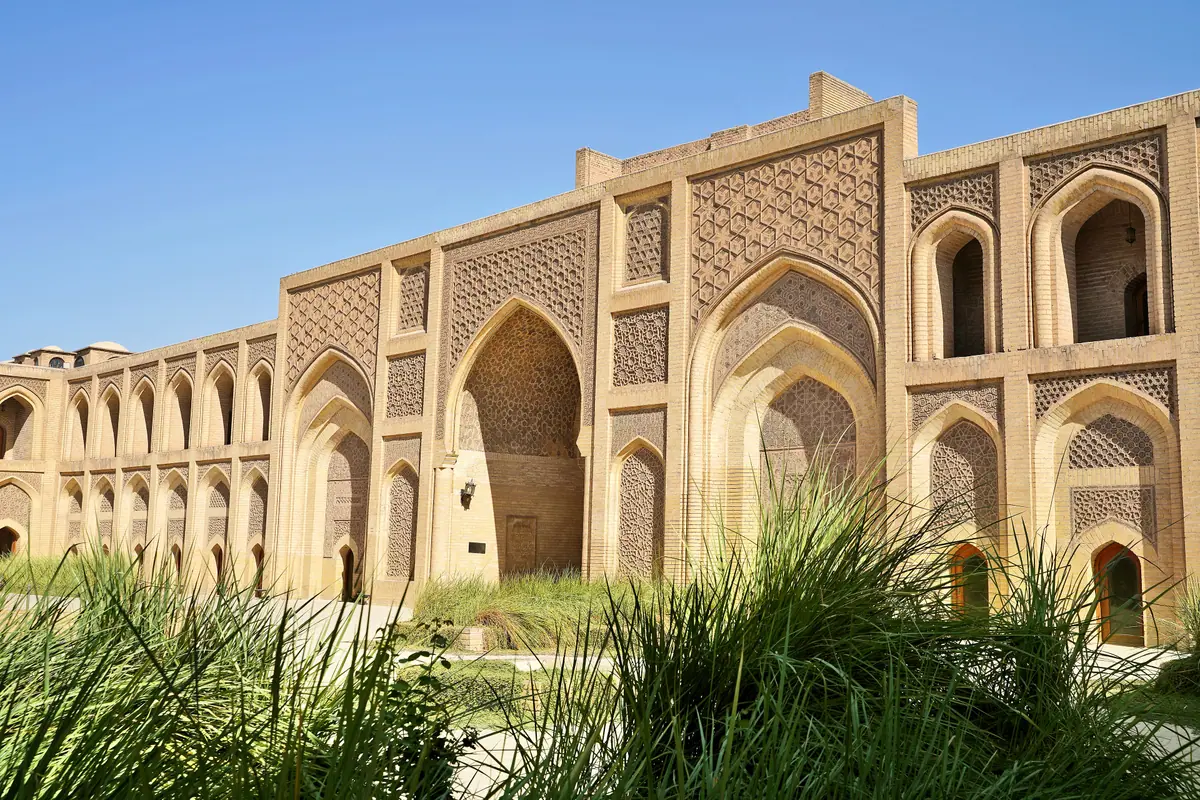
Begin on Mutanabbi Street, the historic booksellers' row that slopes down to the river embankment. On Friday mornings the pavement disappears under poetry collections, brittle old maps and stacked paperbacks, while readers crowd the cafes and the bronze figure of the poet al-Mutanabbi stands guard near the old clock tower. A short walk away on Rashid Street, the Al-Mustansiriya Madrasah raises a carved muqarnas portal and ribbed brick vaults from the 13th century, and the neighbouring Abbasid Palace keeps a maze of cool corridors and pointed arches — both survivors of the city the Mongols levelled in 1258.
The Iraqi National Museum holds the deepest Mesopotamian collection anywhere: Sumerian cylinder seals, Assyrian reliefs carved with bearded kings and winged genies, ivory furniture panels and grave goods from the royal tombs of Ur. Follow it with the Monument to the Martyrs, a split turquoise dome that hovers like a broken shell, and Tahrir Square, where the Freedom Monument wraps bronze reliefs around a central figure — the finest modern sculpture in the country. Budget half a day for the pair, and keep your camera down near checkpoints and government buildings.
Come evening, eat masgouf on Abu Nuwas Street: freshwater carp split, salted, propped on sticks and grilled slowly over open embers, then served with flatbread, pickles, tomatoes and small glasses of sweet tea. Afterwards cross the river to the Kadhimiya district, where the gilded domes of the Kadhimiya Mosque glow above streets that stay busy long after midnight. October to April is the season for this; July heat in Baghdad is genuinely punishing.
Babylon, Ur and the Ziggurat Trail
About 90 kilometres south of the capital, near the town of Hillah, lie the mounds of Babylon. You walk past the Lion of Babylon in weathered black basalt, along the reconstructed Ishtar Gate and Processional Way with their blue-glazed brick beasts, through the remains of Nebuchadnezzar's palace and the later Greek theatre built into its ruins. Parts of the site were rebuilt in the 20th century and the reconstruction divides opinion, but the scale still lands: this was a capital of the ancient world, and you are standing in its courtyard. Go at opening time — there is almost no shade, and the ground bakes by noon.
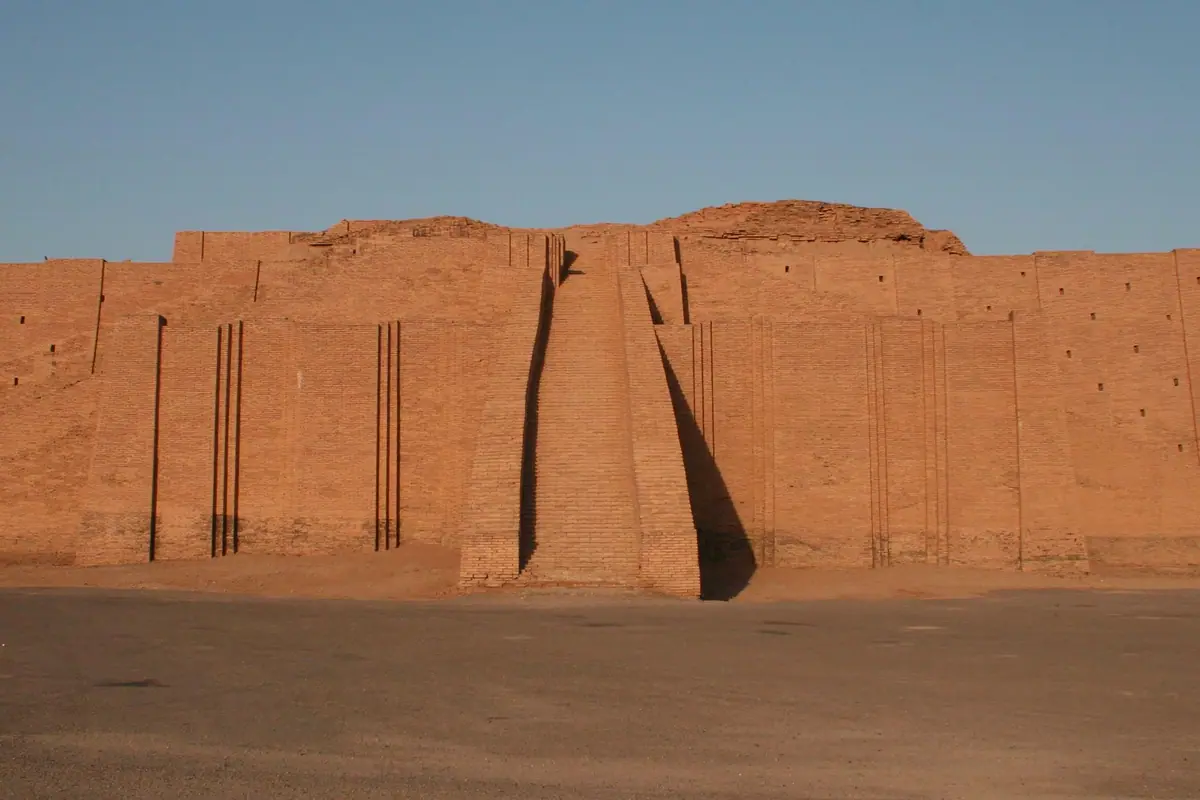
Further south near Nasiriyah stands the Great Ziggurat of Ur, raised by King Ur-Nammu roughly four thousand years ago from tiered mudbrick and bitumen. A monumental staircase climbs to a platform where the temple of the moon god Nanna once stood, and the surrounding royal cemetery produced the gold, lapis and silver headdresses that fill museum cases far from here. Access can require permits, so arrange it in advance through a local guide.
Two more stops suit a dedicated archaeology day: Aqar Quf, the Kassite ziggurat about 30 kilometres west of Baghdad, and Borsippa — known locally as Birs Nimrud — whose vitrified, fire-fused brick core rises above the plain. Both are quick visits, best in winter or early spring when the light is soft and the temperature forgiving.
Ctesiphon, Samarra and the Great Spiral
South-east of Baghdad, close to the Tigris at Salman Pak, the Taq Kasra — the Arch of Ctesiphon — stands alone in a field. It is the surviving audience hall of a Sasanian palace, and the widest single-span brick vault ever raised without centering; the facade has been pared back to a shell, yet the curve still produces a physical jolt when you walk beneath it. Low morning light is best, the visit takes under an hour, and access arrangements change, so confirm before you set out.
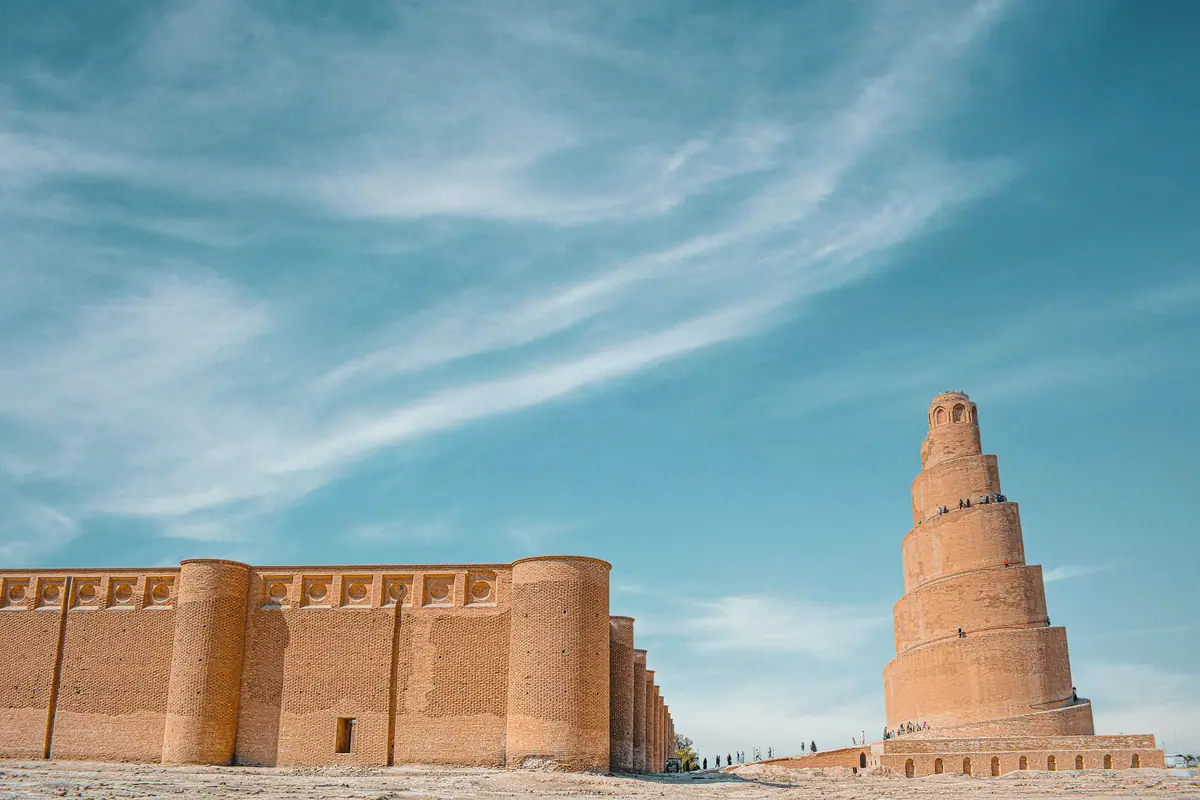
Roughly 125 kilometres north of the capital, Samarra spreads across a far older foundation. The Great Mosque of Samarra is dominated by the Malwiya, a spiral minaret about 52 metres high that you climb by a ramp coiling around its outside — vertigo guaranteed, views across the river plain unforgettable. Around it a forest of brick piers marks the largest mosque of its age, part of a world-heritage listed archaeological zone.
Samarra is also home to the Al-Askari Shrine, its golden dome covering the tombs of two imams and drawing pilgrims from across the region. Expect bag searches, crowds at prayer times and a strict dress code: women fully covered with a headscarf, men in long trousers, shoes removed at the threshold. Visit outside major religious dates if you want space to look at the tilework.
Mosul, Nineveh and the Assyrian North
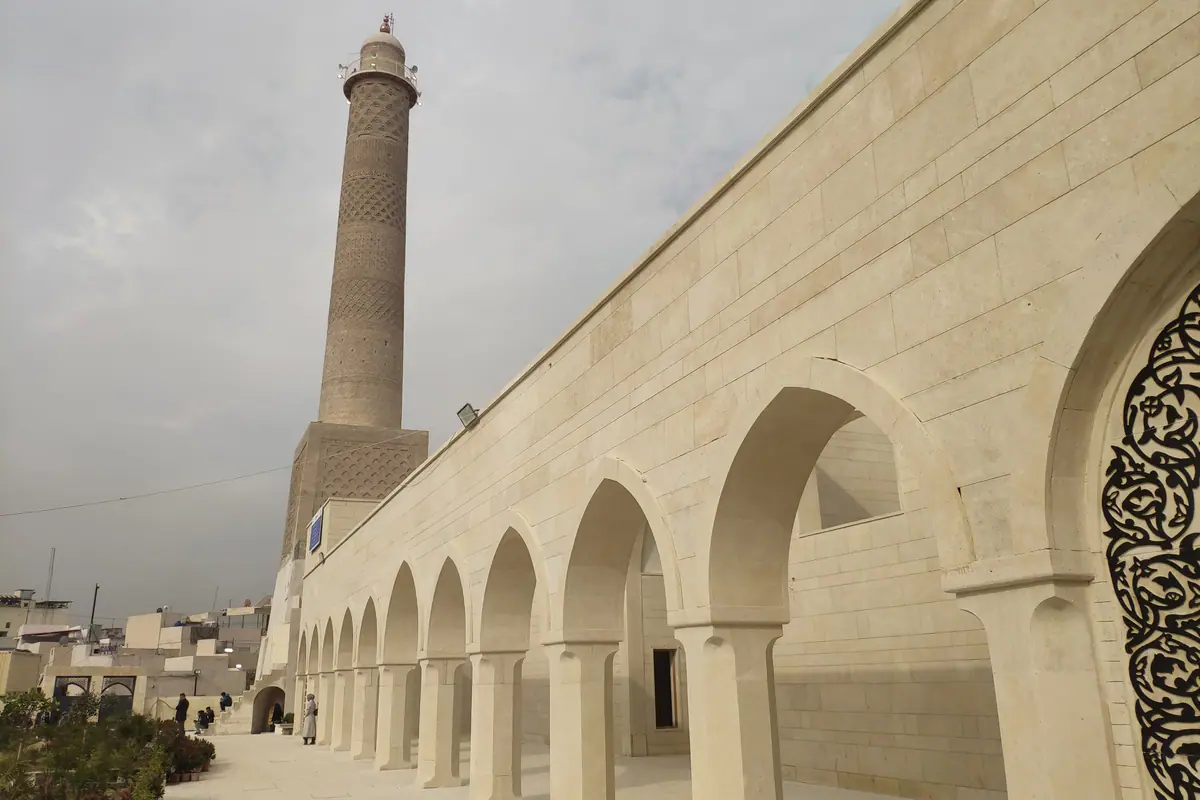
Mosul's old city on the west bank is rebuilding itself street by street. The Al-Nuri Mosque and its leaning Al-Hadba minaret have been raised again, the lanes around them are filling with workshops, teahouses and restored stone houses, and the Mosul Museum displays Assyrian and Hatrene sculpture recovered from the region. Al-Tahera church and the riverside corniche complete a walk that takes a full, slow day — this is a place to spend money locally and talk to people rather than tick off sights.
Across the Tigris, the mounds of Nineveh at Kuyunjik and Nebi Yunus mark the Assyrian capital of Sennacherib, with the remains of his palace and the clay tablet library assembled by Ashurbanipal. Nimrud, ancient Kalhu, lies about 30 kilometres south, its ziggurat and gateways once flanked by colossal winged bulls.
Deeper into the desert between Mosul and Baghdad sits Hatra, a caravan city of elegant limestone temples, iwans and arches that earned a place on the world heritage list. It is remote, the drive is long, and you should go with a guide in the cool months — November to March — with water, shade and a full day set aside.
Iraqi Kurdistan: Citadel, Gorges and Mountain Lakes
Erbil is the easiest gateway to the country, with direct flights and straightforward visa arrangements at its airport. At its centre, the Citadel of Erbil sits on an enormous tell that has been lived on for millennia; inside the walls, restored houses, a textile museum and quiet lanes look out over a city of minarets and cranes. Below it, the Qaysari bazaar sells fabrics, spices and gold in covered alleys, and the slender Mudhafaria Minaret stands a short taxi ride away.
Head east for the landscapes: the Rawanduz gorge, where the road cuts through a canyon of rust-coloured rock; the waterfall at Gali Ali Beg and the springs at Bekhal; the viewpoint above Dukan Lake; and Amedi, a small town sitting flat-topped on a rock plateau like a table. Spring, from March to May, turns the hills green and cool, while summer heat is bearable in the mountains even when Baghdad swelters.
In Sulaymaniyah, Amna Suraka — the former security headquarters turned museum — is sobering and essential, as is the memorial at Halabja. Further west, Lalish is the holiest site of the Yazidi faith, a complex of conical-roofed shrines: remove your shoes, dress modestly, keep your voice low and follow the custodians' instructions on photography.
The Shrine Cities and the Marshes of the South
Najaf centres on the Imam Ali Shrine, its gold dome and twin minarets visible across the city, and beside it the Wadi al-Salaam, a cemetery so vast it reads as a city in its own right. Karbala holds the Imam Husayn Shrine and the Al-Abbas Mosque, joined by the wide open ground where millions of pilgrims gather for Arbaeen each year. Non-Muslim visitors usually cannot enter the inner sanctuaries, but the architecture, the crowds and the tea shops are still worth the journey — check the current access rules before you travel.
South-east of Nasiriyah, the Mesopotamian marshes spread out in channels, reed beds and open water. In Chibayish you can sleep in a mudhif, the traditional guest house built from arched reed columns, eat fresh fish and glide out at dawn in a mashoof canoe past water buffalo and herons. It is a world-heritage listed landscape and, for many travellers, the most peaceful morning in Iraq.
Finish in Basra, where the Shatt al-Arab widens towards the Gulf. The corniche fills with families in the evening, the palm-lined waterways make for an easy boat trip, and the food — grilled fish, sweet tea, dates — is a fitting last taste of the south. November to March is the sweet spot for this region; summer is brutally humid.
Frequently asked questions
When is the best time to visit Iraq?
October to April is the comfortable window almost everywhere, with mild days in Baghdad, Babylon and the south and cool, green conditions in Kurdistan from March to May. July and August are brutal in Baghdad and Basra, often above 45°C, while northern mountain roads can see snow and closures in midwinter.
Do I need a visa for Iraq?
Many nationalities can get a visa on arrival at Baghdad, Erbil or Sulaymaniyah airports, but the Kurdistan region and federal Iraq have historically handled entry separately, so travelling south from Erbil to Baghdad may need the correct federal document. Rules change often — confirm with an Iraqi embassy before booking flights.
Can I travel around Iraq independently?
Kurdistan is manageable on your own with taxis and shared cars, but most visitors to central and southern Iraq travel with a licensed guide or small group. Some sites, including Ur and Hatra, may require permits or a police escort, and you should expect frequent checkpoints and requests for ID.
How long do I need and how do I get around?
Ten to fourteen days lets you cover Baghdad, Babylon, Najaf or Karbala, Mosul, and Erbil with a few mountain days. Domestic flights link Baghdad with Erbil, Mosul and Basra, while road journeys between regions often take five to eight hours — avoid night driving and build in buffer time.
What should I wear and how should I behave?
Pack loose, modest clothing that covers shoulders and knees; women should carry a scarf for shrines and cover their hair inside religious sites. Remove shoes where indicated, ask before photographing people, and avoid photographing checkpoints, bridges and government buildings. Carry cash in Iraqi dinars, as cards are widely accepted only in larger hotels.
Sort the rest of your trip
Everything for Iraq, in one place

More guides in Iraq
Best Time to Visit Iraq: Seasons, Must-See Sites and Where to Stay
Best Places to Visit in Iraq: Ancient Cities, Golden Shrines and Kurdish Mountains
A Tour of Iraq: Food, Culture and Must-See Landmarks of Mesopotamia