Georgia packs snow-capped Caucasus peaks, a labyrinthine capital of sulfur baths and wine bars, cave cities carved into cliff faces and a Black Sea coastline into one compact country. It is small enough to cross in a day and rich enough to keep you busy for weeks.
Tbilisi: Sulfur Baths, Fortresses and the Old Town
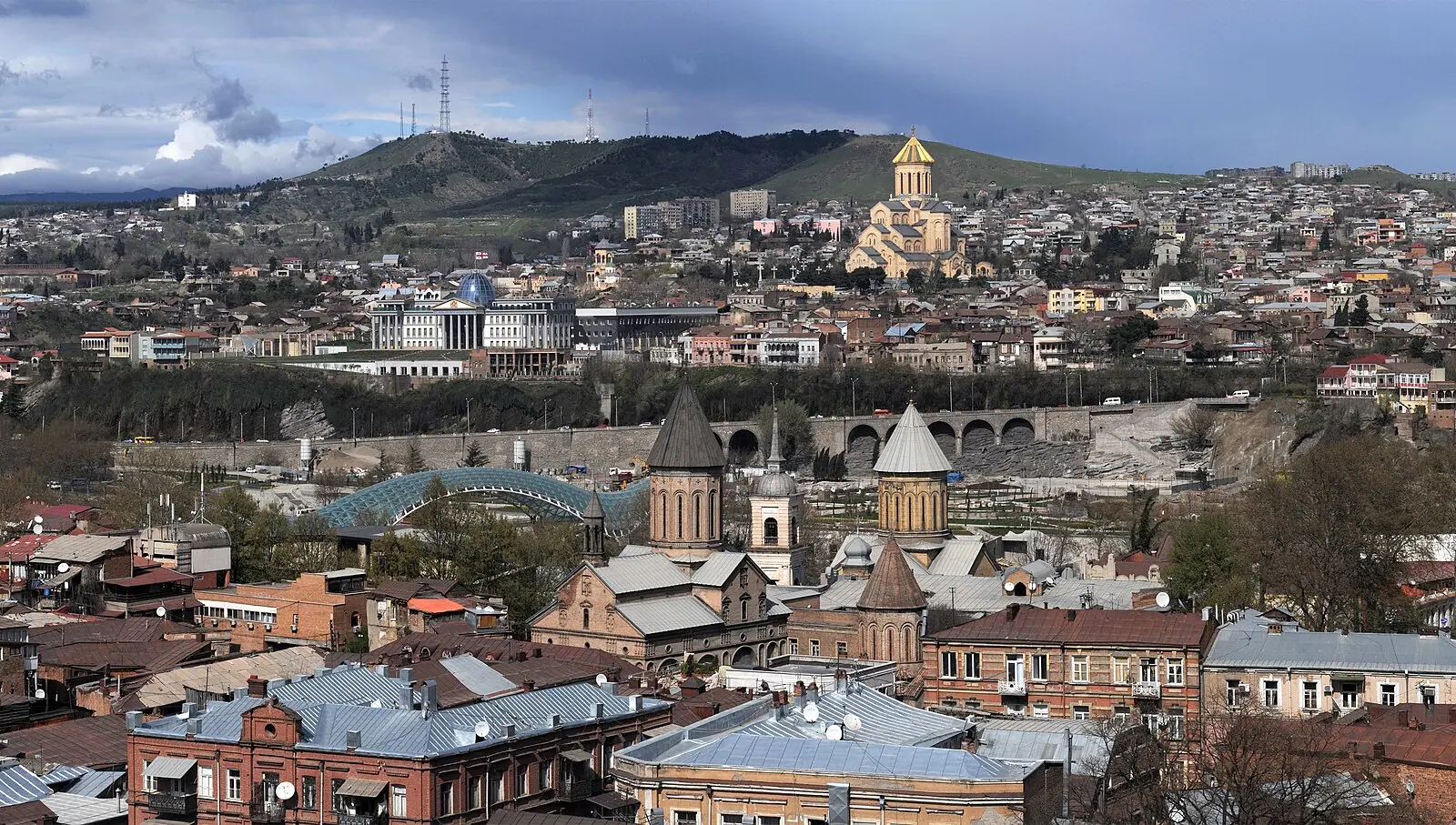
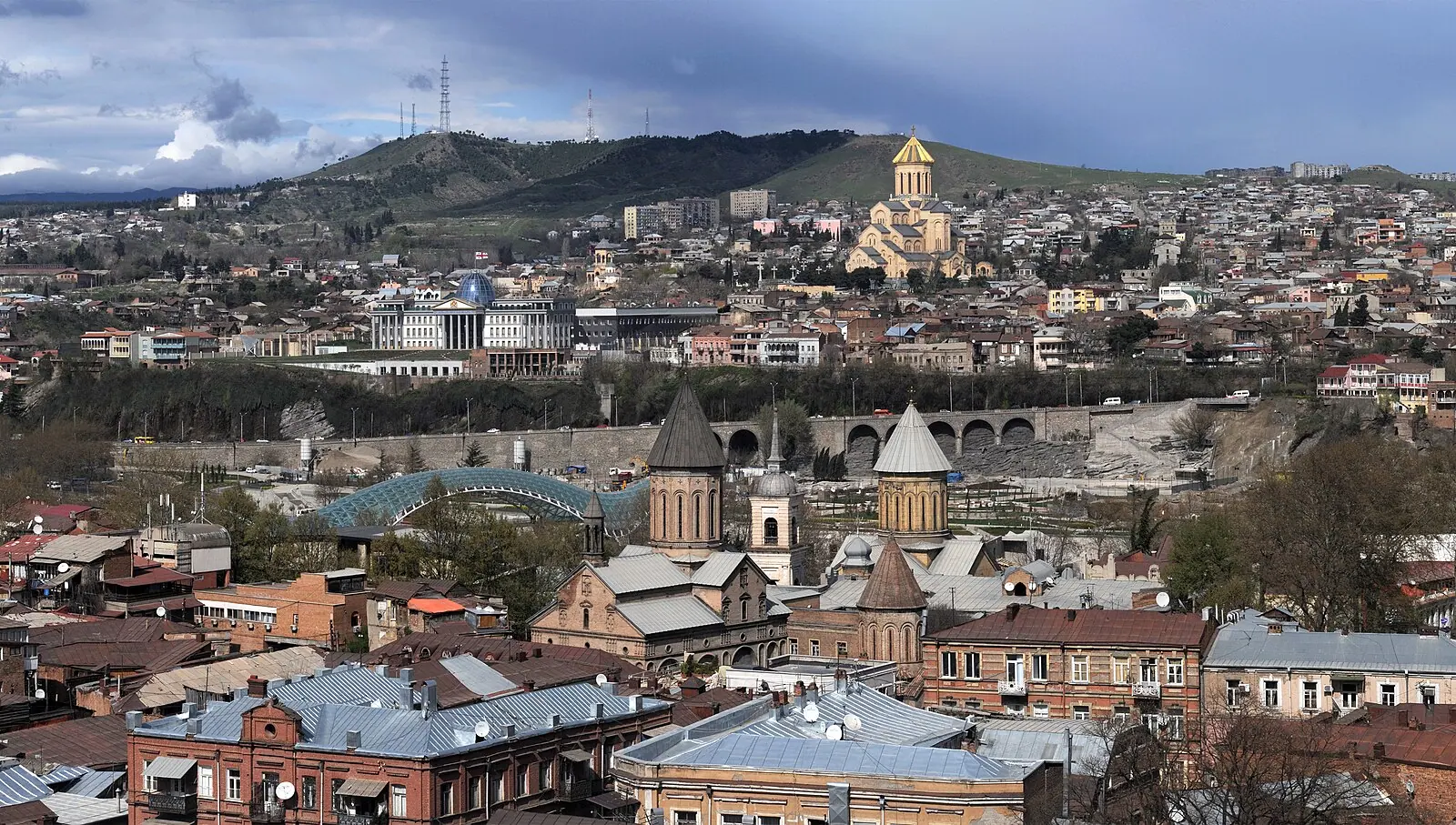
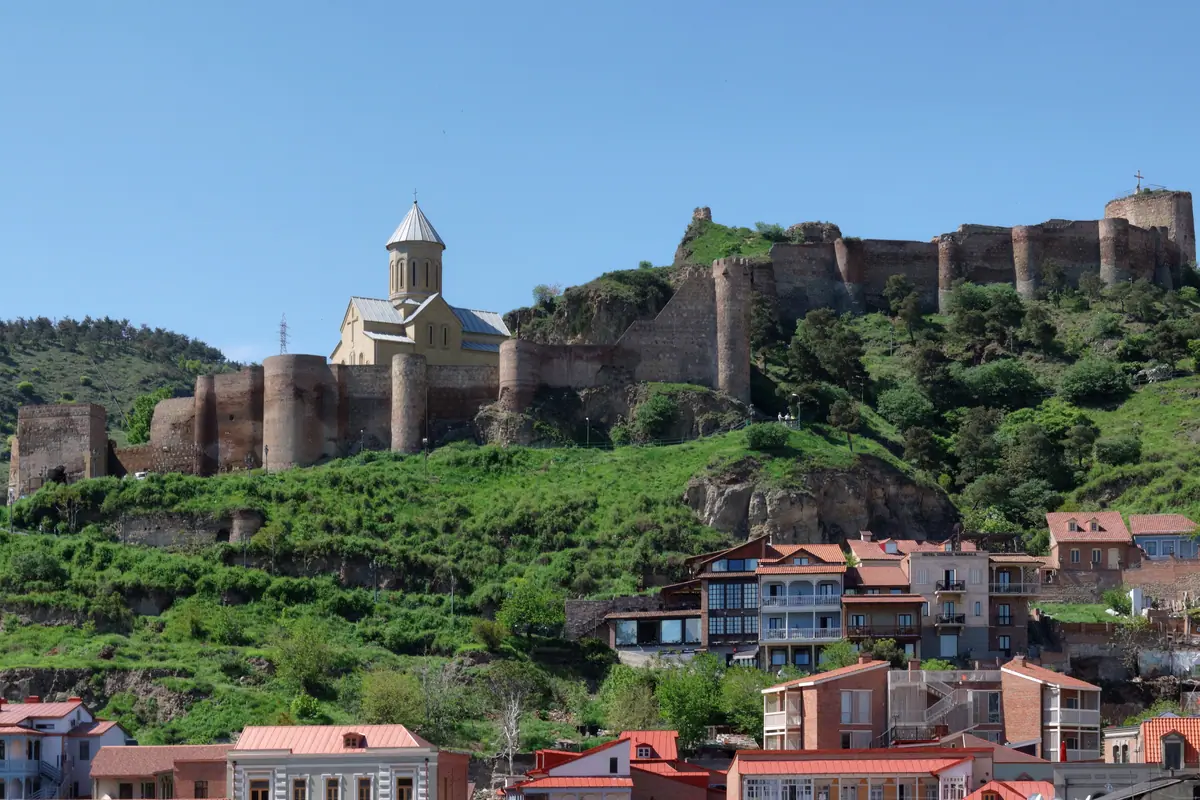
Tbilisi rewards wandering more than sightseeing. The capital spills down both banks of the Mtkvari River, and its name comes from the hot springs that still bubble up in Abanotubani, the bathhouse district where domed brick roofs rise out of the ground like a row of beehives. Above it all sits Narikala Fortress, reachable by cable car from Rike Park or by a steep climb through the old town's crooked lanes. From the ramparts you get the classic view: the towering statue of Mother of Georgia, the glass-and-steel Bridge of Peace arcing over the river, and church towers stacked against the hillside.
Give yourself at least two full days in the centre. Walk Rustaveli Avenue past the Parliament building and the opera house, cross Freedom Square, and climb to the Holy Trinity Cathedral, whose gold dome dominates the skyline. The Dry Bridge flea market is where you hunt for Soviet-era cameras, medals and enamelware, while the lanes around Sioni Cathedral hide wine bars, carpet shops and courtyards that open onto sudden panoramas.
Then eat: khinkali dumplings eaten by hand, molten khachapuri cheese bread, walnut-and-aubergine rolls, and churchkhela — strings of nuts dipped in grape must — sold from roadside stalls. In the evening, ride the funicular up to Mtatsminda Park for the city lights, or head to the monumental Chronicle of Georgia near the Tbilisi Sea for a quieter, stranger sunset. Finish the night in a sulfur bath, scrubbed pink by a bathhouse attendant.
Mtskheta and the Georgian Military Highway
Forty minutes from the capital, Mtskheta was the country's ancient capital and remains its spiritual heart. Svetitskhoveli Cathedral, a vast stone church crowned with a conical dome, holds the graves of Georgian kings and has been the setting for coronations for a thousand years. Across the river, the hilltop Jvari Monastery looks down on the meeting of the Mtkvari and Aragvi rivers — the view that appears on half the postcards ever printed of this country. Both are easy half-day trips, and both are best visited early before tour minibuses arrive.
Keep going north and the road becomes the Georgian Military Highway, the old invasion route through the Greater Caucasus. First stop is the turquoise Zhinvali reservoir, then Ananuri Fortress, a walled 17th-century complex whose battlements and two churches hang directly over the water. It is meant to be a five-minute photo stop and almost always turns into an hour.
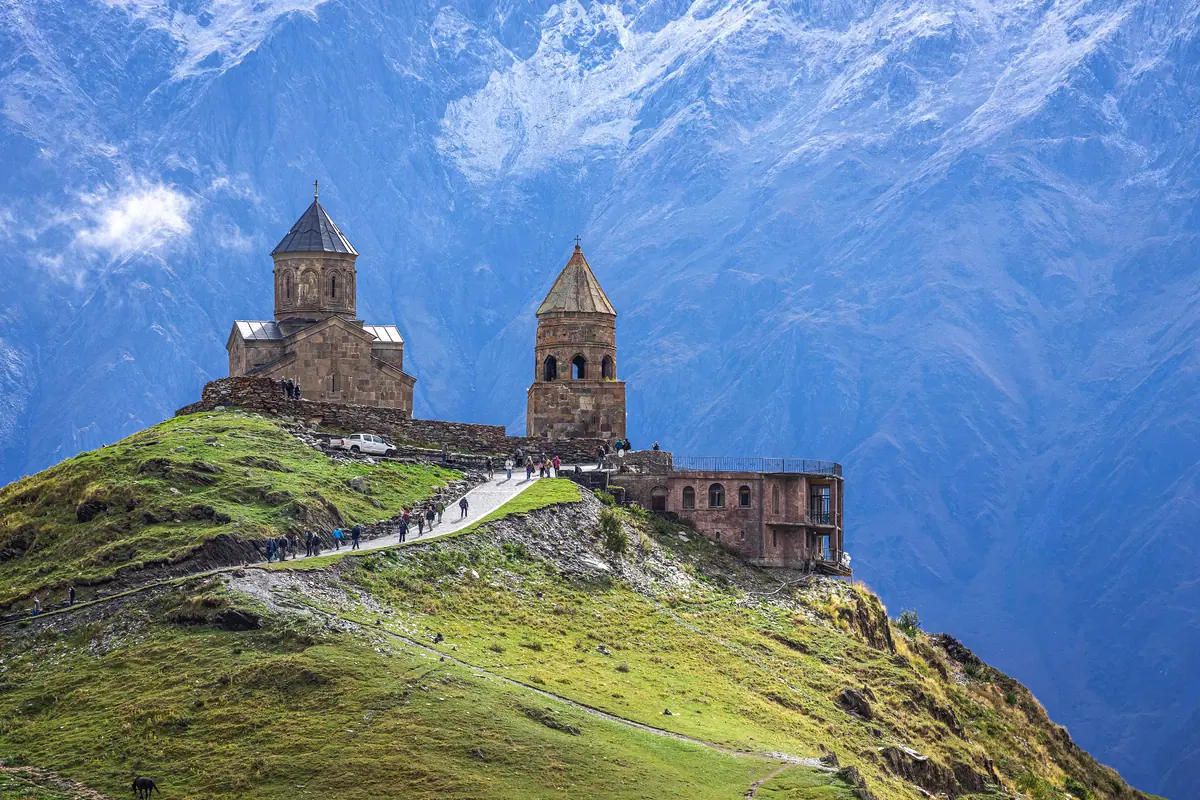
Beyond the ski slopes of Gudauri the valley narrows and you reach Stepantsminda, usually called Kazbegi, beneath the permanently snow-covered cone of Mount Kazbek at 5,054 metres. From town it is a 1.5 to 2-hour uphill walk — or a short 4x4 ride — to Gergeti Trinity Church, a lone stone chapel perched at roughly 2,170 metres with glacier and peak behind it. Go in the morning; clouds usually swallow the summit by mid-afternoon.
Hiking the High Caucasus: Truso, Juta and Svaneti
The north is walking country. From Kazbegi you can day-hike into the Truso Valley, a wide glacial basin of mineral springs, ruined tower villages and orange-tinted travertine terraces, or take a bumpy road to Juta and climb toward the jagged Chaukhi massif. In winter, Gudauri turns into the country's main ski base, with lift-served terrain from December through April and heli-skiing for the adventurous.
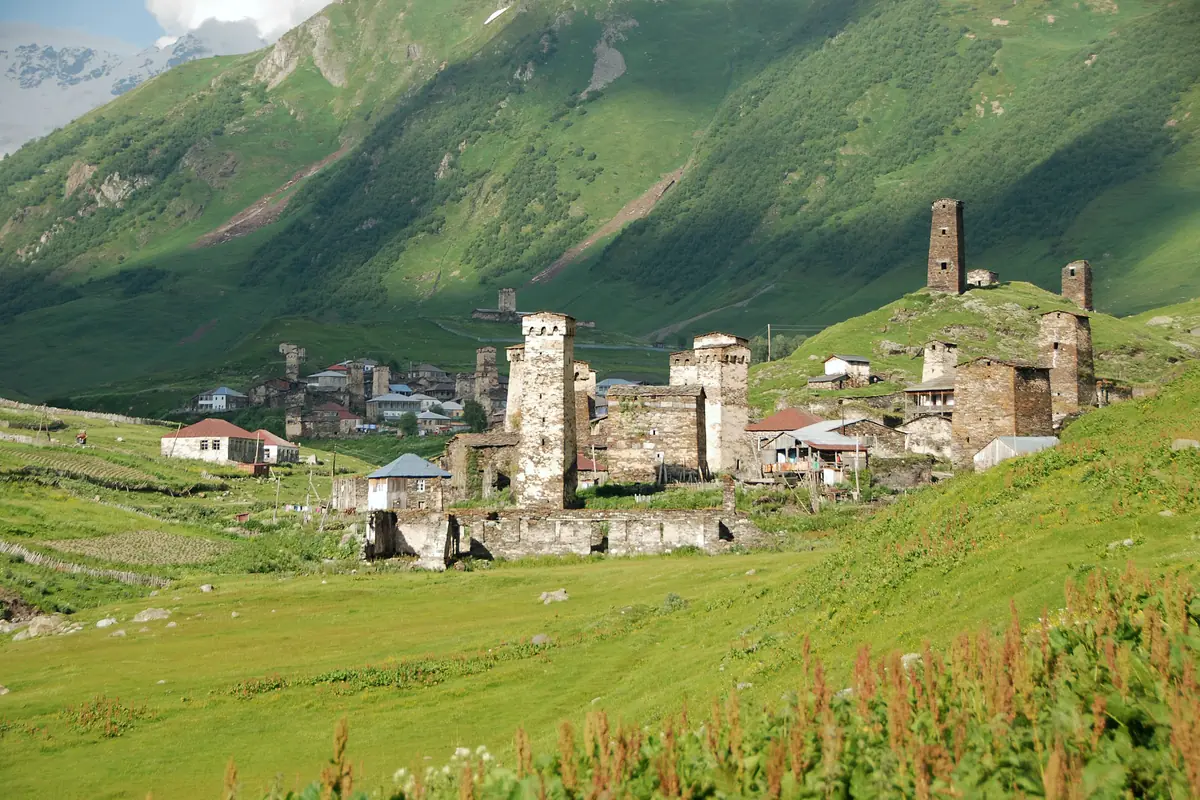
Further west lies Svaneti, the most atmospheric mountain region of all. Mestia is the gateway, a town of stone defensive towers built to shelter families during centuries of raids, with a surprisingly good museum of icons and manuscripts. Beyond it, a rough road winds to Ushguli, a cluster of hamlets around 2,100 metres that ranks among the highest permanently inhabited settlements in Europe, sitting under 5,193-metre Mount Shkhara.
Plan mountain trips for July to September, when the 3- to 4-day trek from Mestia to Ushguli, the climb to the Koruldi Lakes and the short walk to Chalaadi Glacier are all comfortably passable. Guesthouses in Mestia and Ushguli are simple, warm and generous with food. Outside summer, snow can close the passes and the flights and roads into the region become unreliable, so build in a spare day.
Cave Cities, Rock Monasteries and Kutaisi
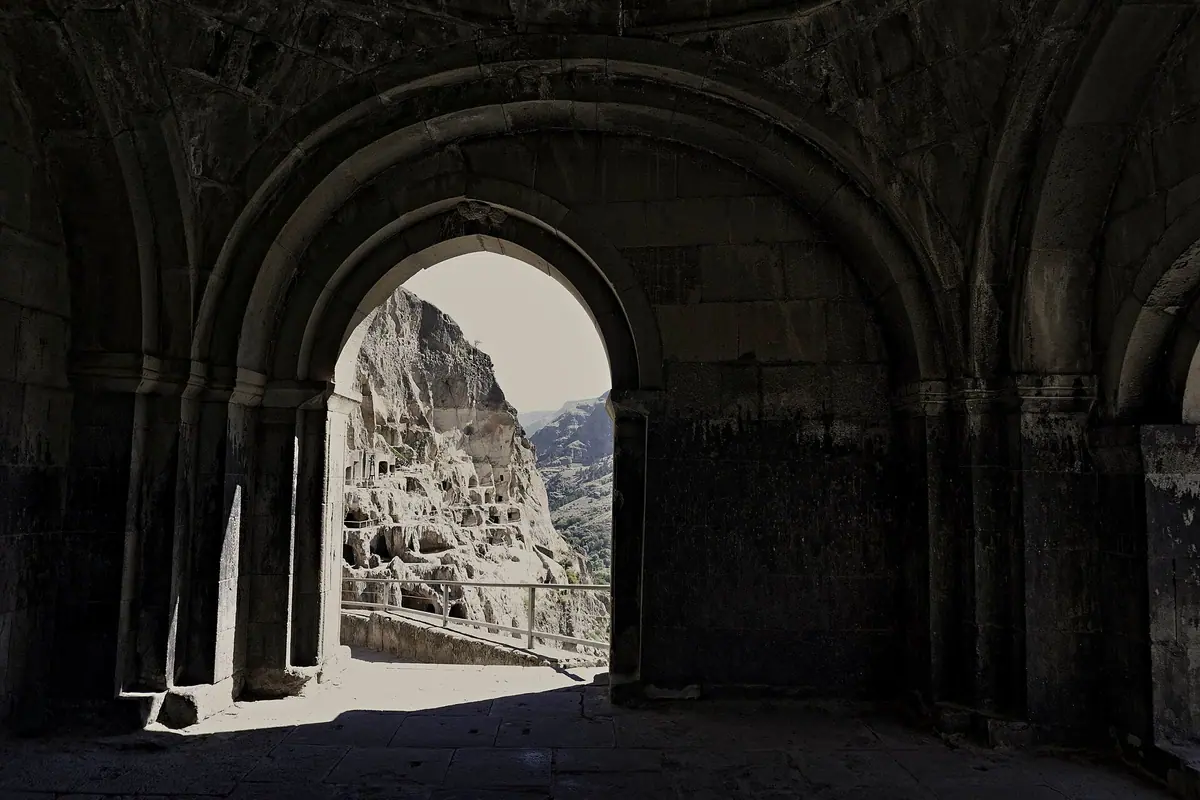
Georgia's south is carved, not built. Vardzia is the showstopper: a 12th-century cave monastery of roughly a dozen levels cut into the Erusheti cliffs above the Mtkvari, with a church whose frescoes of Queen Tamar still glow in near-darkness. Bring a torch, wear grippy shoes, and allow two hours to climb the tunnels and terraces. Nearby Uplistsikhe, close to the town of Gori, is older still — a pagan cave town of halls, wine presses and a secret tunnel, occupied for well over two thousand years.
Southeast, the semi-desert plateau of David Gareja holds a labyrinthine rock monastery complex decorated with faded frescoes; parts of the ridge straddle a border, so check locally which sections are open before you set out. In the west, the city of Kutaisi pairs the golden-domed Bagrati Cathedral with Gelati Monastery, a UNESCO-listed medieval academy where the country's greatest king is buried.
If you want geology rather than history, the same region delivers Prometheus Cave, a huge lit cavern with an underground boat ride, and the emerald pools and walkways of Martvili Canyon. Both sit within an hour of Kutaisi and make an easy, family-friendly day out.
Kakheti: Wine Cellars and the Alazani Valley
East of Tbilisi, Kakheti is the country's wine heartland, where vines have been cultivated for thousands of years and fermentation still happens in qvevri — egg-shaped clay vessels buried up to their necks in the earth. The region's towns are the reason to linger: Sighnaghi, a hilltop town ringed by 18th-century walls with the best view over the Alazani Valley, and Telavi, a leafy market town that makes a good base for winery visits.
Do not skip the Bodbe Monastery just below Sighnaghi, a working convent with terraced gardens and a healing spring, or the Tsinandali estate, whose 19th-century manor house and walled garden belonged to a Georgian prince who planted some of the region's first European-style vineyards. Small family cellars along the back roads will happily pour you a taste of saperavi, rkatsiteli or amber wine straight from the tank.
September brings rtveli, the grape harvest, when villages smell of fermenting must and everyone is busy — the most lively, though also the busiest, time to visit. Spring and early summer are greener and quieter, and the drive from Tbilisi takes under two hours. Hiring a driver for the day is far safer than tasting and driving on the winding valley roads.
Batumi and the Black Sea Coast
Georgia's second city is a subtropical, slightly surreal seaside resort. The Batumi Boulevard runs for about seven kilometres along the shore, lined with palm trees, bike paths, fountains and a moving sculpture of two figures who slowly pass through one another. Nearby, the Batumi Botanical Garden spills down a hillside above the sea with nine kilometres of paths through bamboo groves, cacti and citrus.
South of town, the coastline turns greener and quieter. Gonio Fortress, a Roman-era stronghold, is the oldest surviving fortification in the country, while Petra Fortress sits on a rocky headland further north. The beaches at Kvariati and Sarpi are pebbly but clean, and the water is warm from June through October — this is the one part of Georgia where swimming, not hiking, is the main activity.
Do not leave without trying Adjarian khachapuri, a boat-shaped bread filled with molten cheese, butter and a raw egg yolk stirred in at the table. Batumi is a five-hour train ride or a short flight from Tbilisi, making it an easy add-on to any itinerary — and a welcome dose of sea air after the mountains.
Frequently asked questions
How many days do I need in Georgia?
Seven to ten days covers Tbilisi, Mtskheta, Kazbegi and a night or two in Kakheti at a comfortable pace. Add three or four more days for Svaneti or the Black Sea coast. Two full weeks lets you travel without rushing and still include a cave city and a couple of long walks.
When is the best time to visit?
May, June, September and October offer the best mix of mild weather, open mountain roads and manageable crowds. July and August are ideal for high-altitude trekking in Svaneti but hot in Tbilisi. December to April is ski season at Gudauri, while Svaneti in deep winter is beautiful but often cut off.
Can I get around without a car?
Yes, mostly. Minibuses run from the main bus stations in Tbilisi to most towns, trains connect Tbilisi with Batumi and Kutaisi, and hiring a driver for a day is inexpensive and standard for wine regions and mountain routes. For remote valleys like Truso or Ushguli, a local driver with a 4x4 is essential.
Is Georgia safe for travellers?
It has a strong reputation for low street crime and legendary hospitality, and violent crime against visitors is rare. The main risks are practical: fast mountain driving, unmarked trail junctions and sudden weather changes in the Caucasus. Carry a charged phone, tell your guesthouse where you are hiking and buy travel insurance that covers hiking.
What food and drink should I not miss?
Order khinkali dumplings, khachapuri in its many regional forms, badrijani with walnut paste, and grilled meat with tart plum sauce. Drink saperavi, amber qvevri wine and the local grape brandy called chacha, plus mineral water from the spa town of Borjomi. Vegetarians are well looked after, and portions are generous.
Plan it — experiences in Georgia
Live search, booked directly with trusted providers.
Sort the rest of your trip
Everything for Georgia, in one place
Stay in Georgia
Hotels, guesthouses and apartments — compared in one search.
Search hotels
Transfer in Georgia
Private driver waiting on arrival — no queues, no surprises.
Book a transfer
Stay online in Georgia
Travel eSIM — data the moment you land, no roaming bills.
Get an eSIM