Croatia compresses a Roman emperor's retirement palace, a walled city that seems to float on the Adriatic and sixteen terraced lakes into a coastline strung with more than a thousand islands. The trick is knowing which stretches deserve your days — and which months to give them. Here is how to see the country's essential landmarks without spending the whole holiday in a queue.
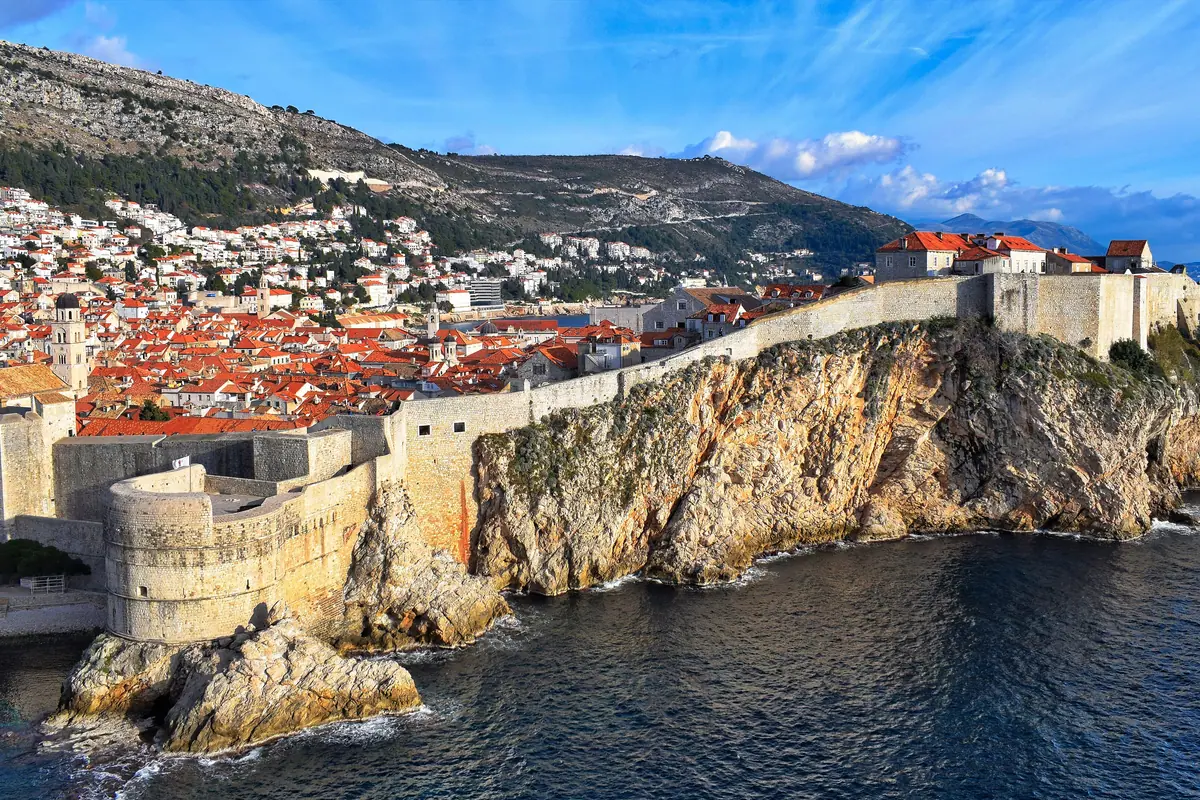
Dubrovnik: Walking the Medieval Walls Above the Adriatic
Dubrovnik's Old Town is entered through one of two medieval gates, and the moment you step onto Stradun, the polished limestone main street, the scale of the place becomes clear. The city walls run almost two kilometres around the old town, rising to roughly 25 metres in places, with forts, towers and a walkway wide enough to spend a happy hour and a half circling above the rooftops. Fort Lovrijenac, perched on its own sea cliff outside the walls, is covered by the same ticket and rewards the extra climb with a view straight back at the city. The Rector's Palace, the Franciscan and Dominican monasteries and Onofrio's Fountain line the route, while the baroque churches and shuttered stone houses below are best studied slowly from above.
Timing matters more here than almost anywhere else in Croatia. Walk the walls at opening time or in the last two hours before closing — midday in July and August means a slow-moving line in full sun with no shade at all. In peak season, day visitors arrive in waves between roughly 10am and 4pm, so plan a swim, a boat trip or an inland excursion for those hours and keep the old town for early and late.
Above the city, a cable car lifts you to Mount Srđ in about four minutes for a panorama over the red roofs, the island of Lokrum and the Elaphite Islands scattered offshore. Lokrum itself is a short boat ride from the old harbour: a botanical garden, resident peacocks, the ruins of a Benedictine monastery and rocky swimming coves. Give Dubrovnik two full days, and consider May, June, September or early October, when the sea is still swimmable but the streets can breathe.
Split and Diocletian's Palace: A Roman City Still Lived In
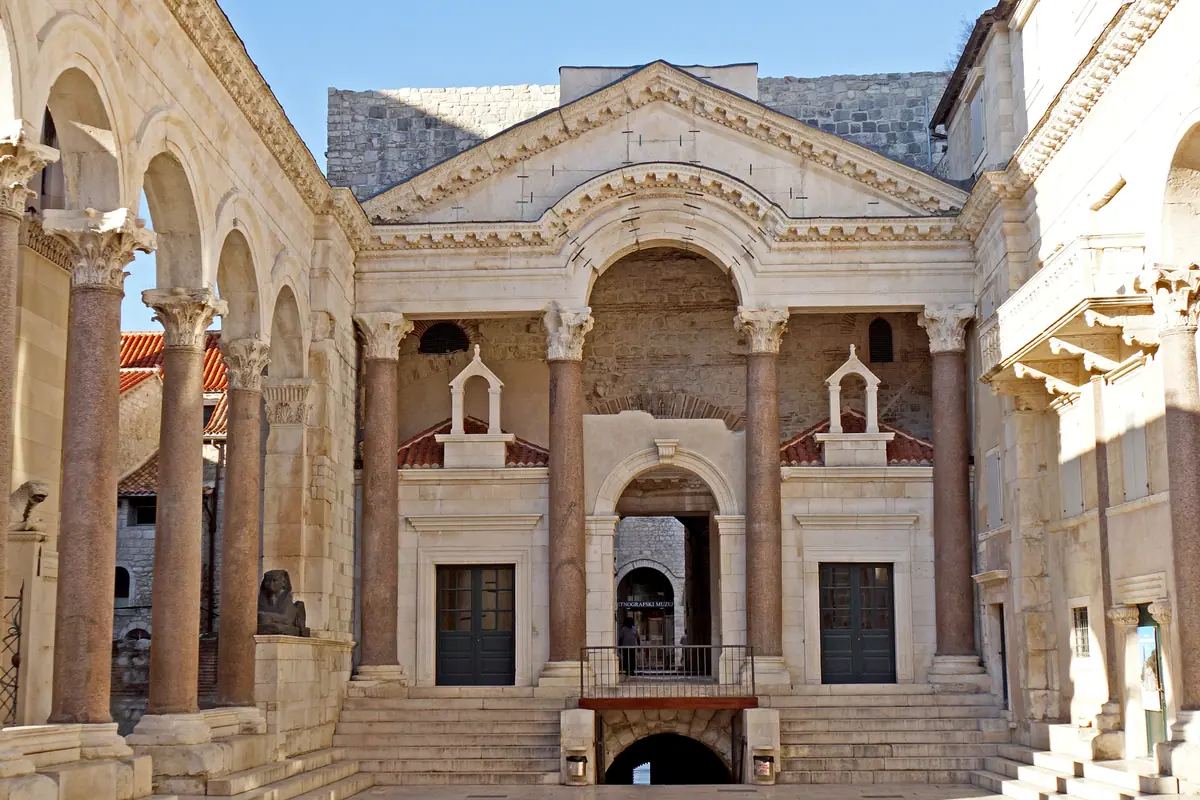
Split grew up inside a palace. Diocletian's Palace was built for a Roman emperor's retirement around the year 305, and it was never abandoned — today its colonnaded central square, the Peristyle, is a cafe-lined stage framed by ancient columns, and thousands of people still live within the old walls. Climb the bell tower of the Cathedral of Saint Domnius, originally the emperor's mausoleum, for the finest view of the harbour, then drop into the palace cellars, a cool, echoing maze that doubles as a market arcade.
Beyond the palace, the Riva promenade runs along the waterfront and fills every evening with strollers, ice-cream vendors and the occasional klapa singing group. A fifteen-minute walk east brings you to Bačvice, a shallow sandy bay where locals play picigin, a keepy-uppy game played in ankle-deep water. West of the centre, the wooded Marjan peninsula offers pine-shaded paths, swimming steps and lookout points across the islands.
Split works best as a base for two or three nights: mornings inside the palace before the crowds, afternoons at the beach or on Marjan, evenings on the Riva. Day trips reach Trogir, another walled town on a tiny island half an hour away, the Roman ruins of Salona at Solin, and the clifftop fortress of Klis, which guards the mountain pass above the city. Ferries and catamarans to the islands leave from the harbour right in the middle of town.
Plitvice Lakes and Krka: Croatia's Waterfall Country
Plitvice Lakes is the country's most famous inland sight and its most carefully managed: sixteen terraced lakes spilling into one another over travertine barriers, linked by wooden boardwalks that float just above the water. The tallest fall, Veliki Slap, drops around 78 metres. Paths, shuttle buses and an electric boat across the largest lake let you string together anything from a two-hour taster to a full day — four to six hours is the sweet spot.
Timed entry slots are used in high season and they do sell out, so book ahead for a morning slot and be at the gate when it opens. Swimming is prohibited and the rule is enforced. Wear shoes with grip, because the boardwalks turn slick, and start with the lower lakes before the coaches arrive — or head for the quieter upper lakes first if you want the forest to yourself.
Krka National Park is the more accessible alternative, roughly an hour from Split: a wide, roaring cascade at Skradinski Buk that you can walk right up to, reached by boat from Skradin or by road, plus the island monastery of Visovac upstream. Swimming has been restricted on some stretches in recent years, so check current local rules rather than assuming. On the way, the watermill village of Rastoke makes a fine stop. Spring fills both parks with meltwater; October brings colour and far fewer people.
Island Hopping: Hvar, Korčula, Brač and Vis
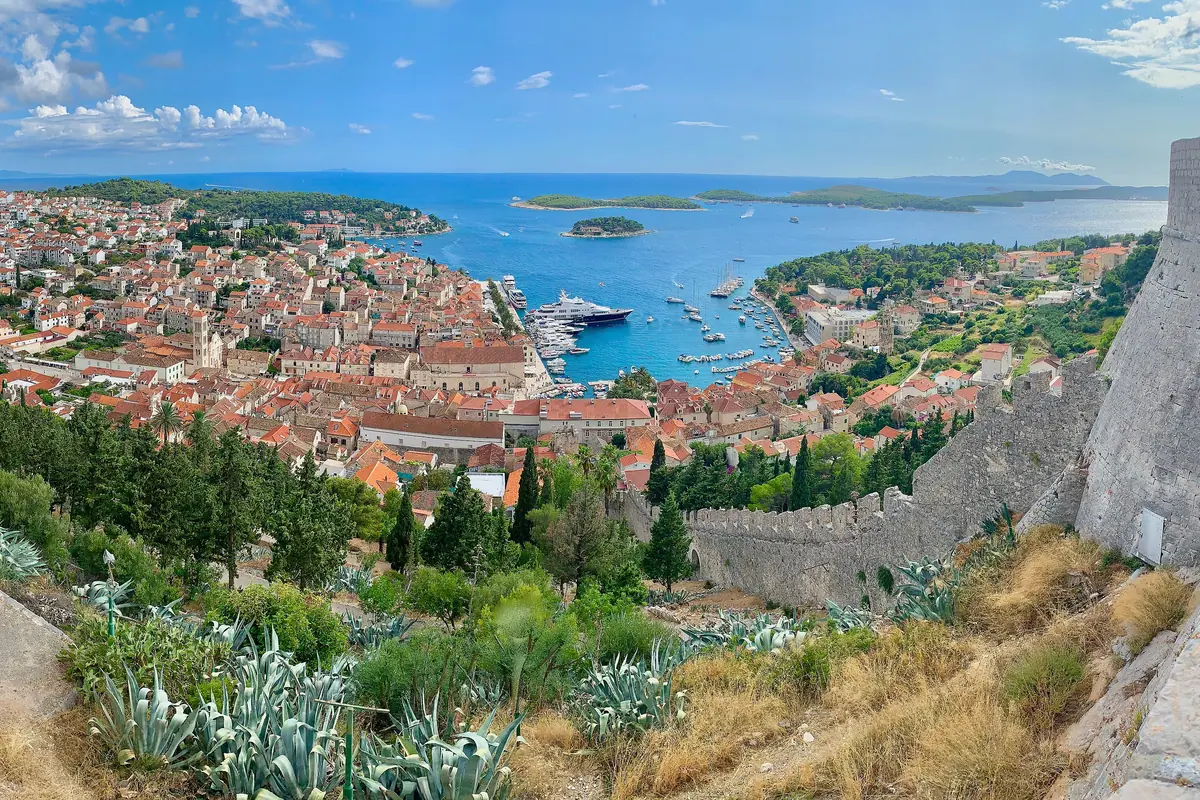
Hvar Town is the polished face of Dalmatian island life: a Venetian-era square, a harbour full of yachts and the Fortica fortress on the hill above, reached by a staircase through pine trees for a view over the Pakleni Islands. In June the island's lavender fields are in flower, and inland the Stari Grad Plain still preserves a Greek grid of field boundaries laid out more than two thousand years ago.
Korčula's Old Town sits on a small peninsula, its streets arranged in a fishbone pattern to catch the breeze, with St Mark's Cathedral at the centre and the sword-and-drum Moreška dance performed through the summer. Brač is home to Zlatni Rat, the Golden Horn — a pebble spit near Bol that visibly shifts with wind and current — and to Vidova Gora, the highest island peak in the Adriatic, with a view across to Hvar. Vis, the most remote inhabited island, pairs the Blue Cave on neighbouring Biševo with the hidden cove of Stiniva and the fishing harbour of Komiža.
Catamarans carry foot passengers quickly and cheaply; car ferries are slower but let you bring a vehicle, so book well ahead for July and August, when afternoon sailings fill up. Split to Hvar Town takes about an hour by fast catamaran, to Vis around two and a quarter hours, and morning crossings usually mean calmer water. Rent a scooter or small car on the bigger islands, but remember the roads are narrow and the locals know them far better than you do.
Zadar, Kornati and Mljet: The Quieter Side of Dalmatia
Zadar's seafront holds two pieces of modern public art that have become the city's signature: the Sea Organ, a set of submerged pipes that turn the waves into low, breathy music, and the Greeting to the Sun, a glass disc that glows at dusk. Sit on the steps at sunset — the city's evening light has a serious reputation — then walk two minutes to the ninth-century Church of St Donatus, a round pre-Romanesque building standing over the old Roman forum.
Offshore, the Kornati archipelago is a scatter of around 89 bare karst islands crossed by dry-stone walls and with almost no fresh water; day boats run from Zadar, Murter and Sali. Telašćica Nature Park on the southern edge has cliffs dropping steeply into the sea and a salt lake, Mir. Further south, Mljet National Park is greener and gentler: two saltwater lakes joined to the sea by a narrow channel, a small Benedictine monastery on an islet in the larger lake, and bike and kayak rental at the water's edge.
On the Pelješac peninsula, Ston and Mali Ston guard a stone wall nearly five and a half kilometres long climbing over the hills — among the longest fortified lines in Europe — built to protect salt pans that still produce today. The bay below is known for oysters and mussels, and the peninsula's wine roads run through the Dingač and Postup vineyards. Spring and autumn are ideal for walking the walls; summer is for swimming off the rocks.
Istria, Kvarner and Inland Croatia: Beyond the Coast
Istria, the peninsula in the country's northwest, is where Croatia feels most Mediterranean and most Italian at once. Pula's Arena is a first-century Roman amphitheatre, one of the best preserved anywhere, still used for summer concerts and film screenings. Rovinj's Old Town climbs a former island to the bell tower of St Euphemia, its narrow lanes dropping straight into the sea. In Poreč, the sixth-century Euphrasian Basilica preserves mosaics of astonishing colour.
Inland Istria is hilltop towns and slow food: Motovun and Grožnjan perched above vineyards, autumn truffle hunting in the Mirna valley, olive oil and Malvazija white wine on every menu. Along the Kvarner coast, Opatija keeps its elegant nineteenth-century promenade, while the islands of Krk, Cres, Lošinj and Rab offer quieter coves — dolphins are regularly spotted around Lošinj.
The capital rewards a day or two as well. Zagreb's Ban Jelačić Square leads to Dolac, the open-air market, and up into the Upper Town, where St Mark's Church wears a roof of coloured tiles bearing medieval coats of arms. The funicular linking the two levels is one of the shortest public railways in the world, and Mirogoj Cemetery's arcades and cypresses are unexpectedly beautiful. Day trips reach the baroque streets of Varaždin, Trakošćan castle, and the vineyards and thermal spas of the Zagorje hills.
Frequently asked questions
What is the best time of year to visit Croatia?
Late May, June, September and early October are the sweet spot: the Adriatic is warm enough for swimming, the big sights are calmer and accommodation is easier to find. July and August are hottest and busiest, especially in Dubrovnik and on Hvar. Plitvice Lakes and Krka are at their fullest in spring and loveliest in autumn, while Zagreb and the inland regions suit May to October.
How many days do you need in Croatia?
A week lets you cover Split and Dubrovnik with one or two islands at a comfortable pace. Ten days to two weeks allows you to add Plitvice Lakes, Istria and Zagreb without spending every morning in transit. Aim for at least two nights in Dubrovnik, two or three in Split, and one full day each for the lakes.
Do I need a car in Croatia?
Not if you stay on the coast and hop between islands by catamaran and ferry — the main towns and ports are walkable. A car is genuinely useful for Istria's hill towns, Plitvice Lakes, the Pelješac wine roads and inland Croatia. Motorways charge tolls, and car ferries should be booked well ahead for July and August.
How do I avoid the worst crowds in Dubrovnik?
Walk the city walls at opening time or in the final two hours of the day, and use the middle of the day for swimming, a boat trip to Lokrum or an excursion inland. Day visitors arrive heaviest between roughly 10am and 4pm in high season. Shoulder months such as May and October transform the experience.
What food and drink should I try in Croatia?
Look for peka, meat or octopus slow-cooked under a metal bell, black cuttlefish risotto, Pag cheese, cured ham from the Drniš area, and oysters straight from the bay at Ston. For sweets, try fritule and rozata. Drink local: Pošip and Malvazija whites, Plavac Mali reds, and the cherry liqueur that Zadar has produced for centuries.
Plan it — experiences in Croatia
Live search, booked directly with trusted providers.
Sort the rest of your trip
Everything for Croatia, in one place
Stay in Croatia
Hotels, guesthouses and apartments — compared in one search.
Search hotels
Transfer in Croatia
Private driver waiting on arrival — no queues, no surprises.
Book a transfer
Stay online in Croatia
Travel eSIM — data the moment you land, no roaming bills.
Get an eSIM