Croatia manages to compress a whole Mediterranean holiday into a country you could drive end to end in a day: Roman palaces you can wander through at midnight, a thousand-plus islands, and lakes so blue they look digitally enhanced. This guide picks the places genuinely worth your time, with the named sights, seasons and timing that make a trip work.
Dubrovnik: The Walled City Above the Adriatic
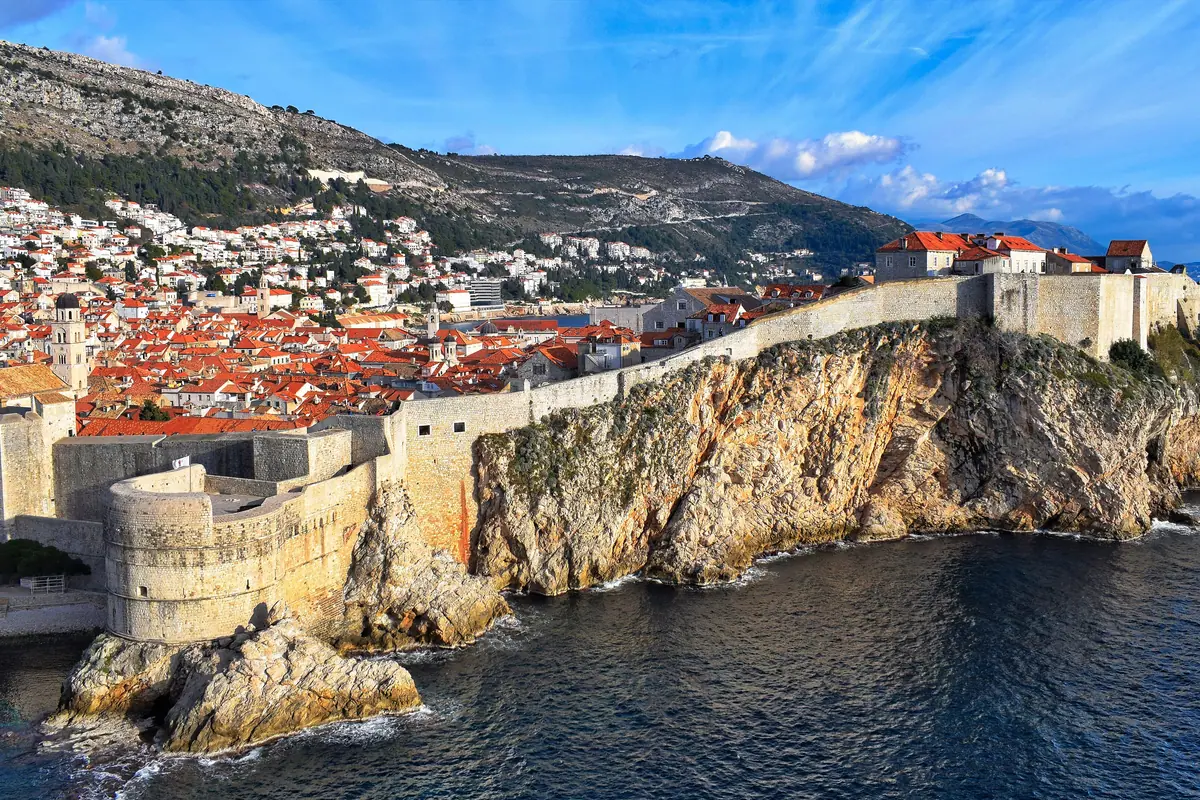
Dubrovnik's old town is a stage set made of pale limestone, polished to a shine by centuries of footsteps. The spine of it is Stradun, the wide main street running between the two city gates, but the real drama happens above: the medieval city walls run roughly two kilometres around the whole town, past the Minčeta Tower, Fort Bokar and a string of bastions looking straight down onto terracotta roofs and open water. Walking the full circuit takes about an hour and a half at an unhurried pace, and it is the single best thing to do here — start at opening time in summer or come back in the last two hours before closing, when the heat and the day-trippers have thinned out.
Outside the walls, Fort Lovrijenac clings to a 37-metre rock and offers the classic postcard angle back towards the old town; the walls ticket usually covers entry within a short window, so keep both for the same day. From the old harbour, small boats shuttle to Lokrum, a wooded island with a botanical garden, free-roaming peacocks and a small saltwater lake known locally as the Dead Sea. Sea kayaking trips paddle around the walls to Banje beach, and a cable car climbs Mount Srđ for the sunset view that ties the whole coastline together.
Give Dubrovnik two or three days. May, late September and October are the sweet spot — the sea is still warm enough for swimming into October, but the summer crush has gone. In July and August, plan sightseeing before 10am and after 5pm, and eat lunch late in a side alley rather than on Stradun.
Split and Diocletian's Palace: Roman Ruins You Can Live In
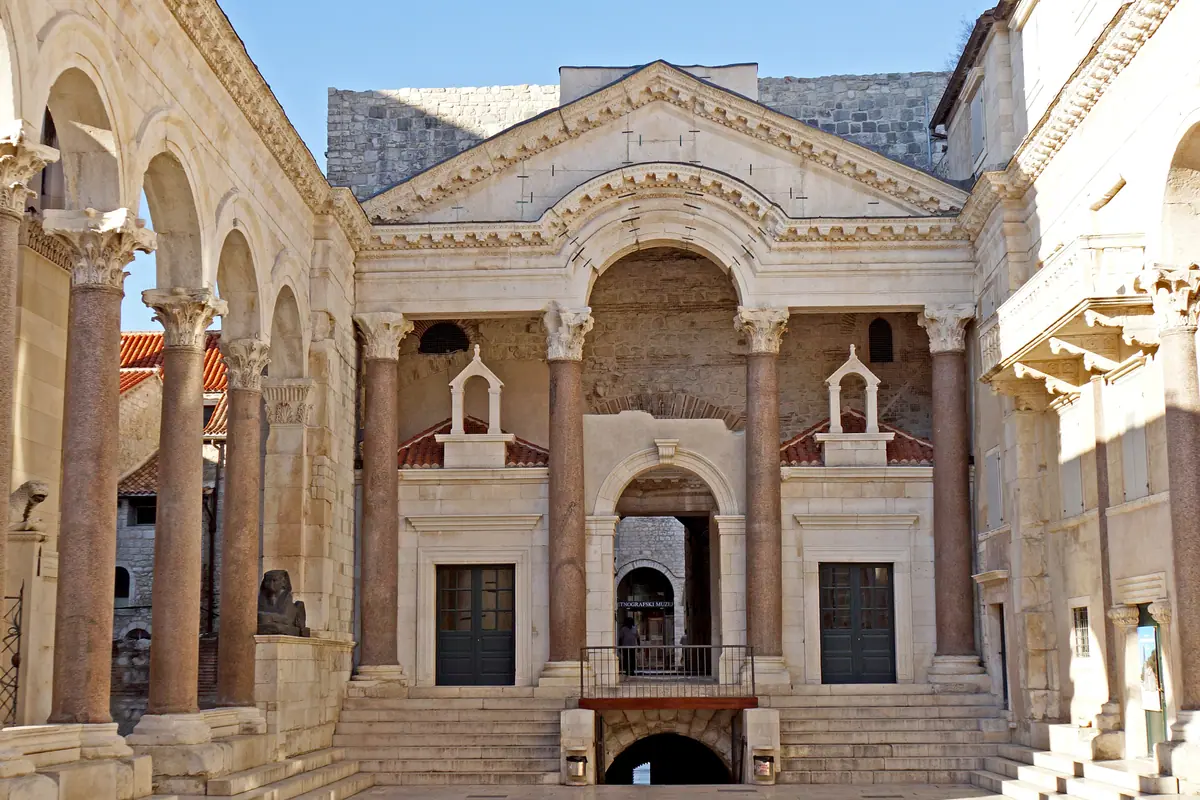
Split's old town is built inside a Roman emperor's retirement home. Diocletian's Palace went up around AD 305, and rather than being fenced off as a ruin, it became the city — shops, apartments and cafés now occupy the ancient walls. The ceremonial courtyard at its centre, the Peristyle, is the beating heart of Split, framed by a colonnade and the bell tower of the cathedral, which you can climb for a view over the whole palace footprint. Below ground, the palace cellars are a cool, echoing maze that's a blessing in August.
Beyond the palace, the Riva seafront promenade fills every evening with the city's slow, theatrical passeggiata. Marjan hill rises just west of the centre, covered in pine forest with jogging paths and swimming coves at its feet, while Bačvice is the sandy city beach where locals play picigin, a frantic paddle game in ankle-deep water. Above town, Klis Fortress guards the mountain pass, and the Roman ruins of Salona sit just outside the city. With an extra day, Trogir — a tiny walled island-town half an hour away — and the Cetina river near Omiš, where you can raft or ride a zip line over the gorge, are both easy trips.
Two full days is the minimum for Split, three if you want a beach day. Late spring and September give you warm swimming without the furnace of mid-summer, when temperatures push past 33°C and the palace alleys become a slow-moving queue.
Zadar, Šibenik and the Central Dalmatian Coast
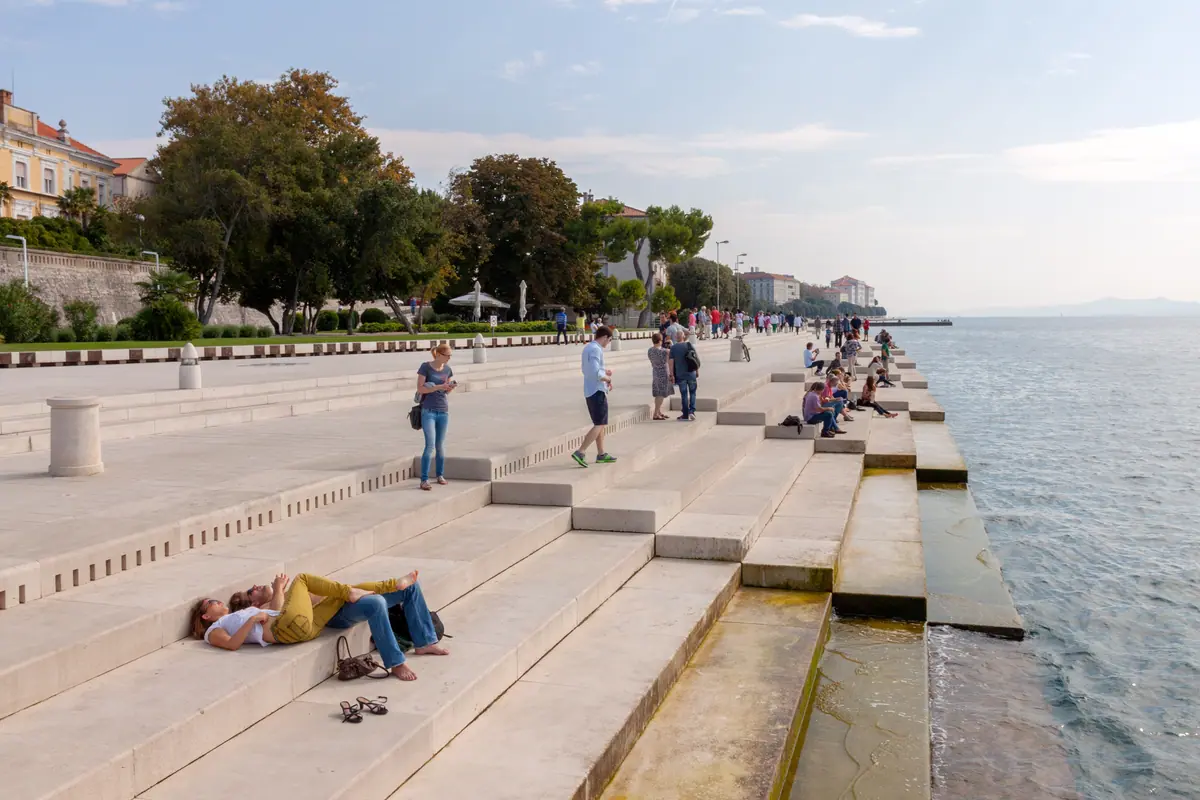
Zadar's old town sits on a peninsula with a Roman forum underfoot and two of the strangest, most lovable attractions on the Adriatic. The Sea Organ is a set of stone steps hiding pipes and chambers — as waves push air through them, the sea literally plays music, a low, shifting drone that changes with the weather. Beside it, the Greeting to the Sun is a large disc of solar panels that comes alive with light after dark. Add the ninth-century Church of St Donatus and the pre-Romanesque core, and you have a city best explored in the late afternoon, staying for what locals insist is the finest sunset on the coast.
South-east along the coast, Šibenik is the underrated one. Its UNESCO-listed Cathedral of St James took from 1431 to 1536 to complete and is entirely built of stone, with a dome of interlocking slabs and a row of carved heads around the apse. Above the town, St Michael's Fortress hosts summer concerts with a view over the channel, and the Kornati archipelago — around 89 bare, beautiful islands with no permanent freshwater — is reachable by boat trip from both Šibenik and Zadar.
Zadar deserves two nights; Šibenik works as a full day or an overnight if you want to pair it with Krka. May, June and September are ideal, when the sea is swimmable and the stone streets aren't yet radiating heat.
Plitvice Lakes, Krka and the Green Interior
Plitvice Lakes National Park is the reason many people rent a car in Croatia at all. Sixteen terraced lakes cascade into one another over natural travertine barriers, linked by a network of wooden boardwalks that put you metres from thundering water, including the 78-metre Veliki Slap. A boat carries you across the largest lake, Lake Kozjak, and a panoramic train links the upper and lower sections. Allow four to six hours for a thorough visit; entry is by timed ticket that genuinely sells out in summer, so reserve well ahead and arrive for the earliest slot you can get. Swimming is not permitted, and the paths get busy from mid-morning — early is everything.
Krka National Park, closer to Šibenik, is smaller and looser, with the wide curtain of Skradinski Buk as its centrepiece and designated swimming areas open in the warmer months. Two to four hours covers it comfortably.
The natural base for all of this is Zagreb, a two-hour drive from Plitvice. The capital rewards a day of its own: Ban Jelačić Square, the produce stalls of Dolac market, the tiled roof of St Mark's Church, the tiny funicular linking the lower and upper towns, and the café-lined Tkalčićeva street. Autumn is spectacular here — the beech woods around Plitvice turn copper in October, and the crowds drop away sharply after September.
The Islands: Hvar, Korčula, Brač, Vis and Mljet
Hvar is the glamorous one, and it earns it. Hvar Town wraps around a small harbour beneath the Fortica fortress, a steep 20-minute climb that pays off with views across the Pakleni Islands, a scatter of pine-covered islets perfect for a lazy boat day. The island is reputedly the sunniest in the country, lavender fields bloom across the interior in June and July, and the Stari Grad Plain — a Greek agricultural grid still in use after 2,400 years — is a UNESCO site. It's also the island with the liveliest nightlife, if that's on your list.
Korčula is Hvar's quieter, more grown-up sibling: a miniature walled town on a peninsula, with the alleged birthplace of Marco Polo, the clashing swords of the Moreska dance performed in summer, and serious white wines grown on the surrounding hills. Brač offers the beaches — Zlatni Rat near Bol is a white pebble spit that visibly changes shape with the wind, and Vidova Gora above it is the highest point of any Croatian island at 778 metres, with a view across to Hvar. Bol is also one of the Adriatic's better climbing spots.
For something wilder, Vis was closed to visitors for decades as a military base and remains the most unspoilt of the main islands, with the Blue Cave on neighbouring Biševo and the hidden cove of Stiniva. Mljet, further south, is largely national park, its two saltwater lakes ringed by forest and cycle paths, with a 12th-century monastery on a tiny island in the larger lake. Catamarans are faster and carry foot passengers only; car ferries should be booked weeks ahead for July and August.
Istria and the Kvarner Gulf: Rovinj, Pula and Opatija
The Istrian peninsula, in the country's north-west, feels more Venetian than Dalmatian. Rovinj's old town climbs a former island in a stack of pastel houses, crowned by the baroque bell tower of St Euphemia — climb it and you can see Italy on a clear day. Grisia, the cobbled art street, is lined with galleries, and traditional batana boats still row out of the harbour. Nearby Pula holds one of the largest surviving Roman amphitheatres anywhere, a first-century arena that still fills with crowds for concerts and a summer film festival, plus a remarkably intact Temple of Augustus in the main square.
Inland Istria is hill-town country: Motovun and Grožnjan perched on ridges, truffle hunting in the damp oak woods in autumn, and vineyards producing fresh malvazija whites and deep teran reds. On the coast, Poreč's sixth-century Euphrasian Basilica glows with gold-ground mosaics, and the Brijuni islands are a short boat hop away.
Up in the Kvarner Gulf, Opatija is a relic of Habsburg-era elegance, its villas and cafés strung along the Lungomare, a 12-kilometre seaside promenade running to the fishing village of Lovran. The bay's islands — Krk, linked to the mainland by bridge, plus Cres and Rab — are easy add-ons. Istria is at its best from May to June and September to October, when truffle season and wine harvest coincide with comfortable temperatures and warm sea.
Frequently asked questions
What is the best time of year to visit Croatia?
Late May, June, September and early October are the sweet spots: warm sea, open ferries and boat trips, and far fewer people than in high summer. July and August are hottest and busiest, with peak prices in Dubrovnik and Hvar. The Adriatic is at its warmest in September, which many regular visitors consider the single best month.
How many days do you need in Croatia?
Seven days covers Split, Dubrovnik and one island comfortably. Ten to fourteen days lets you add Plitvice Lakes, Zadar or Šibenik and a second island without spending your whole trip in transit. Trying to do the coast, the islands and inland Croatia in under a week means a lot of time on buses and ferries.
Do you need a car to get around Croatia?
Not for the cities and main islands — buses and catamarans link Split, Zadar, Šibenik and Dubrovnik well. A car is genuinely useful for Istria's hill towns, Plitvice Lakes and the interior, and for islands with car ferries such as Brač and Krk. Note that some islands, including Hvar Town's car-free centre areas, are easier on foot.
Do you have to book Plitvice Lakes in advance?
Yes. Entry runs on timed tickets and summer slots sell out days ahead, sometimes longer. Choose the earliest entry you can manage, wear shoes with grip for the boardwalks, and plan on four to six hours. Swimming is not allowed anywhere in the lakes.
Which Croatian islands should a first-timer choose?
Hvar for scenery, nightlife and the Pakleni Islands; Korčula for a compact walled town and wine; Brač if beaches such as Zlatni Rat are the priority. Vis suits travellers who want somewhere quieter and less developed, while Mljet is the pick for national park walking and cycling.
Plan it — experiences in Croatia
Live search, booked directly with trusted providers.
Sort the rest of your trip
Everything for Croatia, in one place
Stay in Croatia
Hotels, guesthouses and apartments — compared in one search.
Search hotels
Transfer in Croatia
Private driver waiting on arrival — no queues, no surprises.
Book a transfer
Stay online in Croatia
Travel eSIM — data the moment you land, no roaming bills.
Get an eSIM