Croatia is a thin crescent of a country, and the flight you choose decides the shape of your week. Land in the inland capital and roll downhill to the Adriatic, hop between Roman ruins and island harbours, then fly home from the far south with sea salt still in your hair.
Landing in Croatia: Choosing Your Airport, Season and Route
Croatia's international gateways are strung along the coast and tucked into the interior, so your arrival point does most of the planning for you. Zagreb's Franjo Tuđman Airport sits in the flat north, an easy 30-minute transfer into the city. Split and Dubrovnik handle the heaviest summer traffic on the Dalmatian coast, Zadar covers the northern stretch, and Pula and Rijeka open up Istria. There is also a small seasonal strip on the island of Brač. Direct flights from across Europe multiply between June and September, then thin out sharply in winter, when many coastal connections simply pause until spring.
Timing matters as much as the airport. July and August deliver bath-warm sea, roughly 25°C, alongside peak crowds in every walled town and packed car ferries. Late May, June, September and early October are the sweet spot: swimmable water, milder walking temperatures and space to actually see the cobbles you are standing on. May and October can bring rain, especially inland around the lakes, but the trade-off is a much calmer country.
The smoothest one-week shape is an open-jaw route: fly into Zagreb and out of Dubrovnik, or the reverse. That saves you backtracking 600 kilometres. If you would rather skip the drive, a short internal hop from Zagreb to Dubrovnik takes about an hour, while the coastal motorway runs six to seven hours with a stop at the lakes built in. Foot-passenger catamarans link Split, Hvar, Korčula and Dubrovnik, and they are the most pleasant way to move between islands.
Days 1–2: Zagreb, the Inland Beginning
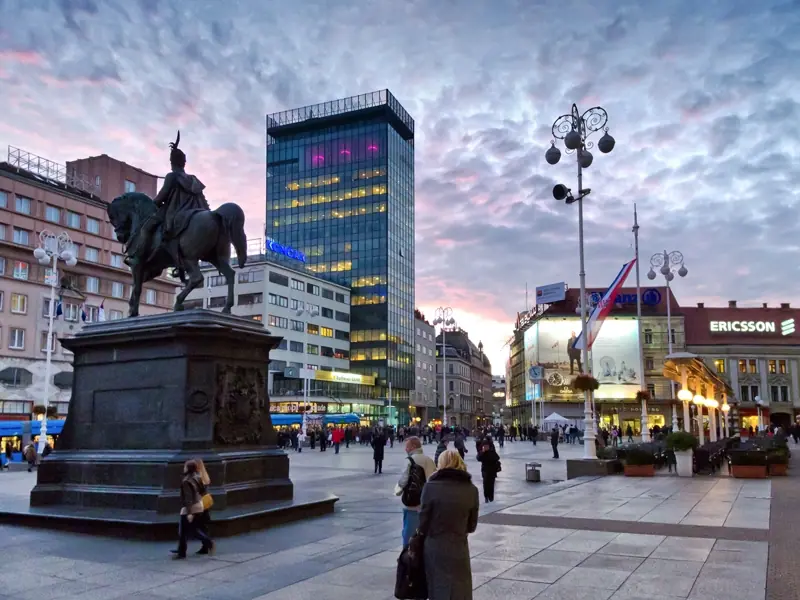
Zagreb makes a gentle first landing. The centre splits into the brisk grid of the Lower Town and the lantern-lit lanes of Gradec and Kaptol above it, joined by one of the shortest funiculars anywhere. Start on Ban Jelačić Square, the city's meeting point, then drift up Ilica and along Tkalčićeva Street, where café tables spill onto the pavement and the coffee culture is taken seriously. Just off the square, Dolac Market spreads its red umbrellas over pyramids of peppers, berries and cheese, and the smell of štrukli, a baked cheese pastry, drifts from the surrounding kitchens.
In the Upper Town, St. Mark's Church is unmistakable for its roof of coloured tiles laid out as medieval coats of arms. Nearby, the Stone Gate holds a shrine glowing with candles, and the Lotrščak Tower fires a small cannon at noon, a ritual that has run for over a century. The Museum of Broken Relationships is small, strange and worth an hour, while the arcaded walkways and clipped hedges of Mirogoj Cemetery are quietly one of the most beautiful spots in the country.
Give yourself a second morning before moving on. Wander Jarun lake if you want greenery, or simply repeat the ritual of a long coffee and a pastry while watching the market reset itself. By early afternoon you will be ready for the road south.
Day 3: Plitvice Lakes and the Drop to the Coast
Plitvice Lakes National Park is the reason many people fly to Croatia in the first place, and it earns the fuss. Sixteen terraced lakes tumble into one another over travertine barriers, linked by wooden boardwalks that float inches above turquoise water. The lower lakes cluster around Veliki Slap, a waterfall of nearly 80 metres, while the upper lakes are broader and quieter. Electric boats and a shuttle train connect the sections, so you can walk one way and ride the other.
Budget four to six hours for a decent visit and a full day if you want both lakes groups without hurrying. In summer the gates open early, and arriving at opening time is the difference between a serene boardwalk and a single-file shuffle. Water levels and colours shift through the year: spring snowmelt brings volume, late summer brings the deepest greens and blues, and heavy autumn rain can close individual paths. Check conditions before you commit to a route.
From the park it is roughly two hours by road down to Zadar, or a little further to Split. Staying overnight in one of the villages near the park gates lets you see the lakes at dusk and dawn, when the day-trippers have gone and the forest goes completely still. If you would rather not drive, organised day trips run from Zagreb, Zadar and Split, though they tend to compress the visit into a few rushed hours.
Day 4: Zadar and the Waterfalls of Krka
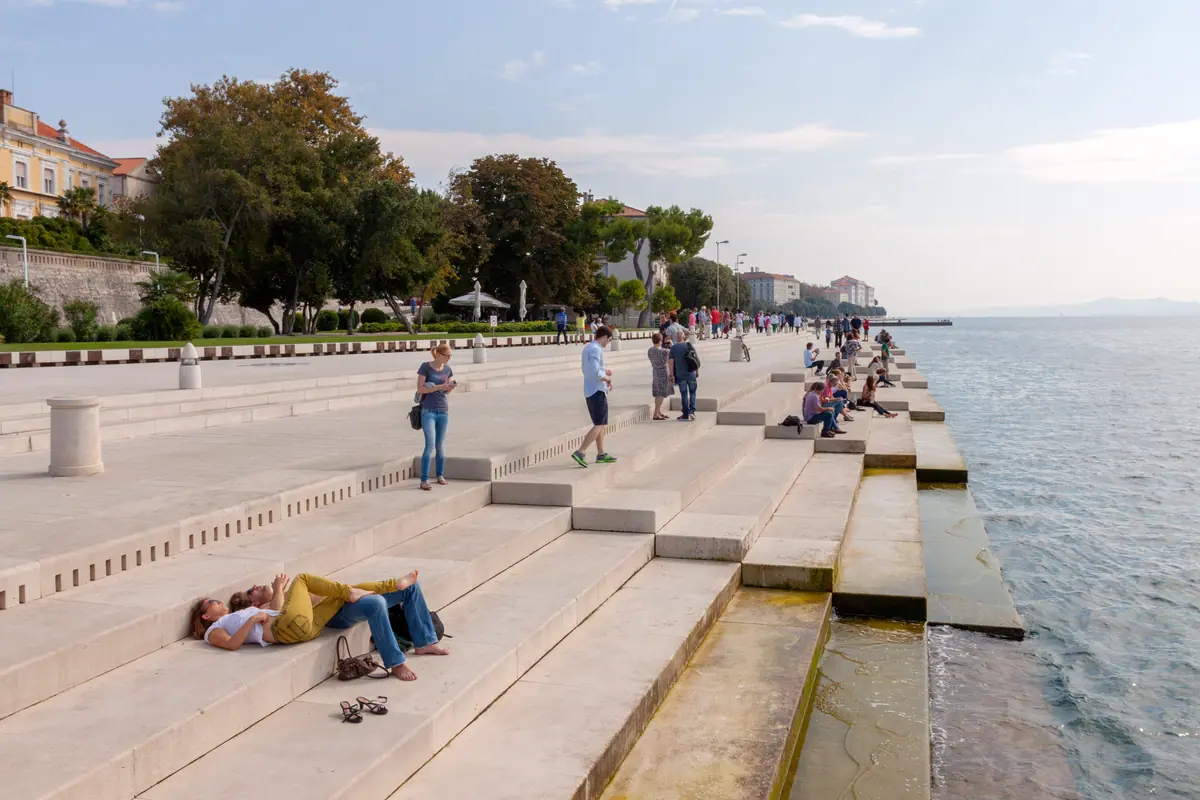
Zadar's old town occupies a compact peninsula of polished limestone, and its two most famous sights are entirely modern. The Sea Organ is a set of steps hiding pipes that turn the breathing of the Adriatic into low, mournful chords, and the Greeting to the Sun beside it is a wide glass disc that collects daylight and blooms into colour after dark. Both are best at sunset, when the whole tip of the peninsula fills with people sitting and listening.
Behind them lies the Roman Forum, still paved with original stone, and the ninth-century Church of St. Donatus, a squat, round pre-Romanesque oddity that anchors the square. Climb the bell tower of St. Anastasia for a rooftop view across terracotta tiles and moored boats, then follow Kalelarga, the main spine of the old town, for gelato and wine. Zadar is also a handy base for day trips inland.
Krka National Park lies about an hour away and is the greener, more accessible cousin of Plitvice. Skradinski Buk is a broad staircase of falls pouring into a pool you can circle on a boardwalk, with a cluster of old watermills alongside. Rules on swimming have tightened in recent years, so ask locally rather than assuming, and arrive early in July and August when the car parks fill by mid-morning.
Day 5: Split, Diocletian's Palace and a Dash to Hvar
Split is built inside a Roman retirement home. Diocletian's Palace, raised at the turn of the fourth century, is not a ruin behind a rope: it is the living core of the city, its streets lined with bars, bakeries and apartments. Walk in through the Golden Gate, descend into the vaulted cellars, then step out onto the Peristyle, the colonnaded square where the emperor once appeared to his subjects. The Cathedral of St. Domnius, converted from his mausoleum, has a bell tower with the best view in town.
Just outside the walls, the Riva promenade runs along the harbour, all white awnings and endless coffee. For a swim, head to Bačvice for sand and shallow water, or climb Marjan hill, a pine-covered park with quiet coves and lookouts over the islands. Split's airport is only about half an hour away, which makes it a natural pivot point for the second half of the week.
If you have a spare afternoon, take a catamaran to Hvar. The crossing takes roughly an hour to an hour and a half depending on the service, landing you below the Spanish Fortress in Hvar Town. The island is famous for lavender, stone lanes and the Pakleni Islands just offshore, and the agricultural plain near Stari Grad is protected for its ancient field system. Alternatively, stop at Šibenik on the way south to see the Cathedral of St. James, a masterpiece of carved stone.
Days 6–7: Dubrovnik, the Islands and the Flight Home
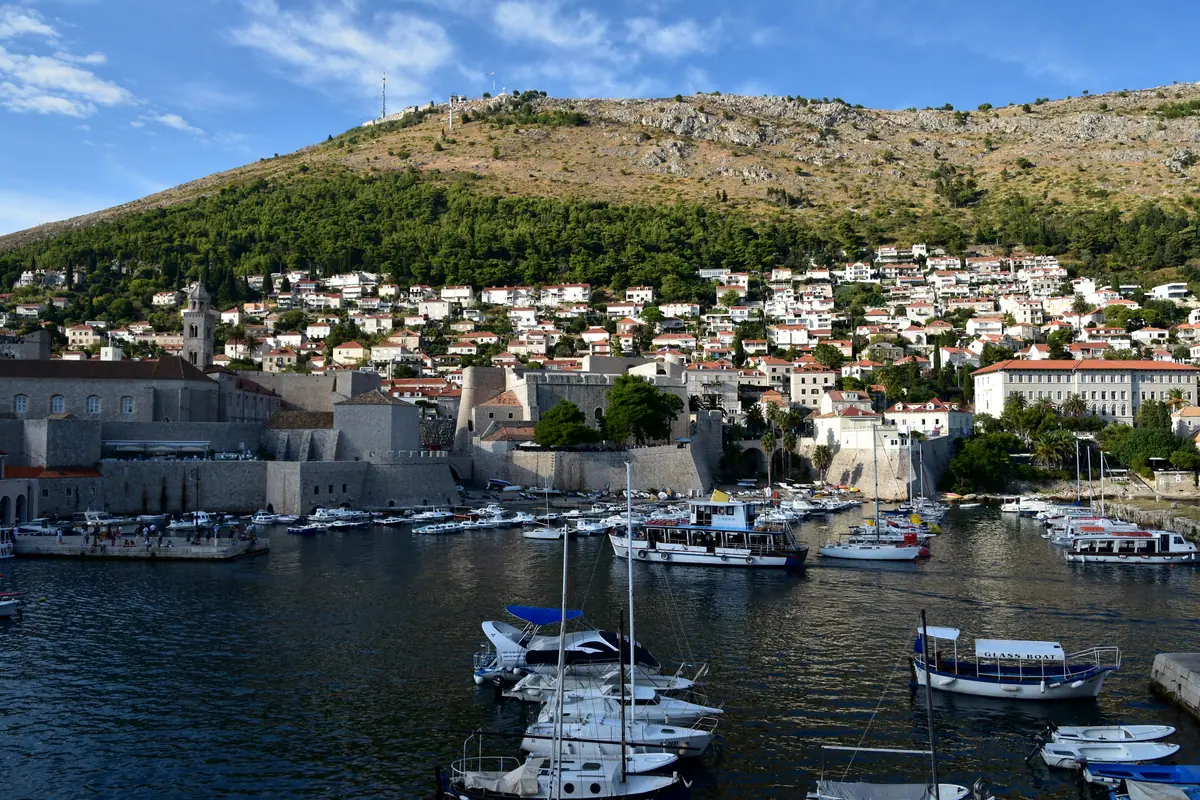
Dubrovnik closes the loop perfectly. Its Old Town, ringed by walls up to six metres thick, is a UNESCO-listed maze of monasteries, fountains and churches, with the polished limestone Stradun running straight through. Walk the full circuit of the City Walls early in the morning or in the last two hours of daylight; it takes one to two hours and delivers the postcard view down over the rooftops and out to Lokrum. Inside, don't miss the Rector's Palace, the cathedral treasury, and the Franciscan monastery's old pharmacy.
Ride the cable car up Mount Srđ for a panoramic sunset, or take the short ferry to Lokrum for botanical gardens, peacocks and a saltwater lagoon. Dubrovnik's airport sits about 20 kilometres south in the Konavle valley, so plan a buffer on departure day, especially in summer when the coastal road slows to a crawl.
For a final day, choose between a boat trip through the Elaphiti Islands, a ferry to Mljet National Park with its forested lakes, or the quiet town of Cavtat just down the coast. Travellers who prefer fewer crowds should aim for June or September; August in Dubrovnik is intense, with cruise crowds peaking mid-morning and mid-afternoon. Swim before breakfast, sightsee early, and save the evening for wine and seafood on a side street away from the Stradun.
Frequently asked questions
Which airport should I fly into for a one-week Croatia trip?
Zagreb suits an inland-to-coast route via the lakes and Zadar. Split is ideal if you want islands and central Dalmatia, and Dubrovnik works best for a southern loop. Booking an open-jaw ticket, arriving in one city and leaving from another, saves a long return journey.
How long do I need at Plitvice Lakes?
Four to six hours covers one lakes group comfortably; a full day lets you walk both the upper and lower lakes. Arrive at opening time in summer, and check in advance whether timed entry or trail closures are in force.
Do I need to rent a car in Croatia?
Not strictly. Buses and foot-passenger catamarans connect most coastal towns, and organised trips reach the national parks. A car makes Plitvice, Krka and Istria far easier, but parking inside Split and Dubrovnik is difficult and expensive, so many travellers drop the car before the final city.
When is the best time to visit Croatia?
Late May, June, September and early October balance warm sea with manageable crowds. July and August are hottest and busiest, and winter brings cheaper flights but reduced ferry and island connections.
Can I reach the Croatian islands without a car?
Yes. Fast catamarans for foot passengers run frequently between Split, Hvar, Korčula and Dubrovnik in summer, usually taking one to three hours per leg. Services thin out in winter, so check timetables before building your route around them.
Sort the rest of your trip
Everything for Croatia, in one place
Stay in Croatia
Hotels, guesthouses and apartments — compared in one search.
Search hotels
Transfer in Croatia
Private driver waiting on arrival — no queues, no surprises.
Book a transfer
Travel insurance
Medical cover, delays and lost baggage — sorted before you go.
Get covered