Bosnia and Herzegovina packs an improbable amount into a country you can cross in a day: Ottoman bazaars, a single-arch stone bridge that has become a national symbol, emerald rivers cutting limestone gorges, and mountains that hold some of Europe's last primeval forest. It is a place of strong coffee, stronger rakija, and hospitality that arrives before you've finished asking for directions. This guide covers the landmarks and experiences a first-time visitor should not miss.
Sarajevo's Ottoman Heart: Baščaršija and the Old Town
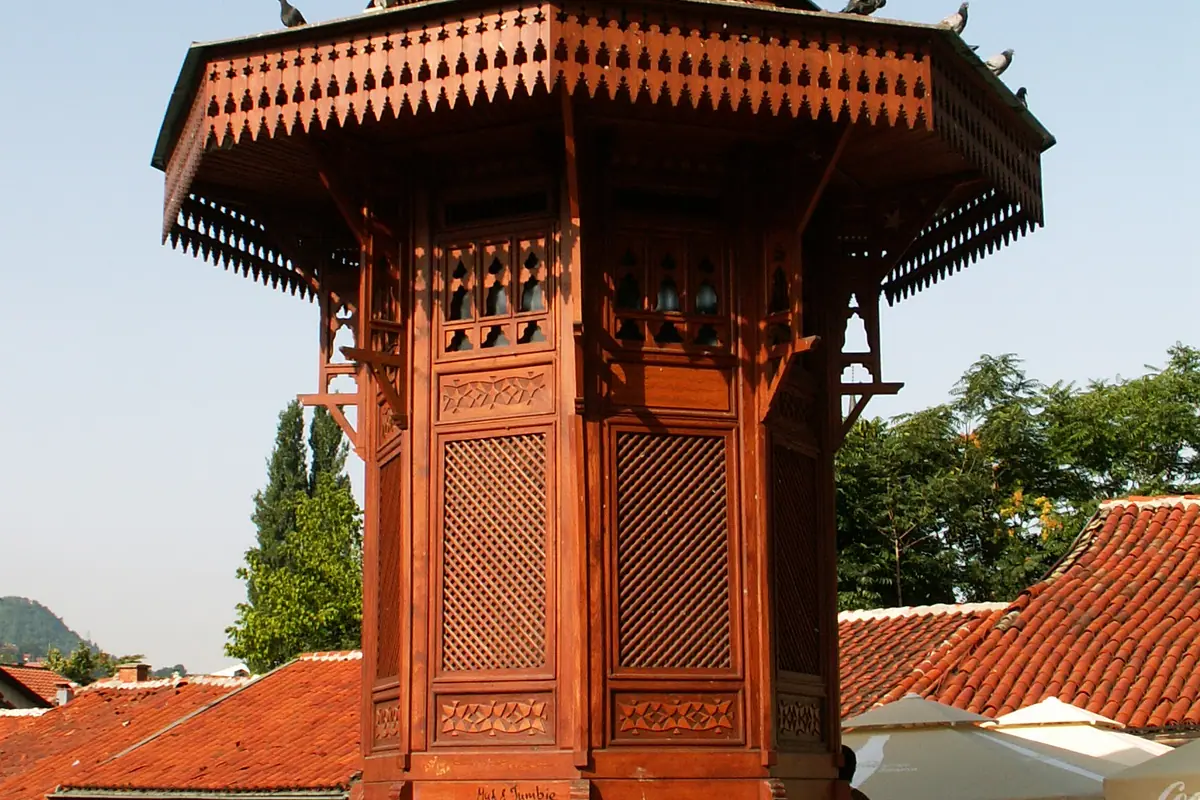
Start in Baščaršija, Sarajevo's old bazaar quarter, where the city's Ottoman centuries are still fully intact. The square is anchored by the Sebilj, an ornate wooden kiosk fountain from the 18th century that has become the city's meeting point — locals say that if you sit beside it long enough, you will eventually see everyone you know. From there, lanes fan out into coppersmiths' rows, sweet shops selling tufahija, and courtyards where you can drink Bosnian coffee from a copper set and be told, firmly, that it is not Turkish coffee.
A few minutes' walk brings you to the Gazi Husrev-beg Mosque, completed in the 1530s and still the most important Islamic building in the country, with a columned arcade and a courtyard shaded by a single ancient plane tree. Nearby, the Vijećnica — the Austro-Hungarian city hall from the end of the 19th century, dressed in Moorish revival arches — sits right at the seam where the Ottoman town meets the Habsburg boulevards, a visible join between two empires.
Give Sarajevo at least two full days. Walk west along the Miljacka to the Latin Bridge, the stone crossing where the events of June 1914 began, then climb to the Yellow Fortress for sunset, when the minarets, the yellow fort walls and the white gravestones across the hills all glow and the call to prayer overlaps from half a dozen mosques.
Mostar and the Ottoman South of Herzegovina
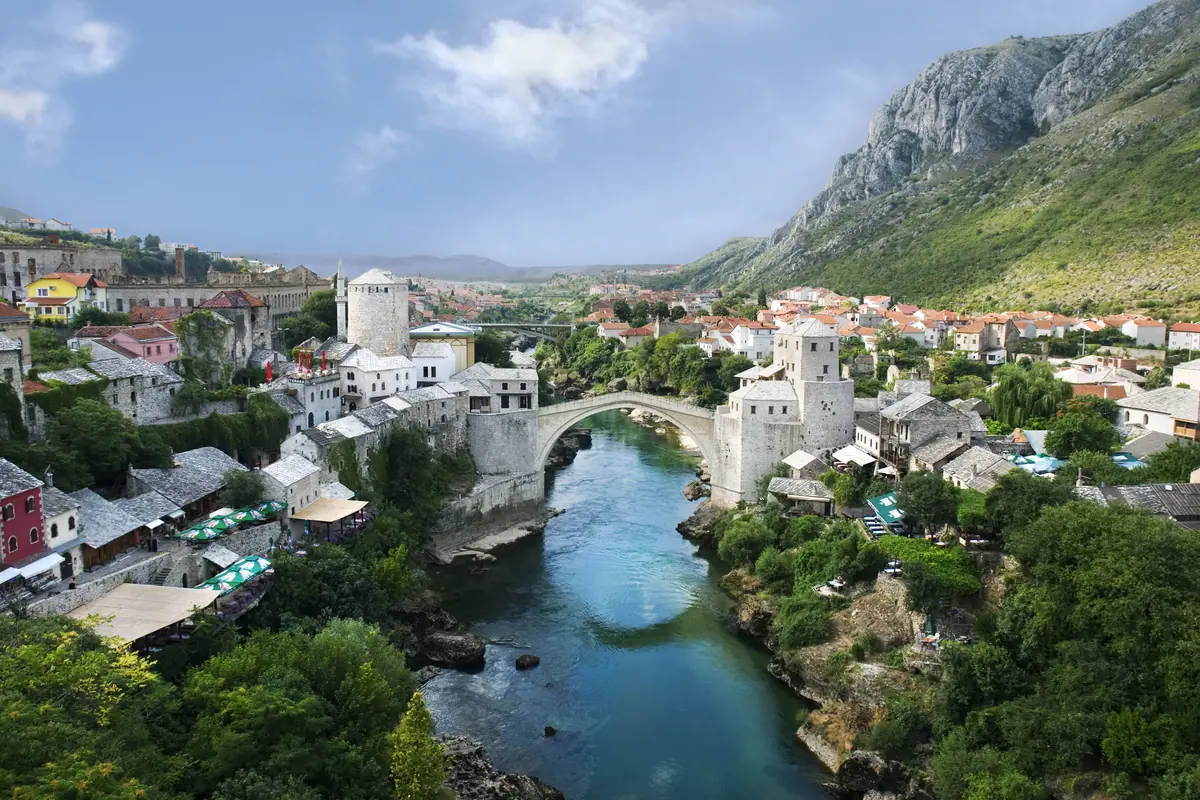
The Stari Most is the image most people carry of this country: a steep, hump-backed limestone arch flung across the Neretva, originally raised in the 16th century by the Ottoman architect Mimar Hayruddin, destroyed in 1993 and rebuilt from the original stones, reopening in 2004. Watching the Neretva run deep green beneath it never gets old. Divers from the local club still leap the roughly 24 metres into the cold water below — a tradition that goes back centuries, and one they will happily postpone until enough of a crowd has gathered to make it worthwhile.
Both banks are worth a slow morning. On the east side, Kujundžiluk is a lane of Ottoman houses turned into workshops and cafés; on the west, the Koski Mehmed Pasha Mosque has a minaret you can climb for the definitive view down onto the bridge and the gorge. Cross into the bazaar, buy a copper coffee pot, and sit on a terrace above the river; the light is best before about ten in the morning, before the day-trippers arrive from the coast.
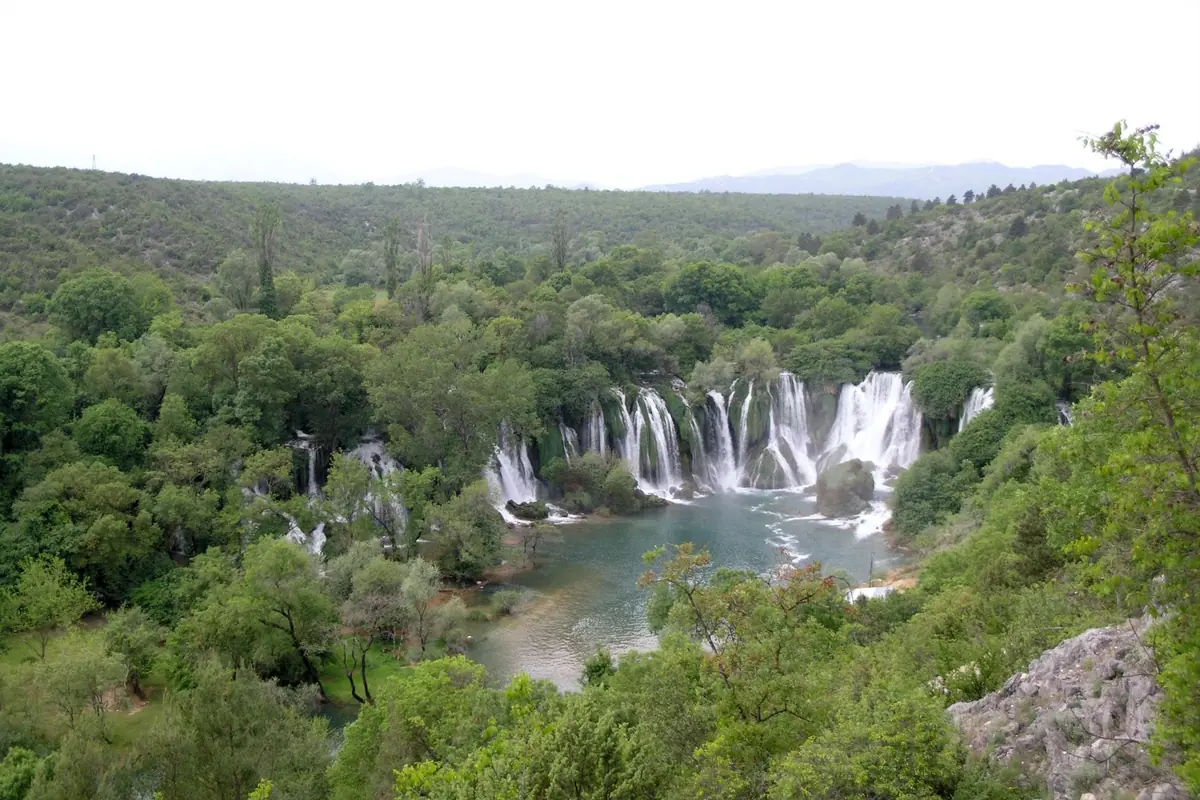
Herzegovina rewards a wider loop. Blagaj Tekke, a whitewashed Sufi lodge wedged against a cliff at the mouth of the Buna spring, is a 15-minute drive south, and the spring itself is one of the strongest karst springs in Europe, erupting ice-cold from a cave wall. Continue to Počitelj, a fortified Ottoman village stacked up a hillside with an octagonal tower, and finish at the Kravice waterfalls on the Trebižat river, where a wide curtain of water drops into a swimmable pool. Summer weekends there are busy; early morning in late May or September is close to perfect.
Rivers, Waterfalls and Rafting: Una, Neretva and the Pliva
This is a country shaped by water, and its rivers are the best way to see it. Una National Park, in the far northwest around Bihać, protects a river so clear it looks digitally over-saturated, tumbling over travertine steps at Martin Brod and thundering down Štrbački buk, a multi-tiered fall you can reach on foot or see from a boat. Rafting here runs from spring through early autumn, with the biggest water after snowmelt in April and May.
In the centre of the country, the Neretva near Konjic offers some of the most accessible rafting in the Balkans, with gentle stretches for beginners and livelier rapids further upstream near Glavatičevo. The Tara and Drina canyons on the eastern border are for more serious paddling, with multi-day trips launching from around Foča, and the Tara gorge is among the deepest canyon systems in Europe.
For something gentler, head to Jajce in central Bosnia, where the Pliva river pours over a 21-metre waterfall directly into the Vrbas in the middle of town — a strange, lovely sight with a viewing platform and a small park beside it. Just outside Jajce, the Pliva lakes are a pair of calm, green mirror-surfaces with a cluster of little wooden watermills between them, and the water is warm enough to swim by July. Closer to Sarajevo, Vrelo Bosne at Ilidža is a wooded park of springs and swan ponds, an easy half-day escape by tram and a short walk.
Mountains, Primeval Forest and Ski Slopes
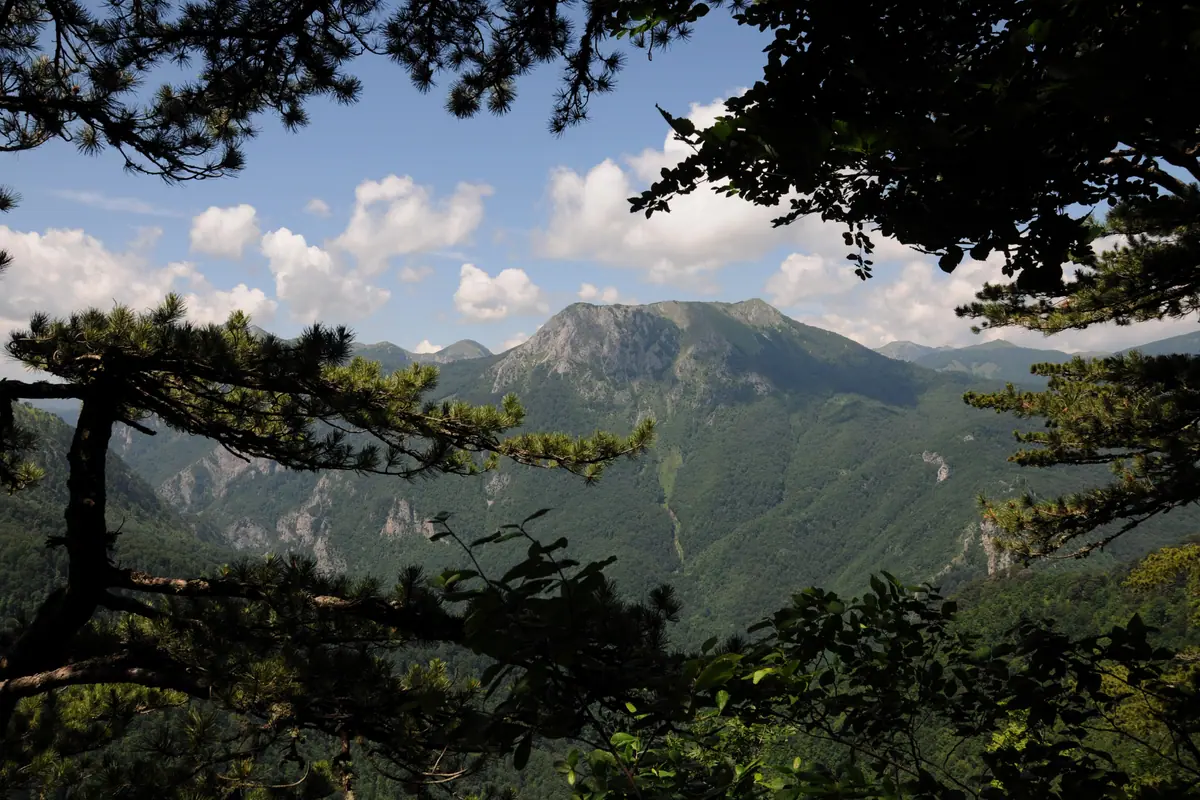
Sutjeska National Park, in the southeast, holds Perućica, one of the last true primeval forests in Europe — a strictly protected tangle of beeches and firs, some of them centuries old, where you are not allowed to leave the marked trail. Above it rises Maglić, at 2,386 metres the highest point in the country, and on the mountain's shoulder sits Trnovačko Lake, a heart-shaped tarn in a grassy amphitheatre that is one of the finest day hikes in the Balkans. Allow six to eight hours for the round trip from the Prijevor trailhead, and go between June and early October.
Winter flips the country entirely. Bjelašnica and Jahorina, both within easy reach of Sarajevo, are the main ski areas, with Jahorina carrying the legacy of the 1984 Winter Olympics; the season generally runs from mid-December into March, with the most reliable snow in January and February. Beyond the groomed runs, Bjelašnica's high plateau hides Lukomir, the highest inhabited village in the country, a cluster of stone houses and steep pastures that is reachable on foot in summer and makes for one of the most memorable walks in Bosnia.
Further west, Prokoško Lake on the slopes of Vranica sits in a bowl of glacial rock at around 1,600 metres, ringed by shepherds' huts and, in July, wildflowers. Nights get cold even in midsummer, so pack a layer.
Bridges, Fortresses and Layers of History
In Višegrad, in the east, the Mehmed Paša Sokolović Bridge strides across the Drina in eleven elegant stone arches, built in the 1570s by the Ottoman court architect Mimar Sinan and now a protected monument of world significance. It is the bridge of a famous novel, but it stands perfectly well on its own terms, especially at dusk when the river turns pewter. Next to it, Andrićgrad is a modern stone town of squares and galleries, built as a cultural tribute rather than a historic quarter, and pleasant for an hour of wandering.
Around Stolac, in Herzegovina, the Radimlja necropolis collects carved medieval tombstones known as stećci — heavy slabs and chests decorated with hunting scenes, dancers and twisted vine patterns. They are among the most distinctive archaeological remains in the region and are collectively recognised as a site of exceptional value. Combine them with the hilltop fortress of Stolac and the nearby Bregava river.
Sarajevo's modern history is equally tangible. The Tunnel of Hope in Dobrinja, dug under the airport runway in 1993 to connect the besieged city to free territory, is preserved as a small, deeply affecting museum with a stretch of the tunnel you can walk through. A half-day can also take in Travnik, with its painted mosques and the spring-lined Plava Voda gorge, and the hilltop fortress of Jajce, where medieval Bosnian kings were crowned.
When to Go, How Long and What to Eat
The best months are May, June, September and early October: mild temperatures, working waterfalls, open mountain trails and manageable crowds. July and August are hot in Herzegovina — Mostar and the Kravice area regularly push past 35°C — but the rivers and lakes are at their most swimmable, and Sarajevo stays a few degrees cooler. Winter belongs to the mountains and to Sarajevo's café culture, when snow settles on the old town and the city's long tradition of lingering over small cups of coffee makes complete sense.
For a first visit, plan seven to ten days. Two or three days in Sarajevo, one or two in Mostar with a day for Blagaj, Počitelj and Kravice, a night near Jajce or Travnik, and two days for either Una National Park or Sutjeska gives you a real sense of the country rather than a highlights blur. Public buses connect the main towns reliably, but a rented car makes the waterfall-and-monastery detours far easier.
Eat accordingly: ćevapi in warm flatbread with raw onion, burek from a bakery window, grilled trout from the Neretva, and a plate of smoked meats and cheese with rakija as an appetiser you did not order. Also, learn the local coffee ritual — it is served in a small copper pot with a tiny cup, sugar cubes and a glass of water, and it is meant to last at least an hour.
Frequently asked questions
How many days do I need in Bosnia and Herzegovina?
Seven to ten days lets you cover Sarajevo, Mostar and Herzegovina's waterfalls, plus either the Una or Sutjeska national parks, without rushing. If you have only a long weekend, base yourself in Sarajevo for two days and take a day trip to Mostar — but you will be trading depth for breadth.
What is the best time of year to visit?
Late May to June and September to early October are ideal, with comfortable temperatures and flowing waterfalls. July and August suit swimmers and rafters but are hot and busy in Herzegovina, while December to March is ski season on Bjelašnica and Jahorina.
Is Mostar or Sarajevo the better base?
Both are worthwhile and they serve different purposes. Sarajevo has the deepest cultural and culinary scene and the best connections; Mostar is smaller, walkable, and an excellent base for Blagaj, Počitelj and the Kravice waterfalls. Staying a night in each is the ideal arrangement.
Do I need a car to get around?
Not strictly — buses and trains link the main towns, and day tours run from Sarajevo and Mostar to the big sights. But a car gives you far more freedom for Blagaj, Počitelj, Jajce, Una National Park and the mountain villages, where public transport is thin.
What should I not miss on a first trip?
The Stari Most in Mostar, Baščaršija and the Tunnel of Hope in Sarajevo, Blagaj Tekke, Kravice waterfalls, the Pliva waterfall at Jajce, and either Sutjeska's primeval forest and Trnovačko Lake or the Una's travertine cascades. Those five or six stops capture the range of the country.
Plan it — experiences in Bosnia and Herzegovina
Live search, booked directly with trusted providers.
Sort the rest of your trip
Everything for Bosnia and Herzegovina, in one place
Stay in Bosnia and Herzegovina
Hotels, guesthouses and apartments — compared in one search.
Search hotels
Transfer in Bosnia and Herzegovina
Private driver waiting on arrival — no queues, no surprises.
Book a transfer
Stay online in Bosnia and Herzegovina
Travel eSIM — data the moment you land, no roaming bills.
Get an eSIM