Bosnia and Herzegovina folds Ottoman bazaars, Austro-Hungarian boulevards, emerald rivers and a single sliver of Adriatic coast into a country you can cross by road in a day. Most travellers arrive by air into Sarajevo or Tuzla, and a week is just enough to loop from the capital's old town to Mostar's stone arch, the waterfalls of the Una and the primeval forest of Sutjeska. Here is how to spend seven days, with the flight logistics that make the whole thing work.
Flights into Bosnia and Herzegovina: Which Airport to Choose
Almost every trip begins with a choice between four small international airports, and the one you pick quietly shapes your whole route. Sarajevo International Airport sits only about six kilometres from the old town, which means you can land, clear a compact terminal and be drinking coffee beside the Sebilj fountain within half an hour by taxi or trolleybus. It has the widest year-round network, including winter services for the ski crowds heading up to Jahorina and Bjelašnica.
Tuzla International Airport in the north-east is the favourite of budget carriers, with a steady flow of low-cost flights from across Europe. It suits travellers who want to start with the salt lakes and old town of Tuzla, then work south. Banja Luka in the north-west is the natural gateway to Una National Park and the Kozara hills, while Mostar's airport is small and largely seasonal, though wonderfully placed for Herzegovina.
Flight times are short: most of Western Europe is roughly one hour forty-five to two hours thirty away, and even longer connections rarely eat a full day. The trade-off is that services thin out dramatically between November and March, so check schedules before you commit to a winter arrival day. If your dates are flexible, flying into Sarajevo and out of Tuzla or Banja Luka turns a there-and-back drive into an elegant open-jaw loop.
Days 1-2: Sarajevo, from Baščaršija to the Latin Bridge
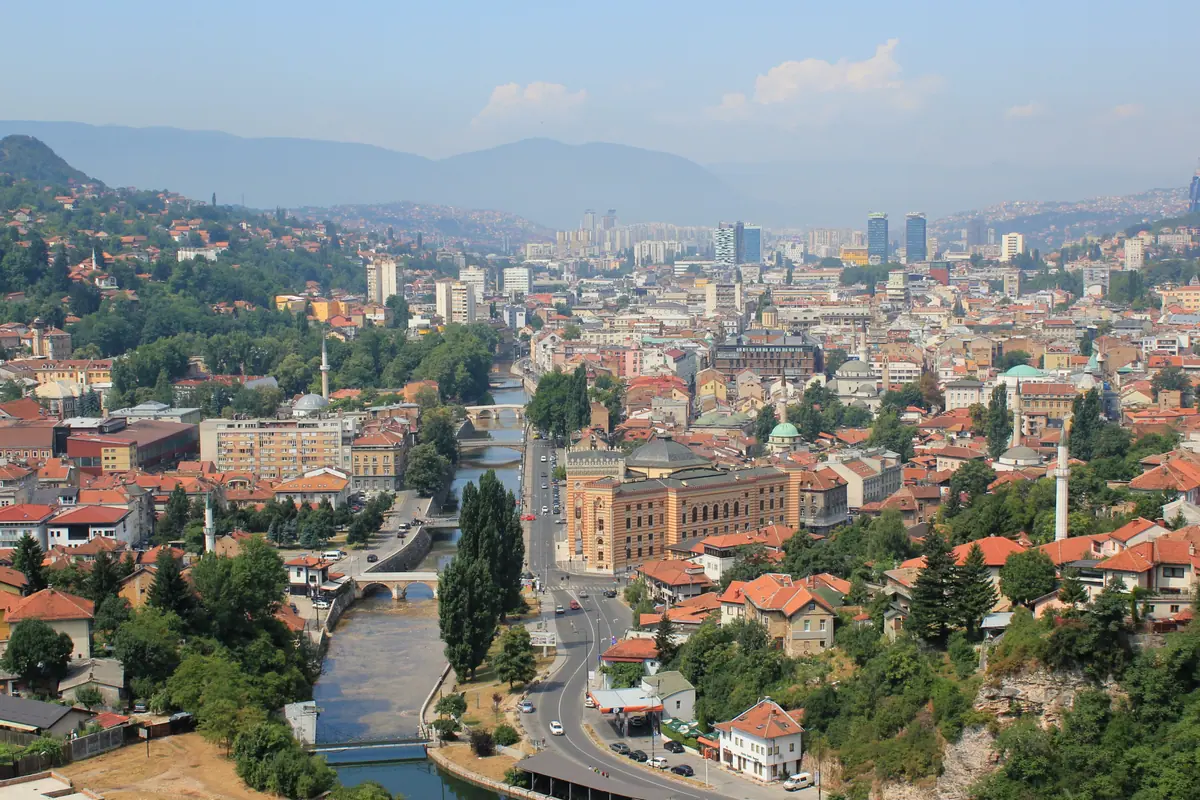
Give Sarajevo two full days, because it rewards slow walking more than any other city in the Balkans. Start in Baščaršija, the old bazaar district where coppersmiths still hammer trays in the lanes around Kazandžiluk street. The Gazi Husrev-beg Mosque, the largest Ottoman-era mosque in the country, anchors the quarter, and the little wooden Sebilj fountain at its edge is the city's de facto meeting point. Behind it rises the Sahat Kula clock tower, keeping time on a lunar clock that has ticked for centuries.
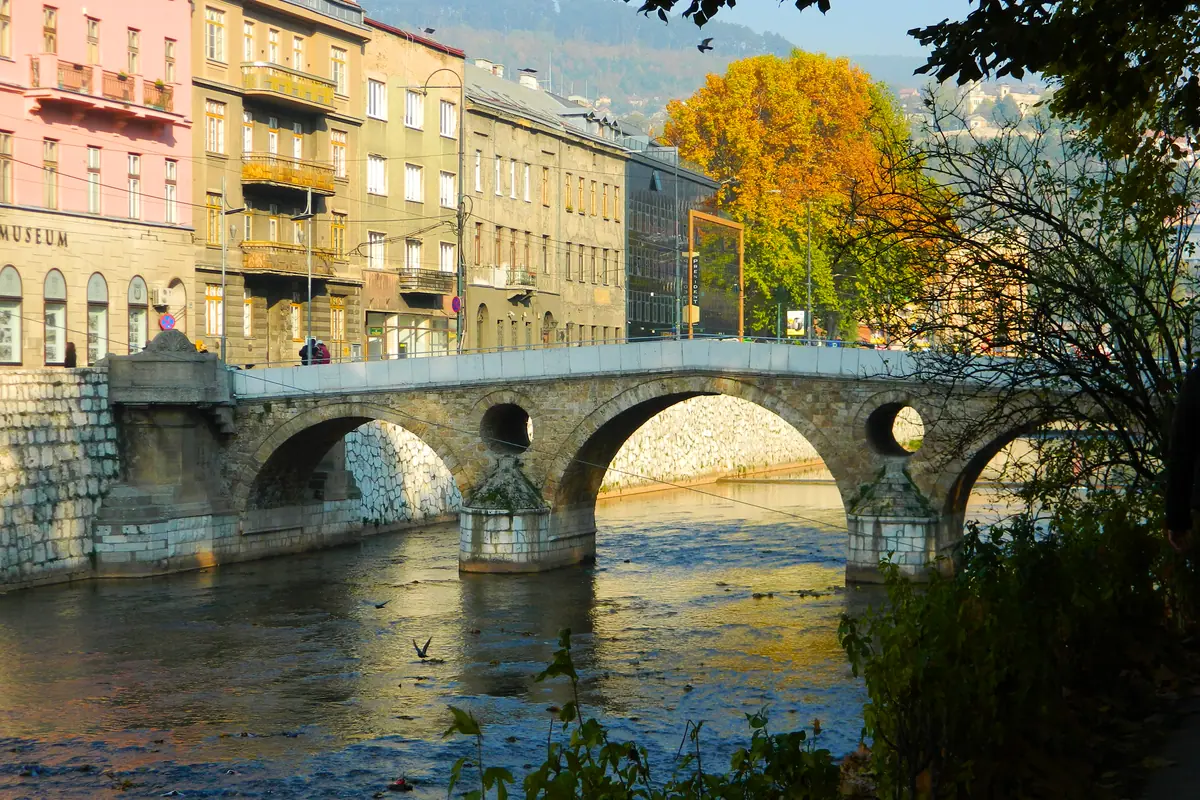
Head west along the Miljacka river to the Latin Bridge, the stone span where the shots that sparked the First World War were fired in 1914, then continue to Viječnica, the flamboyant pseudo-Moorish city hall that now houses the national library. Climb to the Yellow Fortress for sunset over the minarets and the white graves of the martyrs' cemetery, or take the cable car up Trebević for the abandoned 1984 Olympic bobsleigh track, still streaked with graffiti and framed by pine forest.
Use the second day for the harder history. The Tunnel of Hope near the airport is a short stretch of the hand-dug passage that once linked the besieged city to the outside world, and the gallery above it explains the siege years with quiet precision. Pair it with the Old Orthodox Church, the Cathedral of the Sacred Heart and the cobbled Austro-Hungarian street of Ferhadija, which is where Sarajevo's café culture truly comes alive in the evenings.
Day 3: Travnik, Jajce and the Pliva Waterfall
Rent a car or arrange a driver for this day, because public transport through central Bosnia is slow and infrequent. Travnik, about ninety minutes west of Sarajevo, was the seat of Ottoman viziers for over 150 years, and its fortress on the hill above town looks down on the Šarena džamija, a mosque painted inside with swirling floral frescoes. Stop at the Blue Water spring, a gushing karst source beside a row of small cafés, before pushing on.
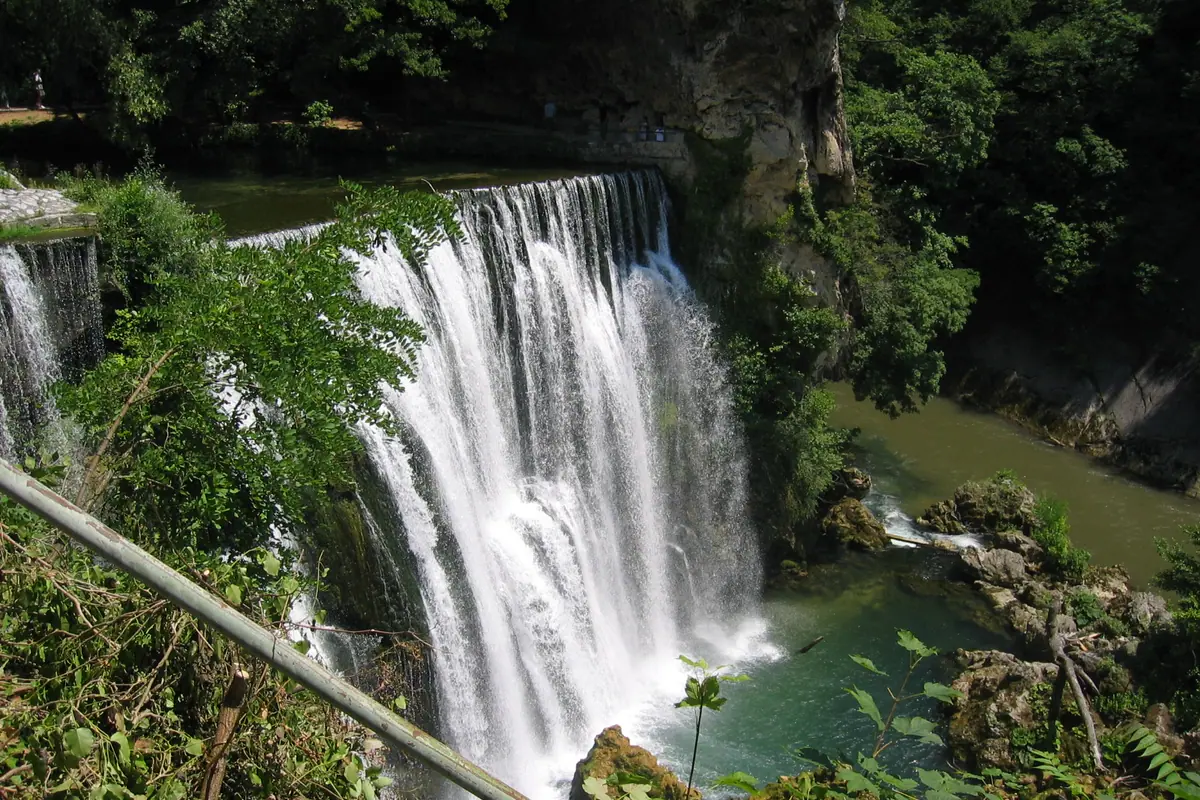
Jajce is the highlight. Here a twenty-one-metre waterfall thunders in the middle of the town, where the Pliva river tips over a travertine lip into the Vrbas, a sight best seen after spring snowmelt. Behind it stands the fortress where Bosnia's last medieval king was crowned and killed, along with the vaulted catacombs beneath the Church of St Mary and a rare Roman Mithraeum carved into a hillside.
If you still have daylight, walk or drive the few kilometres out to the Pliva lakes, where the Mlinčići watermills sit on a small island of green between two glassy lakes. Sleep in Jajce or push on to Banja Luka, and plan a late start tomorrow, because the driving distances in this part of the country look deceptively short on the map.
Days 4-5: Herzegovina, Mostar and the Kravice Waterfalls
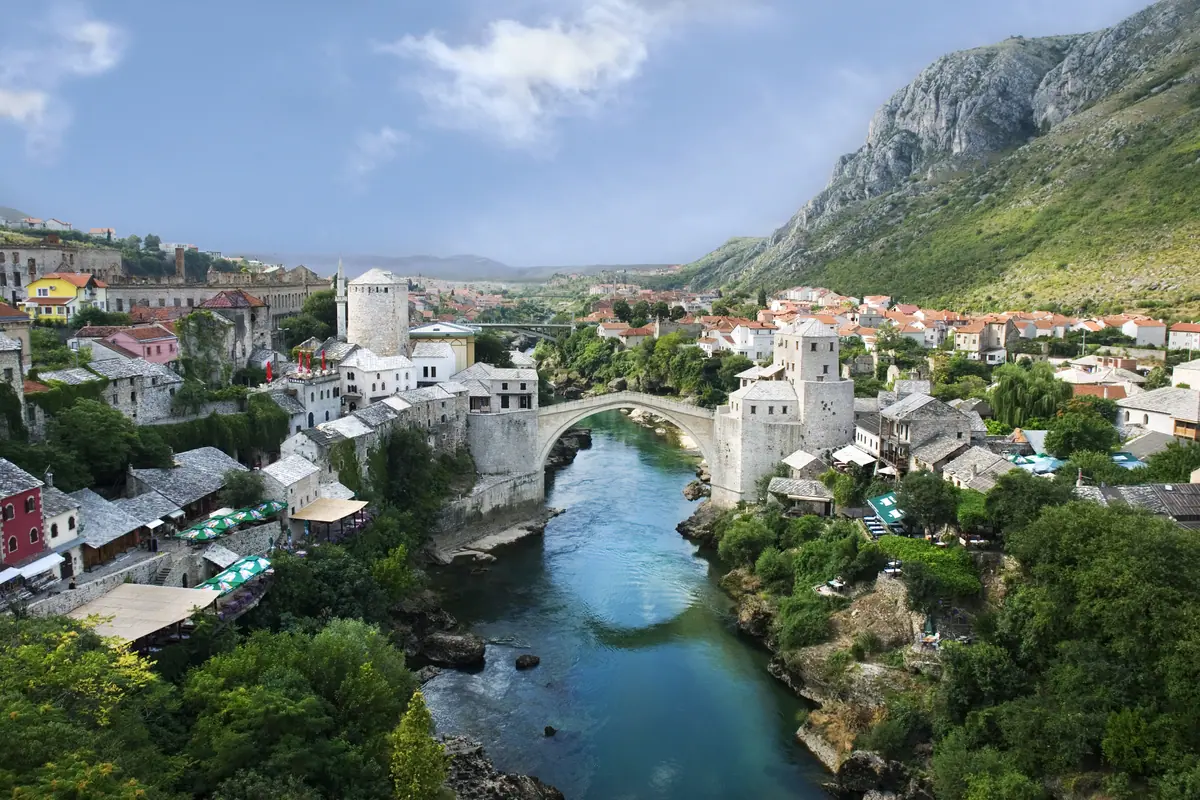
Drop south on the new motorway and the landscape changes fast: pine scrub, stone villages, and then the Neretva river running impossibly green beneath cliffs. Mostar's Stari Most, a single graceful arch rebuilt after the 1990s war, is the image everyone carries home, and it earns the hype. Watch divers leap from the bridge into the cold current below, then climb the minaret of the Koski Mehmed Pasha Mosque for the classic view back across the arch.
Spend the rest of the day in Kujundžiluk, the bazaar of polished cobbles and copper stalls on the east bank, and stay overnight so you see the bridge lit up after dark. On day five, work through Herzegovina's short-radius wonders: Blagaj Tekke, a Sufi dervish house tucked under a huge cliff where the Buna river erupts from a cave, and Počitelj, a tiered fortified village of stone steps and pomegranate trees.
Save the afternoon for Kravice Waterfalls, a wide horseshoe of falls on the Trebižat river that swells into a curtain of white in spring and becomes a swimming hole in summer. Nature lovers should add the Vjetrenica cave near Ravno or the Roman villa ruins at Mogorjelo, and anyone craving saltwater can reach Neum, the country's only coastal town, in under an hour.
Day 6: Sutjeska National Park and the Drina at Višegrad
This is a long but unforgettable day eastward into the Dinaric Alps. Sutjeska National Park protects Perućica, one of Europe's last primeval forests, where beeches grow to enormous heights and wolves and bears still move through the dark. The view from the Tjentište memorial complex looks straight up towards Maglić, at 2,386 metres the country's highest peak, and the glacial Trnovačko Lake below it repays a two-hour hike if your legs are fresh.
From Tjentište it is roughly an hour of winding river road to Višegrad, where the Mehmed Paša Sokolović Bridge strides across the Drina on eleven elegant arches. It is a UNESCO World Heritage site and the setting of a famous novel, so allow time to walk the full span and look back at the bridge from the water's edge. Close to it, Andrićgrad is a purpose-built stone town of courtyards and galleries, pleasant for an evening meal.
Consider sleeping in Višegrad or doubling back towards Foča, then returning to Sarajevo the next morning. Drive times are the thing to plan around here: the roads are good but they buckle and bend, so count on three hours for stretches that look like two.
Day 7: Una National Park, Bihać or a Highland Farewell
With a late flight or an extra day, head north-west to Una National Park around Bihać, where the river tumbles through a string of tufa barriers. The main spectacle is Štrbački buk, a two-tier waterfall near Kulen Vakuf that can be viewed from a wooden walkway, with gentler cascades at Martin Brod a little upstream. Rafting, kayaking and zip-lines run from spring through early autumn.
If your flight leaves from Sarajevo instead, keep the final day gentle. Bjelašnica's highland villages are within an hour of the capital, and the remote hamlet of Lukomir clings to a canyon edge where shepherds still summer on the plateau. The Blidinje Nature Park, with its lone pine tree standing on an open pass, is another beautiful last stop on the road between Mostar and Sarajevo.
Aim to be back at your departure airport three hours before an international flight, and leave a generous buffer if you are returning a rental car — paperwork at small terminals can be slow. For the best weather, come in May, June or September into early October, when the rivers run full, the mountains are green and the old towns are busy but not yet stifling.
Frequently asked questions
How long are flights to Bosnia and Herzegovina from Europe?
Most direct services from Western and Central Europe take roughly one hour forty-five minutes to two hours thirty. Sarajevo has the widest year-round network, Tuzla and Banja Luka are strong for low-cost carriers, and Mostar's airport is mainly seasonal. Winter schedules thin out noticeably between November and March, so check timetables before booking ski trips.
Which airport should I choose for a one-week itinerary?
Sarajevo works best for a loop that includes Sarajevo, central Bosnia, Mostar and Sutjeska, because it sits closest to the middle of the country. If your priority is Herzegovina and the coast around Neum, Mostar saves you a drive, though options are limited. For Una National Park, the Kozara hills or Jajce via the north, Banja Luka or Tuzla can make more sense as a start or finish.
Do I need a rental car to follow this route?
Not for Sarajevo itself, which is walkable and has cheap trams and trolleybuses. Public buses connect the main towns, but they are slow and infrequent on the central Bosnian and eastern mountain routes. A rental car, or a private driver for the Jajce and Sutjeska days, unlocks the waterfalls, the highland villages and the Drina valley that make the trip memorable.
When is the best time of year to visit Bosnia and Herzegovina?
Late May, June and September into early October offer the sweet spot of warm days, full rivers and open mountain roads. July and August are hot in Mostar and busy along the Neretva. Winter transforms Sarajevo and the Olympic mountains into a ski destination, but some rural roads and seasonal attractions, including parts of Una National Park, close or slow down.
How many days do Sarajevo and Mostar each need?
Two full days in Sarajevo lets you cover Baščaršija, the Gazi Husrev-beg Mosque, the Latin Bridge, Viječnica, the Yellow Fortress and the Tunnel of Hope without rushing. Mostar is comfortably done in one night and two half-days, leaving time for Blagaj Tekke, Počitelj and Kravice Waterfalls. Anything less and you spend your week in transit.
Plan it — flights in Bosnia and Herzegovina
Live search, booked directly with trusted providers.
Sort the rest of your trip
Everything for Bosnia and Herzegovina, in one place
Stay in Bosnia and Herzegovina
Hotels, guesthouses and apartments — compared in one search.
Search hotels
Transfer in Bosnia and Herzegovina
Private driver waiting on arrival — no queues, no surprises.
Book a transfer
Travel insurance
Medical cover, delays and lost baggage — sorted before you go.
Get covered