Bolivia is the South America that refuses to be tidy — a country where a mirror-flat salt desert meets freezing geyser fields, where cable cars glide over a canyon capital, and where a silver mountain financed an empire. This is a land of extreme altitude and equally extreme beauty, and the landmarks below are the ones worth building a whole trip around.
Salar de Uyuni: Standing on the World's Largest Salt Flat
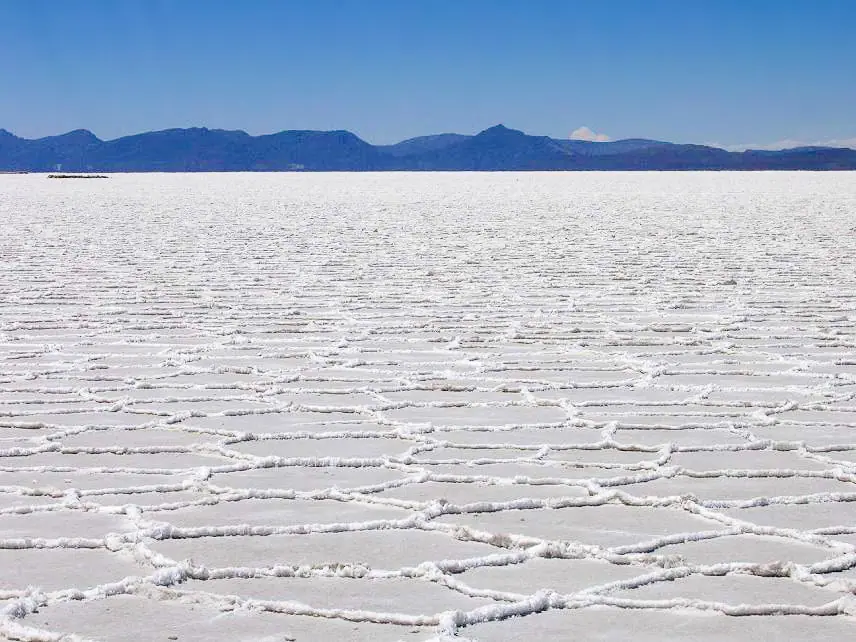
There is nothing else quite like the Salar de Uyuni. Stretching across more than 10,000 square kilometres of the Altiplano at roughly 3,650 metres above sea level, this is the largest salt flat on earth — a blinding white plain that, in the wet season, becomes a shallow mirror reflecting the sky so perfectly that the horizon vanishes. Between December and April travellers come for that surreal doubling of clouds and feet; from May to October the surface dries into a cracked hexagonal crust that makes crossings easier and sunsets sharper.
Most people base themselves in the small town of Uyuni, reached by overnight train or a short flight from La Paz, and join either a single-day outing or a longer 4x4 circuit. The signature stop is Incahuasi Island, a fossil-rich outcrop in the middle of the salt covered in towering trichocereus cacti — some over ten metres tall and many centuries old — with a short trail leading to a panoramic viewpoint above the endless white. Before heading onto the flats, the Cementerio de Trenes on the edge of town, a graveyard of rusting 19th-century locomotives, makes a strange and photogenic first stop.
Red Lagoons, Geysers and the Eduardo Avaroa Reserve
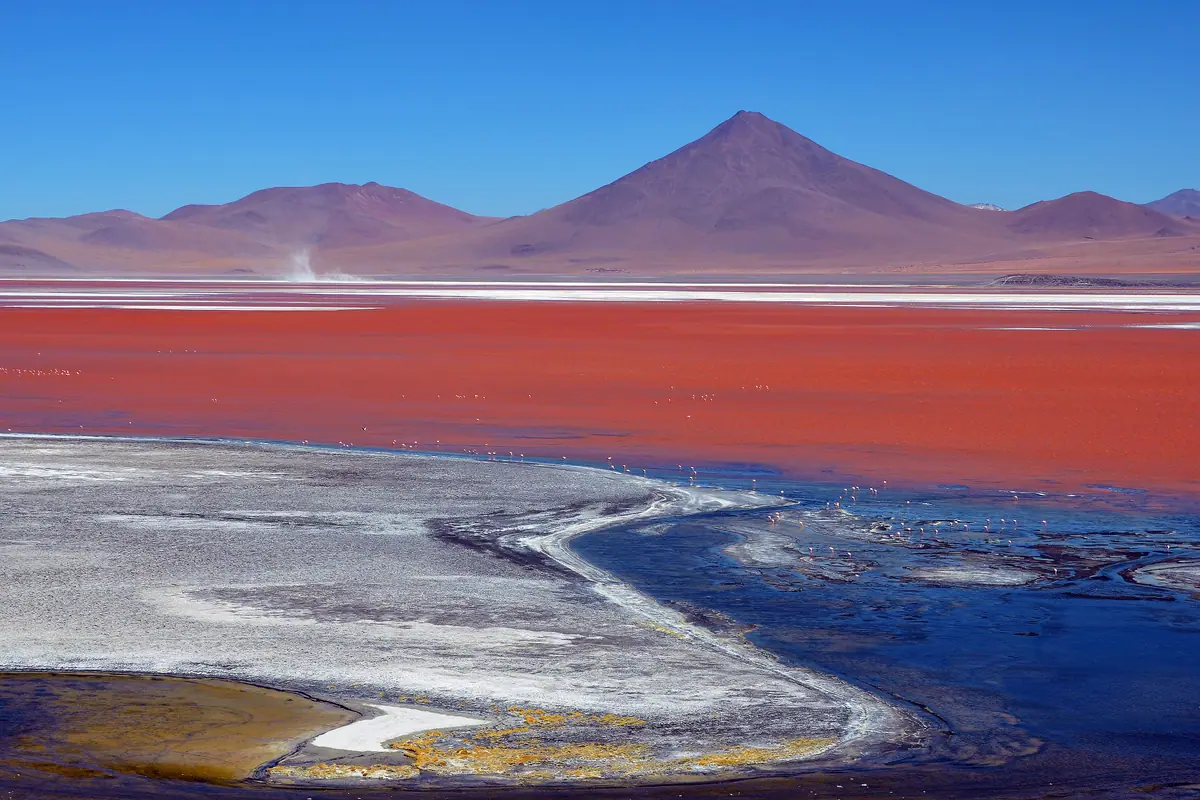
The salt flat is only the opening act. Most multi-day expeditions continue south into the Eduardo Avaroa Andean Fauna Reserve, a high-altitude wilderness of volcanic rock and mineral lakes that sits between 4,200 and 5,000 metres. Laguna Colorada is the showpiece: a vast shallow lake turned brick-red by algae and sediments, dotted with thousands of Andean flamingos. Nearby, Laguna Verde takes on an eerie emerald tint at the foot of the Licancabur volcano, and the Sol de Mañana geyser field sends plumes of steam and bubbling mud into the thin, cold air.
The route threads through the Siloli Desert, where the wind-carved Arbol de Piedra — a stone tree balanced on a narrow stem — has become the region's most photographed rock, and onwards past the surreal formations of the Desierto de Dalí. Practical realities matter here: expect long, bumpy hours in a 4x4, nights in basic salt hotels or simple refugios, and temperatures that can plunge to around -15°C between June and August. Pack a down jacket, gloves and a warm hat even in the middle of the dry season. The reward is dawn at the Termas de Polques hot springs, soaking in steaming water while the altiplano frosts over around you.
La Paz: Cable Cars Above a Canyon Capital
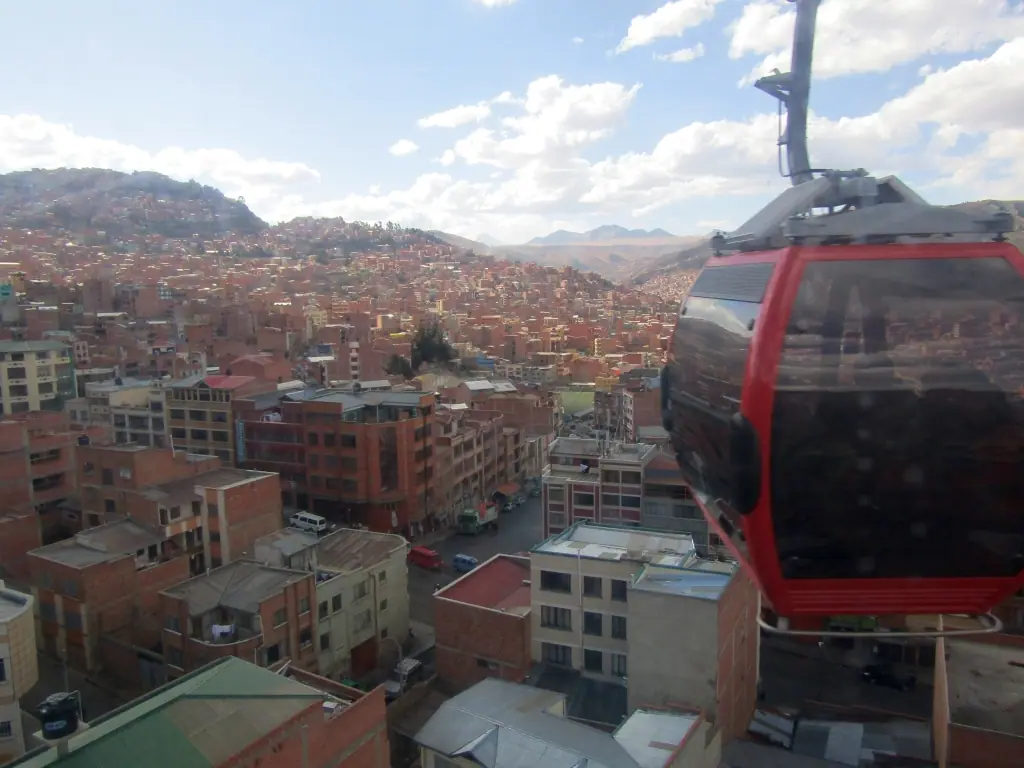
La Paz is built like a bowl, and the best way to understand it is from above. The Mi Teleférico cable car network — the highest urban cable system in the world — stitches the city together, lifting passengers from the historic centre up to El Alto and over the rim of the canyon. A ride costs almost nothing and delivers views of terracotta rooftops spilling down the slopes with the snow-capped Illimani, at 6,438 metres, looming behind. Down on the ground, Plaza Murillo anchors the old town with its cathedral and government palaces, while the San Francisco Church and the Witches' Market on Calle Linares sell dried herbs, amulets and folk remedies in a tradition that predates the Spanish arrival.
Adrenaline seekers do not have to look far. The legendary Death Road drops from the La Cumbre pass at 4,650 metres down into the Yungas cloud forest near Coroico, a 3,500-metre descent by mountain bike that swaps freezing páramo for banana palms in a single afternoon. Above the city, Huayna Potosí at 6,088 metres is one of the most accessible glaciated peaks of its height anywhere, with guided climbs running roughly May to September. Closer to town, the eroded clay spires of Valle de la Luna in Mallasa make an easy half-day escape, and El Alto's sprawling Feria 16 de Julio, held on Thursdays and Sundays, is one of the largest street markets in South America.
Tiwanaku and Lake Titicaca: Isla del Sol and Copacabana
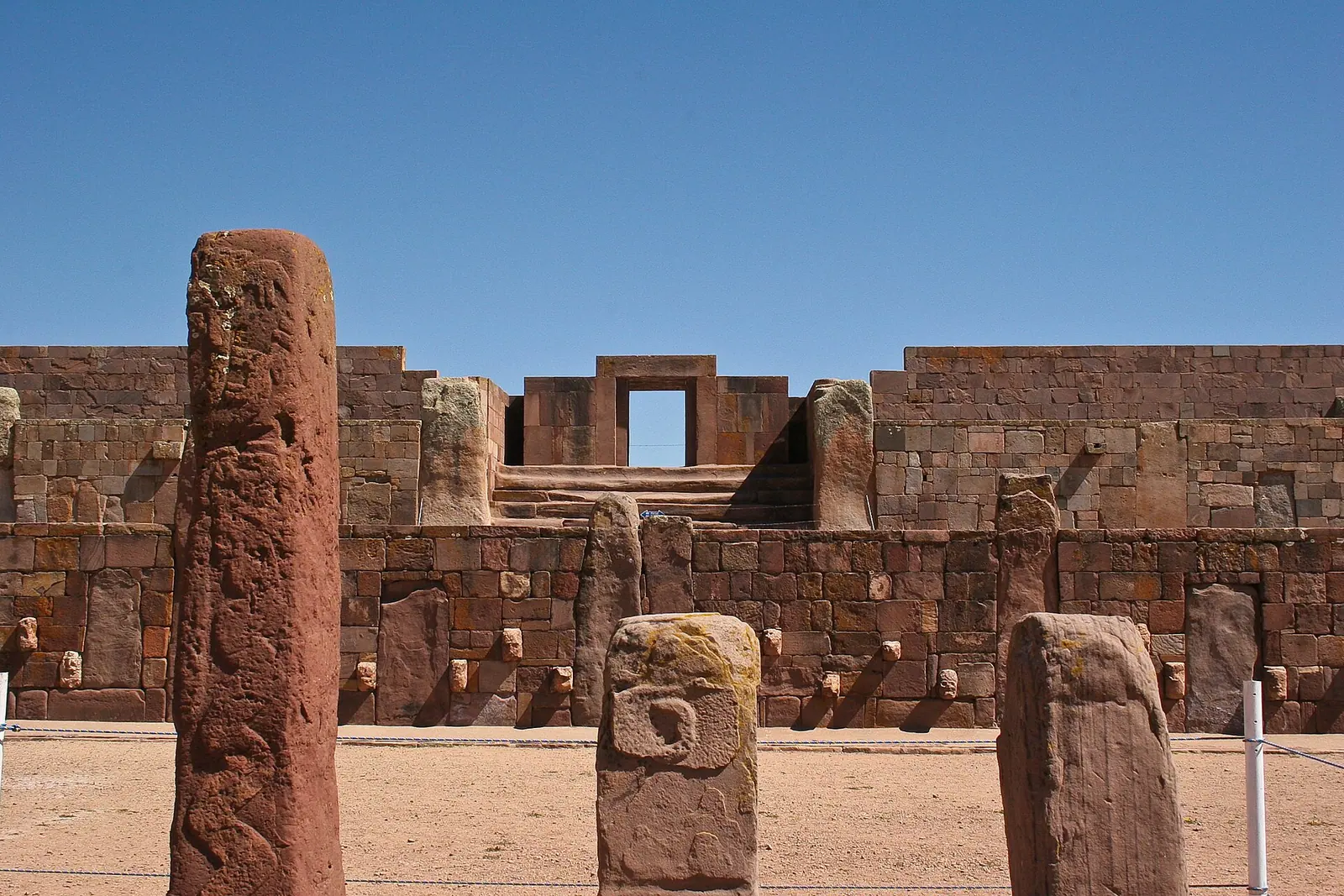
About 70 kilometres west of La Paz lie the ruins of Tiwanaku, the ceremonial heart of a civilisation that dominated the southern Andes from roughly 500 to 900 AD, long before the Inca. The site's signature monument is the Puerta del Sol, or Gate of the Sun, a single block of carved stone bearing a rayed figure that visitors still argue over. Elsewhere you can climb the stepped Akapana pyramid, wander the sunken temple and the Kalasasaya courtyard, and inspect the monolithic Ponce and Fraile statues. A licensed local guide transforms what could look like scattered stones into a genuine story, and the on-site museums hold remarkable carved heads and ceramics.
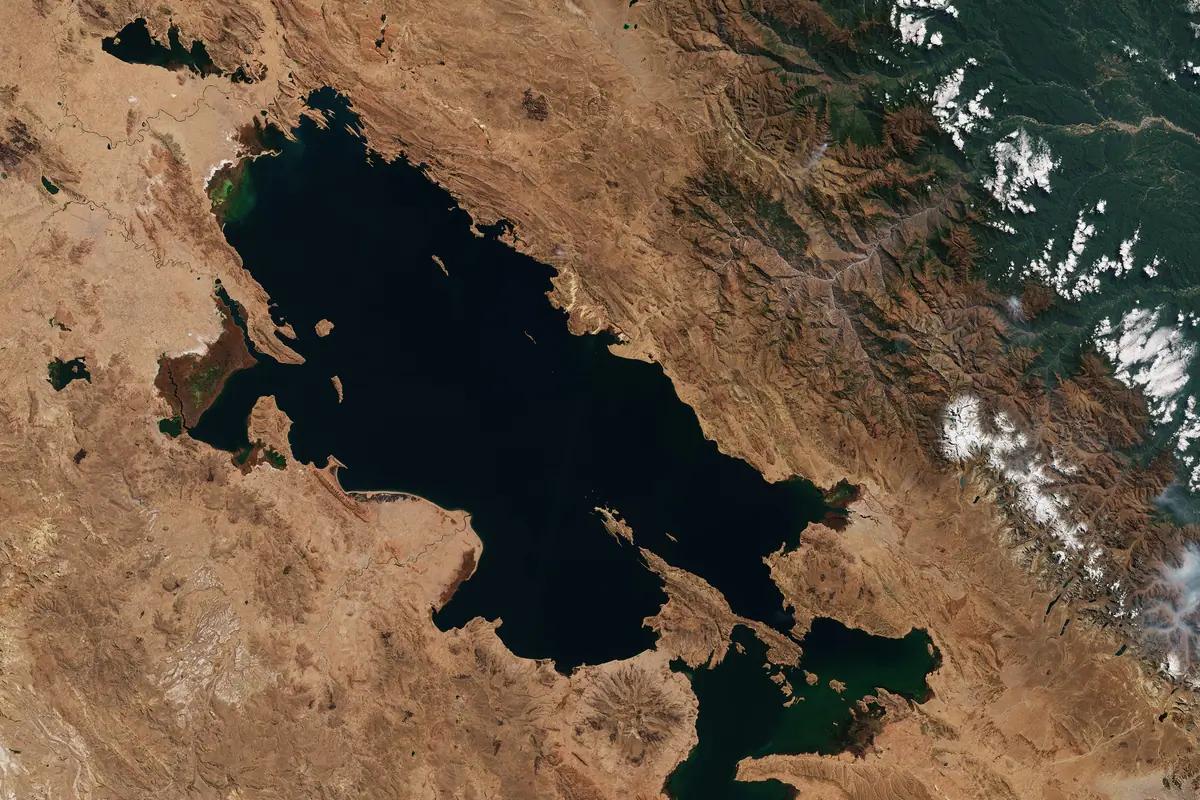
From there, the road continues to Lake Titicaca, the world's highest navigable lake at 3,810 metres. Copacabana is the base: a pilgrimage town with a white-and-blue basilica where Bolivians bring new cars and trucks to be blessed with garlands and beer. Boats take about an hour and a half to Isla del Sol, the legendary birthplace of the sun, where the village of Yumani climbs a hillside of pre-Columbian terraces. Climb the Inca Steps to the Fountain of Youth, walk the ridge to the Sun Temple and the Pilko Kaina ruins, and stay overnight for a sunset that turns the whole lake to bronze. Smaller Isla de la Luna, with its convent ruins, is often added on the return.
Sucre and Potosí: Colonial Splendour and a Mountain of Silver
Sucre, Bolivia's constitutional capital, is a low-rise grid of whitewashed colonnades and terracotta roofs that feels a world away from the altiplano chill. The Casa de la Libertad is where the country's independence was declared in 1825, and the Convento de San Felipe Neri offers a rooftop view over the entire historic centre. The city's unexpected star, however, is Parque Cretácico at Cal Orck'o, where a sheer limestone wall preserves thousands of dinosaur footprints — the largest such concentration ever documented, best seen from the viewing platform with a guide explaining the trackways.
Four hours away and 4,090 metres up sits Potosí, one of the highest cities on earth and home to the Cerro Rico, the silver mountain that bankrolled the Spanish empire for two centuries. The Casa de la Moneda, or National Mint, is a superb museum of colonial coinage, with original wooden rolling mills and vast vaults. Guided visits into working cooperative mines are offered too: they are physically demanding, cold and emotionally confronting, and visitors are expected to bring small gifts of coca leaves for the miners. Sucre and Potosí pair naturally over three or four days, and both reward slow travel rather than a rushed stop.
The Amazon and the Eastern Lowlands: Madidi, Samaipata and the Chiquitos Missions
Bolivia's eastern lowlands are a different country entirely — humid, green and thick with wildlife. The town of Rurrenabaque, a short flight from La Paz, is the gateway to Madidi National Park, one of the most biologically diverse protected areas on the planet, where jaguars, macaws and hundreds of bird species share pristine rainforest. Most travellers split their time between a jungle lodge and a pampas tour on the Yacuma River, drifting past pink river dolphins, capybaras, howler monkeys and sunbathing caimans. The dry months from May to October offer easier access and better wildlife visibility; the wet season floods the tracks but fills the wetlands with birds.
Further east, Santa Cruz de la Sierra serves as the lowland hub. From here you can reach Samaipata, a cool cloud-forest town beneath the elaborately carved sandstone ceremonial rock of El Fuerte de Samaipata, and the trails of Amboró National Park. Deep in the Chiquitos region, the towns of San Javier, Concepción and San José de Chiquitos preserve a chain of baroque-mestizo mission churches, several dating to the late 17th century, whose painted wooden interiors and colonnaded plazas are best combined with the mission music festival that fills the region with orchestras each spring.
Frequently asked questions
What is the best time of year to visit the Salar de Uyuni?
It depends on the effect you want. The wet season, roughly December to April, creates the famous mirror reflection and is the dream for photographers, though some parts of the flat can be off-limits after heavy rain. The dry season from May to October gives crisp blue skies, easier access to Incahuasi Island and clearer views on the southern lagoon circuit — but nights can drop to -15°C between June and August.
How many days do you need in Bolivia?
Ten days to two weeks covers the essentials: two to three days acclimatising in La Paz, a three or four-day Salar de Uyuni and lagoons circuit, and time in Sucre or Copacabana. If you want to add the Amazon, the missions or the wine valleys around Tarija, budget at least three weeks. Bolivia is large, internal flights are limited, and long-distance buses eat whole days.
How do you handle the altitude in Bolivia?
Arrive in La Paz or Sucre and give yourself two or three full days before any strenuous activity. Drink plenty of water, eat lightly, skip alcohol on your first nights, and try coca tea, which is sold everywhere and genuinely helps some travellers. Avoid flying straight from sea level to Uyuni and starting a tour the same day. If you develop a persistent headache with breathlessness or nausea, descend rather than push on.
Is it worth combining the Altiplano with the Amazon?
Absolutely, and it is easier than it sounds. Flights from La Paz to Rurrenabaque take under an hour, and you can go from glacier views to jungle humidity in a single morning. Plan the Amazon for the middle or end of your trip if possible, since the lowlands are near sea level and give your body a break from altitude before you fly home.
What should I pack for Bolivia?
Layers, always. A warm down jacket, thermal base layers, gloves, a hat and sturdy broken-in shoes cover the Altiplano, while breathable long sleeves, insect repellent and quick-dry trousers are essential in the Amazon. Add high-factor sunscreen and sunglasses, because the UV at 4,000 metres is ferocious, plus a headlamp for early tour departures. Carry cash in local currency — small notes are far easier to use in markets and on tours than large ones.
Plan it — experiences in Bolivia
Live search, booked directly with trusted providers.
Sort the rest of your trip
Everything for Bolivia, in one place
Stay in Bolivia
Hotels, guesthouses and apartments — compared in one search.
Search hotels
Transfer in Bolivia
Private driver waiting on arrival — no queues, no surprises.
Book a transfer
Stay online in Bolivia
Travel eSIM — data the moment you land, no roaming bills.
Get an eSIM