Bolivia is the kind of country that rearranges your sense of scale: a capital cupped inside a canyon, a lake the Incas called the birthplace of the sun, and a salt flat so vast and flat it buckles the horizon. With a week and a domestic flight pass, you can stitch together the Andes' greatest hits without losing days to buses. This is how to do it, altitude and all.
Day 1: Touch Down at El Alto and Ease Into La Paz
Your trip begins with one of the most dramatic landings on the planet. El Alto International Airport sits at roughly 4,060 metres on the rim of the Altiplano, making it one of the highest international airports anywhere, and the descent drops you straight over the clay-coloured canyon that holds La Paz, with the triple summit of Illimani — 6,438 metres of ice — floating on the skyline behind it. Step off the plane and the thin air is instantly noticeable: your heartbeat quickens, your lips dry out, and the first staircase feels like a small mountain. Treat day one as a light acclimatisation day, not a sightseeing day.
Keep the morning gentle. Ride the city's soaring cable-car network, Mi Teleférico, which links El Alto down into the bowl of La Paz in a few silent, glass-walled minutes and doubles as the best rooftop viewpoint in the country. From the station at the top, the whole city spills below you like a landslide of brick. Back at ground level, drift through Plaza Murillo, the colonial heart, where the cathedral, the presidential palace and the congress buildings face each other across a square full of shoe-shiners and pigeons. A few blocks away is the Mercado de las Brujas, the Witches' Market on Calle Jiménez, hung with dried herbs, amulets, seed pods and other talismans that Andean households still buy for luck and protection.
If your head is clear by mid-afternoon, take a taxi south to the Valle de la Luna, where erosion has sculpted pale clay into spires and cones that genuinely look lunar — an easy 45-minute wander. Otherwise, save your energy and climb to the Killi Killi viewpoint for sunset, when Illimani turns rose-gold and the canyon lights up below. Drink mate de coca, eat lightly, skip the alcohol, and get an early night. Nothing ruins a one-week Bolivia itinerary faster than a bad first 24 hours.
Days 2–3: Copacabana and the Sacred Waters of Lake Titicaca
An early bus or shared van north from La Paz reaches Copacabana in about three and a half hours, crossing the Tiquina Strait on a barge with the lake stretching out on both sides at 3,800 metres. Copacabana itself is a small pilgrim town built around the whitewashed, Moorish-domed Basilica of Our Lady of Copacabana, one of South America's most important shrines. If you're lucky you'll catch a blessing ceremony in the forecourt, where new cars and trucks are draped in garlands and showered with confetti before hitting the road. For sunset, climb Cerro Calvario — a 30-minute walk past the Stations of the Cross that rewards you with the finest panorama of the lake and its reed-fringed shore.
Day three belongs to Isla del Sol, reached by boat in roughly one and a half to two hours. Inca legend places the birth of the sun god here, and the island still feels ceremonial: terraced hillsides, tiny stone villages, and no cars at all. At the northern end near Challapampa you'll find the Chinkana labyrinth and the Sacred Rock; at the southern end, the village of Yumani sits above a long Inca staircase and the so-called Fountain of Youth. Ridge trails link the two halves in two to four hours of walking, and staying overnight in a simple Yumani guesthouse — electricity limited, stars unlimited — is one of the most memorable nights you can spend in Bolivia.
Return to La Paz by late afternoon on day three, or arrange to head straight onward if your domestic flight times allow. Either way, keep this leg short: the lake is a two-night detour that fits a week neatly, but stretching it to four nights will cost you the salt flats, which are the real centrepiece.
Day 4: Tiwanaku by Morning, Uyuni by Afternoon
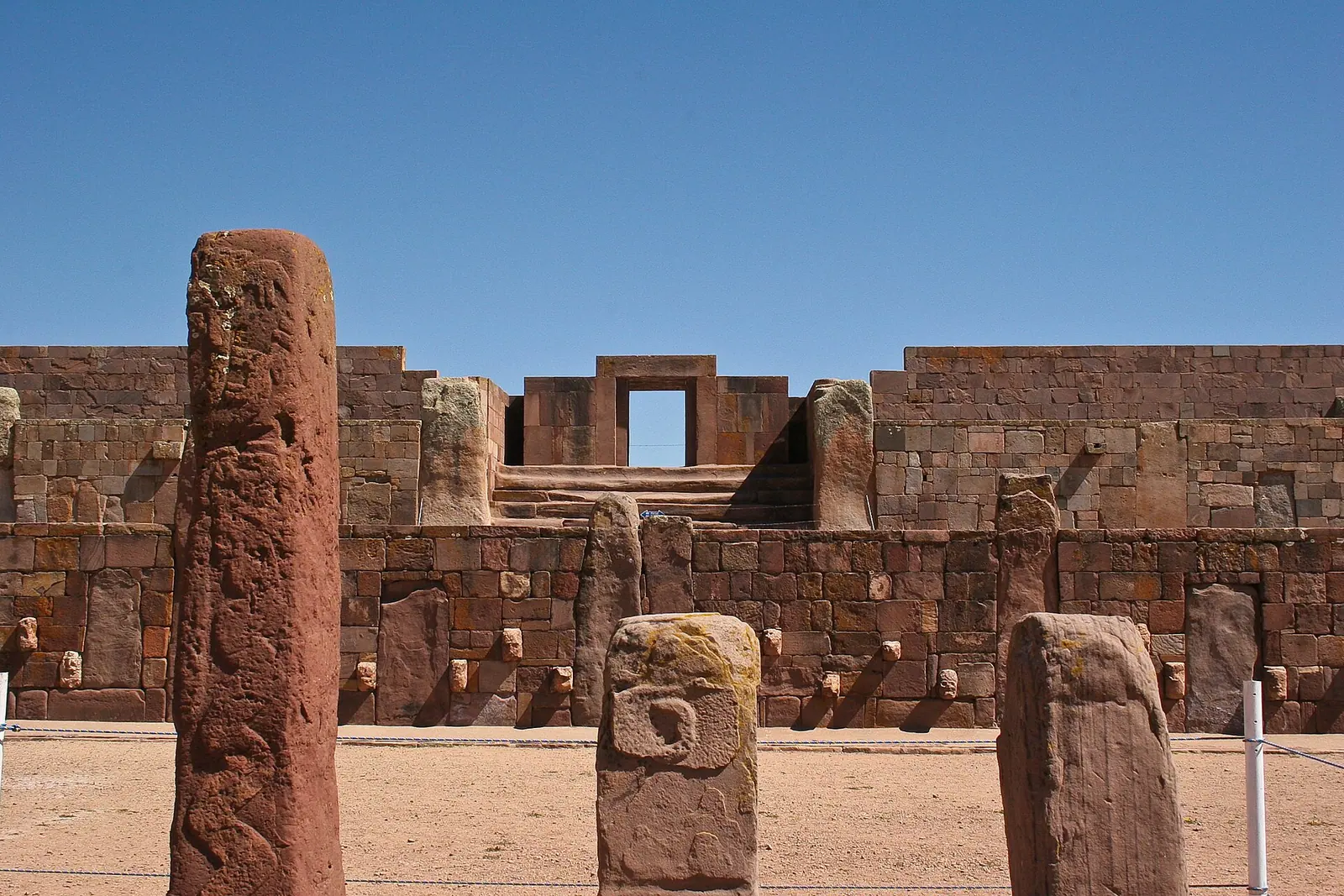
Before you leave the Altiplano, spend a half-day at Tiwanaku, about 70 kilometres west of La Paz and roughly an hour and a half by road. This pre-Inca ceremonial city was the capital of an empire that dominated the Andes centuries before the Incas, and it is a UNESCO-listed archaeological site on an enormous scale. Walk through the Kalasasaya temple courtyard, stand in front of the Puerta del Sol — the Sun Gate, carved from a single block of andesite — and look down into the semi-subterranean temple with its walls studded by carved stone heads. The Akapana pyramid and the nearby Pumapunku complex give a sense of how much engineering lies under the soil, and the on-site museum explains the monoliths, including the towering Bennett Stela.
By early afternoon you should be back at El Alto for the flight south to Uyuni, a hop of about an hour that swaps the Altiplano's brown plateau for the high, cold edge of the world's largest salt flat. Uyuni town itself sits at 3,670 metres and is a scruffy, wind-bitten frontier settlement with one obvious purpose: launching expeditions onto the salt. Check into a guesthouse, buy your gloves and reef boots if you forgot them, and confirm your tour departure for the following morning.
If daylight allows, take a short taxi to the Cementerio de Trenes, the train cemetery on the town's outskirts, where rusting British-era locomotives and freight cars sit half-sunk in the sand — a strange, photogenic monument to Bolivia's vanished railway boom. Finish the day watching sunset from the edge of the salar, where the white plain turns pink and the horizon flattens into a perfect line.
Days 5–6: The Salar de Uyuni and the Eduardo Avaroa Reserve
Day five starts before dawn if you've chosen a sunrise departure, and you should. The Salar de Uyuni covers more than 10,000 square kilometres, and in the dry season it is a cracked mosaic of bright white salt polygons stretching to the curve of the earth. Drive out to Isla Incahuasi, a fossil coral outcrop rising from the flat and covered in towering trichocereus cacti — a 20-minute scramble to the summit gives you the classic 360-degree view of nothing but salt. Nearby you'll pass the salt mounds and craft stalls of Colchani, the little pools known as ojos de sal where groundwater bubbles up through the crust, and a monument to the Dakar Rally that crosses the flat each year.
The following day, continue south on a multi-day tour into the Reserva Nacional de Fauna Andina Eduardo Avaroa, the wild, high-altitude corner of Bolivia that borders Chile. The scenery escalates aggressively: Laguna Colorada, turned brick-red by algae and dotted with rare James's flamingos; the steaming fumaroles and mud pots of the Sol de Mañana geysers at nearly 4,900 metres; the hot springs at Termas de Polques, where you can soak at dawn with steam pouring off the water; and Laguna Verde, a mineral-green lake sitting beneath the perfect cone of the Licancabur volcano. The Árbol de Piedra, a wind-carved stone tree standing alone in the Siloli Desert, is the desert's strangest photo stop.
Be realistic about conditions. Nights are spent in basic refugios at around 4,200 metres, and in the winter months of June to August temperatures can drop well below freezing, so pack a genuine down jacket, a hat and a headlamp. Between December and March, a thin layer of water over the salar turns it into a giant mirror and the photos are extraordinary — but roads into the reserve can flood and some routes close. Whatever the season, bring high-factor sunscreen, glacier-grade sunglasses and more water than you think you need.
Day 7: Colonial Sucre, or the Silver Mountain of Potosí
Fly out of Uyuni on day seven — services are short, often under an hour, though not every route operates daily, so check schedules early and keep an overnight bus as a fallback. Sucre, at a merciful 2,800 metres, is the gentlest city in Bolivia and a perfect final stop. This UNESCO-listed white city is the country's judicial capital, and its Plaza 25 de Mayo is the colonial showpiece: arcaded buildings, the Cathedral with its bell tower, and the Casa de la Libertad, the museum where Bolivia's independence was declared in 1825. Climb to the rooftop of the Convento de San Felipe Neri for a tiled panorama of domes and courtyards, and browse the Mercado Central for salteñas and fresh fruit juice.
If you'd rather end with something heavier, swap Sucre for Potosí, one of the highest cities in the world at over 4,000 metres. Everything here revolves around Cerro Rico, the silver-rich mountain that bankrolled the Spanish empire and consumed the lives of countless indigenous and African miners. The Casa de la Moneda, the colonial mint, is an outstanding museum of silver, machinery and coins, and the Convento de Santa Teresa offers a quieter, beautifully preserved cloister. Cooperative mine tours are available and deeply affecting, but they are also ethically debated — go only with an operator that treats working miners fairly and be honest with yourself about whether you want to be there.
Whichever you choose, leave one buffer evening before your international departure. Bolivia's domestic network is small and weather, altitude and thin demand can all shift a schedule at short notice. A spare afternoon in Sucre or La Paz is far better than a sprint to the airport.
Bolivia Flight Logistics: Airports, Seasons and Altitude
Bolivia has two main international gateways and they could hardly be more different. Santa Cruz's Viru Viru airport sits in the hot, humid lowlands at around 400 metres, which makes it the far kinder place to land if you're worried about altitude. El Alto, serving La Paz, puts you straight onto the Altiplano at over 4,000 metres. Other useful airports are Cochabamba's Jorge Wilstermann in the temperate middle valleys, Uyuni's Joya Andina for the salt flats, and Sucre's airport for the colonial south. Domestic hops are typically short — La Paz to Santa Cruz is about an hour, La Paz to Uyuni roughly an hour, La Paz to Sucre around 45 minutes — but they run on limited frequencies, and some routes operate only two or three days a week.
Timing matters more than most travellers expect. The dry season from roughly May to October delivers crisp skies, reliable roads and the classic white salt-flat photographs, but cold nights and busy departures around June to August. The wet season from December to March creates the famous mirror reflections on the salar, at the cost of flooded tracks and occasional cancellations. Carnival in February and the high-season weeks around New Year fill both flights and hotels, so book weeks ahead. On small aircraft, checked baggage is often capped around 15 to 20 kilograms, so travel light or expect to pay for the excess.
Finally, respect the altitude. La Paz, El Alto, Uyuni, Potosí and the entire Eduardo Avaroa Reserve sit between 3,600 and 4,900 metres, and altitude sickness does not care how fit you are. Give yourself two nights at altitude before anything strenuous, drink more water than feels necessary, go easy on alcohol, eat smaller meals, and keep coca tea or a basic altitude remedy on hand. Sleeping low and moving high — basing yourself in La Paz rather than El Alto, for instance — helps many people adjust faster. Build slack into the itinerary, and Bolivia will reward you with a week you'll be describing for years.
Frequently asked questions
Is one week enough for Bolivia?
Seven days is enough for a tight loop covering La Paz, Lake Titicaca, Tiwanaku and the Salar de Uyuni with the Eduardo Avaroa Reserve, plus a final stop in Sucre or Potosí. It is not enough to add the Amazon lowlands around Madidi or the vineyards of Tarija — for those, plan on ten days to two weeks.
How reliable are domestic flights within Bolivia?
Routes are limited and many operate only a few days a week, so build in a buffer day before any international departure. Morning departures are less likely to be disrupted, and long-distance overnight buses are a practical backup for legs such as Uyuni to Sucre or La Paz to Cochabamba.
What is the best time of year to visit the Salar de Uyuni?
May to October is the dry season, with hard white salt crusts, clear skies and access to the full reserve — but very cold nights. December to March brings the mirror effect as a shallow layer of water covers the flat, though flooded roads can cut off parts of the route. April and November are quieter shoulder months with decent conditions.
Do I need to worry about altitude sickness?
Yes. La Paz, El Alto, Uyuni, Potosí and the geyser fields all sit well above 3,600 metres. Arrive with a light first day, avoid alcohol and heavy meals, drink plenty of water, and consider starting in lowland Santa Cruz before flying up to the Altiplano. Most people adjust within two to three days.
Can I fly into Bolivia and out of a different city?
Absolutely, and it often makes the best use of a week. A common approach is arriving into La Paz and departing from Santa Cruz, or the reverse, so you don't waste a day doubling back. Domestic flights connect the two in about an hour, and open-jaw tickets usually cost little more than a standard return.
Sort the rest of your trip
Everything for Bolivia, in one place
Stay in Bolivia
Hotels, guesthouses and apartments — compared in one search.
Search hotels
Transfer in Bolivia
Private driver waiting on arrival — no queues, no surprises.
Book a transfer
Travel insurance
Medical cover, delays and lost baggage — sorted before you go.
Get covered