Thirty-two islands and cays scattered across a warm turquoise channel, Saint Vincent and the Grenadines is the Caribbean for people who would rather sail to dinner than drive. Choosing where to sleep here is really choosing which version of the archipelago you want: rainforest volcano, sailors' harbour, or a private cay you can walk around before breakfast.
Island-Hopping in Saint Vincent and the Grenadines: Where the Stays Actually Are
The country splits neatly into two personalities. Saint Vincent itself is the big, rugged, workaday island — volcanic, banana-planted, wrapped in cloud forest and home to the capital, Kingstown. South of it, strung out like stepping stones towards Grenada, lie the Grenadines: Bequia, Mustique, Canouan, Mayreau, Union Island, Petit Saint Vincent, Palm Island and the uninhabited Tobago Cays. Almost every accommodation decision you make here comes down to which of these dots on the map you pick, because there is no bridge and no road between them.
That's the charm and the logistics in one. A morning ferry from Kingstown reaches Bequia in about an hour; the run south to Canouan and Union Island takes considerably longer, and light aircraft hop the same route in minutes. Because of that, most visitors choose one island as a base and day-trip outwards, rather than changing hotels every night. If you want variety without repacking, split your stay between a hillside or beachfront place on Saint Vincent and a small guesthouse or villa in the Grenadines, using water taxis and the inter-island ferry to fill in the gaps.
Accommodation ranges from simple family-run guesthouses with mosquito nets and a shared veranda to fully staffed private-island resorts where the rate includes your meals and your transfer. Between those extremes sit a lot of small independent hotels, apartment rentals and villa lets, especially around Admiralty Bay on Bequia and along the coast south of Kingstown. Book well ahead for the December-to-April high season and around the big sailing events, when the same handful of rooms gets chased by a lot of sailors.
Saint Vincent: Volcanoes, Rainforest and the Capital's Colonial Bones
Saint Vincent rewards anyone who gives it more than a transit night. Kingstown, the capital, is a working Caribbean city of stone arcades, a busy produce market and the twin-towered St George's Cathedral, one of the oldest Anglican churches in the eastern Caribbean. Above town, Fort Charlotte — a British garrison built in the late 1700s — delivers the best panorama in the country: Kingstown's bay on one side and, on a clear day, the Grenadines fading south on the other. The surrounding Botanical Gardens, laid out in the 1760s, are among the oldest in the Western Hemisphere and still hold breadfruit trees descended from the original introductions.
North of the capital the island turns dramatic fast. The La Soufrière volcano dominates the interior, and fit hikers can take the cross-island trail up to its crater rim, past sulphur vents and stands of tree fern, on a demanding full-day outing with a local guide. Easier rewards lie along the Leeward coast: the triple cascade of Dark View Falls, reached by a short walk and a bamboo bridge; the black-sand bays and the film-set jetty at Wallilabou Bay; and the Falls of Baleine in the far north, usually reached by boat and followed by a scramble over slippery volcanic rock. On the windward side, the Owia Salt Pond, a natural tidal pool ringed by black boulders, and the terraced blooms of Montreal Gardens make a rewarding loop back towards town.
For wildlife, the Vermont Nature Trail in the island's interior is the best place to listen for the endemic Saint Vincent parrot, and the drive through the Mesopotamia Valley — the island's garden, thick with nutmeg, cocoa and breadfruit — is a sight in itself. Base yourself in or just outside Kingstown for convenience, or on the calm west coast around Indian Bay and Villa for swimming, and expect to hire a car or a driver-guide; the roads are steep, narrow and left-hand drive, and the cross-island routes take far longer than the map suggests.
Bequia: The Classic Sailor's Stop
Bequia is the Grenadine most first-timers fall for, and it's the easiest to reach. Port Elizabeth wraps around Admiralty Bay, where schooners, catamarans and the odd century-old trading boat share the anchorage, and the waterfront is a pleasant jumble of rum shops, bakeries, fruit stalls and small hotels. Staying here means you can walk to dinner, catch a water taxi to a beach, and watch the sunset from a bar built over the sand — a rare thing in this part of the world.
The beaches are the headline. Princess Margaret Beach, named for a royal visit, is a curve of soft sand with calm swimming and a couple of low-key places to eat; Lower Bay, just over the headland, is longer, breezier and a favourite with locals at weekends. Both are linked by a coastal path from Port Elizabeth, so you don't need a car. On the wild Atlantic side, Industry and Friendship bays feel emptier and rougher, good for a picnic and a walk rather than a swim.
Beyond the sand, Bequia keeps its character. The Old Hegg Turtle Sanctuary on the north coast has spent decades rearing hawksbill hatchlings before release, and visits are by arrangement. On the southern tip, the strange stone-and-concrete houses of Moonhole, built into the cliffs from the 1960s onwards, are a curiosity best seen from the water. Bequia's Easter Regatta fills every bed on the island with sailors and spectators, so book months ahead if you want to be there for it; outside that week, guesthouses, small beach hotels and self-catering apartments in Port Elizabeth and Belmont are plentiful and mostly relaxed about children.
Mustique and Canouan: The Private-Island End of the Spectrum
Mustique is the Grenadines at their most polished: a privately managed island of villas, manicured roads and golf buggies instead of hire cars. Its most photographed beach, Macaroni Beach on the Atlantic side, is a long pale crescent backed by sea grape and casuarina, while Endeavour Bay and Britannia Bay offer gentler water. The island's famous waterfront bar draws a mixed crowd of villa guests and yachties at sunset, and the hilltop views from the island's southern lookouts take in Bequia, Canouan and sometimes the peaks of Saint Vincent.
Accommodation on Mustique is essentially two-tier: a small, elegant island hotel, and a large portfolio of private villas rented by the week, most of which come with staff, a cook and a buggy. It is not a budget destination and there is no backpacker scene — many visitors arrive by private yacht or light aircraft. If you want the same scenery without the price tag, Canouan, just south, offers a gentler version: a wide bay at Charlestown, a golf course and resort cluster on the Atlantic side, and empty beaches like Glossy Bay and Godahl that you can often have to yourself.
Canouan also has a genuine local life away from the resorts — fishing boats at Charlestown, a handful of bars, and hiking up to the island's highest point, Mount Royal, for a view across the whole Grenadine chain. Both islands are reached by short flights from Saint Vincent or by ferry and water taxi combinations, and both are best booked as part of a package with transfers arranged in advance, because casual same-day accommodation is scarce and expensive.

The Southern Grenadines: Union Island, Mayreau and the Tobago Cays
This is the wild, barefoot end of the country. Union Island's main town, Clifton, is a single street of colourful bars, dive shops and guesthouses facing a shallow harbour, with the dramatic pointed peak of Mount Parnassus behind it. On the quiet west coast, Chatham Bay is a long, undeveloped sweep of sand reached only by boat or a rough track, where a few beach shacks grill fresh fish at lunchtime. Union is also the launching point most people use for the Tobago Cays, the archipelago's crown jewel.
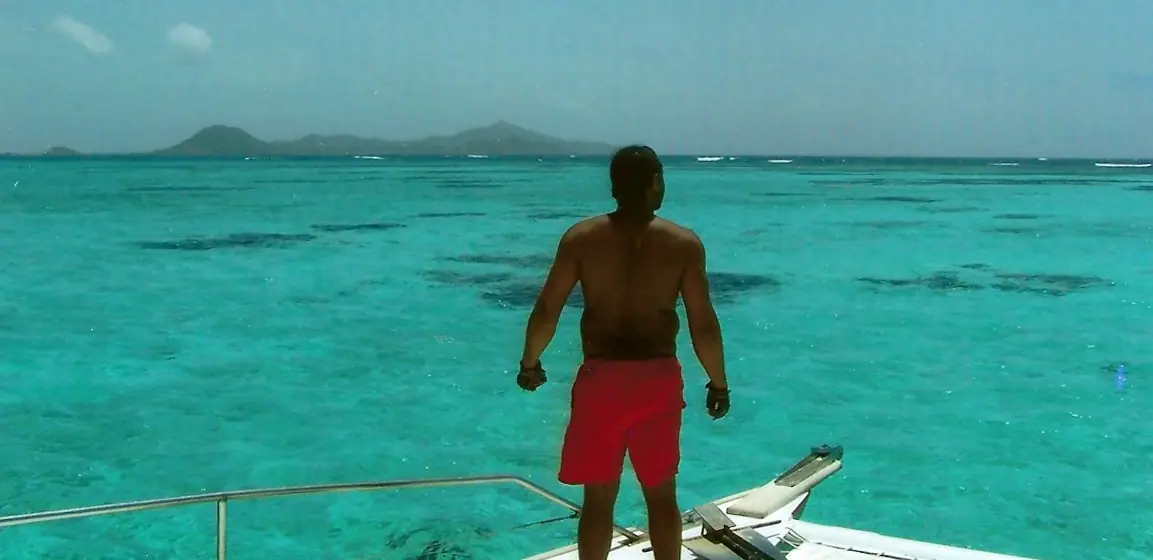
The Tobago Cays Marine Park is a scatter of tiny islets — Baradal, Petit Bateau, Jamesby and Petit Tabac among them — enclosed by a horseshoe reef. The water inside is absurdly clear, the snorkelling over shallow coral gardens is excellent, and green and hawksbill turtles graze on the seagrass. Petit Tabac, a strip of sand and palms, is the classic castaway photograph. You cannot stay overnight on the cays themselves, so visitors come by day charter, catamaran or liveaboard yacht from Union, Mayreau or Canouan, and the park charges a modest entry fee that supports its moorings and rangers.
Mayreau, between Union and Canouan, is the smallest inhabited island in the chain, with one village, one hill and the celebrated Saltwhistle Bay — a near-perfect palm-fringed crescent on its northern tip. Accommodation across the southern Grenadines is small-scale: family guesthouses, a few boutique beach hotels, and an exclusive resort on its own private island nearby where guests are left gloriously alone. Bring cash in Eastern Caribbean dollars, expect simple plumbing and intermittent Wi-Fi, and plan around ferry and charter schedules rather than assuming you can improvise.
When to Go, How to Move, and What to Expect
The dry season, roughly December to April, brings the steadiest weather, the clearest water and the highest room rates — and it's also regatta and festival season, with sailing events in Bequia at Easter and music and villa parties on Mustique in the early weeks of the year. May and June are a sweet spot: the trade winds still blow, the crowds thin, and prices soften. July to November is hotter, wetter and carries hurricane risk, though many small hotels simply close in September and October. Vincy Mas, Saint Vincent's carnival, lands in late June and early July and is worth planning a trip around if you like street parades and soca.
Getting between the islands is the thing to research before you book. A fast ferry links Kingstown with Bequia, Canouan and Union Island on a regular schedule, and smaller ferries and water taxis cover shorter hops; light aircraft connect the main island with the Grenadines in minutes. Schedules shift with the seasons and the weather, luggage allowances are tight, and the last ferry of the day is not one to miss. On land, Saint Vincent needs a car or a driver-guide, while Bequia, Mayreau and Union are small enough to walk, hire a scooter or take a water taxi.
Practicalities are straightforward but worth knowing: English is spoken everywhere, the currency is the Eastern Caribbean dollar, driving is on the left, and many smaller places accept cash only. Tap water is generally fine on the main islands; on the smaller cays it's rain-fed and better avoided. Pack reef-safe sunscreen, insect repellent for the rainforest trails, and sturdy shoes if La Soufrière or the Vermont Nature Trail is on your list. Above all, build slack into your itinerary — in the Grenadines, the boat decides the schedule, not you.
Frequently asked questions
Which island should I choose for a first trip to Saint Vincent and the Grenadines?
Bequia suits most first-timers: it's an easy ferry ride from Kingstown, has walkable beaches like Princess Margaret Beach and Lower Bay, and offers everything from guesthouses to small beach hotels. If you want rainforest hiking and the capital's history, base on Saint Vincent itself; if you want a private-island resort, look at Mustique, Canouan, Palm Island or Petit Saint Vincent.
What is the best time of year to visit?
December to April is the dry season, with the most reliable sunshine, the clearest snorkelling and the highest prices. May and June are quieter and still pleasant. July to November is wetter and sits inside hurricane season, and some small hotels close in September and October. Carnival on Saint Vincent falls in late June and early July, and Bequia's Easter Regatta fills the island.
How do you get between the islands?
A regular fast ferry runs from Kingstown to Bequia, Canouan and Union Island, with smaller ferries and water taxis for shorter hops. Light aircraft connect Saint Vincent with the Grenadines in a matter of minutes. There are no roads between islands, so plan around ferry times and book day charters in advance for the Tobago Cays, which has no overnight accommodation.
Do I need a car?
On Saint Vincent, yes — attractions like Dark View Falls, the Vermont Nature Trail and Montreal Gardens are spread around the island and roads are steep and narrow, so hiring a car or a driver-guide is worthwhile. On Bequia, Mayreau and Union Island you can walk, take taxis, hire a scooter or use water taxis. Driving is on the left throughout the country.
What should I pack and what will I pay for?
Bring reef-safe sunscreen, insect repellent, a light rain jacket, sturdy shoes for volcanic trails, and cash in Eastern Caribbean dollars, as smaller guesthouses and beach bars may not take cards. Boat trips, marine park fees and inter-island transfers are usually paid separately from your room, so budget for them on top of your accommodation.
Plan it — hotels in Saint Vincent and the Grenadines
Live search, booked directly with trusted providers.
Sort the rest of your trip
Everything for Saint Vincent and the Grenadines, in one place
Transfer in Saint Vincent and the Grenadines
Private driver waiting on arrival — no queues, no surprises.
Book a transfer
Things to do in Saint Vincent and the Grenadines
Skip-the-line tickets, guided tours and standout experiences.
See experiences
Stay online in Saint Vincent and the Grenadines
Travel eSIM — data the moment you land, no roaming bills.
Get an eSIMMore guides in Saint Vincent and the Grenadines
St Vincent and the Grenadines Food, Culture and Local Experiences Guide
Best Time to Visit Saint Vincent and the Grenadines: A Season-by-Season Hotel Guide
Top Things to Do in Saint Vincent and the Grenadines: Landmarks, Volcanoes and Island-Hopping