Few arrivals in the world feel as scripted and as strange as touching down at Pyongyang's Sunan International Airport, where the runway empties into a terminal so quiet you can hear your own footsteps. This seven-day route uses the country's small domestic flight network to stretch from the capital's monumental squares to the crater lake on Mount Paektu, then back down to the old Koryo capital and the truce village on the southern border.
Flying In: Sunan International Airport and Your First Evening
Almost every air arrival begins in Beijing, where the national carrier runs a short hop of roughly an hour and forty minutes into Pyongyang, usually only a couple of days a week and rarely on a schedule that stays fixed for long. The aircraft are vintage Soviet-era jets, meticulously polished, with a cabin crew in crisply pressed uniforms and a meal service that arrives with surprising formality. There is no independent booking, no comparison shopping and no alternative carrier — every seat is part of a state-organised group itinerary, so the flight itself is effectively the first day of the tour.
Landing at Sunan, about 25 kilometres north of the city centre, you clear a modern arrivals hall that opened in stages over the past decade. Customs declarations are taken seriously: cash, cameras, laptops, phones, books and anything with a GPS chip may be inspected, and satellite-capable devices are usually held until departure. Outside the doors, your guides are waiting — there are always two, and they will remain within arm's reach for the rest of the week, which is not surveillance so much as the structure of the entire trip.
The drive into Pyongyang takes about forty minutes along a boulevard built for traffic that never came. Your first evening is deliberately gentle: a hotel check-in, a briefing on photography rules, a set dinner, and a view over the Taedong River that makes the city look like an architectural model left switched on overnight.

Days One and Two: Pyongyang's Squares, Towers and Monuments
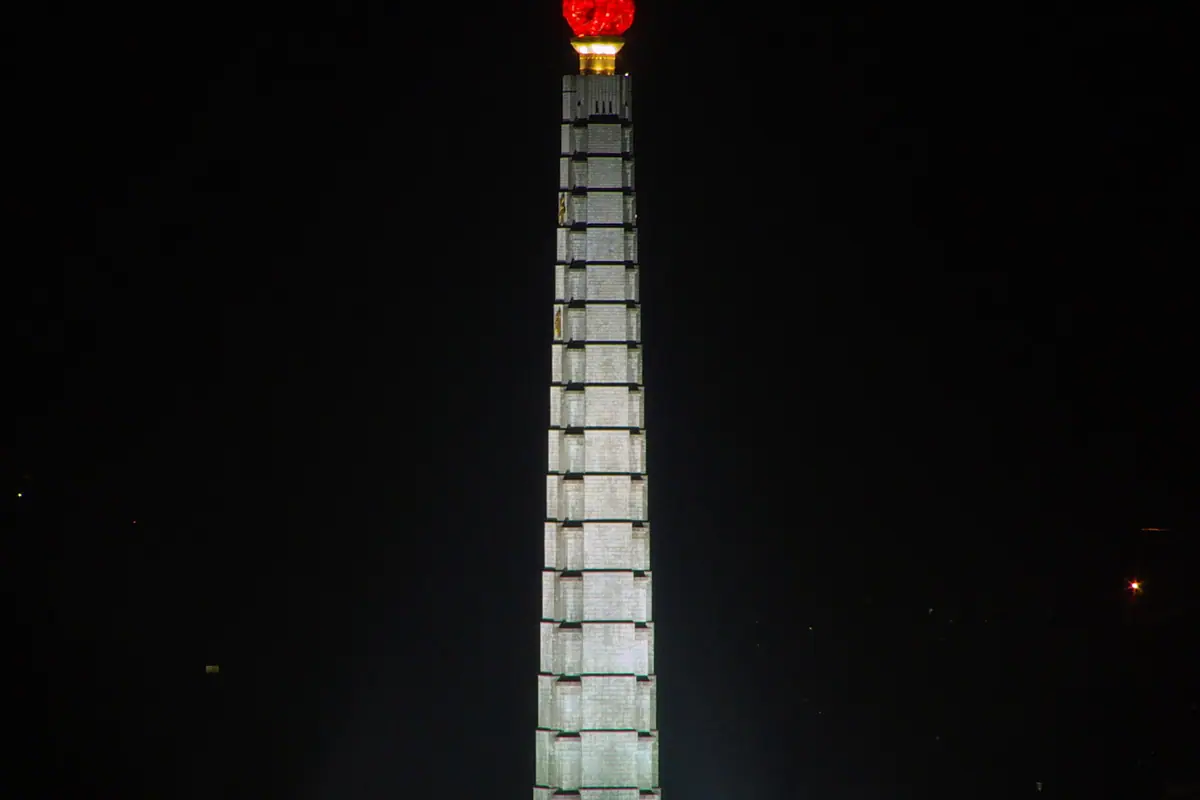
Begin where every itinerary begins, at Kim Il-sung Square, a 75,000-square-metre expanse of pink granite on the west bank of the Taedong River, flanked by the Grand People's Study House. Directly across the water rises the Juche Tower, a 170-metre granite column topped with a red flame and completed in 1982; a lift carries visitors to an observation deck with the best panorama in the city, including the unmistakable pyramid silhouette of the unfinished Ryugyong Hotel. Allow an hour or two for both, plus the walk along the riverbank between them.
From there, most groups climb Mansu Hill to the Grand Monument, where two colossal bronze figures gaze south over the city and visitors are expected to bow and leave flowers. Nearby stands the Monument to the Party Founding, its three granite fists gripping a hammer, a sickle and a writing brush, and a short drive west brings you to the Arch of Triumph, at 60 metres deliberately taller than its Parisian counterpart and built to mark the end of the Korean War.
Save an afternoon for the metro, the deepest in the world at around 110 metres, where chandeliers, mosaics and painted ceilings make the stations the real attraction — the ride between Puhung and Yonggwang is only a few minutes but is usually the most photographed part of the day. Finish on Moran Hill, whose Ulmil Pavilion looks out over the Taedong, and if you are travelling in September or October, keep an evening free for the mass gymnastics spectacle at the vast Rungrado 1st of May Stadium, a card-stunt performance involving tens of thousands of participants.
Day Three: The Domestic Hop to Mount Paektu
The country's internal air network is small, quirky and weather-beaten, and the flight that matters most runs north-east to Samjiyon, the gateway to Mount Paektu. It takes about an hour in a propeller or short-haul jet, and it is the single best reason to build a trip around flying rather than driving: the alternative is a punishing overnight rail journey of well over a day. Schedules shift with demand and visibility, so a flexible final day in Pyongyang is wise in case your departure slides.
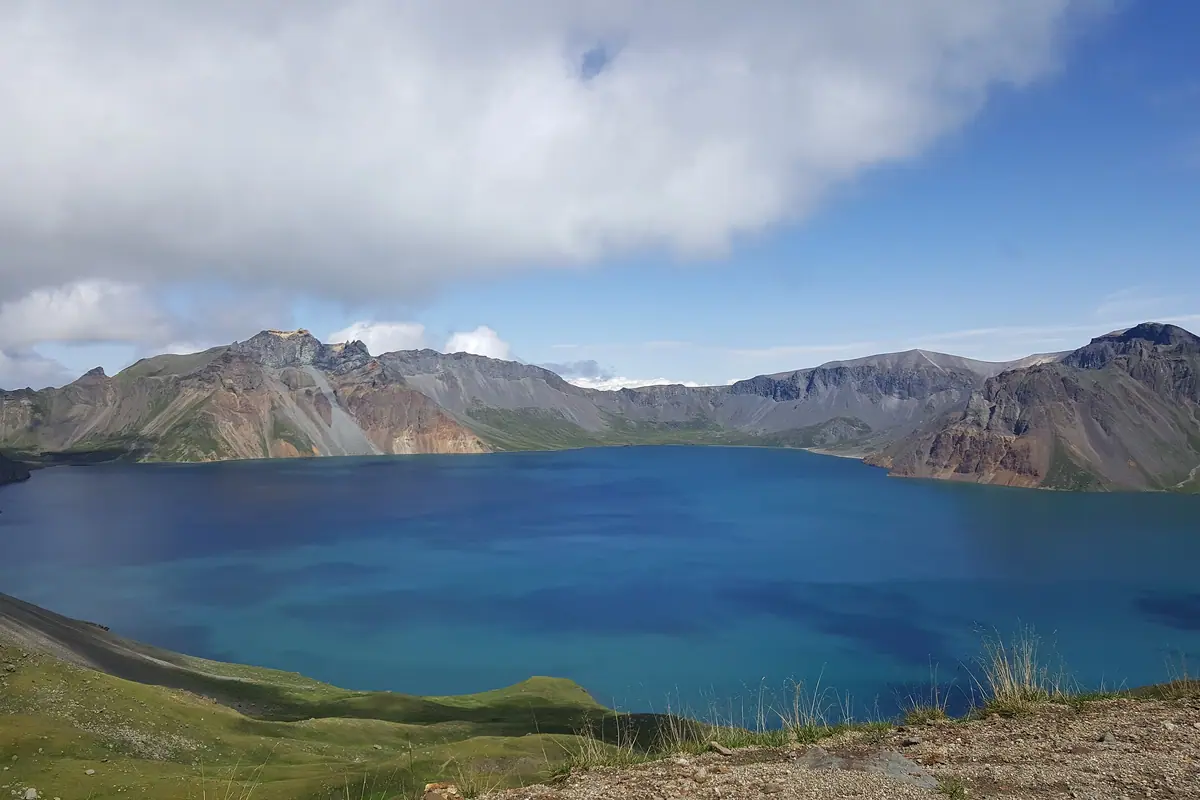
Mount Paektu rises to 2,744 metres, the highest point in Korea, and its crater holds Heaven Lake, a near-circular expanse of water roughly two kilometres across that straddles the border with China. A chairlift and a short stairway climb take you to the rim, but the lake has a habit of vanishing into cloud within minutes — travellers who see it clearly on the first attempt are considered lucky. July to September offers the best odds; by early October snow can close the road, and in winter the temperature here is genuinely Arctic.
Around Samjiyon, the rebuilt town is worth a slow hour: wide avenues, mosaic monuments and a museum dedicated to the wartime resistance camps. Rimyongsu Falls, where the water pours from a basalt ledge, is a twenty-minute detour, and the thin, resinous air of the high plateau — pine, cold rock, woodsmoke — is unlike anything else in the country.
Day Four: Kaesong, the Koryo Dynasty and Panmunjom
Head south early for the two-and-a-half to three-hour drive to Kaesong, the medieval capital of the Koryo dynasty, along a highway so empty that the road itself becomes a sight. The old city keeps its Namdaemun gate, a cluster of hanok alleys and the Koryo Museum, a former Confucian academy whose courtyards shelter stone pagodas and bronze artefacts from a kingdom that ruled the peninsula from the tenth century. Ask your guides to include the Tomb of King Kongmin, 13 kilometres west, where fourteenth-century murals survive inside the burial chamber.
Eight kilometres east of Kaesong lies Panmunjom and the Joint Security Area, the blue conference huts that straddle the Military Demarcation Line. When tours are permitted, visitors are briefed, asked to sign a declaration, driven in by coach and allowed a few moments inside the central hut, where you can technically step across the border and back. Dress smartly, expect soldiers to be present, and photograph only what you are told you may — the Bridge of No Return nearby is usually viewed from a distance.
Return to Pyongyang in the evening, or, if your itinerary allows, overnight in Kaesong for a quieter morning in the old town before the long drive back. Kaesong ginseng is the traditional souvenir, sold in sealed boxes at the museum shop.
Day Five: Mount Myohyang and the Friendship Exhibition
A 150-kilometre drive north brings you to Mount Myohyang, one of the country's five celebrated mountains, and to the Manpok Valley, where granite walls, shaded pools and small waterfalls make for the most genuinely restful walking of the week. Trails are gentle enough for anyone comfortable on their feet, and a cable car climbs part of the way for those who prefer the view without the effort.
Above the valley sits the International Friendship Exhibition, a pair of bunker-like halls carved into the mountainside that hold the gifts presented to the country's leaders by foreign delegations over the decades — everything from porcelain and tapestries to railway carriages and aircraft. The scale is staggering, the lighting is theatrical, and the guides who lead you through it recite each item's origin with evident pride.
Lower down, Pohyon Temple is the reason many travellers rate this day highest: founded in the eleventh century, it has survived wars and reconstruction to remain one of the oldest Buddhist complexes in Korea, with painted eaves, drum towers and a calm that the rest of the itinerary rarely provides. If you have already seen it, substitute a half-day at the West Sea Barrage near Nampo, an eight-kilometre sea wall with a lock system and fine views across the estuary.
Days Six and Seven: War Museums, Mausoleum Etiquette and the Flight Home
Spend your final full day on the exhibits that explain how this country sees itself. The Victorious Fatherland Liberation War Museum occupies a vast modern building filled with dioramas, captured equipment and captured enemy hardware, and moored outside on the Potong River is the intelligence-gathering ship seized in 1968 and still displayed as a trophy. Then brace yourself for the Kumsusan Palace of the Sun, the marble mausoleum where the founder and his successor lie in state: dress code is enforced, no photography is allowed, you bow at the statues, and the route through the halls takes around two hours mostly on moving walkways.
Your last evening is the moment to see the city at its most relaxed — a walk along Kwangbok Street, a circus or acrobatics performance, or a schoolchildren's song-and-dance show that leaves almost every visitor quietly floored. Stamps, postcards, ginseng and embroidery are the usual souvenirs; postcards can take several weeks to arrive, if they arrive at all.
Flights out tend to leave in the morning, so expect a two- to three-hour airport check with a thorough hand-luggage inspection before your short hop back to Beijing. September and October are the sweet spot for the whole week, with April and May close behind; July and August bring heavy monsoon rain and thick humidity, while December to February is fiercely cold but brilliantly clear. Because tourism here is entirely state-run and occasionally suspended altogether, confirm current access with a licensed specialist before you plan anything around a specific date.
Frequently asked questions
How do you fly into North Korea, and how long is the flight?
Almost all international arrivals land at Pyongyang's Sunan International Airport, most commonly on a roughly one-hour-forty-minute flight from Beijing, with occasional seasonal services from a handful of nearby cities. There is only one national carrier, frequency is low — often just a couple of days a week — and schedules change, so build slack into the start and end of your trip.
Can I book flights and travel independently?
No. Every foreign visitor travels on an organised, state-approved group itinerary with two guides accompanying them throughout. You cannot book your own domestic flights, choose your own hotels, leave the group or alter the route, and devices with satellite or GPS capability are typically held at the airport until you depart.
What is the best time of year to visit?
September and October are ideal: clear skies, comfortable temperatures and the mass gymnastics season at the stadium. April and May are a strong second. Avoid July and August if humidity and monsoon rain bother you, and note that December to February is very cold, especially around Mount Paektu, where snow can close the crater road from October onwards.
What should I pack and wear?
Bring modest, smart clothing — the mausoleum visit requires a collared shirt and proper trousers or a skirt, with no jeans, shorts, sandals or open-toe shoes. Pack cash in Chinese yuan or euros, since foreign cards are effectively useless, plus any medication you need, a European-style plug adapter and a camera that is not attached to a drone.
Can I take photographs and use the internet?
Photography is allowed in many places but forbidden around military sites, checkpoints, construction and anything your guides flag as off-limits — always ask first. There is no ordinary international internet access for visitors, mobile coverage is limited to a local network that most foreign phones cannot use, and the mausoleum, the border area and parts of the metro are strictly no-camera zones.
Plan it — flights in North Korea
Live search, booked directly with trusted providers.
Sort the rest of your trip
Everything for North Korea, in one place
Stay in North Korea
Hotels, guesthouses and apartments — compared in one search.
Search hotels
Transfer in North Korea
Private driver waiting on arrival — no queues, no surprises.
Book a transfer
Travel insurance
Medical cover, delays and lost baggage — sorted before you go.
Get covered