Japan looks small on a map until you realise that Tokyo to Hiroshima is roughly the distance from London to Moscow. Flying turns that sprawl into a tidy seven-day loop: neon Tokyo, castle-topped Osaka, the shrine forests of Kyoto and a floating torii gate off Hiroshima. This itinerary is built around short domestic hops, with enough ground time at each stop to actually see the icons rather than sprint past them.
Day 1: Landing in Tokyo and Finding Your Feet in Asakusa
Most long-haul arrivals touch down at Haneda in the late afternoon or at Narita a little earlier. Haneda sits close to the city and a monorail or train gets you to central Tokyo in well under an hour; Narita is roughly double that, so factor in the extra time when you book an onward connection. Before you leave the airport, pick up a reloadable transit card and a pocket wifi or data SIM — both save you endless small frictions over the next week.
Fight the jet lag by heading straight out rather than napping. Asakusa is the ideal first stop: flat, walkable and softly lit after dark. Senso-ji, Tokyo's oldest temple, is approached through the Kaminarimon gate and the long arcade of Nakamise-dori, lined with stalls selling rice crackers, sweet bean pastries and folding fans. The temple itself is open around the clock, though the main hall closes in the late afternoon; arriving at dusk means smaller crowds and lantern glow instead of midday glare.
Finish with a bowl of noodles on a side street and a view of the Tokyo Skytree glowing across the Sumida River. Sleep early — tomorrow is the big city day.
Days 2 and 3: Tokyo Icons, from Meiji Jingu to the Shibuya Crossing
Give Tokyo two full days and resist the urge to chase everything. Start day two at Meiji Jingu, the shrine set inside a 100,000-tree forest in the middle of the city, reached from Harajuku Station. The gravel approach under the torii is one of the calmest walks in Tokyo, and it empties your head before you plunge into the crowds of Takeshita Street and Omotesando. In the afternoon, head to Shibuya to watch the famous scramble crossing from above — a café or department-store window seat beats standing in the middle of it — then wander to Shinjuku's Omoide Yokocho for yakitori under strings of lanterns.
Day three belongs to the old city and the water. Tsukiji Outer Market opens early with tamagoyaki skewers, fresh uni and knife shops; go before nine for the best of it. From there, the Hamarikyu garden offers a tea house on a tidal pond, and a short ferry ride up the Sumida River links you back to Asakusa. If you want a skyline panorama, Tokyo Skytree and the Metropolitan Government Building observation decks deliver it, one for a fee and one free.
If you have the energy for a longer side trip, a day tour to Lake Kawaguchi puts Mount Fuji in front of you with the Chureito Pagoda and its five-storey silhouette framing the peak — best between November and February, when the air is clearest. Just remember the mountain hides in cloud for much of summer.
Day 4: Fly South to Osaka — Castles, Street Food and Neon
The first domestic flight of the trip is the shortest and most satisfying: Tokyo to Osaka takes around an hour and ten minutes in the air, and there are departures roughly every half hour from Haneda to either Itami or Kansai. Booking a mid-morning slot means you are eating lunch in Osaka by early afternoon. Domestic terminals are quick, but arrive 60–75 minutes ahead, especially if you are checking a suitcase.
Osaka rewards appetite. Start at Osaka Castle, whose green-roofed keep and stone ramparts sit inside a moat-ringed park that turns pink with plum and cherry blossom in late March and early April. Climb to the top floor for the view over the city, then take the loop line to Kuromon Ichiba Market for scallops, wagyu skewers and fruit. As darkness falls, Dotonbori becomes the point of the day: the Glico running man sign, the canal reflections, takoyaki and okonomiyaki cooked in front of you.
A quieter alternative is the Umeda Sky Building's floating garden observatory at sunset, where the two towers are joined by a ring of glass 170 metres above the streets. Either way, sleep in Osaka — it is your base for Kyoto tomorrow and costs noticeably less than the temple city itself.
Day 5: Kyoto's Greatest Hits, from Fushimi Inari to Arashiyama
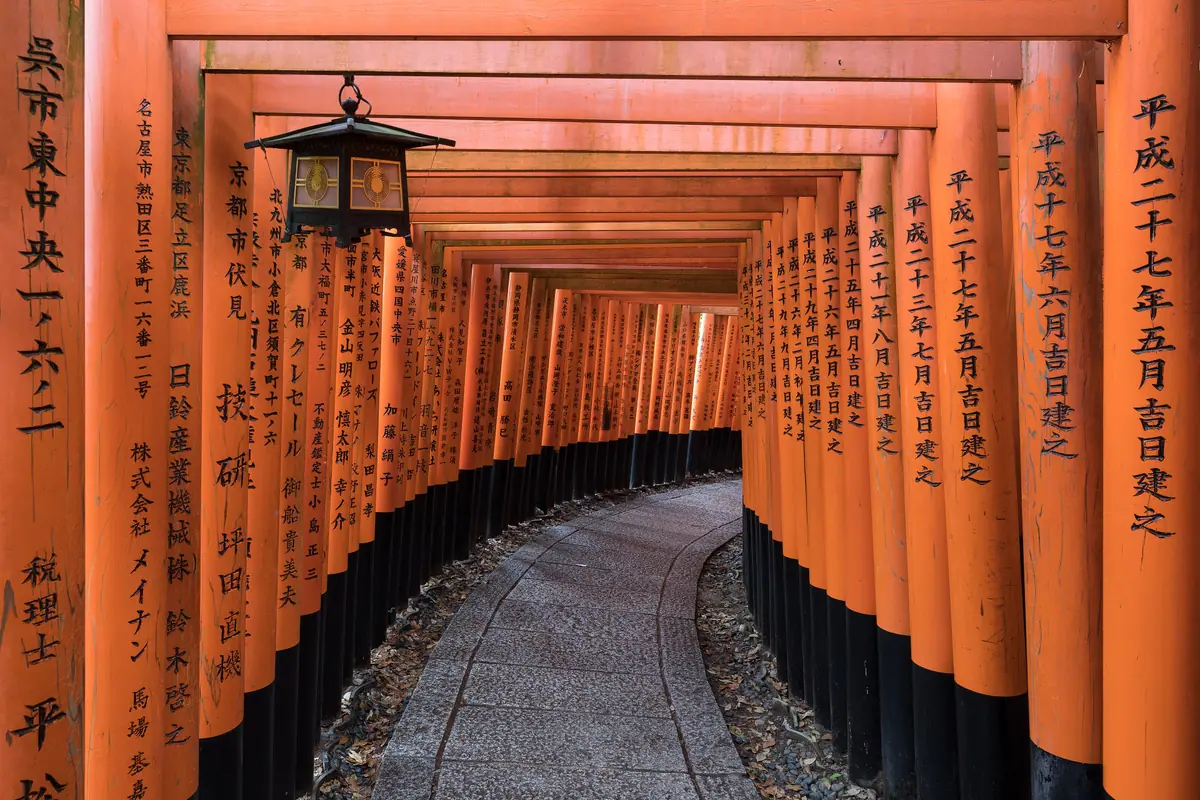
Kyoto is a 15-minute train ride from central Osaka, which makes a full day there entirely realistic. Arrive before sunrise at Fushimi Inari Taisha and you can walk the first stretch of vermilion torii tunnels almost alone. The full loop up Mount Inari takes two to three hours; even 30 minutes of climbing past the crowded lower gates rewards you with near silence.
From there, work west. Kiyomizu-dera's wooden stage juts over a hillside of maples, and the lanes of Higashiyama below it — Sannenzaka and Ninenzaka — are the best-preserved in the city. Kinkaku-ji, the gold-leaf pavilion mirrored in its pond, is a short bus hop away and never quiet, but it earns the fuss. Gion in the late afternoon gives you a chance of spotting a geiko hurrying between appointments; keep your distance and never block a doorway for a photograph.
If time permits, end at Arashiyama, where the bamboo grove is at its most atmospheric before 8am or after the tour groups leave, and the Togetsukyo Bridge frames the wooded hills. Nara, with Todai-ji's colossal bronze Buddha and the bowing deer of Nara Park, is the other strong alternative if you would rather trade temples for deer and a giant hall.
Day 6: Fly to Hiroshima and Miyajima's Floating Torii
Osaka to Hiroshima is a 45-minute flight, and it puts you on the doorstep of two profoundly different experiences. Begin at the Peace Memorial Park, where the Atomic Bomb Dome stands preserved exactly as it was left, and the Peace Memorial Museum provides context that no photograph manages. Allow two to three hours; the exhibits are heavy and worth taking slowly.
In the afternoon, take the ferry to Miyajima and Itsukushima Shrine, whose great orange torii appears to float on the tide at high water and stands on mudflats at low. Check tide tables before you go — the shrine's piers and the gate itself look completely different depending on the hour. The island's maple-studded slopes, wild deer and the five-storey pagoda on the hill above make it worth a full half day.
Hiroshima also has one of the country's best casual food scenes: okonomiyaki layered with noodles and egg, cooked on a hotplate in front of you. Eat before heading back to your hotel, and pack light — tomorrow you fly again.
Day 7: The Return Flight and How to Fly Japan Well
The final day is a repositioning flight back to Tokyo, roughly an hour and a half from Hiroshima to Haneda. If your international departure is later the same day, leave at least four hours between the domestic arrival and the long-haul check-in, since you may need to change terminals. If you have a spare half day, Haneda's proximity to central Tokyo means you can squeeze in one last stop — the Odaiba waterfront, the Tokyo National Museum in Ueno, or a final ramen counter.
Booking domestic flights is straightforward: reputable carriers and low-cost options fly the same routes, fares open a few months ahead, and early-morning and late-evening departures are cheapest. Checked baggage is often an add-on with budget fares, so compare the total rather than the headline price. A rail pass can be better value on the Tokyo–Osaka–Hiroshima corridor if you prefer city-centre to city-centre travel, but flying wins on the longer legs and on any Hokkaido or Kyushu extension.
Timing matters more than anything else. Cherry blossom in late March to early April and autumn colour from mid-November to early December are spectacular and extremely busy — book flights and accommodation months ahead. Summer is hot and humid with a typhoon risk in September, while winter offers crisp skies, quiet temples and the clearest views of Mount Fuji. For a first week in Japan, spring and autumn remain the sweet spots.
Frequently asked questions
Is it better to fly or take the train between Japanese cities?
For Tokyo to Osaka, the train is city-centre to city-centre and very convenient. For longer legs — Osaka to Hiroshima, Tokyo to Sapporo or anything to Kyushu — flying is faster and usually cheaper. Many travellers mix both, using trains on the busy Tokyo–Kyoto–Osaka corridor and short flights beyond it.
How early should I arrive at a Japanese domestic airport?
Sixty to 75 minutes before departure is comfortable if you are checking a bag, or around 45 minutes with hand luggage only. Security is efficient and queues move quickly, but terminal transfers and shuttle buses between domestic and international buildings can add unexpected time.
What is the best month for a one-week flight-based Japan itinerary?
Late March to mid-April for cherry blossom, or mid-November to early December for autumn colour and clear mountain views. Both are peak season, so reserve flights and hotels well in advance. Late May and October are quieter, mild and still very pleasant.
Can I see this itinerary without flying at all?
Yes, but it becomes tighter. Replacing the Osaka–Hiroshima flight with rail adds a couple of hours but keeps the rest of the plan intact. Dropping Hiroshima would let you spend the final day in Kyoto or Nara instead, which suits travellers who prefer fewer stops and slower days.
How much luggage should I bring for a week of domestic flights?
A single carry-on-sized case plus a day bag is ideal. Budget fares frequently charge extra for checked bags, and smaller regional aircraft have tighter cabin limits. Many travellers forward a larger suitcase between hotels by courier and travel light for the flying days.