Vanuatu is a Y-shaped scatter of some 83 islands strung across the South Pacific, where you can watch lava fountain out of a crater at dusk, swim through the flooded hold of a wartime liner, and stand under a tower of vines as a land diver falls past you. It rewards travellers who trade resort lounging for a small plane, a bumpy 4WD track and a very early start.
Port Vila and Efate: The Gateway Island
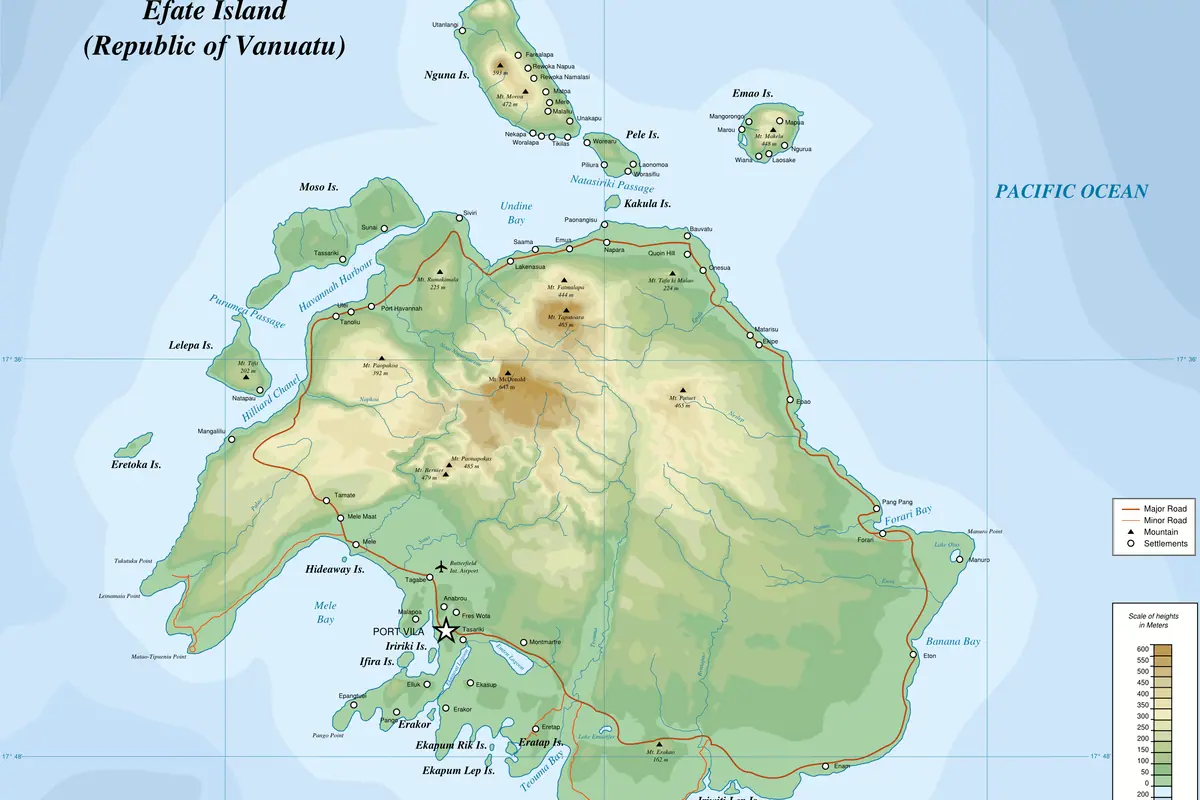
Almost every Vanuatu trip begins on Efate, and its capital, Port Vila, curls around one of the prettiest natural harbours in the Pacific. Start at the waterfront handicraft market on the seawall, where woven pandanus mats, carved tam-tams and shell jewellery are sold by the makers themselves, then walk a block inland to the produce market for island peanuts, mangoes and bundles of island cabbage. Just outside town, the Vanuatu Cultural Centre holds slit drums, outrigger canoes and a small but illuminating collection on kastom (traditional custom) that makes sense of everything you'll see later in the outer islands.
Efate's real draw is what lies beyond the roundabout. Mele Cascades, a 20-minute drive west of town, tumbles down tiers of limestone into swimming-cold pools behind a rainforest walk of roughly 15 to 20 minutes on a sometimes slippery path — arrive before 10am to have the upper pools to yourself. A short hop offshore, the Hideaway Island marine reserve is famous for the world's only underwater post office, a submerged mailbox where you can snorkel down and drop a waterproof postcard; the reef shallows here are gentle enough for nervous first-time snorkellers.
History buffs should set aside a half-day for Chief Roi Mata's Domain, a UNESCO World Heritage landscape reached by boat across to Lelepa and Eretoka islands. It tells the story of a powerful 17th-century paramount chief buried with his attendants on Eretoka, alongside Fels Cave, whose red-and-black rock art has watched over the site for centuries. Tours are guided only, deliberately limited in size, and are one of the most quietly affecting experiences in the country. If you have a spare day, circumnavigate Efate's ring road for the pale sands of Eton Beach and the luminous Blue Lagoon, or take a small boat to Nguna and Pele for village stays and empty reefs.
Tanna: Sleeping Beside an Active Volcano
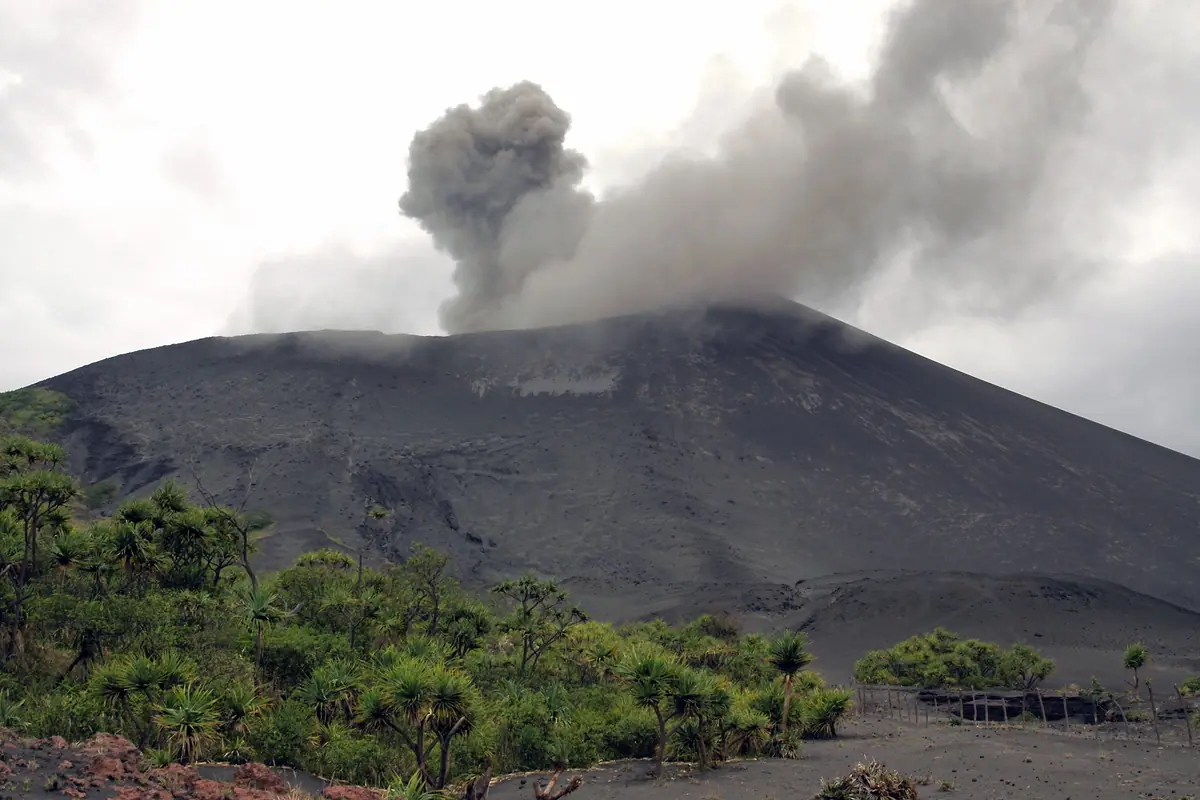
Tanna is the island people fly to Vanuatu for. Mount Yasur, at roughly 361 metres, is among the most accessible active volcanoes on earth: a 4WD grinds up the ash slopes from the south coast, and from the vehicle you walk only a few minutes to the crater rim, where the ground vibrates and molten rock arcs up in orange arcs against the dark. Sunset is the classic time to go, which means a late, head-torch descent; permits and a local guide are mandatory, and access to the very rim is restricted when the volcanic alert level rises. Check conditions on arrival rather than booking far ahead.
The rest of Tanna is a study in contrast. Port Resolution, on the east coast, is a bay of black sand and steaming vents where the first European visitors anchored in the 1770s, and the drive there through coconut plantations and cattle country is a highlight in itself. In the island's interior, villages such as Yakel have kept kastom life largely intact — thatched nakamal meeting houses, penis sheaths, and a governing system of chiefs that runs parallel to the national government. Visits are arranged through local operators and should be treated as a privilege, not a photo stop.
Base yourself near Lenakel or along the black-sand west coast, where the water is warm year-round (roughly 24–28°C) and sunsets come with a view straight to the volcano. Tanna's volcanic soil produces some of the Pacific's best coffee, and the island's bush kitchens turn out laplap — root vegetables and coconut cream steamed in banana leaves — in roadside eateries and guesthouses. Bring cash: ATMs are scarce, and card acceptance outside a couple of hotels is close to non-existent.
Espiritu Santo: The World's Great Wreck Dive
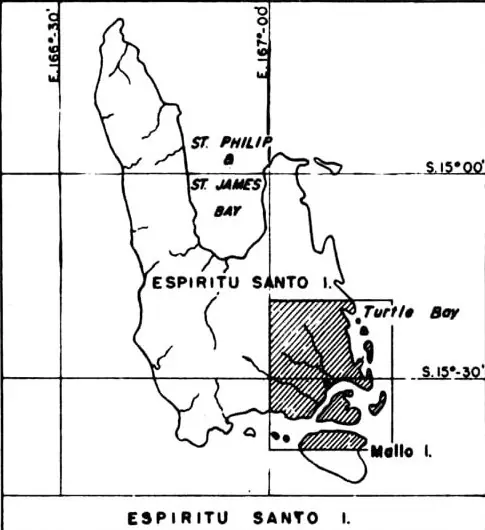
Santo, as everyone calls it, is Vanuatu's largest island and its diving capital. The SS President Coolidge is the headline act: a 1930s luxury liner converted into a troop ship, which struck mines in the Segond Channel in 1942 and settled on its side in 20 to 70 metres of water. Because it lies close to shore, recreational divers can wade in and descend straight onto the hull — swimming through the galley, past rifles, helmets, jeeps and the famous porcelain figure nicknamed 'The Lady' in the first-class area. Do at least two dives; the scale is enormous, and most operators run guided trips with a strict no-penetration-without-guide policy.
If rust isn't your thing, Million Dollar Point offers a stranger sight: a shallow underwater junkyard of bulldozers, trucks and crates dumped into the sea by departing military forces in the 1940s. It's about a 10-minute drive from Luganville and works as a snorkel or an easy shore dive, with coral colonising the machinery. Luganville itself is a low-key, wide-streeted town with ATMs, markets and the best-stocked supermarkets in the outer islands — stock up here before heading further afield.
Santo's freshwater is the other obsession. Matevulu Blue Hole, reached by 4WD or a rented kayak from the nearby beach, is an improbable shade of cobalt, with a rope swing strung over the deep middle and picnic tables in the shade. Nanda Blue Hole is smaller, quieter and even clearer, with a walkway through the trees. Further north, the Millennium Cave day trip combines a river walk through a limestone canyon, a torchlit passage and a swim below a jungle waterfall — a full, wet, muddy day out that ranks among the best adventure experiences in the country.
Champagne Beach, Port Olry and the Santo Coast
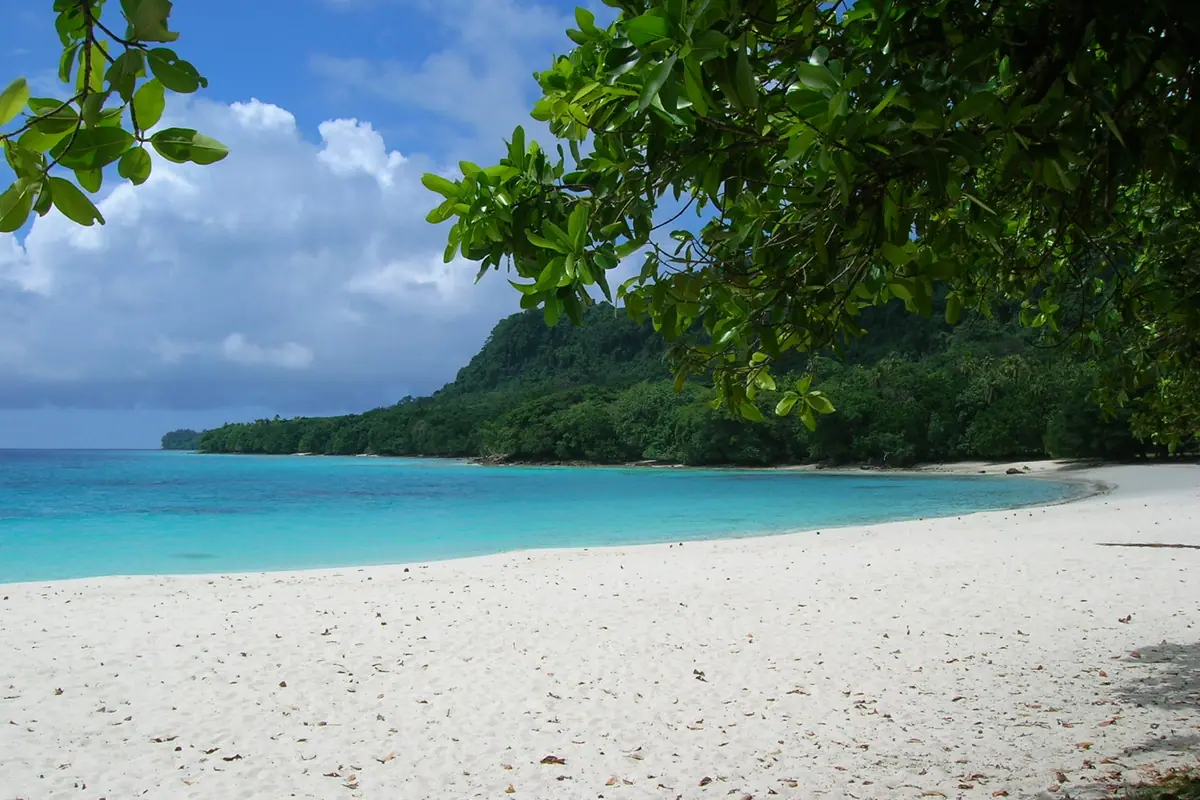
Champagne Beach on Santo's east coast is the postcard: a long crescent of powdery white sand, leaning coconut palms and water so clear that boats seem to float on air. The name comes from the fizzy volcanic bubbles that once rose through the shallows — the effect comes and goes depending on tides and seismic activity, but the beach itself never disappoints. A small entry fee applies, cruise-ship days are crowded, and on quiet weekdays you may share the whole bay with a couple of fishermen. It sits roughly an hour by 4WD from Luganville on a road that can be rough after rain.
Nearby Lonnoc Beach offers the same white sand with a handful of simple guesthouses and a quieter, slower mood — a fine place to stay overnight instead of day-tripping. Continue north around the coast to Port Olry, a French-speaking village of pastel houses, outrigger canoes and a sheltered turquoise bay fringed with islands you can wade across to at low tide. The seafood here is superb: grilled reef fish, coconut crab and Santo beef are the local staples, and the tiny seafront eateries are worth the drive alone.
Inland from the coast, Mount Tabwemasana rises to 1,879 metres — Vanuatu's highest peak — and the multi-day trek to its summit is genuinely tough, requiring a local guide, porters and a good level of fitness. For something gentler, the beaches of Malo and Aore islands are reachable by boat from Luganville, and the coral gardens off the west coast are excellent for snorkellers who'd rather float than flop in with tanks.
Pentecost and Ambrym: Land Diving and Lava Lakes
On the southern tip of Pentecost, around the villages of Bunlap, Panngi and Lonorore, men still perform naghol — the original bungee jump. A tower of timber and vines is raised, sometimes 20 to 30 metres tall, and divers leap from the platforms with only two vines tied to their ankles, timing the fall so their shoulders brush the earth. It traditionally takes place on Saturdays from around April to June, tied to the yam harvest, and it is a genuine ritual rather than a show: visitors attend by arrangement with the community, and access is limited to a handful of viewpoints.
Getting there takes commitment. Pentecost has a small airstrip at Lonorore with a sporadic island-hopper schedule, and during the land-diving season a long day trip by boat and 4WD from Port Vila is possible when conditions allow. The roads are tracks, the guesthouses are basic, and mobile coverage is patchy — which is precisely the point. Bring cash, a torch and patience with weather delays.
Ambrym, a black ash island west of Pentecost, is Vanuatu's other volcanic pilgrimage. Mount Marum and Mount Benbow sit inside a vast, grey desert of ash plain, and a two- to three-day trek with local porters gets you to viewpoints over the lava lakes. Ambrym is also the heartland of the carved slit-drum tradition and the spectacular Rom dance, performed in villages such as Fanla. Land here and you'll understand why Vanuatu's outer islands are not a beach holiday with a bit of culture attached — they are the culture, with a beach attached.
When to Go, How to Move, and What to Know
The dry season runs roughly May to October, and it is the most comfortable window: lower humidity, steadier seas and reliable diving visibility. November to April is cyclone season, hotter and wetter, with the risk of disrupted inter-island flights and closed dive sites; the trade-off is lower rates and greener landscapes. Water temperatures stay swimmable all year. Whatever month you choose, build slack into your itinerary — small aircraft, weather and volcanic ash between them mean schedules on the outer islands bend, and a buffer day before an international departure is not paranoia.
Island hopping happens by small domestic flights of 35 to 50 minutes, plus a few slow, characterful cargo-and-passenger boats. Book flights early in the dry season and reconfirm the day before. On Efate you can manage with a car or local buses, but on Tanna, Santo, Pentecost and Ambrym you'll want a guided 4WD, because 'road' often means rutted coral dirt. Pack reef-safe suncream, sturdy sandals for wet landings, a head torch, a rain shell and enough cash in vatu for weeks off the grid — Luganville and Port Vila have ATMs, the outer islands largely do not.
Culturally, a few courtesies go a long way. Ask before photographing people or entering villages, dress modestly away from the coast, and never enter a nakamal or a ceremony area uninvited. Kava is the national social ritual: at dusk, men (and increasingly women) gather at simple kava bars for a shell of the muddy, numbing brew, followed by quiet conversation. Accept a shell if offered, sip it in one go, and remember that you've just joined a tradition far older than any resort on these islands.
Frequently asked questions
What is the best time of year to visit Vanuatu?
The dry season from May to October brings lower humidity, calmer seas and the best diving visibility. November to April is cyclone season, hotter and wetter with occasional flight disruption, but cheaper and quieter. Pentecost's land diving takes place mainly from April to June, which is a good reason to aim for the shoulder months of April, May or October.
How many days do you need in Vanuatu?
Allow at least ten days to two weeks if you want more than one island. A typical split is three or four days on Efate and Port Vila, three days on Tanna for Mount Yasur, and four days on Espiritu Santo for the wreck diving, blue holes and Champagne Beach. Pentecost and Ambrym add several days each because of limited flights and rough roads.
Can you visit Mount Yasur volcano easily?
Yes — Mount Yasur is one of the world's most accessible active volcanoes. A 4WD takes you up the ash slopes from Tanna's south coast, followed by a short walk to the crater rim. A local guide and a permit are required, sunset is the most dramatic time to go, and rim access can be restricted when the volcanic alert level is raised.
Is Vanuatu good for diving and snorkelling?
Excellent. Espiritu Santo's SS President Coolidge is one of the great wreck dives in the world and can be reached from shore by recreational divers, while Million Dollar Point is an easy snorkel over sunken wartime machinery. Efate's Hideaway Island marine reserve has the world's only underwater post office, and the reefs off Moso, Nguna and the Maskelynes see very little traffic.
Do I need cash in Vanuatu?
Yes, especially outside Port Vila and Luganville. The local currency is the vatu, ATMs are largely confined to those two towns, and outer-island guesthouses, guides, market vendors and village entry fees are usually cash only. Bring more than you think you'll need and keep small notes for market purchases and tips.
Plan it — experiences in Vanuatu
Live search, booked directly with trusted providers.
Sort the rest of your trip
Everything for Vanuatu, in one place
Stay in Vanuatu
Hotels, guesthouses and apartments — compared in one search.
Search hotels
Transfer in Vanuatu
Private driver waiting on arrival — no queues, no surprises.
Book a transfer
Stay online in Vanuatu
Travel eSIM — data the moment you land, no roaming bills.
Get an eSIM