Albania compresses a continent into a country the size of a long weekend drive: Ottoman stone towns stacked on hillsides, Roman ruins under cypress trees, and a coastline that turns an improbable shade of turquoise by midday. Almost every trip begins the same way — a flight into Tirana — and from there a week is just enough to loop south through the mountains to the sea.
Day 1: Arrival in Tirana and the Pull of Skanderbeg Square
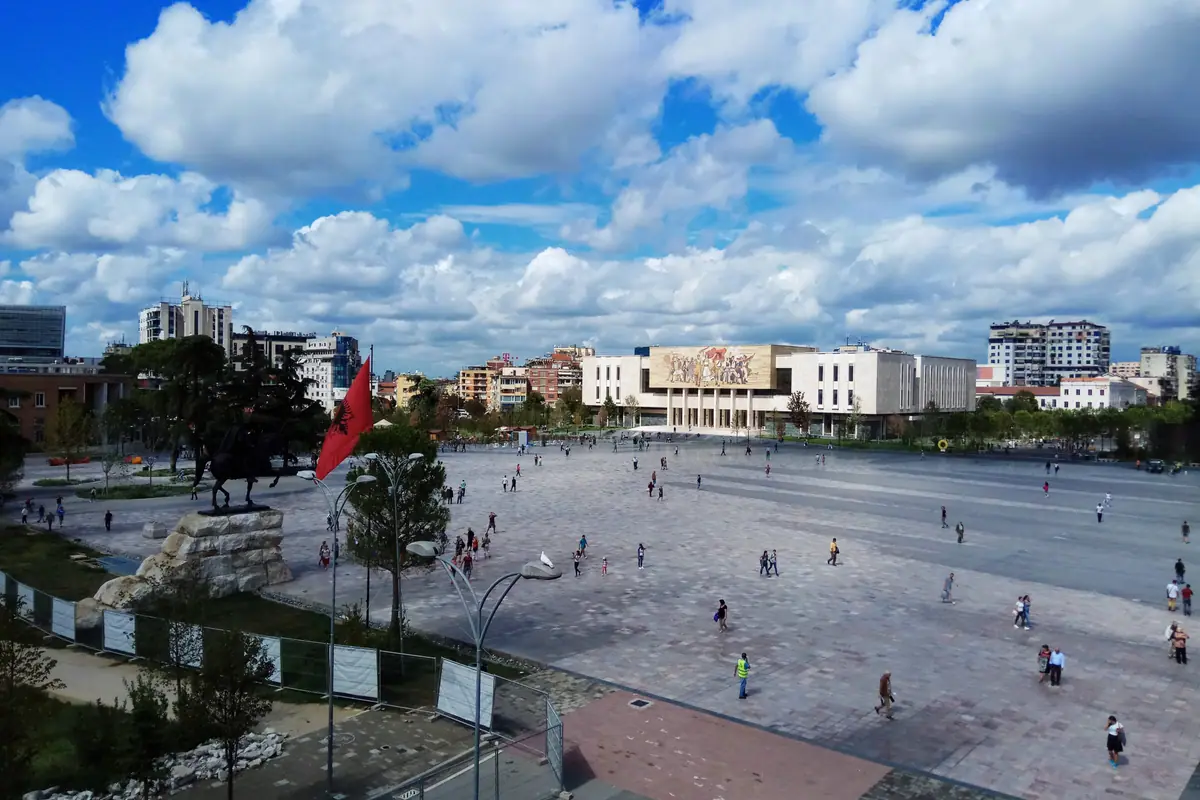
Nearly every visit to Albania starts at Mother Teresa International Airport, a compact, easy-going terminal about 20 to 30 minutes' drive from the capital's centre depending on traffic. Outside arrivals you'll find licensed taxis and a cheap airport bus that drops you near the city core; both are fine, and neither requires booking ahead. If you land in the late afternoon, resist the urge to sleep — drop your bag at a guesthouse in the Blloku district or around the pedestrianised Myslym Shyri quarter, then walk straight to Skanderbeg Square, the vast, pale-paved heart of the city where the National History Museum's mosaic facade glows amber at dusk and the Et'hem Bey Mosque and its slender Clock Tower stand as the last Ottoman remnants on the square.
Day one in Tirana is best spent on foot and unhurried. Circle the square, climb the Clock Tower for a rooftop view, then duck into Bunk'Art 2, an underground Cold War bunker turned exhibition space a few steps away, which gives you a crash course in the country's 20th-century story in under an hour. As evening settles, the bars and restaurants of Blloku fill up with a young, noisy crowd, and the menu is the same everywhere: tavë kosi (baked lamb in yoghurt), fërgesë with peppers, and byrek sold from windows for a euro or two. It's a soft landing, and a useful one — you'll be leaving the capital early tomorrow.
Day 2: Krujë Castle and the Cable Car to Mount Dajti
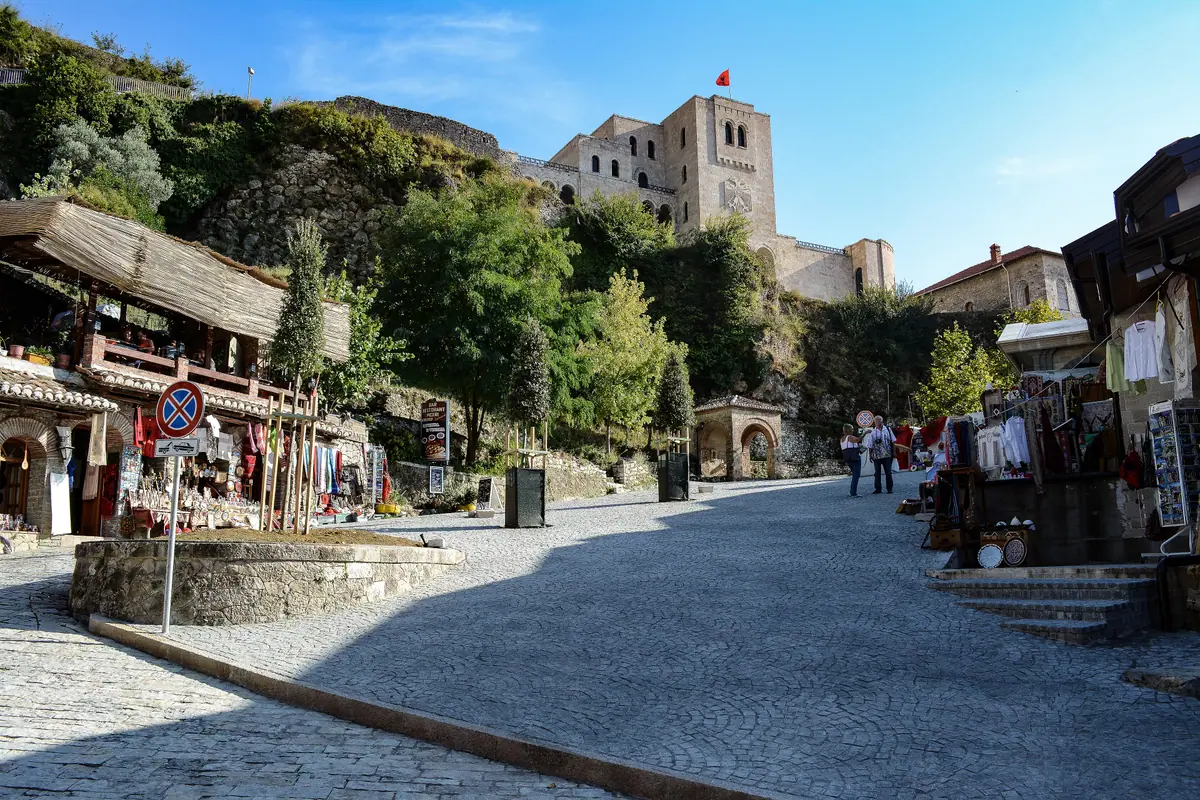
Thirty-five kilometres north of Tirana, reached in about 45 minutes by car or a short bus ride, Krujë is where Albanian history becomes tangible. The hilltop Krujë Castle is the stronghold of national hero Skanderbeg, who held it against Ottoman armies for more than two decades, and the citadel still contains the Skanderbeg Museum, the ruined Fatih Sultan Mehmet Mosque and an ethnographic collection in a fine old house. Below the walls, the cobbled Old Bazaar is a genuine pleasure — wooden shopfronts selling carpets, copperware, filigree and antiques, plus a couple of simple restaurants serving mountain lamb. Allow three to four hours for castle, bazaar and a slow lunch.
Back in Tirana, spend the late afternoon riding the cable car from the city's eastern edge up to Mount Dajti, a ride of roughly fifteen minutes that lifts you to about 1,000 metres. Up top there are walking trails, a couple of restaurants and, on a clear day, a panorama that stretches across the plain to the Adriatic. Sunset is the time to go; the light turns the whole valley gold, and you can watch Tirana switch its lights on below. If you'd rather stay in the city, the leafy Grand Park and its artificial lake make a gentler alternative for an hour's stroll.
Days 3–4: Berat, the City of a Thousand Windows
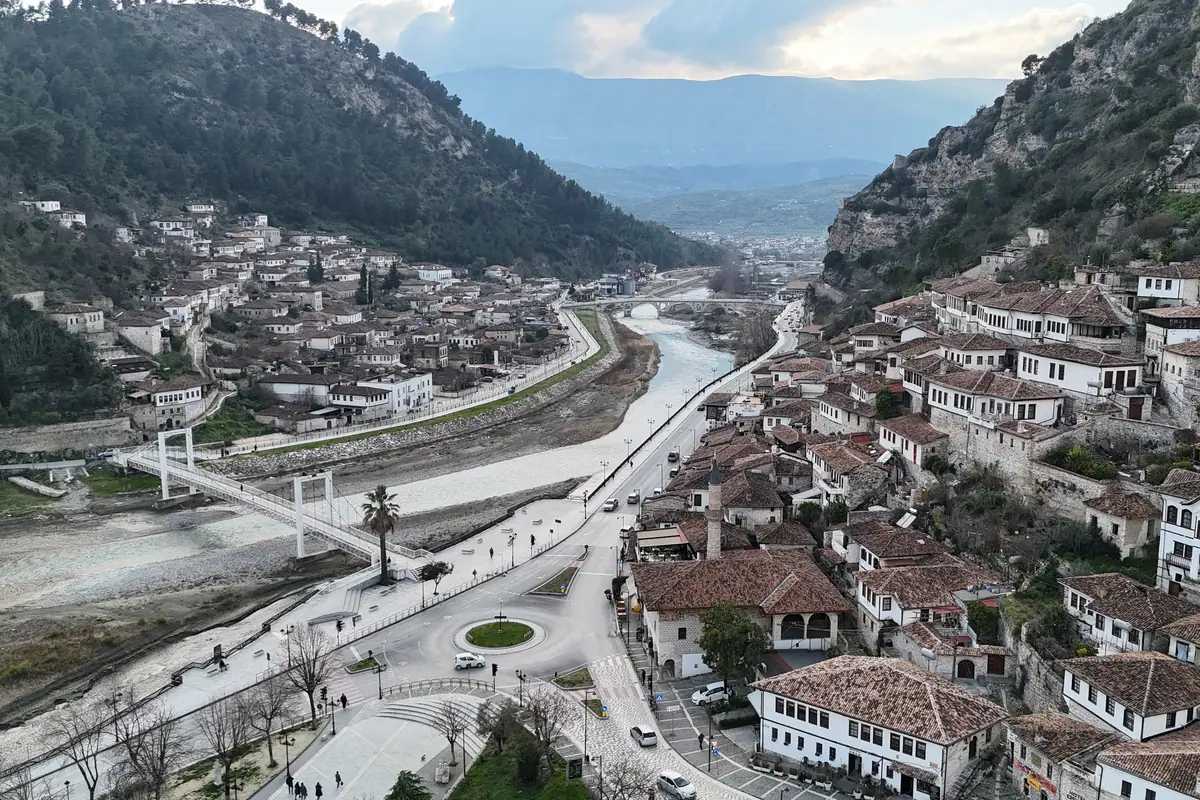
Head south on the SH4 or the newer motorway, roughly two hours to Berat, a UNESCO-listed town that earns its nickname with tiers of white Ottoman houses climbing both banks of the Osumi River, their many windows stacked like honeycomb. The Mangalem quarter on the right bank and the Gorica quarter opposite are linked by a handsome stone footbridge; walk it at blue hour, when the lanterns come on and the whole hillside reflects in the water. Base yourself in a converted stone house in Mangalem — most are family-run, with thick walls, low ceilings and breakfast on a terrace.
Give your second day to Berat Castle (Kalaja), a walled village that has been continuously inhabited for centuries and still holds houses, churches and a mosque inside its gates. The Onufri Iconographic Museum, housed in the Church of the Dormition of St Mary, holds richly dark 16th-century icons by the master painter Onufri; the Red Mosque and the ruined White Mosque sit nearby. The climb is steep but short, and the reward is one of the best views in Albania — the river gorge below and the mountains beyond.
If you have energy left, the surrounding countryside rewards a detour: the Ardenica Monastery on the plain towards the coast, and small family wineries in the hills that pour crisp white and a dark, powerful red. Mornings here are quiet and cool, so sightsee early and leave the afternoons for long lunches and a siesta before the evening promenade along the river.
Day 5: Gjirokastër Castle and the Blue Eye Spring
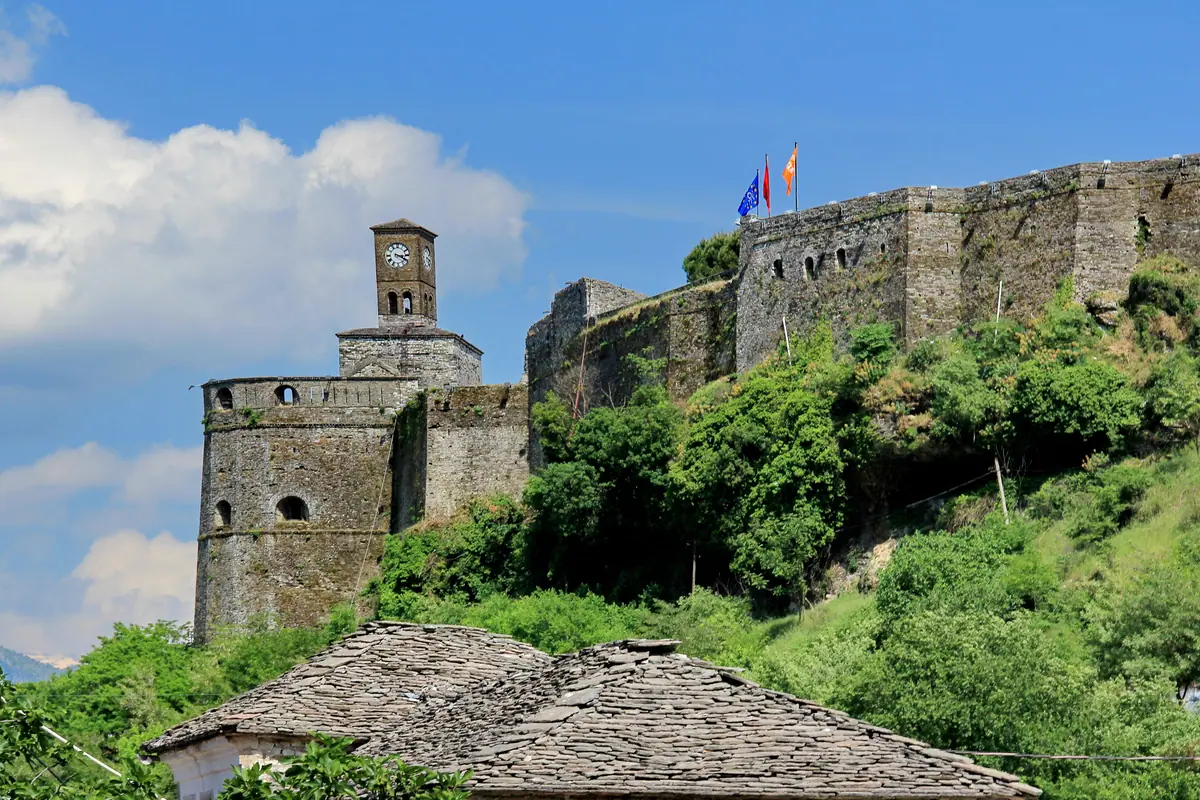
The drive south to Gjirokastër takes about three hours through the Drino valley, winding past half-built villages and dramatic limestone ridges. Gjirokastër itself is a grey, slate-roofed town that tumbles down a mountainside beneath an enormous castle — so steep that its streets are stepped rather than paved. Inside the castle walls you'll find a captured artillery piece, an aircraft and a clock tower, plus sweeping views over the valley. But the real treasures are in the lanes: the Skenduli House and Zekate House, Ottoman mansions with carved ceilings and cool, dim rooms, and the cobbled Old Bazaar below. Stay overnight in one of the town's stone guesthouses; it's worth it for the evening quiet after day-trippers leave.
On the road down towards Saranda, pause at the Blue Eye Spring, known locally as Syri i Kaltër. It is exactly what the name promises: a perfectly round, impossibly blue pool where icy water bubbles up from a depth nobody has reliably plumbed, ringed by boardwalks and beech trees. Come early to beat the coaches, wear shoes with grip, and expect the air to be noticeably cooler than the roadside. From there it's roughly 30 to 40 minutes to the coast at Saranda, where you'll spend the night within earshot of the Ionian.
Days 6–7: Butrint, Ksamil and the Albanian Riviera
Start day six at Butrint National Park, 20 minutes south of Saranda, and arrive at opening time — the site is compact and the shade is precious by mid-morning. This is Albania's most atmospheric archaeological site: a lake-side maze of Greek walls, a Roman theatre still used for performances, an early Byzantine baptistery, a basilica, and a Venetian tower guarding the channel. Layers of civilisations sit almost on top of one another under dense greenery, and herons stalk the shallows. Two to three hours is enough for a thorough wander.
Then reward yourself with the beaches. Ksamil, just beyond Butrint, has a string of small islands you can swim to or reach by pedal boat, with white sand and water that shifts from pale green to deep sapphire; the mussel beds in the lagoon supply most of the seafood you'll eat along the coast. For your final day, drive north along the Albanian Riviera — the road climbs steeply over the Llogara Pass, where the pine forest smells of resin and the whole Ionian opens up beneath you, then drops through Dhermi, Jale and Himarë, each with a pebble cove and a taverna. Finish with an overnight in Himarë or Dhermi, or push back to Tirana in five to six hours if an early flight calls. If you prefer a northern finale, swap the coast for the ferry across Lake Koman and the mountains of Valbona and Theth instead — a completely different Albania, and one that needs its own week.
Flights, Seasons and Getting Around Albania
Albania's internal air network is tiny; there is no realistic scheduled domestic hop between the places on this route, so almost everyone flies into Tirana and travels overland from there. Direct flights from European cities run year-round from a handful of hubs and multiply in summer, with journey times of roughly two hours from Italy, under three from Central Europe and about three from London. July and August bring the most connections but also 35°C afternoons on the coast and heavy traffic on the Riviera road. The sweet spots are late May to mid-June and September to early October, when the sea is still warm, the light is long and the mountain roads are quiet. Winter is cheap and moody but several passes can be snowbound, and many coastal hotels shut entirely.
For getting around, a hire car gives you the most freedom, though you should expect narrow mountain roads, confident local drivers and few guardrails; pick up and drop off in Tirana and avoid night driving in the interior. Without a car, a network of minibuses and intercity coaches links Tirana with Berat, Gjirokastër and Saranda cheaply, but schedules thin out on Sundays and in low season, so plan buffers. Carry cash in lekë — smaller guesthouses, tavernas and castle ticket desks often don't take cards — and buy travel insurance that covers hiking if you plan to walk in the Accursed Mountains. Petty theft is rare, hospitality is genuine and English is widely spoken by anyone under forty.
Frequently asked questions
Can I fly between cities inside Albania?
Realistically, no. Albania has no practical scheduled domestic network for travellers, so the standard approach is to fly into Tirana and then drive, take a minibus or use intercity coaches. Distances are short by European standards — Tirana to Berat is about two hours, Berat to Gjirokastër roughly three, and Gjirokastër to Saranda under an hour.
What is the best month for a one-week Albania itinerary?
Late May, June and September are ideal: warm sea, comfortable walking temperatures in Berat and Gjirokastër, and far less traffic on the Riviera road. July and August are hot, busy and pricier, especially around Ksamil and Saranda. April and October are quieter and cheaper but you risk rain and some closed coastal hotels.
Do I need a car to follow this route?
It helps, particularly for the Blue Eye Spring, Llogara Pass and the Riviera viewpoints, which are awkward without your own transport. That said, coaches connect Tirana, Berat, Gjirokastër and Saranda, and local taxis can cover short hops. If you drive, book a small car, keep the tank topped up in the south and avoid mountain roads after dark.
How much time should I give Butrint and Berat Castle?
Plan two to three hours at Butrint National Park, arriving as it opens to avoid heat and crowds, and about half a day for Berat's castle and its icon museum, including the climb. Gjirokastër Castle plus the old lanes and mansions comfortably fills an afternoon.
Is Albania good for a first trip to the Balkans?
It's an excellent introduction — compact, inexpensive, and unusually varied, with Ottoman towns, Roman ruins, mountain passes and a Mediterranean coast within a few hours of each other. English is widely understood among younger Albanians, hospitality is warm, and the main practical adjustments are carrying cash and being relaxed about slightly unpredictable timetables.
Sort the rest of your trip
Everything for Albania, in one place
Stay in Albania
Hotels, guesthouses and apartments — compared in one search.
Search hotels
Transfer in Albania
Private driver waiting on arrival — no queues, no surprises.
Book a transfer
Travel insurance
Medical cover, delays and lost baggage — sorted before you go.
Get covered


