Guyana is South America's best-kept secret: a country the size of Britain where the rainforest is still unbroken, the rivers run the colour of strong tea, and a single waterfall drops further than most skyscrapers stand. It is the only English-speaking nation on the continent, and the easiest place on earth to feel like an explorer without ever being far from a warm welcome.
Kaieteur Falls: Guyana's Thunderous Centrepiece
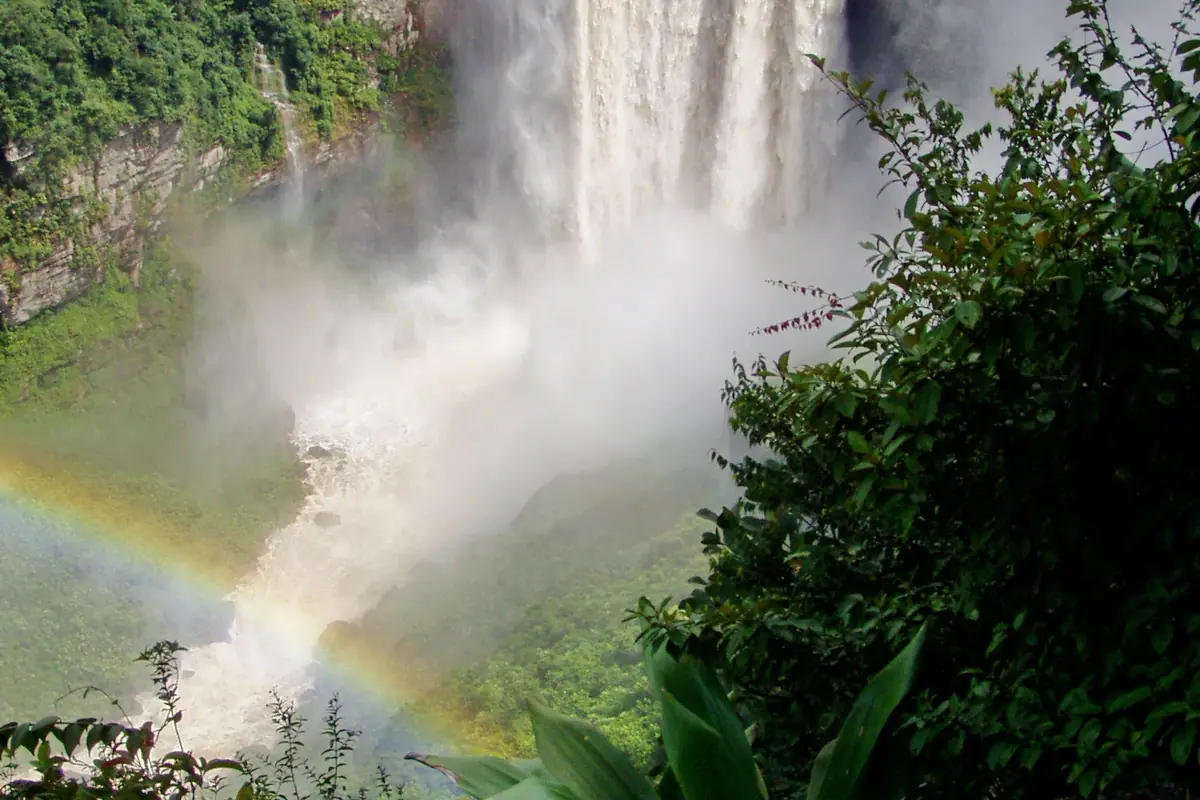
Kaieteur Falls is the sight that pulls most visitors to Guyana, and it earns the fuss. The Potaro River pours over a sandstone lip in one uninterrupted free-fall of roughly 226 metres, a white curtain more than four times the height of Niagara, with none of the crowds or guardrails. Around it spreads Kaieteur National Park, the country's oldest protected area, a plateau of bromeliad-studded forest where the air is permanently damp and rainbow-streaked.
Almost everyone arrives by small plane from the airstrip at Ogle on the eastern edge of Georgetown. The flight takes about 45 minutes over an unbroken green carpet, landing on a grass strip a short guided walk from the viewpoints. Stand at the main overlook long enough and you will notice white-collared swifts flickering in and out of the spray behind the falling water, nesting on the wet rock face, while tiny golden frogs sit in the tanks of water held by giant bromeliads.
The falls pair naturally with Orinduik Falls, a set of jasper terraces on the Ireng River at the Brazilian border where the water is warm, shallow and safe to swim in. Two- and three-day fly-in loops combining both, often with a night in the savannah, are the classic introduction to the interior. Aim for the drier months between roughly August and November or February and April, when landings are reliable and the viewpoints are less likely to be swallowed by cloud.
Georgetown: Wooden Cathedrals, Iron Markets and the Sea Wall
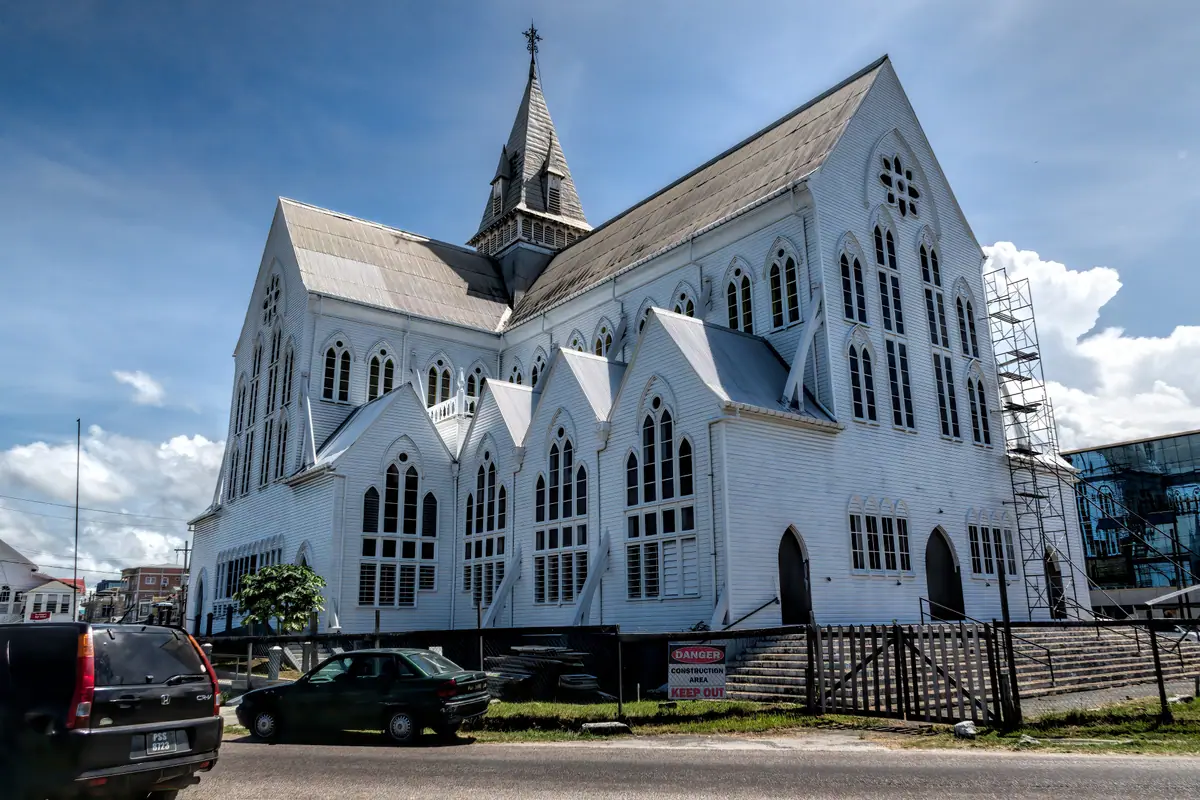
Guyana's capital is a low-rise, tree-shaded city of wooden buildings and colonial leftovers, best explored on foot in a morning before the heat settles in. St. George's Cathedral, an 1892 Gothic confection in greenheart and pitch pine, is one of the tallest wooden churches anywhere in the world, and its interior, all soaring timber arches, smells of old varnish and incense. A few blocks away, Stabroek Market throws its cast-iron frame and clock tower over the Demerara riverfront, packed with fruit, peppers, gold jewellery, river fish and noise.
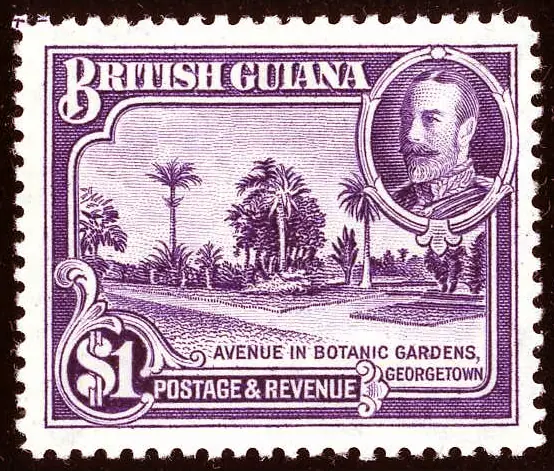
Work your way west along the water and you reach the Public Buildings, the Georgetown Lighthouse of 1830, and the sea wall, where families fly kites at dusk and rum shops open their shutters to the breeze. Inland, the Guyana National Museum and the Walter Roth Museum of Anthropology hold archaeological and Indigenous collections, while the Botanical Gardens next door shelters manatees drifting in its ponds. Beside it, the National Park is anchored by the 1763 Monument, a towering bronze tribute to the enslaved rebellion leader Cuffy, and the Umana Yana, a conical thatched benab built in traditional Amerindian style.
Give Georgetown a full day if you want museums as well as markets, and save the Demerara Harbour Bridge, one of the longest floating bridges in the world, for a late-afternoon drive. February brings Mashramani, the country's loudest street carnival, and the Christmas season turns the city into a blaze of lights. Evenings are best navigated with arranged transport rather than on foot.
Iwokrama Forest and the Canopy Walkway
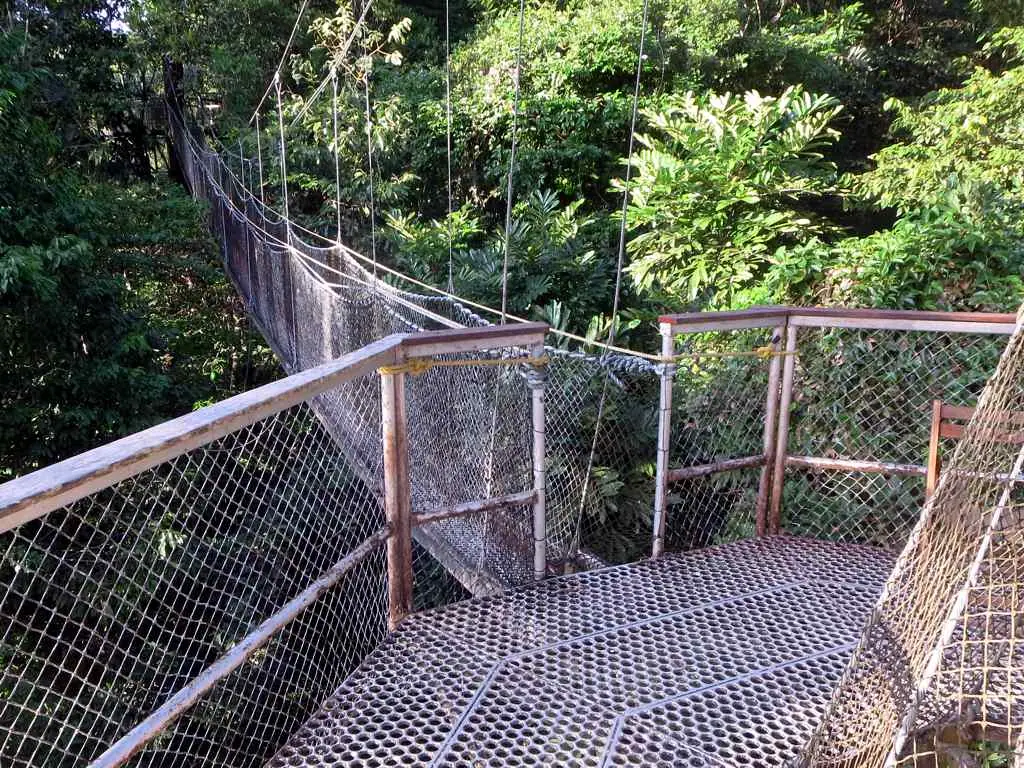
In the country's green heartland, between the Essequibo River and the northern savannahs, the Iwokrama Forest protects a vast tract of intact lowland rainforest. The signature experience is the Iwokrama Canopy Walkway near Annai: three suspension bridges and a series of platforms strung around 30 metres above the forest floor, swaying gently as you walk out into the crowns of the trees. Arrive at first light and you are level with mixed flocks of tanagers, trogons and woodcreepers, with howler monkeys roaring somewhere below.
Iwokrama is also one of the most reliable places in the Guiana Shield to see the Guianan cock-of-the-rock, whose males gather in leks to perform their blazing orange display. Boat trips on the Essequibo pass black caiman on the banks, river turtles on logs and the occasional arapaima surfacing for air, while forest walks reveal spider monkeys, giant river otters and the towering buttresses of kapok trees. Knowledgeable local guides read the forest aloud for you, from fresh jaguar tracks to the calls that mean a raptor overhead.
Two to three nights is the sweet spot: one for the walkway at dawn, one for a river excursion at dusk, and one for a longer trail into the Iwokrama Mountains or up Turtle Mountain for a canopy-level panorama. Access is by short internal flight to Annai or by a long 4x4 run down the Linden to Lethem road. Pack long sleeves, a head net and a torch, and expect humidity year-round; the drier months simply make the trails easier underfoot.
The Rupununi: Savannah, Village Tourism and Giant Otters
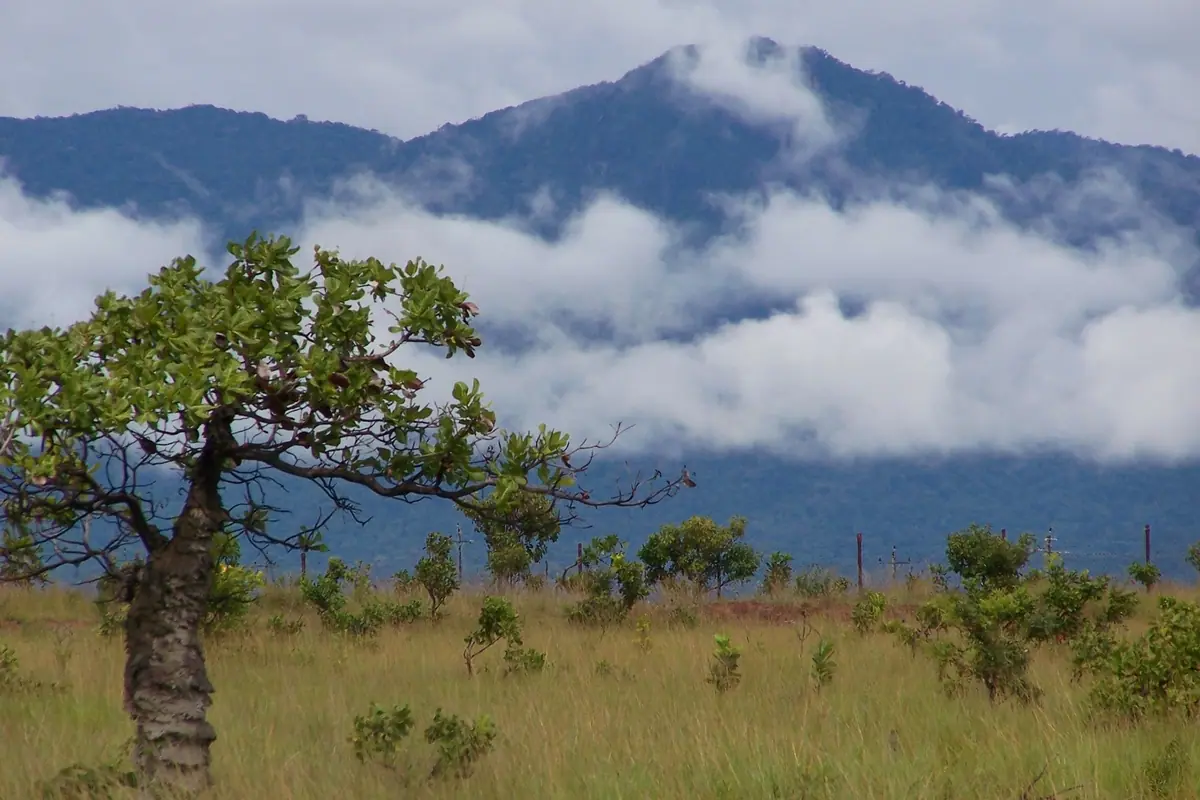
South of the forest, the Rupununi opens into golden grassland split by the Kanuku Mountains, a rugged range that shelters harpy eagles, giant armadillos and pockets of forest alive with macaws. This is the heart of Guyana's community tourism, where Makushi and Wapichan villages run their own lodges and guide services. Surama sits at the savannah's edge beneath the Pakaraima foothills, with trails to a cock-of-the-rock lek and views over the forest from Surama Mountain. Farther south, Rewa lies at the meeting of the Rewa and Rupununi rivers, a favourite base for catch-and-release fly fishing for arapaima.
Downriver, Karanambu is famous for its habituated giant river otters, which patrol the waterways in noisy family groups and can often be watched from a boat at close range. Birders come for the sheer volume of species, from sun parakeets to the red siskin of the deep south, while photographers chase the light across the flooded savannah at the height of the wet season.
The most vivid week to visit is Easter, when Lethem hosts its rodeo: vaqueros from ranches across the savannah compete in front of a roaring crowd, and the town fills with music and food stalls. Otherwise, travel between December and April for green, bird-rich landscapes and easier river access, or in the drier months from July to September for open plains and clear tracks. Small planes link Lethem and Annai with the coast; the overland road takes the better part of a day.
The Essequibo River and the Dutch Forts of Fort Island
The Essequibo is Guyana's great artery, running some 1,000 kilometres from the Brazilian border to the Atlantic, studded with islands and lined with forest. Bartica, at the confluence of the Essequibo, Mazaruni and Cuyuni, is the jumping-off point for the interior and a lively riverside town in its own right, reached by boat or road from the stelling at Parika. From here, river life unfolds in slow motion: ferries loaded with motorbikes, fishing boats, and the smell of diesel and rain.
A day trip downriver brings you to Fort Island, where the Dutch left two of the country's most evocative monuments. Fort Zeelandia, built in the 1740s, still stands with its brick magazine, officers' quarters and a small cemetery shaded by palms, while the nearby Court of Policy building served as a colonial seat of government. A short hop away, the ruins of Fort Kyk-Over-Al, established in the early 17th century, sit on a tiny island in the river, mossy and half-reclaimed by roots.
Combine the forts with a stop at Marshall Falls on the Mazaruni, where the river squeezes through rocks into pools that are glorious for swimming in the heat of the day. Take sun protection, water and insect repellent, and hire a boat with a local skipper who knows the channels. The brown colour of the water is tannin from forest leaves, not silt, and it is perfectly clean to swim in.
Shell Beach, Remote Borders and When to Go
On the northwest coast, Shell Beach is a long strip of sand and shell where four species of sea turtle come ashore to nest between roughly March and July, with leatherbacks peaking from April into June. Community-run patrols and guided night walks let visitors watch a two-metre leatherback haul herself up the beach and lay her clutch, an experience worth planning a whole trip around. Access is by boat from the Mabaruma area, and permits and local guides are essential.
For committed adventurers, Guyana also holds Orinduik Falls and the tabletop massif of Mount Roraima, whose sheer sandstone walls mark the tripoint with Venezuela and Brazil. The Guyanese approach, through the Pakaraima Mountains, is a serious expedition requiring permits, local guides and a tolerance for rough roads and river crossings. Also worth the detour is the Berbice River country and the old colonial town of New Amsterdam, where Guyana feels at its most unhurried.
Timing matters more here than in most of South America. The two drier windows, roughly mid-August to November and February to April, suit almost everything: reliable light aircraft landings, firmer trails, and clear views from the canopy walkway and Kaieteur. May to July and December to January bring heavy rain, dramatic skies, flooded savannahs and superb birding, but slower travel on interior roads. Pack light breathable clothing, a rain shell, high-factor repellent and a yellow-fever certificate, and always travel into the interior with licensed guides who know the rivers.
Frequently asked questions
What is the best time of year to visit Guyana?
Guyana has two dry seasons, broadly mid-August to November and February to April, which suit the interior best: firmer trails, dependable small-plane landings and clear views at Kaieteur Falls and the canopy walkway. The wetter months of May to July and December to January bring flooded savannahs and excellent birding but slower overland travel. Turtle nesting at Shell Beach peaks from April to June, and the Lethem rodeo takes place over Easter.
How do you reach Kaieteur Falls?
The usual route is a small-plane trip from the airstrip at Ogle near Georgetown, a flight of about 45 minutes that lands on a grass strip close to the viewpoints, followed by a guided walk of a few hours. Day trips are common, and two- or three-day itineraries add Orinduik Falls and a night in the interior. Overland expeditions to the falls exist but take several days with river crossings and rough roads, so most travellers fly.
Do I need a guide to visit Guyana's interior?
Yes. The rainforest, savannah and river regions are best, and often only, visited with licensed local guides, and many lodges are run directly by Indigenous villages such as Surama and Rewa. Guides handle navigation, wildlife spotting and boat travel, and their fees support community projects. Georgetown's historic centre, markets and sea wall can comfortably be explored independently.
What wildlife can I expect to see?
Guyana is one of the wildest countries in the Americas. Highlights include jaguars and giant river otters in the Rupununi, black caiman and arapaima in the Essequibo and Rupununi rivers, harpy eagles around the Kanuku Mountains, Guianan cock-of-the-rock at forest leks near Iwokrama, and howler and spider monkeys along forest trails. On the northwest coast, leatherback, green, hawksbill and olive ridley turtles nest on Shell Beach.
What language is spoken and what should I eat?
English is the official language, making Guyana the only English-speaking country in South America, though Guyanese Creole and several Indigenous languages are widely spoken too. The food is a delicious mix of Indian, African, Indigenous, Chinese and European influences: pepperpot, curry and roti, cook-up rice, fresh river fish, and sweet Demerara rum. Vegetarian travellers will find plenty of options, especially around Georgetown and the markets.
Plan it — experiences in Guyana
Live search, booked directly with trusted providers.
Sort the rest of your trip
Everything for Guyana, in one place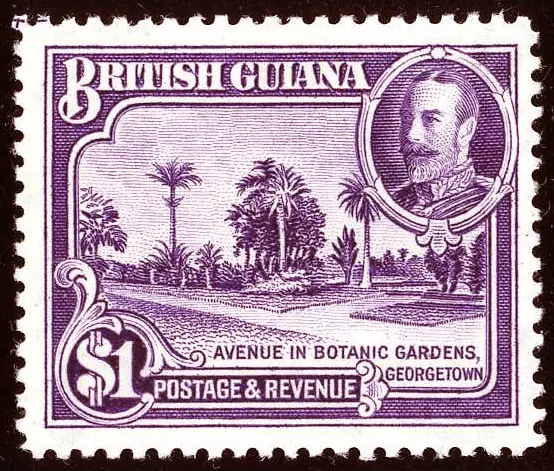
Stay in Guyana
Hotels, guesthouses and apartments — compared in one search.
Search hotels
Transfer in Guyana
Private driver waiting on arrival — no queues, no surprises.
Book a transfer
Stay online in Guyana
Travel eSIM — data the moment you land, no roaming bills.
Get an eSIM