Algeria is Africa's largest country and one of its least visited, which means Roman cities with almost no one in them, Ottoman medinas that still smell of bread and cedar, and a Sahara so vast it swallows entire mountain ranges. It rewards travellers who like their history unpolished and their horizons empty.
Algiers: The Casbah, the Bay and the White City
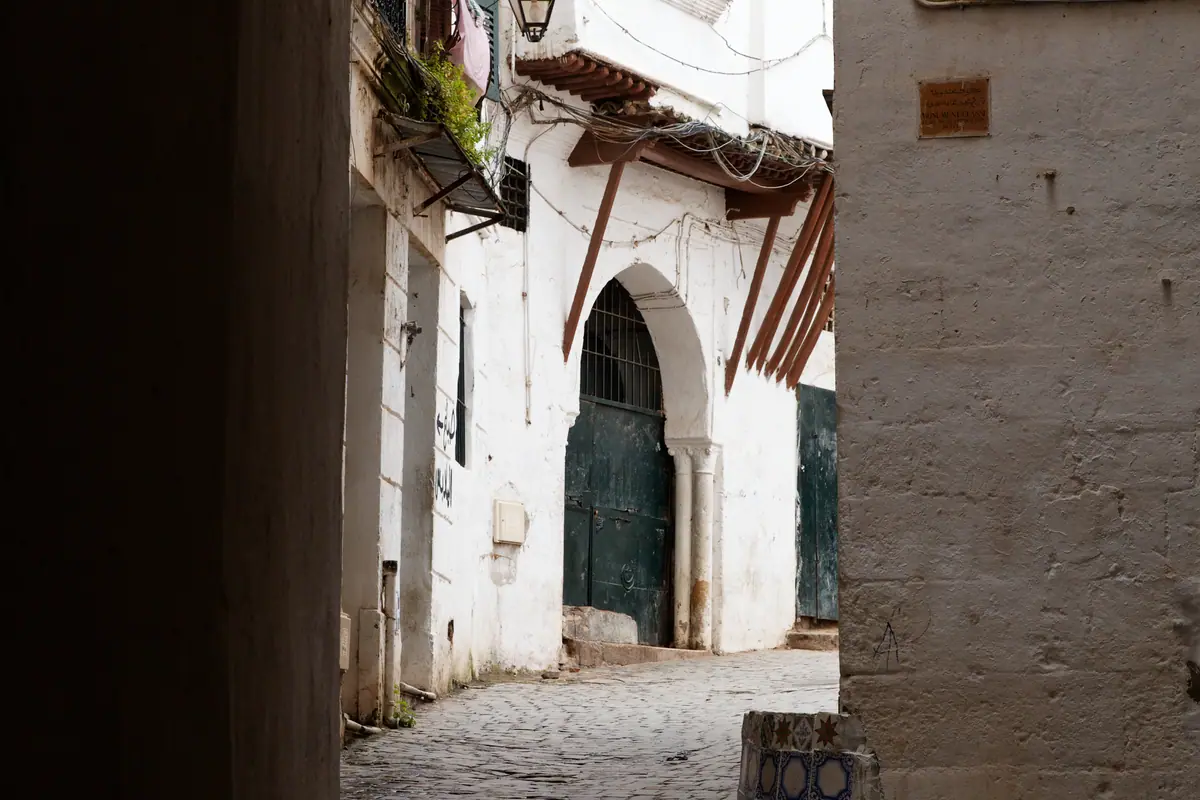
Algeria's capital announces itself in white — chalk-bright facades stacked along a curving Mediterranean bay, which is why Algerians call it El Bahdja, the joyful one. Begin in the Casbah, a World Heritage-listed Ottoman medina climbing the hill above the port in stepped alleys, vaulted passages and studded doors that conceal tiled courtyards. The Ketchaoua Mosque sits near its foot, its twin colonnades restored to honey-coloured stone, and the old palaces of Dar Hassan Pacha and Dar Mustapha Pacha hide carved cedar ceilings and painted plasterwork behind walls that give nothing away. Give the Casbah half a day, wear shoes with grip, and accept that getting slightly lost is the point; locals will point you back toward the sea.
Follow the ridge to the Maqam Echahid, the Martyrs' Memorial, where three enormous concrete palm fronds lean together above the bay and give you the city's best panorama at sunset. A short drive west, Notre-Dame d'Afrique clings to a cliff above the water, its apse inscribed with the words "Our Lady of Africa, pray for us and for the Muslims" — a small, strange monument to coexistence. Closer to the centre, the Jardin d'Essai du Hamma offers shaded paths, palms and a small zoo-like calm after the traffic.
Round off with the Grande Poste's neo-Moorish arches, the collections of the Bardo Museum inside a former palace, and the vast Djamaa el Djazair, whose minaret pierces the skyline at 265 metres — the tallest in the world. Two unhurried days covers Algiers well; a third lets you add the seaside town of Tipaza or the Roman site at Cherchell.
Roman Algeria: Timgad, Djémila and Tipaza
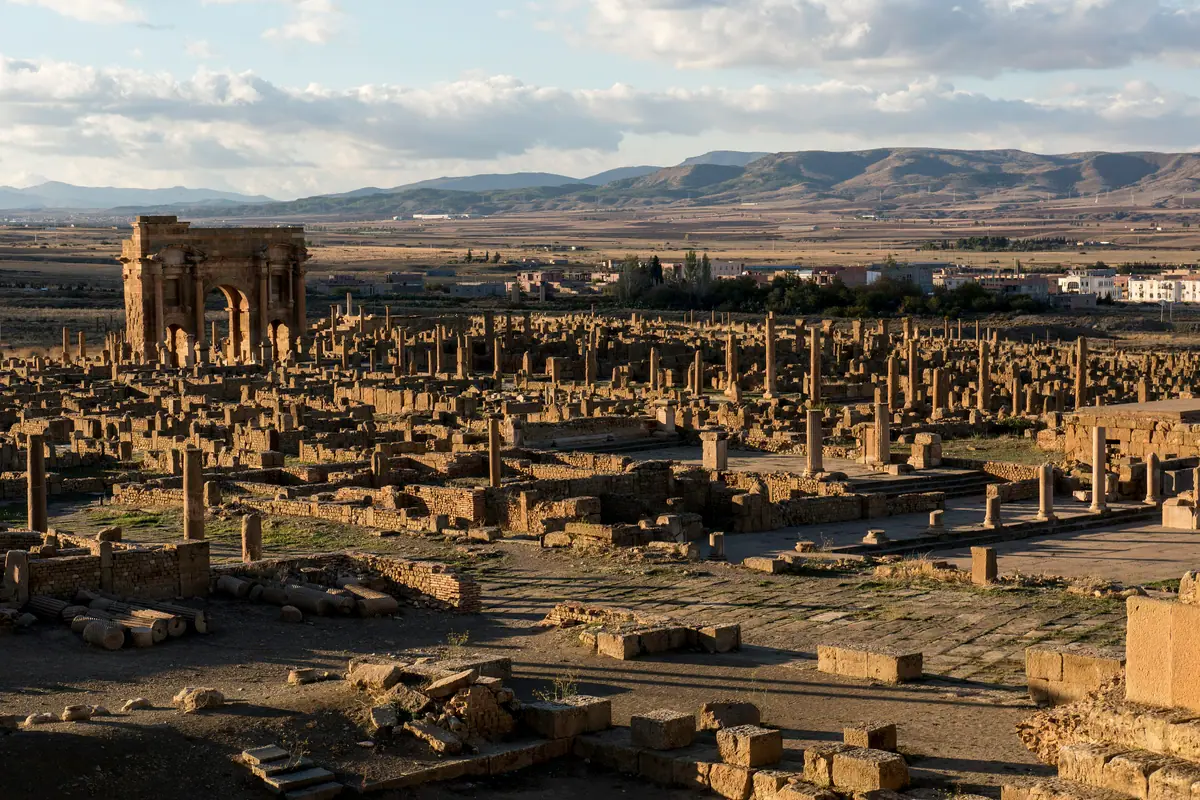
Algeria holds some of the finest Roman ruins anywhere in the Mediterranean, and the astonishing thing is how empty they are. Timgad, near Batna in the Aurès mountains, was founded around AD 100 as a colony for retired soldiers and laid out on a perfect grid that you can still read from the ground: the Arch of Trajan, a theatre that once seated some 3,500 people, a library, baths and a market square. Walk in mid-morning in spring and you may have the whole city to yourself.
Djémila, in the hills inland from Sétif, is smaller and more dramatic, draped across a ridge at around 900 metres. Its forum, Arch of Caracalla and mosaic-floored houses survive in remarkable condition, and the setting — green slopes, cold clean air — makes it a favourite for photographers. Tipaza, on the coast west of Algiers, is a different mood entirely: Phoenician and Roman remains scattered among wild fennel and sea views, with the enormous Royal Mausoleum of Mauretania, a circular tomb the size of a hill, standing a few kilometres inland.
To the east, Annaba holds Hippo Regius, where St Augustine was bishop in the late fourth century, alongside the Basilica of St Augustine, a French-built church of striped stone that dominates the skyline. Spring and autumn are the seasons for these sites; midsummer heat in the Aurès is punishing, and winter rain can turn the Djémila paths slick.
Constantine: Bridges Over the Rhumel Gorge
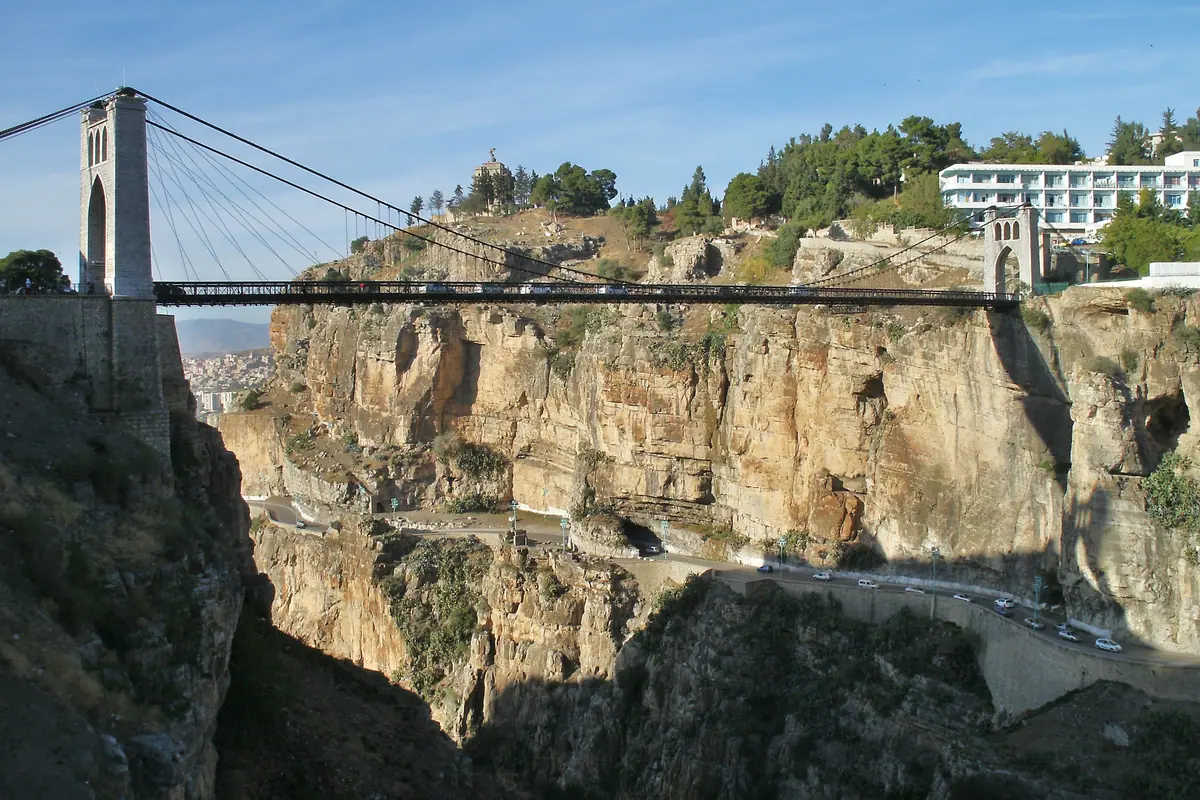
Constantine is built on a plateau split by a deep ravine, and the city's genius lies in the bridges flung across it. The Sidi M'Cid suspension bridge, dating from the early twentieth century, hangs hundreds of metres above the Rhumel river's bed and sways gently when the wind and traffic conspire — cross it on foot and try not to look straight down. Nearby, the older El Kantara bridge and the Mellah Slimane footbridge give different angles on the gorge, and the Monument aux Morts on the edge of the ravine frames a view of the whole city.
The Emir Abdelkader Mosque, with its twin minarets and vast prayer hall, is one of the country's most impressive modern buildings and welcomes respectful visitors outside prayer times. In the old town, the Ahmed Bey Palace combines Italian, Andalusian and Ottoman influences in courtyards of arcaded stone. Constantine is also the heart of malouf, the Andalusian classical music that fills wedding halls and cafés, and a city proud of its university and its edge.
Use Constantine as a base for the surrounding east: the Roman site at Tiddis, carved into a hillside above the Rhumel valley, and the scenic train ride across the high plateau are both easy day trips. Away from the bridges, the city is hilly and traffic-heavy — plan fewer stops than you would elsewhere. Two days is usually enough.
The Sahara: Tassili n'Ajjer, the Hoggar and the M'zab Valley
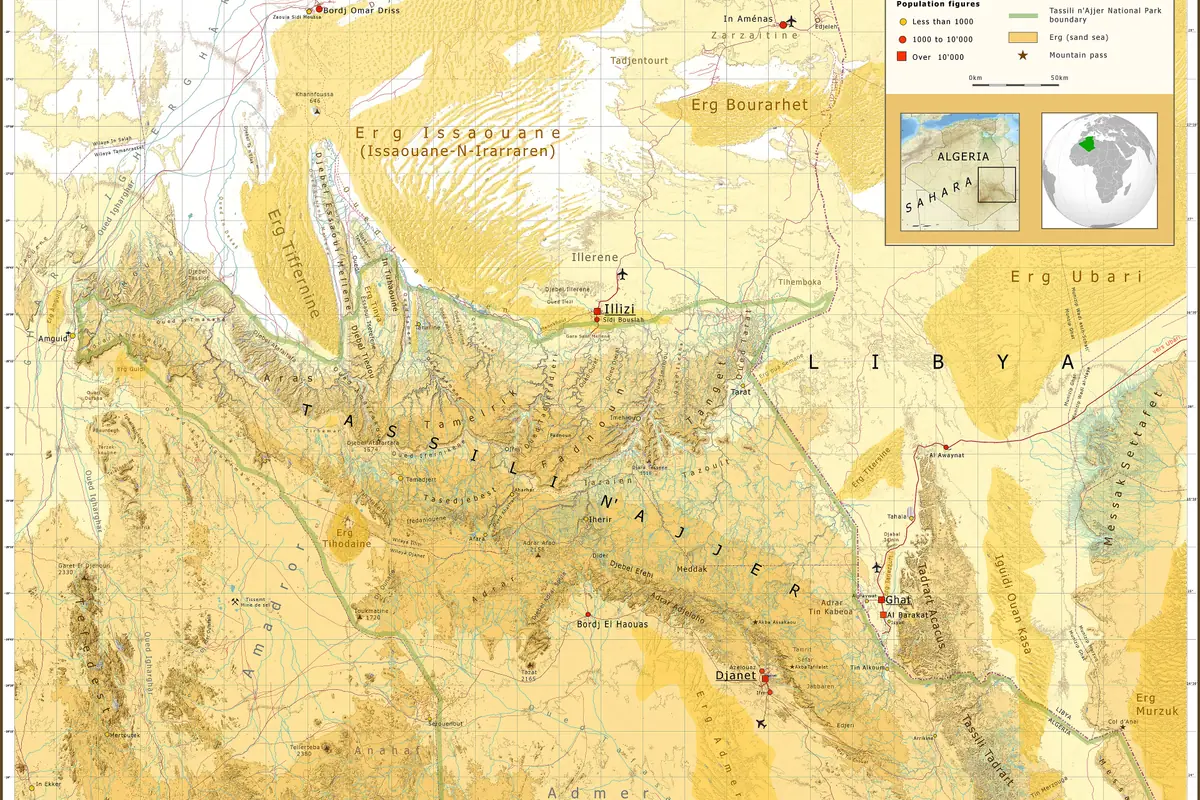
Deep in the southeast, near the oasis town of Djanet, Tassili n'Ajjer is a sandstone labyrinth of rock arches, forests of stone and cliffs painted with thousands of prehistoric images — bighorn sheep, giraffes, hunters and swimmers carved and painted between roughly 8,000 and 2,000 years ago, when this was savannah rather than sand. The neighbouring Tadrart Rouge glows red at dawn and is reached by 4x4 with a local guide. Access here requires a permit arranged through a licensed operator before you travel, and trips typically run three to seven days, camping under rock overhangs.
West of Djanet, around Tamanrasset, the Hoggar mountains rise to volcanic peaks above 2,900 metres. The classic outing is the drive up to the Assekrem plateau to watch the sun rise over a sea of rocky spires, stopping at the small stone hermitage built by Charles de Foucauld in the early 1900s. Nights up there are bitterly cold between November and February despite the desert latitude — pack a proper jacket, a hat and a headlamp.
North of the desert proper, the M'zab Valley around Ghardaïa is a gentler introduction to Saharan Algeria: five fortified towns built on hills in concentric rings, the earliest dating from the eleventh century, with ochre walls, covered market lanes and irrigation channels that still water the palm groves. Beni Isguen can be entered only with a local guide, and its auctions and customs are very much alive. Farther west, Taghit and Timimoun offer dunes, mud-brick ksour and palm oases that see barely a handful of foreign visitors a year.
Oran, Tlemcen and the Green North
On the western coast, Oran is Algeria's second city and its most musical, the birthplace of raï. Climb to the Santa Cruz fort on Mount Murdjajo for a sweeping view of the bay and the harbour, then drop into the old quarter of Sidi El Houari with its Spanish-era gate and mosque. Place du 1er Novembre, the city's main square, and the nineteenth-century theatre nearby anchor an evening stroll, best finished with grilled sardines by the port.
Inland, Tlemcen is an elegant former capital of the Zianid dynasty, with the Great Mosque's carved mihrab, the ruined Mansourah minaret standing alone in the fields, and the El Mechouar palace at its centre. The Lalla Setti plateau above the town gives a panorama over olive groves and vineyards.
For greenery, head for Chréa National Park in the Blida Atlas, where cedar forest and Barbary macaques survive an hour from Algiers, or the Djurdjura range in Kabylie, where the Tikjda area offers ridge walks and snow in winter. On the coast at Béjaïa, Cap Carbon and Gouraya National Park combine cliffs, woodland and quiet coves.
When to Go and How Travel Around Algeria Works
Aim for March to May or September to November for the northern coast, the Roman sites and the mountains: temperatures are mild, the hills are green in spring, and the light is excellent for the mosaic floors and stone arches. The Sahara has its own calendar — October to March is the only sensible window for Tassili n'Ajjer, the Tadrart and the Hoggar, with comfortable days and cold nights. July and August are best reserved for highland areas or the Mediterranean beaches, which fill with Algerian families on Fridays.
Distances are the biggest practical consideration. Algeria is huge, and a drive from Algiers to Tamanrasset is a multi-day affair; domestic flights link the capital with Oran, Constantine, Djanet and Tamanrasset and save you days. Trains run along parts of the northern corridor and are comfortable and cheap, while shared taxis and buses cover the rest. Deep-desert travel is done only with licensed local guides, in convoy, with permits arranged in advance.
A few things that make the trip smoother: the weekend is Friday and Saturday, so Friday mornings can be very quiet; the currency is the Algerian dinar and cash is essential outside major hotels, as international cards and ATMs are unreliable. Arabic and Tamazight are official, French is widely spoken, and English less so — a few words of Arabic go a long way. Always ask before photographing people, avoid photographing police or military buildings, and dress modestly in the south and in religious areas. Travellers should check current visa and entry rules well ahead of booking, as they change.
Frequently asked questions
Is Algeria open and safe for foreign tourists?
Yes. Tourist visas are required for most nationalities and must be arranged before travel; rules change, so confirm with your nearest Algerian embassy well in advance. Violent crime against visitors is rare, but petty theft happens in busy markets — keep valuables close, avoid unlit areas after dark, and use licensed guides for desert regions. Some rural border zones are restricted and should be avoided entirely.
Do I need a guide to visit the Sahara in Algeria?
For Tassili n'Ajjer, the Tadrart, the Hoggar and most deep-desert areas, yes. Permits are issued only through licensed local operators, and travel is in 4x4 convoys with a driver-guide. Agencies in Djanet and Tamanrasset arrange multi-day circuits, and it is best to book before arriving. Ghardaïa and the M'zab towns can be visited more independently, though Beni Isguen still requires a local guide.
How many days do I need in Algeria?
Ten days to two weeks is a realistic minimum for a first trip. Two days in Algiers, two or three for Roman sites such as Timgad, Djémila and Tipaza, a day or two in Constantine, and four to seven days for a Sahara circuit will fill a fortnight. Trying to add Oran, Tlemcen and the M'zab as well pushes the trip closer to three weeks.
What is the best time of year to visit Algeria?
March to May and September to November are ideal for the coast, the Roman cities and the mountains. For the Sahara — Tassili n'Ajjer, the Hoggar and Taghit — travel between October and March, when days are warm and nights are cold. July and August are hot and humid on the coast and brutally hot in the interior, though the highland parks stay pleasant.
What should I pack and know before I go?
Bring layers: the desert swings from 25°C days to near-freezing nights in winter, and mountain areas get snow. Comfortable walking shoes matter on the steep, uneven stones of the Casbah and Roman sites. Carry cash in Algerian dinars, a refillable water bottle, sun protection and a scarf for visiting mosques. English is not widely spoken outside hotels, so a phrasebook or basic French or Arabic helps enormously.
Plan it — experiences in Algeria
Live search, booked directly with trusted providers.
Sort the rest of your trip
Everything for Algeria, in one place
Stay in Algeria
Hotels, guesthouses and apartments — compared in one search.
Search hotels
Transfer in Algeria
Private driver waiting on arrival — no queues, no surprises.
Book a transfer
Stay online in Algeria
Travel eSIM — data the moment you land, no roaming bills.
Get an eSIM