San Marino is the world's oldest republic, a 61-square-kilometre cluster of fortified peaks floating above the Romagna plain — and it has no airport at all. This week-long plan starts with the flight in, then slows right down: cobbled squares, three medieval towers, cable cars, crossbows and long views to the Adriatic.
Flying In: Reaching a Country Without an Airport
San Marino has no runway of its own. The entire country wraps around Monte Titano, and the closest airport sits about 25 kilometres away at Rimini on the Adriatic coast. From there the transfer is genuinely easy: buses leave from outside Rimini's train station roughly once an hour and grind up the SS72, arriving at the gates of the historic centre in around an hour. Bologna, roughly two and a half hours away by rail and road, is the main backup, with Florence, Ancona and Venice worth considering if the fares or timings suit you better.
Driving gives you more freedom, and the approach along the ridge road with Monte Titano rising ahead is a fine introduction. The catch is parking: space inside the walls is almost nonexistent. Leave the car in the multi-storey car parks at Borgo Maggiore or beside Piazzale Nazario Sauro on the upper edge of town, then walk or ride the cable car up. The nearest motorway exit is Rimini Sud, and from there the SS72 is signed all the way to the border — which is little more than a line on the map with a white-and-blue flagstone to mark it.
Where you sleep shapes the whole week. Rooms inside the walls put you in the middle of the evening hush once the day-trippers have drained away, but they are limited and go fast in summer. Guesthouses in Borgo Maggiore are cheaper and sit beside the cable car station and the market. Further out, the countryside around Serravalle and Faetano hides small farm stays, handy if you want to drive down to the coast or into the Romagna hills.
Days 1–2: Piazza della Libertà, the Basilica and the Old Town Core
Start at Porta San Francesco, the old town's main gate, where a frescoed arch opens into the steepest lanes. A short way inside, the adjoining convent church holds a small picture gallery of paintings and sacred objects — a gentle first stop while you get your bearings on the polished, slippery cobbles. From here, everything of importance in the upper town is within twenty minutes on foot, though you will climb every step of it.
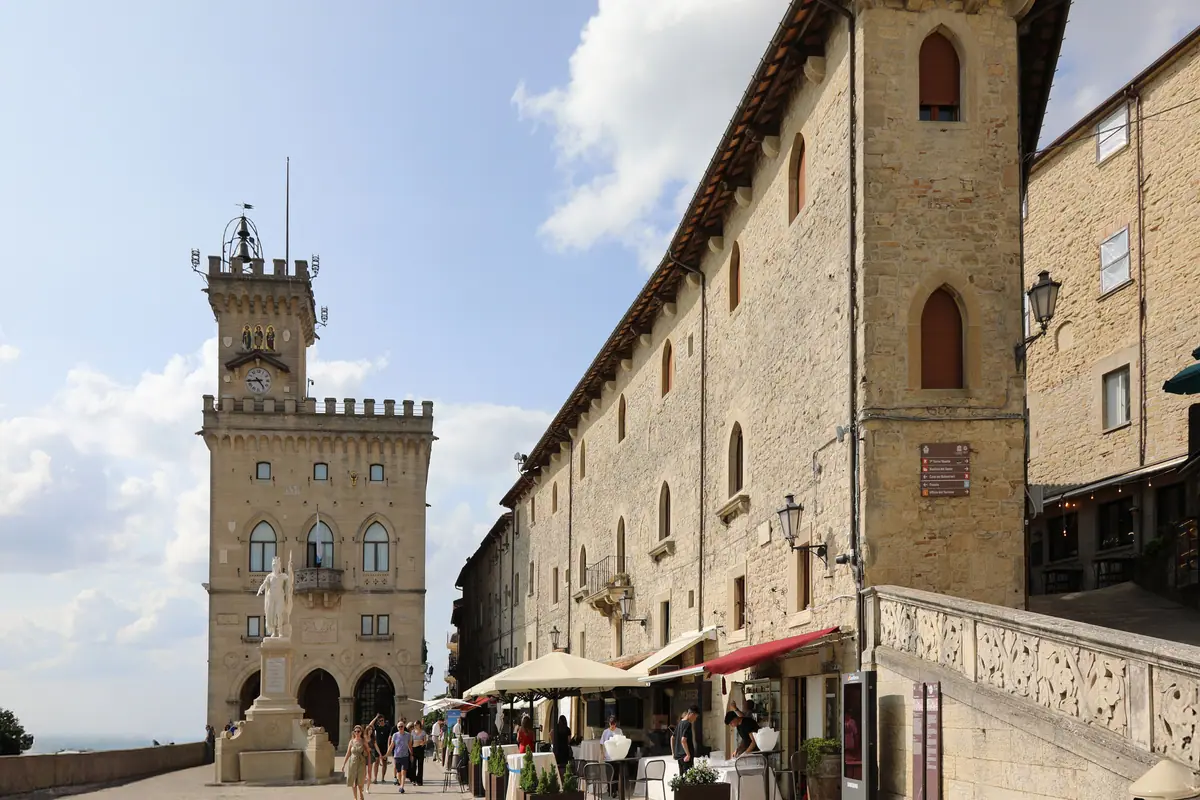
Piazza della Libertà is the ceremonial heart: the neo-Gothic Palazzo Pubblico with its crenellations and battlements, built on the site of the old assembly hall, and the white marble Statue of Liberty facing the square. Time your visit for the changing of the guard, when the uniformed guardia marches in and the square briefly becomes a stage. Sit on the steps of the palazzo afterwards and watch the light shift across the valley; the square is small, but no other spot in the country feels quite so much like the centre of something.
Day two belongs to the Basilica di San Marino, the neoclassical church with its colonnaded portico and unfinished facade, which holds the relics of Saint Marinus, the stonemason traditionally credited with founding the settlement in the fourth century. Just behind it, the tiny Chiesa di San Pietro preserves the twin stone beds where Marinus and his companion are said to have slept. Round the corner, the State Museum gathers archaeology, coins, ceramics and paintings across several floors — an hour or two well spent. Then simply wander: the lanes between Contrada Omagnano and the belvedere hide workshops, stamp and coin dealers, and tiny food shops.
Day 3: The Three Towers — Walking the Monte Titano Ridge
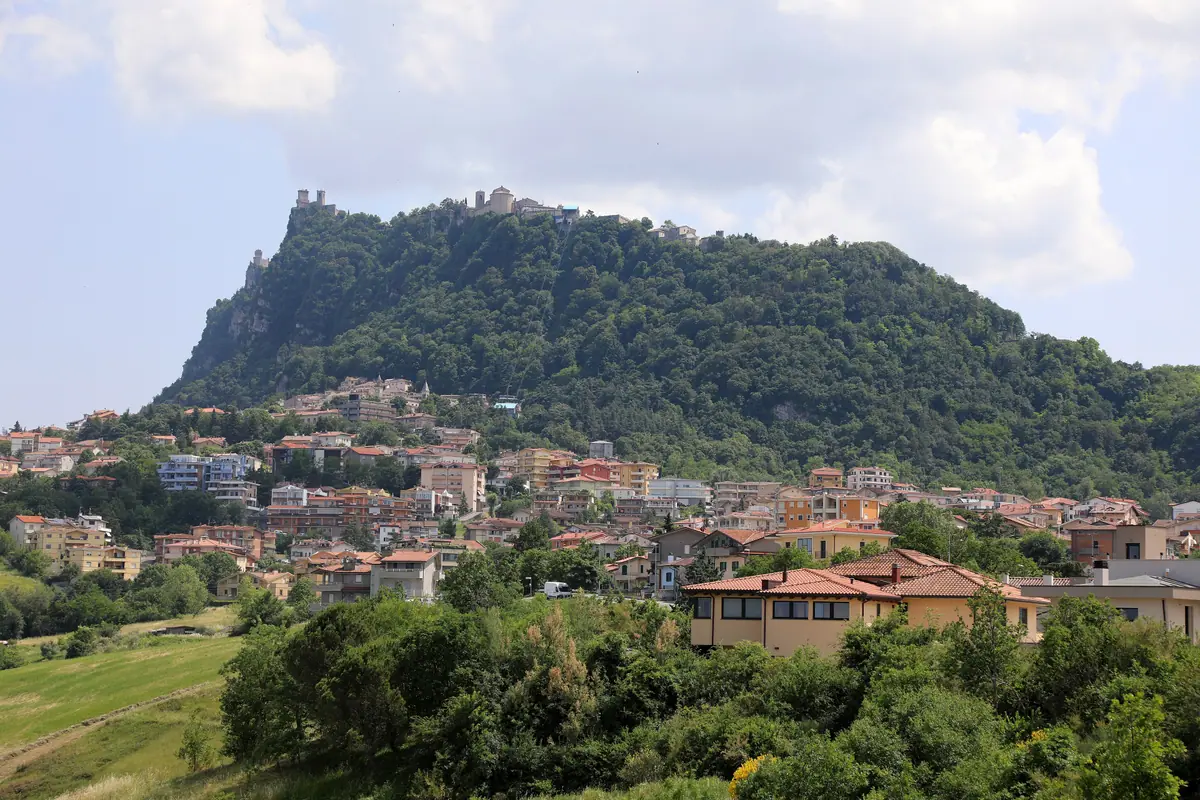
This is the day to do the ridge properly, and to do it early. Guaita, the First Tower, is the oldest of the three, an eleventh-century fortress crouched on the precipice with a bell tower, a small chapel and sheer drops from its walls. Climb its internal staircase and the whole Romagna plain opens out below, with the Adriatic glittering on a clear day and the Apennines folding away to the south.
From Guaita, the Passo delle Streghe — the Witches' Path — runs along the cliff edge, sometimes with a chain to hold, to Cesta, the Second Tower, which crowns the highest point of Monte Titano and houses a collection of armour and historic weapons that will keep enthusiasts occupied for far longer than they expect. Continue to Montale, the Third Tower, a fourteenth-century watchtower set on the sheerest side of the peak; it is not open inside, but it is the most dramatic silhouette of the three and worth the extra stretch of the legs.
Buy a combined ticket for the towers and give the walk three or four hours including the photo stops. Go early — by mid-morning in July and August the paths between Guaita and Cesta become a slow-moving queue. If you have energy left, loop back down past the Cava dei Balestrieri and end with a late lunch. Return around sunset if you can; the light on the towers at dusk, when the crowds have gone and the swallows are out, is the memory most people take home.
Day 4: Museums, Crossbows and the Changing of the Guard
Rainy days in San Marino are not wasted. Beyond the State Museum, the old town packs in a run of small, cheerfully odd collections — curiosity cabinets, a torture museum, a criminology museum — that will appeal to anyone travelling with teenagers or a taste for the macabre. Pair one or two of those with the picture gallery at San Francesco and you have a satisfyingly unhurried day indoors.
The country's living tradition is the crossbow. The Balestrieri corps, in Renaissance dress, train and perform in the Cava dei Balestrieri, the old quarry pit just below the walls, and the great crossbow competitions in early September draw the whole republic out. If your week coincides with a display, plan the day around it. In Piazza della Libertà, the changing of the guard runs through the morning and offers the best free theatre in the country — arrive a few minutes early to get a spot at the front.
Eat properly today. Sammarinese cooking leans on Romagna traditions: piadina and cassoni straight off the griddle, tagliatelle with rich ragù, beans cooked with pork rind, and roast meats. For dessert, look for Torta Tre Monti, a layered wafer cake named after the three towers, or a slice of Bustrengo, the dense apple-and-polenta cake. A glass of Biancale, the local white, finishes it neatly.
Days 5–6: Borgo Maggiore, the Cable Car and the Villages Below
Ride the cable car down to Borgo Maggiore and the country changes character completely. The cabin takes about two minutes, runs every quarter of an hour, and gives you the finest airborne view of the mountain you will get without a plane. Borgo Maggiore itself is a real town rather than a stage set: its Piazza Grande hosts a long-running market beneath the porticoes, and the clock tower and steep alleys are quiet in the evenings.
On day six, explore outward. Serravalle, the largest settlement, is where Sammarinese actually live and work — its castle, sports ground and everyday streets make a bracing contrast with the walled toy town above. Valdragone holds the sanctuary of the Beata Vergine della Consolazione, a calm, pale church that few visitors ever see. Montecchio, further south, has wooded slopes, an adventure park with ropes and zip lines strung through the trees, and the green space of Laiala for a picnic.
If you want a change of scene, the Adriatic is half an hour away: the Roman bridge and beachfront at Rimini, or the hill towns of the Romagna hinterland, make easy half-day trips. Within San Marino, don't leave without browsing the shops that sell stamps, coins and ceramics — this tiny republic has been printing collectible stamps for well over a century, and they remain one of its stranger, quieter pleasures.
Day 7 and Practicalities: Sunrise Views, Seasons and Departures
Save your last morning for the viewpoint. Walk to the belvedere above the basilica or back along the Passo delle Streghe just after dawn, when mist sits in the valleys below and the towers catch the first light. On the clearest days you can see the sea, and occasionally the faint blue line of the Croatian coast. Then find a bar for a cappuccino and a pastry before the coach parties arrive at ten.
Seasons matter here more than in most places. April to June and September to October are the sweet spots: mild, walkable, and busy without being overwhelming. July and August are hot and jammed between ten and four, though the town empties beautifully in the evening — start early, rest at midday, wander late. November to February brings cold, fog and empty lanes; the views vanish for days at a time, but the Christmas market in the old town and the sight of the towers looming out of the murk are worth it for the right traveller.
For departure, allow a comfortable buffer when heading back to Rimini or Bologna — the road down the mountain can crawl when the coaches are leaving. Keep your passport or ID handy even though the border is open, carry some cash for small shops and the cable car, and pack shoes with grip: the old town's polished cobbles are beautiful, and treacherous in the rain.
Frequently asked questions
Does San Marino have its own airport?
No. San Marino is landlocked inside Italy and has no runway. The nearest airport is at Rimini, about 25 kilometres away on the Adriatic coast, with Bologna as the main alternative at roughly two and a half hours by road or rail plus bus.
How do you get from Rimini to San Marino without a car?
Buses leave from outside Rimini's train station roughly once an hour and take about an hour to reach the gates of the historic centre. From there it is a short uphill walk into the old town, or you can take the cable car up from Borgo Maggiore if you arrive by car and park below.
How many days do you actually need in San Marino?
Two full days cover the essential sights — the Three Towers, Piazza della Libertà, the basilica and the State Museum. A week lets you slow down, include Borgo Maggiore, Serravalle and Montecchio, and take a day trip down to the Adriatic coast.
What is the best time of year to visit San Marino?
Late spring (April to June) and early autumn (September to October) offer the best combination of mild weather and manageable crowds. July and August are hot and very busy between mid-morning and late afternoon, while winter brings fog, cold and a much quieter, moodier old town.
Do you need a car in San Marino, and do you need a passport?
A car is convenient for reaching the villages and the coast, but not necessary for the old town, where parking is extremely limited — leave it in the car parks at Borgo Maggiore or Piazzale Nazario Sauro. There are normally no border checks, but carry a passport or identity card, since San Marino sits outside the standard European travel arrangements.
Plan it — flights in San Marino
Live search, booked directly with trusted providers.
Sort the rest of your trip
Everything for San Marino, in one place
Stay in San Marino
Hotels, guesthouses and apartments — compared in one search.
Search hotels
Transfer in San Marino
Private driver waiting on arrival — no queues, no surprises.
Book a transfer
Travel insurance
Medical cover, delays and lost baggage — sorted before you go.
Get covered