Norway stretches almost 1,800 kilometres from the Skagerrak to the Barents Sea, and no single road or railway links its great landscapes. Flying is not a shortcut here — it is the only way to taste the fjords, the fishing villages and the aurora in seven days. This is an itinerary built around short hops that turn a vast country into three unforgettable worlds.
Why Norway Rewards the Flyer: A Week, Three Worlds
Most first-time visitors land at Oslo Gardermoen and imagine a week of trains and ferries. In practice, the distances defeat you: Bergen sits roughly seven hours west of the capital by rail, while the Lofoten Islands and Tromsø lie more than 1,000 kilometres further north, deep inside the Arctic Circle. Domestic aviation stitches that geography together, with frequent short hops of 55 minutes to two and a half hours between compact, easy airports that let you walk straight from the gate to a bus or taxi.
A realistic week breaks into three distinct zones: the cultured south around Oslo, the fjord country of Bergen and the west coast, and the Arctic north, where Lofoten and Tromsø deliver midnight sun, jagged peaks and winter aurora. Plan on three or four domestic flights in seven days. Because the network is dense and several carriers compete on the main routes, seats are rarely a problem outside July and the Christmas–New Year window — but book early for the small northern airports, where aircraft are turboprops with tighter luggage allowances and fewer daily departures.
The rhythm matters more than the distance. Flying in Norway is quick, but airports still cost you two hours on either side, so avoid stacking two flights into one day. Fly in the morning, and you'll have a full afternoon of sightseeing; fly after dark in winter and you'll trade a view of the coastline for a rest.
Days 1–2: Oslo — Opera Houses, Viking Ships and Sculpture Parks
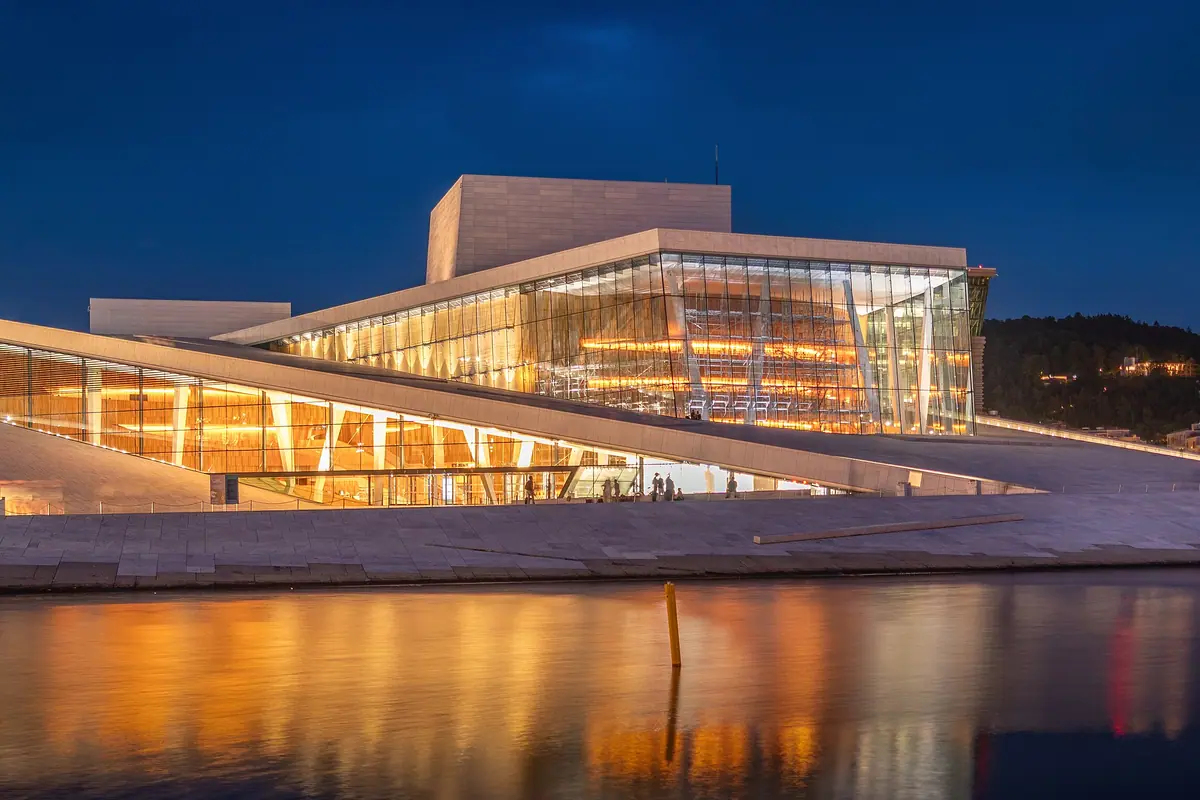
Oslo is a compact capital that rewards two unhurried days. Start at the Opera House on the Bjørvika waterfront, a white marble-and-glass slab that slants straight out of the fjord; its roof is a public plaza, and walking up it for sunset views over the harbour is the city's best free pleasure. Steps away, the Munch Museum holds the world's largest collection devoted to Edvard Munch, including several versions of The Scream, and the baroque streets of Kvadraturen lead up to Akershus Fortress, a medieval castle begun in the 1290s that still watches over the harbour.
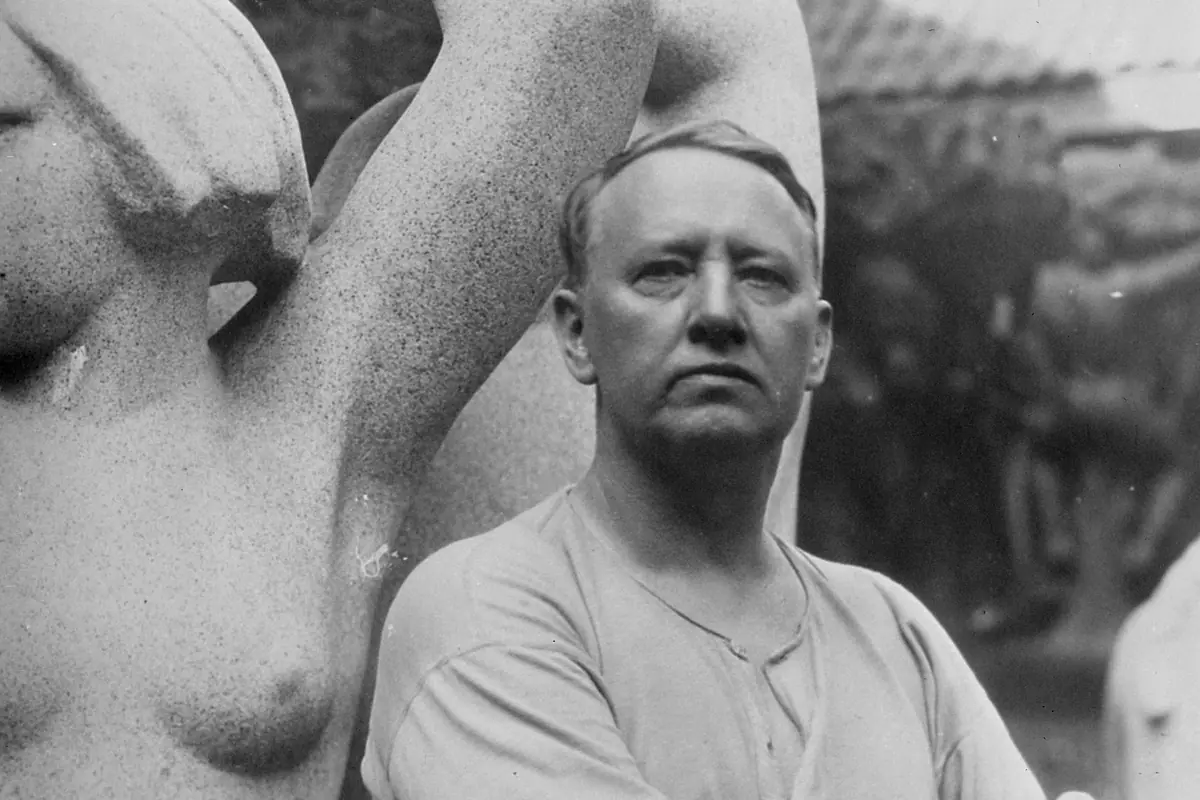
Give your second day to Vigeland Sculpture Park, a life's work of more than 200 granite and bronze figures by Gustav Vigeland, crowned by the towering Monolith. It is free, open every day of the year and best in the early morning before the tour groups arrive. Nearby, the Bygdøy peninsula holds the country's great maritime collections — the Fram polar ship, Thor Heyerdahl's Kon-Tiki raft and the Norwegian Folk Museum with its relocated stave church — while the Holmenkollen Ski Jump, reached by metro from the centre, offers a museum and a panoramic terrace above the city.
Evenings belong to Grünerløkka, where old factory buildings now house coffee bars and small kitchens, or to the Aker Brygge waterfront. A wander down Karl Johans gate, the city's main artery between the Royal Palace and Central Station, gives you the full measure of the place in an hour. If you have only one night in Oslo, spend it on the Opera House roof and a fjord-side dinner — the city is at its best looking out at the water.
Day 3: Fly West to Bergen and the Fjord Gateway
The flight from Oslo to Bergen takes under an hour and crosses the spine of southern Norway — on a clear day you'll see the Hardangervidda plateau and the first snowfields slide past below. Bergen itself is a rain-soaked, wood-built port of about 280,000 people, guarded by seven mountains, and it demands waterproof clothing: it rains here on well over 200 days a year, which is exactly why the place is so green.
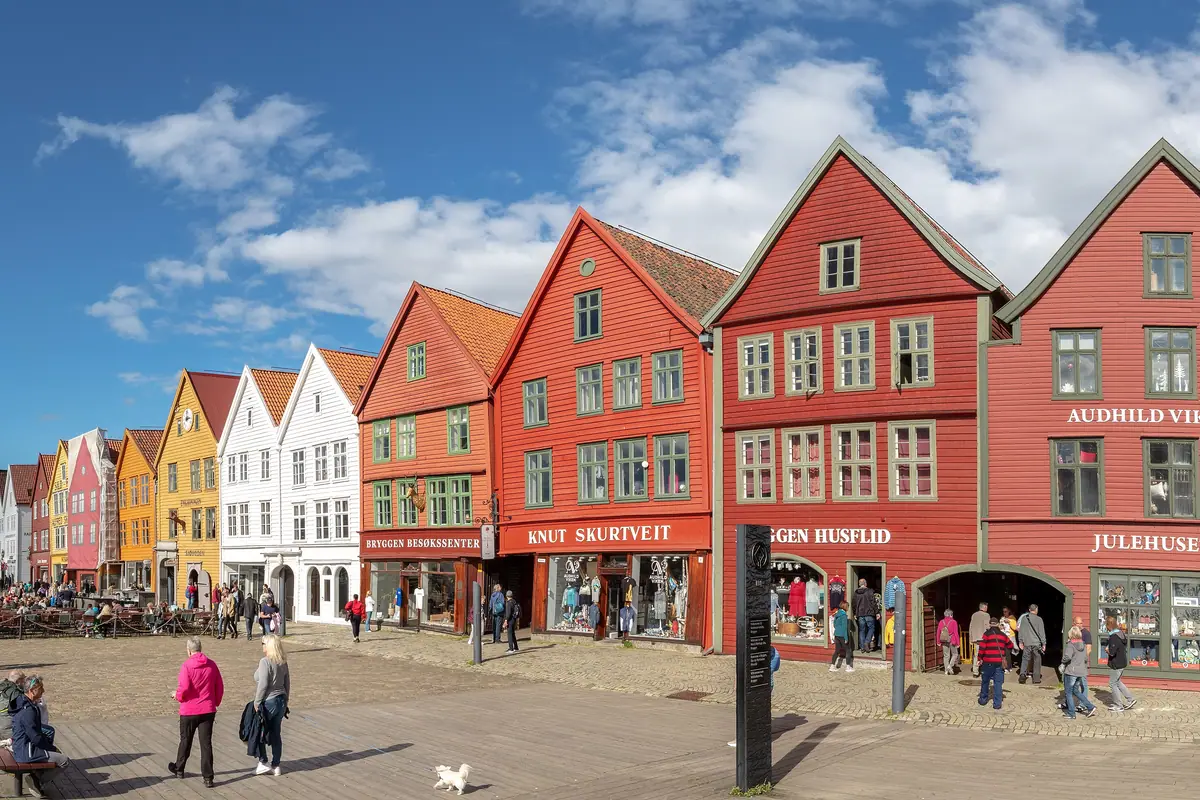
Make straight for Bryggen, the UNESCO-listed row of crooked Hanseatic trading houses that has defined the harbour since the 14th century; behind the painted timber façades, narrow passages lead to artists' studios and small workshops. The Fish Market at the head of the bay trades in smoked salmon, king crab and cloudberry jam, while the Fløibanen funicular climbs 320 metres to Mount Fløyen in six minutes for the classic view over the city and its islands. If you have energy left, the Ulriken cable car goes higher still, to 643 metres.
Use the afternoon for a fjord excursion rather than a museum: the Nærøyfjord, a UNESCO-listed arm of the Sognefjord, is reachable on a long day trip combining the Flåm Railway and a fjord cruise, with the Stegastein viewpoint hanging 650 metres above the Aurlandsfjord on the way. Keep the day loose — good weather in Bergen is a gift, and you should chase it rather than your schedule.
Days 4–5: Into the Arctic — Bodø and the Lofoten Islands
From Bergen, head north. A morning flight via Oslo reaches Bodø in time for lunch, or you can fly direct on seasonal summer routes. Bodø is the gateway to the north, and just outside town the Saltstraumen strait produces one of the world's most powerful tidal currents — whirlpools up to ten metres across form when the tide turns, and a viewing platform and bridge make it an easy, spectacular stop.
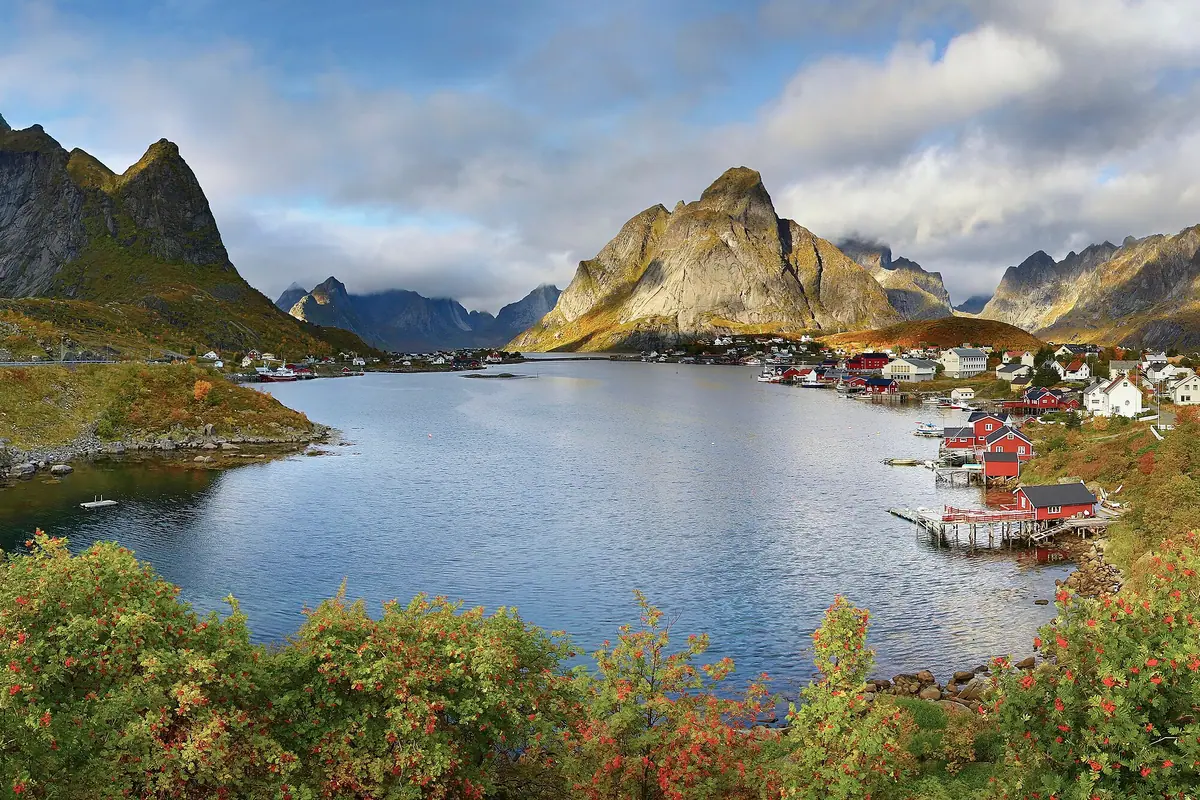
From Bodø, a 25-minute hop lands you on Lofoten, a wall of granite peaks rising straight from the Norwegian Sea. Base yourself in Reine, where red fishermen's cabins cluster around a mirror-still harbour beneath the peak of Reinebringen; the climb to its 448-metre summit follows around 1,500 stone steps built by Nepalese Sherpa workers and takes roughly two hours up and down. Further east, the preserved fishing village of Nusfjord, the harbour of Henningsvær with its improbable football pitch, and Å at the road's southern tip each deserve an hour or two. Kvalvika beach, reached on foot from the road near Fredvang, is the finest white-sand walk in the islands.
Late May to mid-July brings the midnight sun, when the light never leaves and hiking is possible around the clock. Outside that window, days shorten fast: by late September you'll want headlamps, and by November the islands are in polar night. Book accommodation in Reine, Henningsvær or Svolvær well ahead for July and August, when the islands fill up with hikers and photographers.
Days 6–7: Tromsø, the Arctic Cathedral and the Aurora
An hour's flight north of Lofoten lies Tromsø, the largest city above the Arctic Circle and the best base in Norway for the northern lights. The skyline is dominated by the Arctic Cathedral, a 1965 landmark in Tromsdalen whose eleven aluminium-clad arches and vast east-facing glass mosaic glow like an iceberg across the Tromsø Bridge. Take the Fjellheisen cable car up to Storsteinen at 421 metres for a view over the island city, the fjord and, on clear winter nights, the aurora sweeping overhead.
Aurora season runs from early September to late March, with the most reliable dark skies from October to March. Lights appear most often between 6pm and 2am, and you need at least three or four nights here to give yourself a fair chance — one cloudless evening is never guaranteed. Guided chases take small groups inland towards the Finnish border where the continental climate clears the sky, and serious photographers should bring a tripod and a fast wide-angle lens. In late autumn and winter, whale-watching trips run to the fjords near Skjervøy for humpbacks and orcas.
Between mid-May and late July, Tromsø swaps aurora for the midnight sun, with daylight around the clock and hiking on Kvaløya and Tromvik. Check out the Polaria aquarium and the Tromsø University Museum for Sami and Arctic history, and warm up over a bowl of bacalao or a reindeer stew in the harbour district before your flight south — or west to the fjords of Senja and the Atlantic Road if you can stretch the trip.
Flying Norway: Seasons, Connections and Weather Wisdom
Choose your month carefully, because a Norwegian week in June looks nothing like one in January. June to August brings the midnight sun north of the Arctic Circle, open mountain roads, fjord cruises and long hiking days — along with peak crowds on the Lofoten ferry crossings and popular trails like Preikestolen above the Lysefjord, near Stavanger, where the four-hour round trip gets very busy. September offers autumn colour, the aurora's return and quieter roads. February to March is the sweet spot for winter: enough daylight for scenery, deep snow for dog sledging and skiing, and long dark nights for the lights.
Build slack into your transfers. Weather delays and cancellations affect northern airports most in winter, and a single missed connection can cost you a day. Two hours between flights at a large airport is sensible; at small regional airports where you walk across the tarmac to a turboprop, check-in closes earlier than you'd expect, and baggage limits of around 20 kilograms are enforced strictly. Pack soft-sided luggage that fits the overhead lockers, and keep medication and camera gear with you.
Layer for four seasons in one day even in summer: a wool base layer, a fleece, a windproof and waterproof shell, sturdy waterproof boots and a hat and gloves for summit winds. Add sunglasses and high-factor sunscreen for glacier and snow travel, and a headnet for the mosquito-heavy inland north in July. Finally, remember that the northern lights and the midnight sun are mutually exclusive — decide which one you're chasing before you book, because you cannot have both in a single week.
Frequently asked questions
How many flights do I need for one week in Norway?
Three to four domestic flights is the practical sweet spot: Oslo to Bergen, Bergen to Bodø, Bodø to Lofoten (Leknes or Svolvær), and Lofoten to Tromsø, with a final connection back to Oslo Gardermoen for your international departure. Each sector runs between 25 minutes and two and a half hours. Avoid more than one flight per day so you keep a real afternoon of sightseeing at every stop.
When is the best time to see the northern lights in Norway?
Aurora season runs from early September to late March, with the darkest, most reliable skies between October and March. Tromsø, Alta, Kirkenes and the Lofoten Islands are the classic bases. Plan at least three or four nights in one place, watch the sky between 6pm and 2am, and head inland away from coastal cloud if a chase is offered.
Is one week enough to see Norway?
One week is enough for a focused taste of three regions — Oslo, the western fjords and the Arctic north — but not the whole country. If your priority is fjords and hiking, cut Tromsø and add two days around Stavanger for Preikestolen and the Lysefjord. If aurora is the goal, fly north immediately and skip the south entirely.
What should I pack for a week in Norway?
Wool base layers, a fleece, a windproof and waterproof shell, waterproof walking boots and a warm hat and gloves work year-round. Add a swimsuit for fjord saunas, a power bank for cold-weather camera days, and binoculars or a headnet for the northern summer. Winter visitors need insulated boots rated well below freezing and a down jacket.
Can weather disrupt flights in Norway?
Yes, particularly in the north and west between November and March, when wind, snow and low visibility can delay or cancel flights. Allow two hours between connections, favour morning departures, keep your plans flexible for at least one buffer day, and consider travel insurance that covers missed connections caused by weather.
Sort the rest of your trip
Everything for Norway, in one place
Stay in Norway
Hotels, guesthouses and apartments — compared in one search.
Search hotels
Transfer in Norway
Private driver waiting on arrival — no queues, no surprises.
Book a transfer
Travel insurance
Medical cover, delays and lost baggage — sorted before you go.
Get covered