Mauritania is a country the size of two Frances with a road network you could sketch on the back of a napkin, and that is precisely why flying earns its keep here. This seven-day loop stitches together the Atlantic capital, the bird-crowded Banc d'Arguin, the oasis towns of the Adrar and the geological oddity of the Richat Structure using a handful of short hops, saving the long, corrugated desert miles for the places that genuinely deserve them.
Days 1–2: Landing in Nouakchott, the Saharan Capital
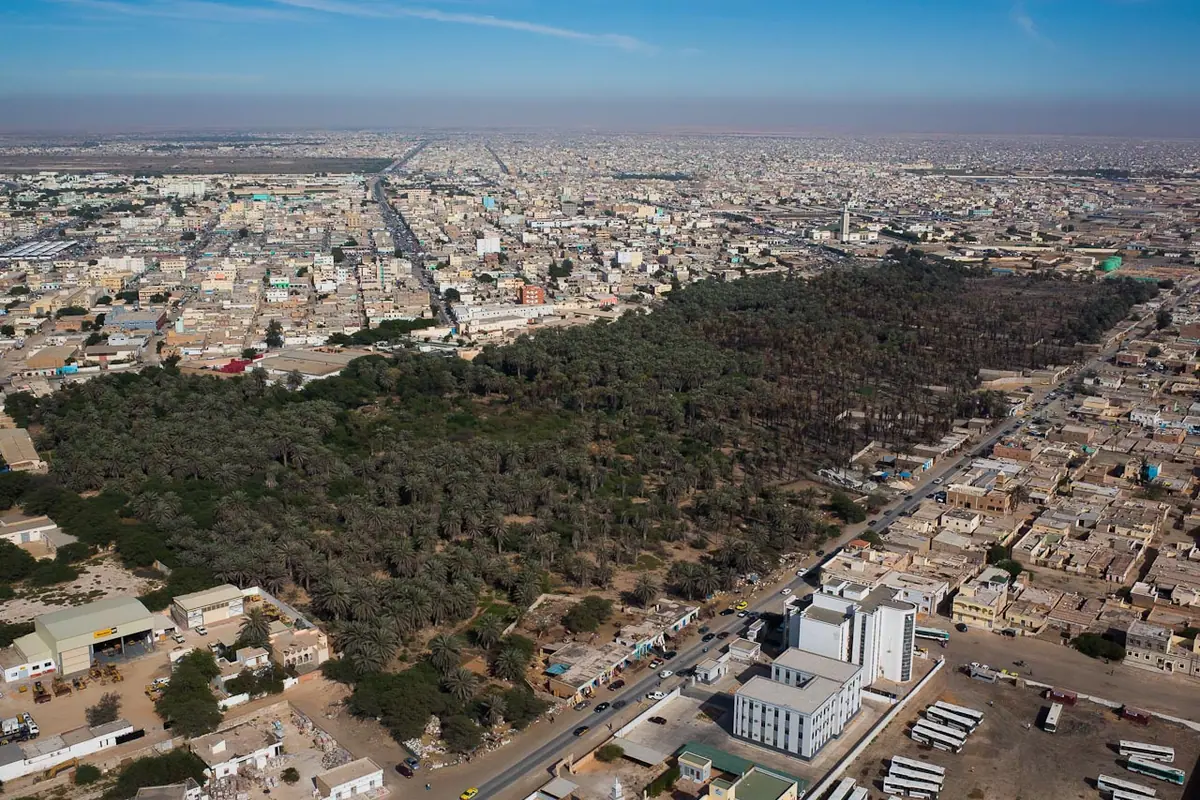
Most journeys begin at Nouakchott–Oumtounsy International Airport, a modern terminal sitting about 25 kilometres northeast of the city centre on a road that crosses pure sand. The capital itself was barely a fishing village in the 1950s and still feels half-built in the most likeable way: low-rise concrete, unpaved cross-streets, goat herds crossing the ring road, and a skyline defined by minarets and satellite dishes. Base yourself in the Tevragh Zeina district near the ocean road, where guesthouses, bakeries and money changers cluster within walking distance of each other.
Give your first full day to the city's markets and waterfront. The Marché Capitale in the Ksar district sprawls across several blocks and sells everything from dates and dried fish to Moorish silver jewellery and indigo cloth, while the camel market on the northern edge is best visited before mid-morning, when animals are still being traded. The real highlight, though, is the Port de Pêche, where hundreds of blue-painted pirogues crowd the quay, boats are caulked and repainted by hand, and the day's catch is auctioned on the concrete in a haze of ice and gulls.
Round things off with the National Museum of Mauritania, whose modest ethnographic and archaeological collections make sense of the country's Moorish, Soninke and Wolof strands, and the Grande Mosquée, whose single square minaret dominates the skyline — non-Muslim visitors generally admire it from outside. Two nights here also give you time to arrange cash, a local SIM card, a guide and any permits you need for the desert, all of which are far easier to sort in Nouakchott than anywhere inland.
Day 3: Banc d'Arguin National Park, Where the Sahara Meets the Sea
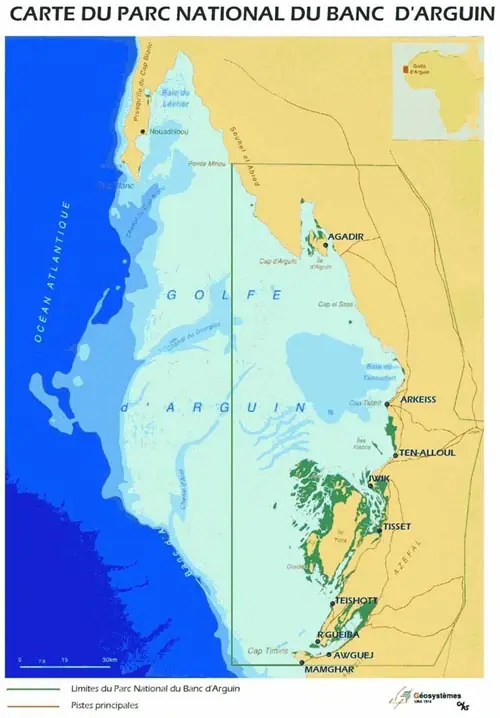
Head north out of the capital on the coastal highway for around four hours until the landscape dissolves into a labyrinth of sandbanks, seagrass flats and tidal channels: Banc d'Arguin National Park, a UNESCO World Heritage site and one of the most important wintering grounds for shorebirds anywhere on the Atlantic flyway. Between November and February the mudflats fill with vast flocks of waders, alongside flamingos, pelicans, terns, ospreys and the occasional soaring raptor hunting over the dunes.
The park's only permanent inhabitants are the Imraguen, fishing families who work from small sailboats and hold historic rights to fish inside the reserve. Arranging a boat trip from the village of Iwik with a local skipper is the best way to see the sandbanks up close; dolphins often pace the bow, and the shallows are thick with rays and juvenile fish. There is virtually no infrastructure, so bring all your own water, food and sun protection, and expect to sleep in a very basic camp or guesthouse if you decide to stay the night.
Most travellers visit as a long day trip, but the four-hour drive each way makes an overnight far more rewarding, particularly if you want dawn light on the flats. The final approach to Iwik runs over soft sand tracks that demand a 4x4 and a driver who knows the route, and park entry fees are collected at the gate. An alternative, if you are already heading north, is the reserve's upper section around the Baie du Lévrier near Nouadhibou, where the desert meets the water in equally dramatic fashion.
Day 4: Fly to Atar and Sleep in the Terjit Oasis
A short domestic hop carries you from the coast to Atar in roughly an hour, replacing a 450-kilometre drive of six to seven hours up the Hope Road. Atar is the Adrar region's market town: single-storey buildings the colour of biscuit, an old colonial-era fort, and a produce market where you can buy dates, melons and battered jerrycans of fuel. It is also the natural staging post for everything the Adrar plateau has to offer, and most desert vehicles, guides and supplies are found here.
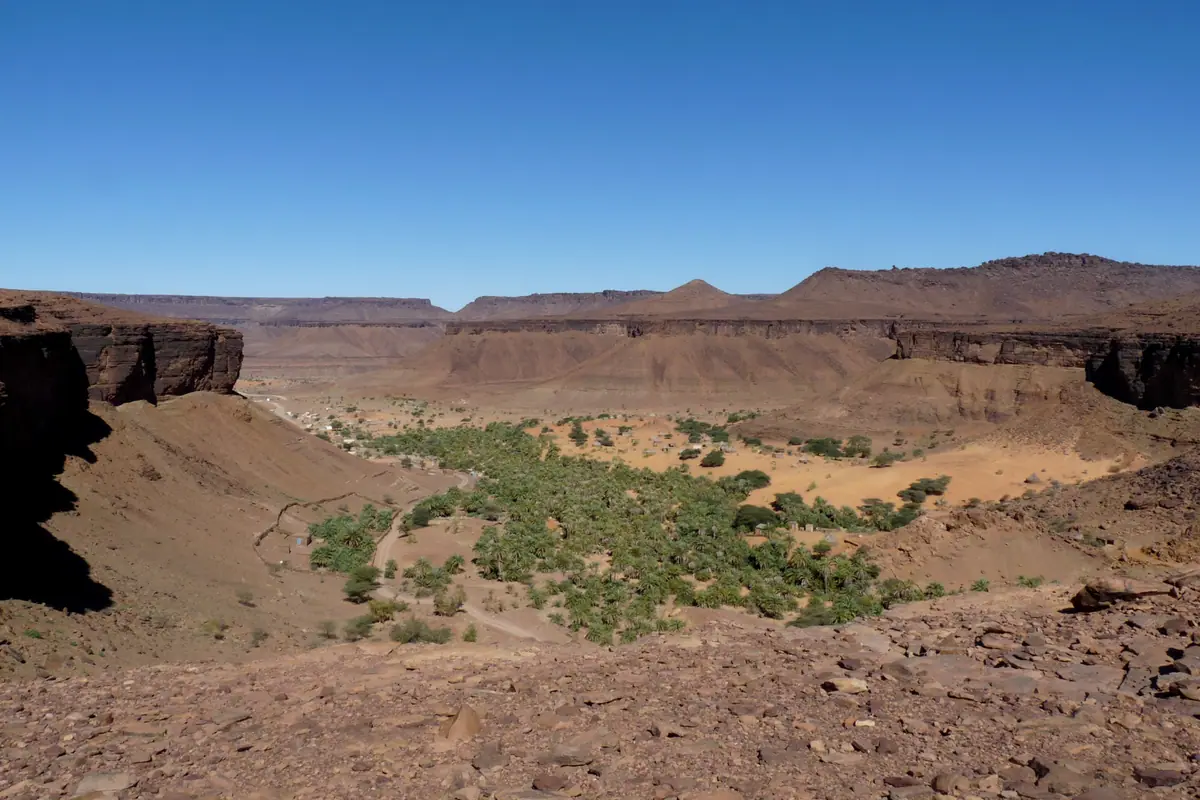
From Atar, a drive of about 85 kilometres south brings you to Terjit, a narrow canyon where a warm spring seeps out of the rock and feeds a ribbon of date palms. Stone pools catch the water for bathing, families spread carpets in the shade and serve mint tea in glasses, and a handful of simple guesthouses offer beds, grilled chicken and cold drinks. In the late afternoon, climb the canyon walls for a view over the palm belt and the black basalt cliffs beyond — the light at that hour is extraordinary.
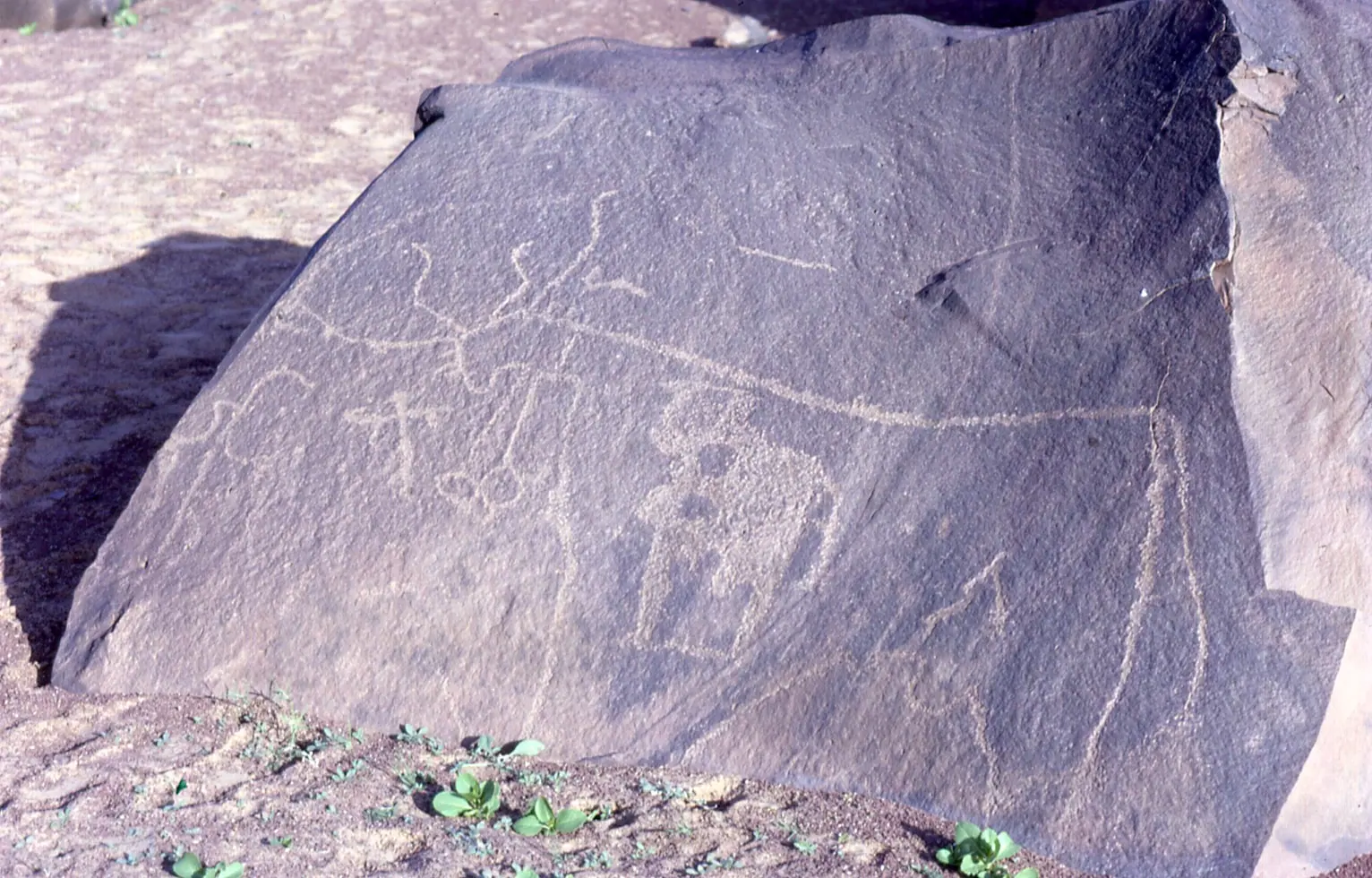
If you have a spare half-day, the nearby Amogjar Pass is worth the detour, with prehistoric rock paintings on the cliff faces and the ruins of a small fortified post perched above the switchbacks. Nights in the Adrar between November and February drop close to 10°C, so pack a fleece and a hat, while winter days are warm enough for shorts and a long-sleeved shirt.
Day 5: Chinguetti and Ouadane, the Ancient Ksour
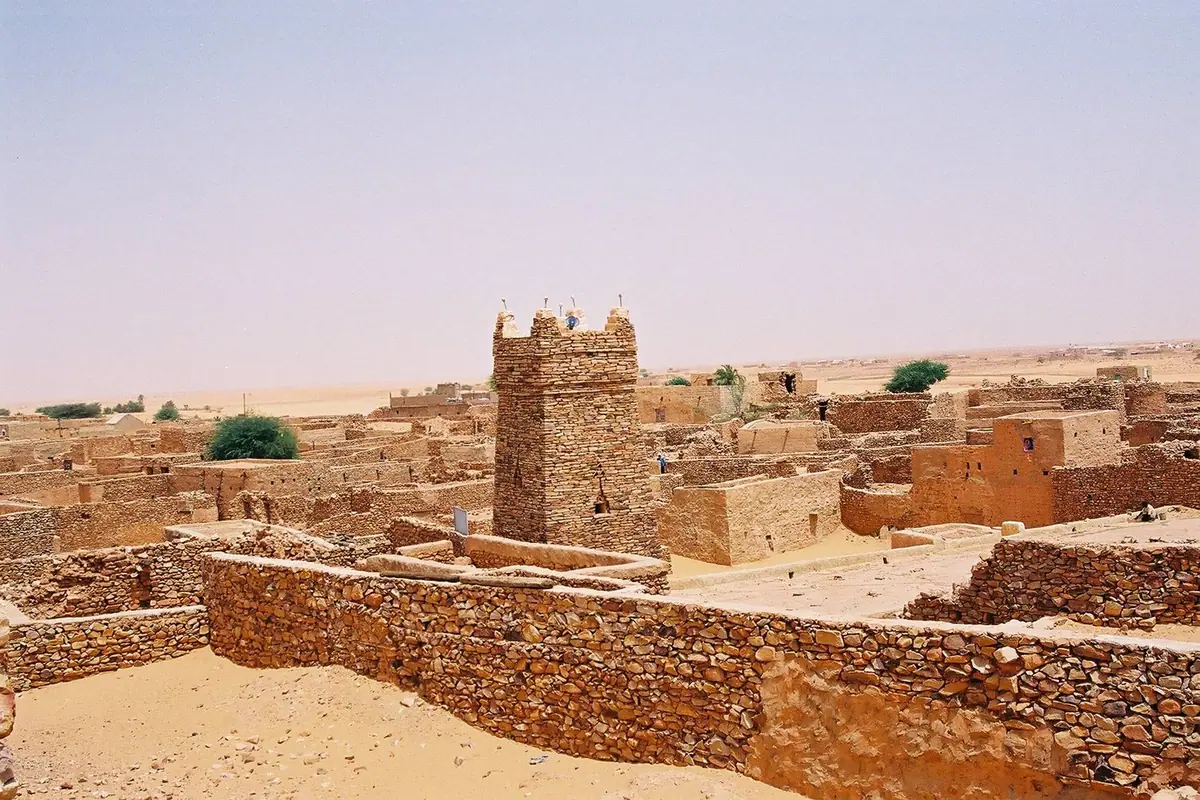
Chinguetti, roughly 90 kilometres east of Atar across dunes and gravel, was founded in the 13th century as a stopover for caravans carrying salt, gold and dates across the Sahara, and it grew rich enough to become a place of pilgrimage in its own right. Its Friday Mosque, with a dry-stone minaret decorated with ostrich eggs, is one of the most photographed structures in the country, and the surrounding lanes of collapsing sandstone houses give the whole town the feel of a place slowly returning to the sand.
The town's real treasures, however, are kept behind unassuming doors. Several families maintain manuscript libraries holding centuries-old Qur'ans, works on astronomy, law, poetry and theology, some of them copied and illuminated by hand. With permission and a modest contribution, you can sit in a courtyard and leaf through pages that have survived five hundred years of heat and blowing grit — a far more affecting experience than any museum case.
Continue northeast for another 120 kilometres and you reach Ouadane, a second UNESCO-listed caravan town, now almost entirely abandoned and poised on the edge of the Adrar escarpment above a dry riverbed. Its ruined mosque still holds a mihrab oriented towards Mecca, and the view from the ridge over an immensity of empty plain is the kind of thing that recalibrates your sense of scale. Simple guesthouses and camps operate just outside the old walls.
Day 6: The Richat Structure, the Eye of the Sahara
Southwest of Ouadane lies the Guelb er Richat, better known as the Richat Structure or the Eye of the Sahara: a 40-kilometre-wide bullseye of concentric rock ridges that is so pronounced it has served as a landmark for orbiting spacecraft. Geologists long argued over whether it was an impact crater or a collapsed dome; the consensus now favours a deeply eroded geological dome, though standing among its rings it hardly matters why it exists.
Seeing it properly is a two-part exercise. From the air, on a sightseeing flight arranged out of Atar, the full pattern resolves into something almost hallucinatory. On the ground, a 4x4 run from Ouadane takes a couple of hours over trackless gravel, crossing breccia, quartzite and ancient limestone before dropping between the inner ridges. There are no marked roads and no signage, so a local guide is not optional — navigation here is part memory, part compass.
Take a full day for this, leaving early to avoid the midday glare, and carry more water than feels reasonable. The temperature between March and June routinely climbs past 40°C in the Adrar, which is why most desert travel is compressed into the cooler months. Bring a wide-brimmed hat, sunglasses that block sideways glare, and a scarf for the dust kicked up by the vehicle.
Day 7: The Iron Ore Railway to Nouadhibou
The final leg is the one people talk about for years afterwards. A domestic flight connects Atar with Zouérat in the far north, from where one of the longest trains in the world — often over two kilometres of linked wagons — hauls iron ore down to the Atlantic port at Nouadhibou. The run takes the better part of twenty hours through open desert, and passengers are allowed to ride in the ore wagons themselves, wrapped in scarves and goggles against the dust, for a fraction of the cost of flying.
Somewhere along the route, near the settlement of Choum, the train passes Ben Amera, one of the largest single monoliths on Earth, a grey mass rising hundreds of metres out of an otherwise flat plain. Further on, the line descends toward the coast and the Baie du Lévrier, where Nouadhibou's harbour is ringed by dozens of rusting trawlers abandoned in the shallows — a shipwreck graveyard that has become an unlikely landmark in its own right.
Cap Blanc, just beyond the port at Cansado, shelters one of the last colonies of Mediterranean monk seals, a critically endangered species that basks on the beaches below the cliffs; sightings are never guaranteed, but patience from the clifftop often pays off. Nouadhibou has its own airport with frequent flights back to Nouakchott, so build in a buffer day before your international departure — domestic services run on thin schedules, and a dust storm or a technical issue can shuffle plans at short notice.
Frequently asked questions
When is the best time to visit Mauritania?
November to March is comfortably the best window. Coastal Nouakchott stays mild, the Adrar is warm by day and cool at night, and Banc d'Arguin fills with wintering birds. From March to June inland temperatures can exceed 40°C, and the harmattan haze of December and February occasionally cuts visibility and delays flights. July to September brings humid, unsettled weather to the south.
Do domestic flights in Mauritania run reliably?
The domestic network is small — essentially Nouakchott, Atar, Nouadhibou and Zouérat — with only a few services a week on each route. Seats sell out days ahead in high season, baggage allowances are modest, and dust or technical problems can cause cancellations. Book as early as you can, choose morning departures where possible, and never schedule an international connection on the same day as an internal flight.
Do I need a visa and a guide?
Many nationalities can obtain a visa on arrival at Nouakchott–Oumtounsy airport, but rules change and you should confirm with the nearest Mauritanian embassy before booking. A guide is not formally required across most of the country, yet in the Adrar, at the Richat Structure and on the sand tracks into Banc d'Arguin, a local driver-guide is effectively essential for navigation, permits and vehicle recovery.
What should I pack and how should I handle money?
Bring loose, long-sleeved layers, a wide-brimmed hat, sunglasses, a dust scarf, a head torch and a refillable water bottle. The ouguiya is a cash economy: ATMs exist only in Nouakchott and even there are unreliable, so carry enough paper money for the whole trip. The country is dry, alcohol is not sold, and modest dress is appreciated everywhere outside hotel grounds.
Can this itinerary be shortened if I only have five days?
Yes. Fly straight to Atar after one night in Nouakchott, spend two nights in the Adrar with day trips to Chinguetti and Terjit, then return to the capital and add a single long day trip north to Banc d'Arguin. Skip Zouérat, the iron ore train and Nouadhibou — they deserve their own trip, and rushing them turns a memorable journey into a punishing one.
Plan it — flights in Mauritania
Live search, booked directly with trusted providers.
Sort the rest of your trip
Everything for Mauritania, in one place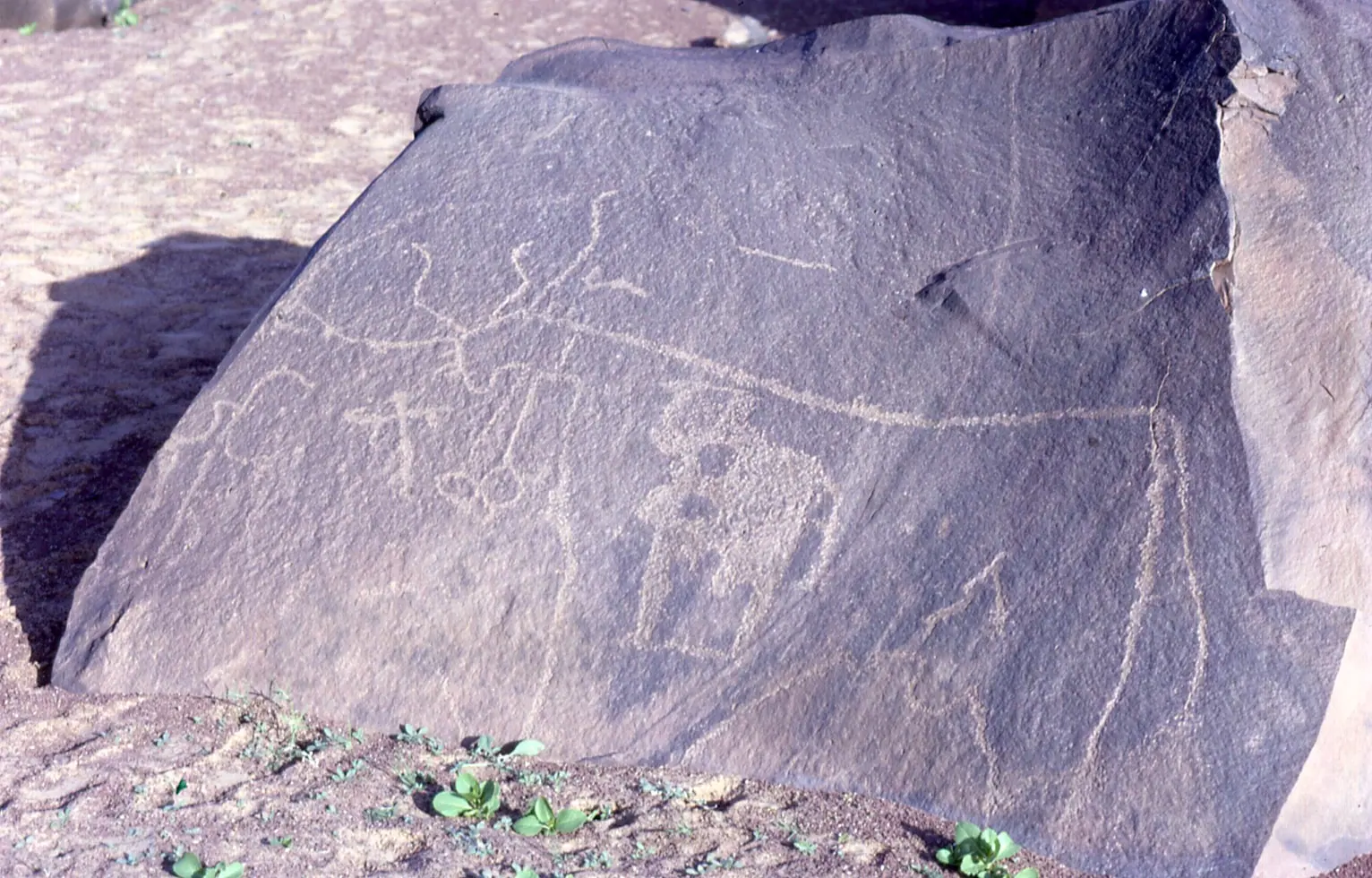
Stay in Mauritania
Hotels, guesthouses and apartments — compared in one search.
Search hotels
Transfer in Mauritania
Private driver waiting on arrival — no queues, no surprises.
Book a transfer
Travel insurance
Medical cover, delays and lost baggage — sorted before you go.
Get covered