Lithuania packs an improbable amount into a country you can cross in half a day: a baroque capital, a fairy-tale island castle, a hill bristling with tens of thousands of crosses, and a wind-carved sand spit that belongs on another continent. Fly into Vilnius, give yourself seven days, and you can see the whole arc — from the Baltic dunes to the medieval lanes where it all began.
Landing in Vilnius: Flights, Timing and Your First Evening
Vilnius Airport sits barely six kilometres from the city centre, which makes arrival almost comically easy — a shuttle bus, a short train hop or a taxi has you in the Old Town within twenty minutes of clearing the terminal. Direct flights arrive from dozens of European cities, especially between April and October, when budget carriers add seasonal routes. Kaunas Airport, roughly 100 kilometres west, is the quieter second gateway and worth checking if the fares are keener; from there a train or bus reaches Vilnius in about an hour and a half.
The best months for a one-week trip are late May through early September, when the days stretch past ten at night and the café terraces along Pilies Street stay full until midnight. September is arguably the sweet spot: warm enough for the Curonian Spit, with fewer crowds and the soft amber light that makes Lithuanian photography look professionally done. If you come in December, accept short grey days in exchange for Christmas markets in Cathedral Square and a dusting of snow on the baroque rooftops.
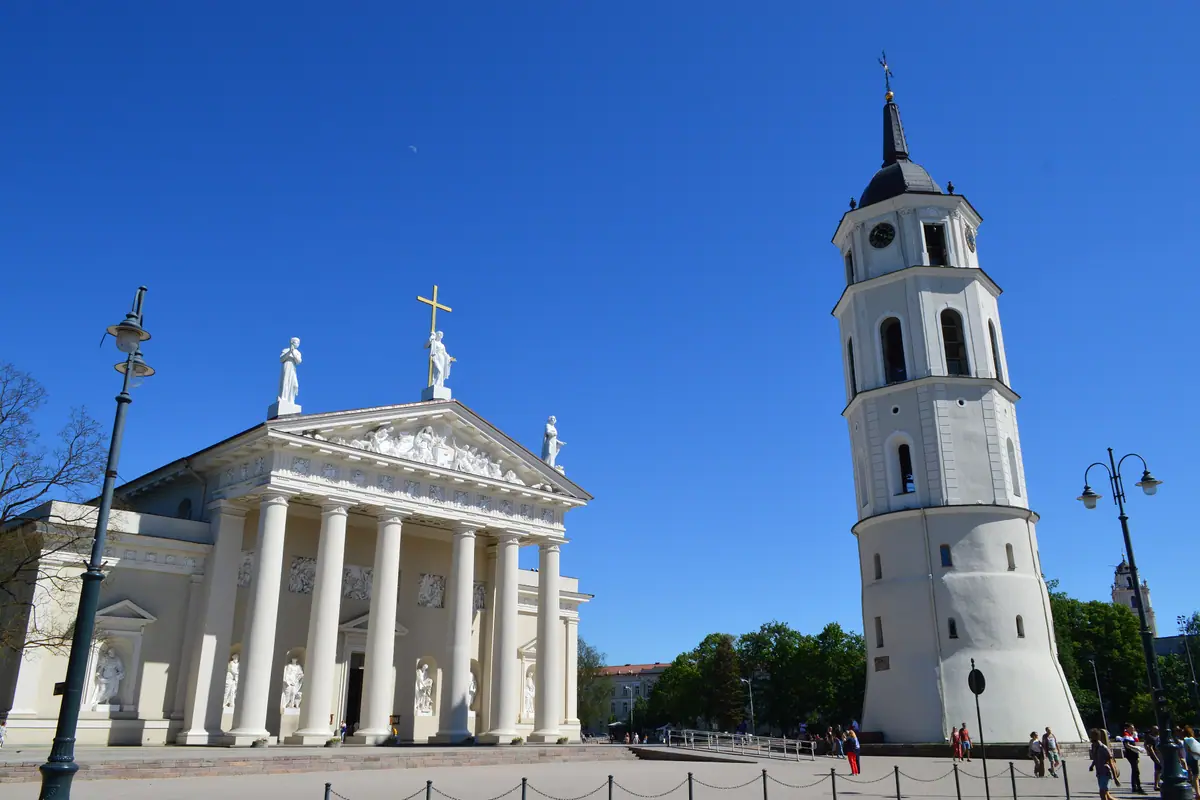
Keep your first evening gentle. Wander Cathedral Square, look up at the white bell tower, and walk the length of Gedimino prospektas as the city lights come on. Order cepelinai — potato dumplings the size of fists, stuffed with meat and drowned in sour cream — and a bowl of cold pink šaltibarščiai, and you'll understand why Lithuanian food is built for cold-climate appetites.
Days 1–2: Vilnius Old Town and the Republic of Užupis
Vilnius Old Town is one of the largest surviving medieval cores in Europe, and it wears its UNESCO status lightly. Start at Vilnius Cathedral, then climb — or ride the funicular — to Gediminas Tower, the red-brick remnant of the upper castle, for the classic view over terracotta roofs to the Neris river. From there, follow Pilies Street past the Gates of Dawn, where the black-and-gold Madonna draws a steady stream of pilgrims, and detour into the courtyard of Vilnius University, a labyrinth of arcaded Renaissance cloisters that has been teaching since 1579.
Give the afternoon to the oddities. St Anne's Church is a filigree of Gothic brick so delicate that the story goes Napoleon wanted to carry it home in his palm. Cross the bridge into Užupis, the self-declared bohemian republic with its own constitution pinned to a wall in two dozen languages, its own tiny army, and a mermaid statue in the river. Then spend a sobering hour at the Museum of Occupations and Freedom Fights, housed in the former KGB headquarters, where the basement cells are preserved exactly as they were left.
On day two, slow down. Browse Halės Market for smoked eel, hemp butter and dark rye bread, then follow the river north to the green pocket of Belmontas and the wooded slopes around Verkiai Palace, an easy half-day escape from the cobbles. Finish with dinner in the courtyard-lined streets south of Town Hall, where Lithuanian chefs have spent the last decade reinventing Baltic ingredients — birch sap, deer, fermented cabbage — into something quietly exciting.
Day 3: Trakai Island Castle and the Kernavė Hillforts
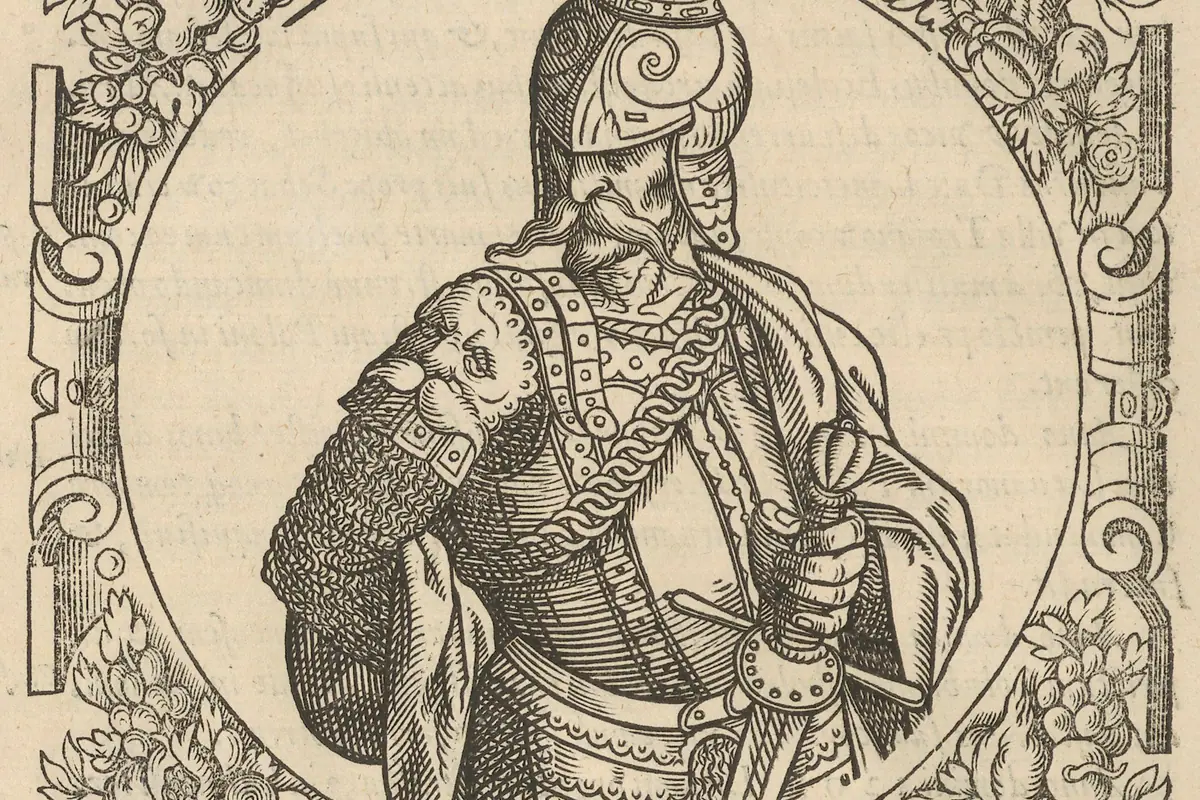
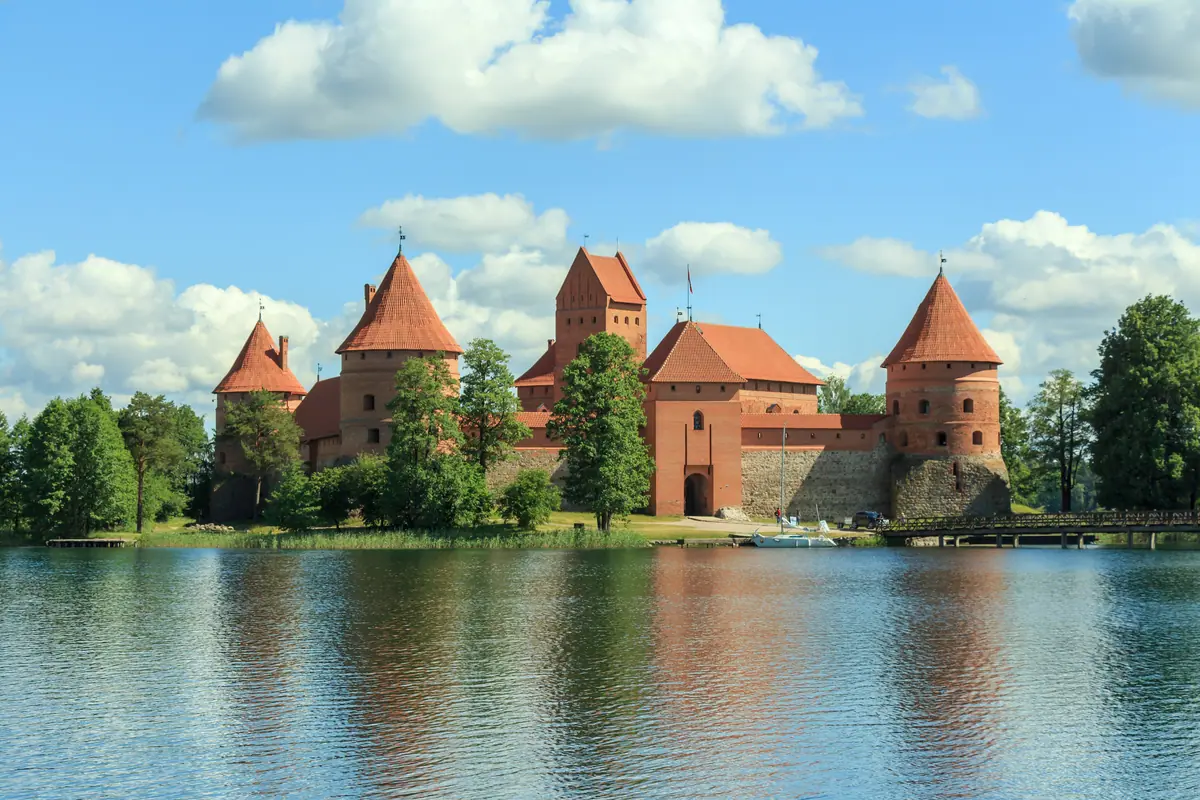
Twenty-eight kilometres west of Vilnius, Trakai Island Castle rises straight out of Lake Galvė on a small island, connected to shore by a wooden footbridge. Built in the 14th century and later expanded under Grand Duke Vytautas, it's the country's most photographed building and genuinely deserves the fuss: red brick, pointed towers, a moat-like expanse of water on every side, and a museum inside that traces the Grand Duchy's golden age. Trains and buses from Vilnius take about forty minutes, so this is a comfortable half-day, and you can stretch it with a boat ride on the lake or a walk along the peninsula castle ruins nearby.
Lunch in Trakai means kibinai — flaky, crescent-shaped pastries filled with lamb or beef, brought here centuries ago by the Karaim community, whose tiny wooden prayer house still stands on the main street. It's the one dish you should not leave town without eating.
If you have a car and energy to spare, push on to Kernavė, a UNESCO-listed archaeological reserve where five hillforts rise in a chain above the Neris valley. People lived here for nine millennia before the Teutonic Order burned the town in 1390; today it's a grassy, windblown place with long views and almost no crowds. Walking the ridge at sunset, with the river glinting below, is one of the most quietly memorable hours you can spend in Lithuania.
Days 4–5: Kaunas, the Ninth Fort and the Hill of Crosses
Kaunas, an hour and a quarter from Vilnius by train, was the country's interwar capital and retains a dense, confident core of modernist architecture that now holds UNESCO listing. Walk Laisvės alėja, the long pedestrian spine, past the White Swan Town Hall in the Old Town square, then climb Žaliakalnis by the creaking old funicular for a rooftop panorama. Kaunas Castle guards the confluence of the Nemunas and Neris, and the Pažaislis Monastery, a baroque ensemble hidden in a forest east of the city, is a ten-minute detour that rewards anyone with an hour to spare.
Two sites anchor the emotional weight of the trip. The Ninth Fort, on the city's edge, is a star-shaped tsarist fortress turned Nazi killing site and Soviet prison, with a monumental memorial that is hard to walk through and impossible to forget. The Devil's Museum, by contrast, is pure Lithuanian surrealism — a collection of hundreds of carved devils from folk tradition, housed in a former private villa.
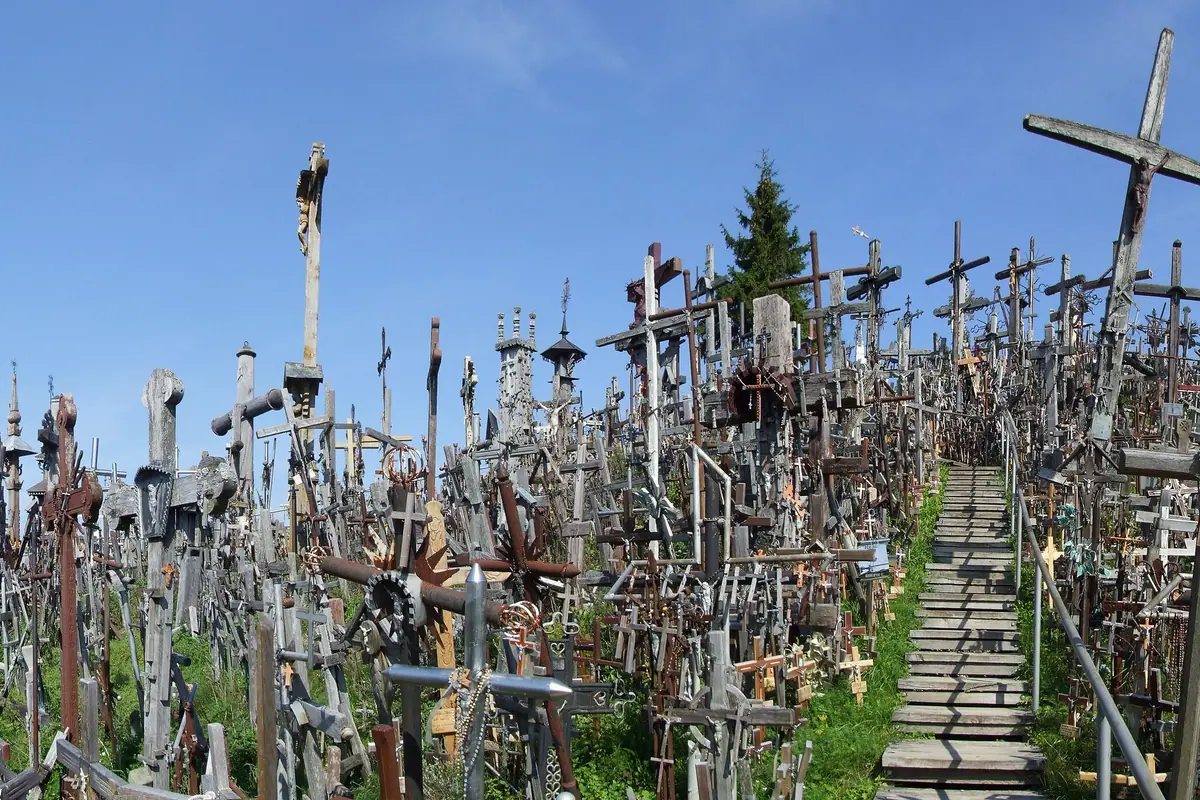
On day five, drive north to the Hill of Crosses outside Šiauliai, roughly two hours from Kaunas. Tens of thousands of crosses, crucifixes and rosaries cover a low mound in the middle of flat farmland, planted by pilgrims since the 19th century despite repeated Soviet attempts to bulldoze them. There is no admission fee, no queue, no interpretation board telling you how to feel; you simply walk among the swaying metal and wood. Continue west afterwards toward Klaipėda, about two hours further, and sleep near the coast.
Days 6–7: Klaipėda and the Curonian Spit
Klaipėda's Old Town is a compact grid of half-timbered facades and cobbled lanes around Theatre Square, where the fountain statue of Ännchen von Tharau has stood since German times. The city has a salty, seafaring character unlike anywhere else in Lithuania, with ferry terminals, smoked fish stalls and a sculpture park along the Dane river. From the northern pier, a short ferry crosses the channel to Smiltynė, the gateway to the Curonian Spit — a 98-kilometre ribbon of sand separating the Baltic Sea from the Curonian Lagoon, shared with neighbouring Kaliningrad and protected as a UNESCO World Heritage landscape.
Base yourself in Nida, the prettiest of the spit's villages, and give the final two days to dunes and bicycles. Climb the Parnidis Dune for the panorama over the shifting sand and the sun-dial carved into stone, walk the Dead Dunes near Juodkrantė where buried villages still lie beneath the sand, and cycle the flat pine-forest path between settlements past the Hill of Witches, a hillside of carved wooden figures from local legend. Amber washes up on the beaches after storms; in summer, families comb the shoreline at dusk with plastic bags, genuinely finding pieces of the Baltic's fossilised resin.
Keep the last morning loose. Swim if the water is warm enough — it usually is by August — eat smoked bream at a lagoon-side café, and then either drive back to Vilnius (three and a half hours) or fly out from Palanga Airport, twenty minutes up the coast, which handles seasonal services to a handful of European cities. It's a fittingly unhurried way to end a trip through a country that rarely shouts.
Practical Notes: Getting Around, Seasons and Booking Ahead
Lithuania is small enough that a hire car transforms the itinerary, especially for the Hill of Crosses, Kernavė and the Curonian Spit, where buses run infrequently and schedules thin out outside July and August. Without a car, the Vilnius–Kaunas–Klaipėda rail spine is fast and comfortable, and regional buses fill most of the remaining gaps, though transfer times will cost you half a day here and there. Roads are good, driving distances short: Vilnius to Klaipėda is around three hours, Vilnius to Kaunas roughly one.
Weather is the variable that shapes everything. Late spring and early autumn can swing between 8°C drizzle and 22°C sunshine in the same afternoon, so layers and a light waterproof beat an umbrella in Lithuania's coastal wind. Mid-summer brings long bright evenings and the busiest fortnight around the Sea Festival in Klaipėda; book Curonian Spit guesthouses several months ahead if you're travelling then, since Nida's rooms are limited and demand is fierce. Winter trips are best kept short and city-based, with Vilnius and Kaunas carrying the itinerary.
Allow one full day of slack somewhere in the middle. Lithuania rewards detours — the treetop walkway at Anykščiai, the spa parks and mineral springs of Druskininkai, the lakes and wooden villages of Aukštaitija National Park — and a rigid seven-day plan leaves no room for the long lunch or unexpected folk festival that ends up being the thing you remember.
Frequently asked questions
Which airport should I fly into for a one-week Lithuania itinerary?
Vilnius Airport is the obvious choice: it's close to the Old Town, has the widest range of direct European routes and sits at the logical start of the Vilnius–Kaunas–coast arc. Kaunas Airport works as a cheaper alternative if you're hiring a car, since it's closer to the centre of the country. For a trip ending on the coast, Palanga Airport offers seasonal departures and saves you the drive back east.
What is the best time of year to visit Lithuania?
Late May to early September gives you long daylight, warm Baltic beaches and everything open. September is the sweet spot for comfortable temperatures and thinner crowds. July and August are liveliest but busiest, particularly on the Curonian Spit. Winter is dark and cold, though December brings Christmas markets and a snow-dusted Old Town in Vilnius.
Do I need to hire a car in Lithuania?
Not strictly, but it helps. Trains and buses connect Vilnius, Kaunas and Klaipėda efficiently, and Trakai is easy by rail. Sites like the Hill of Crosses, Kernavė and the villages on the Curonian Spit are far more comfortable with your own wheels, and driving distances are short — no leg of this itinerary takes more than three and a half hours.
How do I reach the Curonian Spit from Klaipėda?
Take the short passenger ferry across the channel from Klaipėda's Old Town to Smiltynė, then continue by bus, bicycle or car along the single road that runs the length of the spit to Nida. Vehicles need a permit to enter the national park, and the ferry gets busy in summer, so travel early in the morning if you're driving.
Is seven days enough to see Lithuania properly?
Yes, for the classic highlights: two days in Vilnius, a day at Trakai, a day or two around Kaunas and the Hill of Crosses, and the final stretch on the coast and Curonian Spit. It's a relaxed pace rather than a rushed one. If you want to add Druskininkai's spas or the lakes of Aukštaitija National Park, stretch the trip to ten days.
Plan it — flights in Lithuania
Live search, booked directly with trusted providers.
Sort the rest of your trip
Everything for Lithuania, in one place
Stay in Lithuania
Hotels, guesthouses and apartments — compared in one search.
Search hotels
Transfer in Lithuania
Private driver waiting on arrival — no queues, no surprises.
Book a transfer
Travel insurance
Medical cover, delays and lost baggage — sorted before you go.
Get covered