Kazakhstan is the ninth-largest country on earth, and its highlights sit a thousand kilometres apart — which is exactly why a week here belongs to the domestic flight network rather than the railway. This route threads Almaty's snowbound mountains, Astana's glass-and-steel capital, the Timurid mausoleums of Turkistan and the red rock of Charyn Canyon into seven tight, unforgettable days.
Day 1–2: Almaty, Where the City Meets the Snow Line
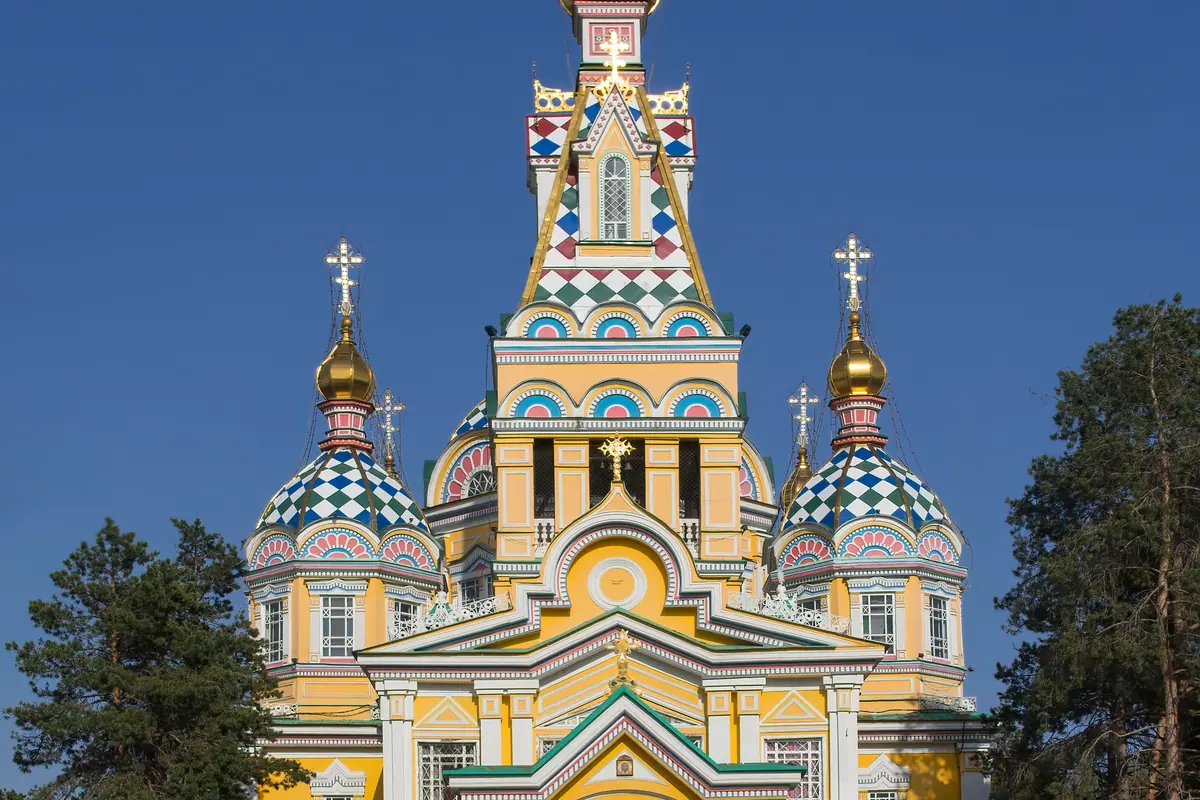
Start in Almaty, the former capital and still the country's cultural heart, sprawled beneath the Zailiysky Alatau range. Give your first morning to Panfilov Park, where the Ascension Cathedral — better known as Zenkov Cathedral — rises in candy-coloured tiers of wood, completed in 1907 without a single nail and counted among the tallest timber churches anywhere. Beside it sits the Museum of Folk Musical Instruments, and a short walk away the Green Bazaar, where stalls heave with dried apricots, horse sausage and bowls of kumys, the tart fermented mare's milk.
Spend the afternoon riding the cable car up Kok-Tobe for the classic view of the city dissolving into foothills and, on clear days, the permanent snow above. Come evening, wander the pedestrian stretch of Zhibek Zholy and the Arbat for cafés and street musicians, or catch a performance at the Opera and Ballet Theatre. If rain rolls in, the single metro line is worth a ride purely for its marble-and-mosaic stations.
Day two belongs to the mountains. Drive up to Medeu, the open-air speed-skating oval at 1,691 metres, then continue by cable car to Shymbulak, a ski resort at 2,200 metres that becomes a hiking base in summer. Push on to Big Almaty Lake, a turquoise reservoir at 2,511 metres roughly forty minutes beyond the city limits; the road can close with snow or rockfall in spring, so June to September is the reliable window. Finish the day back at Kok-Tobe for sunset.
Day 3: Fly North to Astana, the Futurist Capital
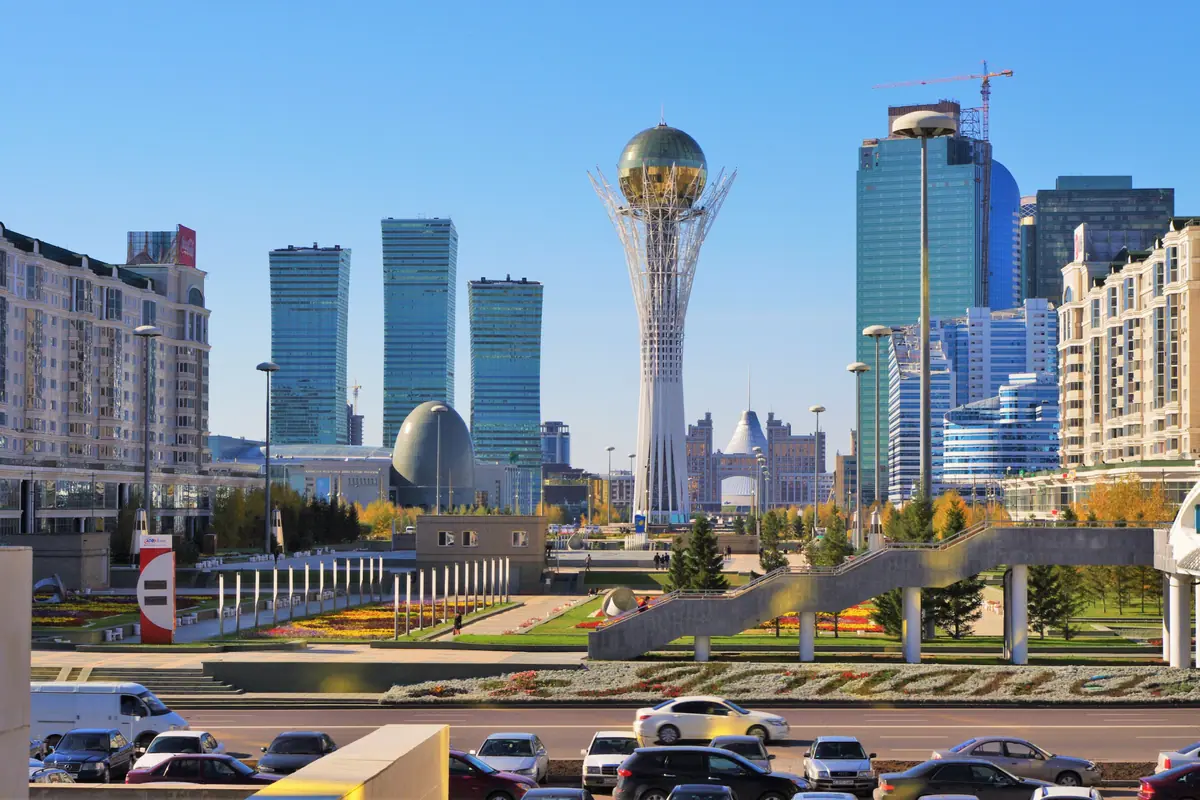
A morning flight of about one hour and fifty minutes carries you from Almaty's mountain fringe to Astana, the purpose-built capital on the Ishim River. The contrast is deliberately theatrical: here the skyline is glass, steel and white lattice, laid out along a single grand axis, Nurzhol Boulevard, that runs from the river to the presidential quarter. Allow a full day on the ground, more if you want to see the surrounding steppe.
Walk the boulevard from Khan Shatyr, the 150-metre transparent tent whose interior holds shops, a food court and an indoor beach, past the Opera House, to Bayterek Tower. The 97-metre white lattice crowned with a golden glass sphere has an observation deck level with the orb; visitors traditionally rest a palm in the gilded handprint there and make a wish. Nearby stand the pyramid-shaped Palace of Peace and Reconciliation and the National Museum of the Republic of Kazakhstan, which does a fine job of explaining the country's nomadic and Soviet past in an afternoon.
Cross the river to the old Expo site and Nur Alem, a 100-metre glass sphere that is the largest spherical building in the world, now housing an interactive museum of future energy. Then visit Hazrat Sultan Mosque, a marble-and-gold landmark among the biggest mosques in Central Asia. With a spare half day, drive 250 kilometres north to Burabay and its pine-fringed lakes and the Zhumbaktas rock formation.
Day 4–5: Turkistan and the Mausoleum of Khoja Ahmed Yasawi
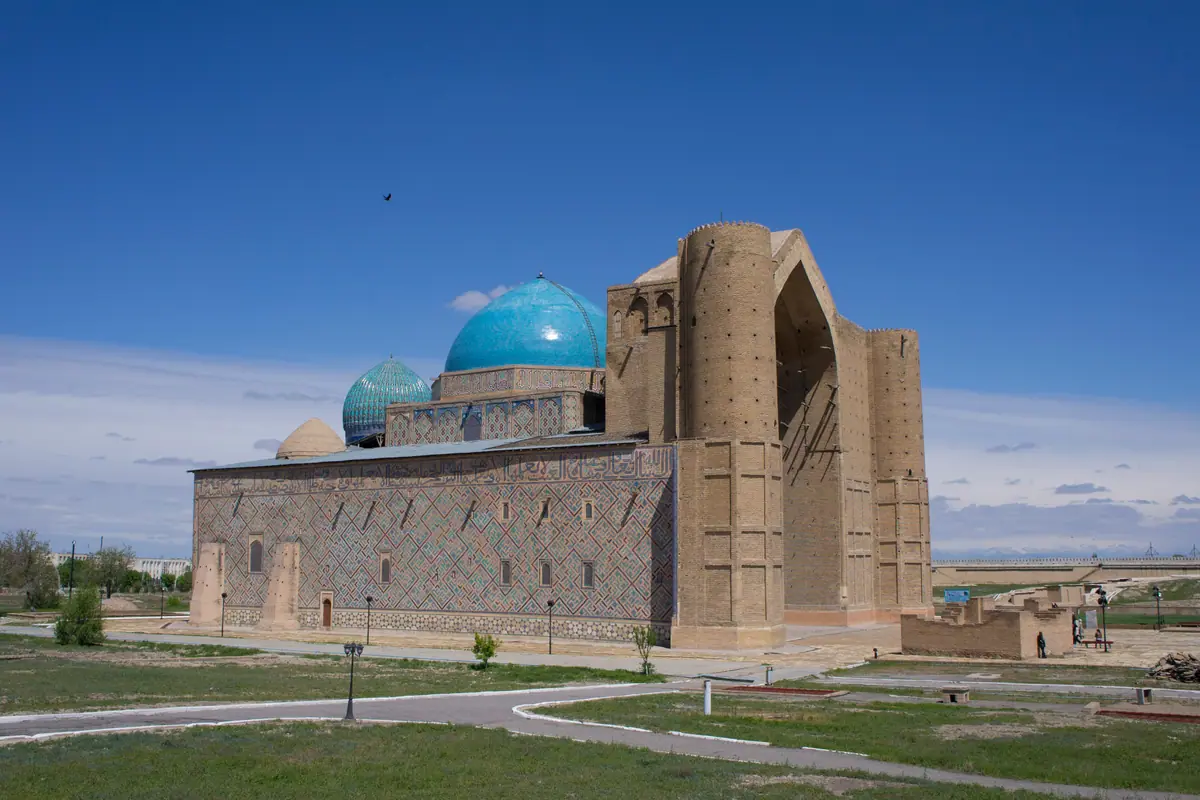
Fly south from Astana or Almaty — around ninety minutes either way — to Turkistan, the Silk Road city once known as Yasi. Its centrepiece is the Mausoleum of Khoja Ahmed Yasawi, commissioned by Timur at the end of the fourteenth century and inscribed as Kazakhstan's first UNESCO World Heritage site in 2003. The vast unfinished portal, clad in blue and turquoise tilework, opens into a hall dominated by a giant bronze cauldron, while the poet's tomb chamber lies at the far end. Come early or late: the low sun sets the glazed tiles alight and the tour groups thin out.
Two days lets you add the surrounding monuments. About thirty kilometres west stands the Arystan Bab Mausoleum, the twelfth-century shrine of Yasawi's own teacher, and beyond it the ruins of Otrar, the Silk Road city razed by Mongol armies in the early thirteenth century, plus the walled remains of Sauran. Within the Turkistan complex itself, don't miss the Hilvet, the underground chamber where Yasawi is said to have meditated in near-darkness. Guesthouses and small hotels cluster within walking distance of the shrine, and afternoon is the best time for photography.
Day 6: Charyn Canyon and the Kolsai Lakes
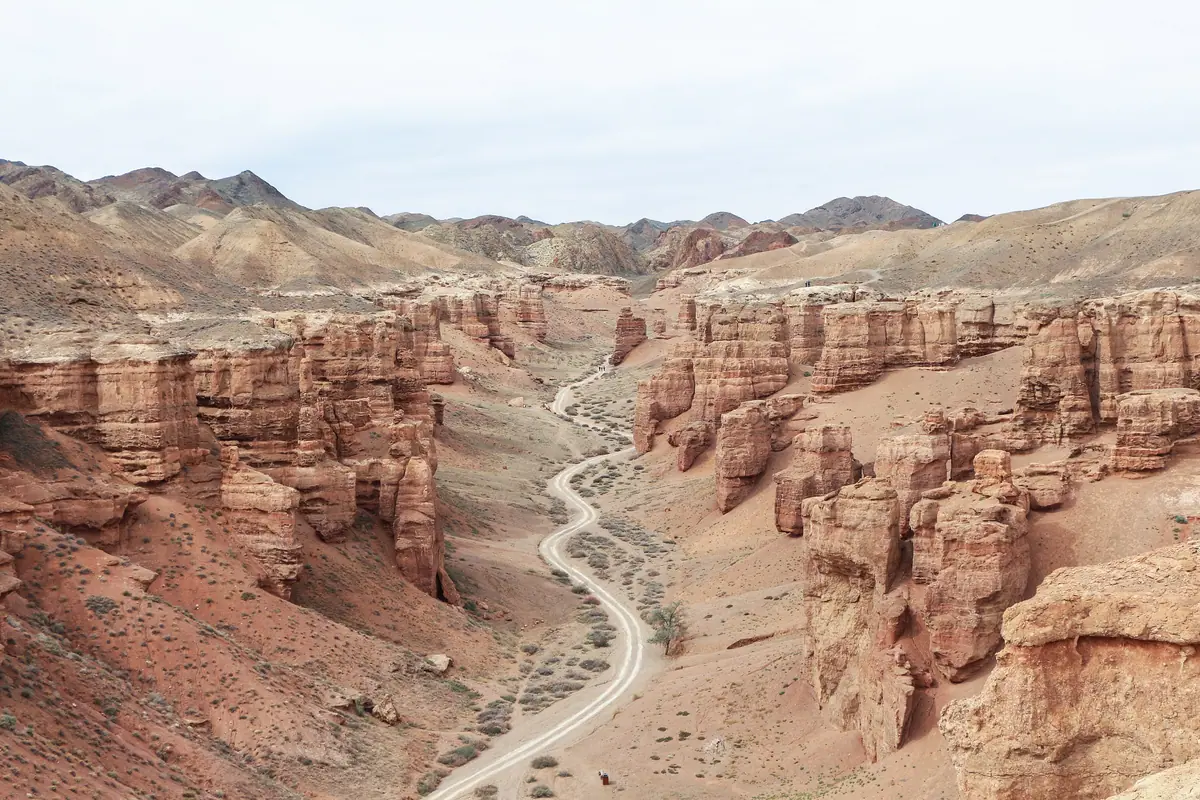
Fly back to Almaty and use your next day for the desert-and-mountain circuit east of the city. Charyn Canyon lies about 200 kilometres away, three and a half to four hours by road, and its Valley of Castles section is a two- to three-kilometre walk between rust-red walls that rise 150 to 300 metres above the riverbed. Go for sunrise or late afternoon — at midday the light flattens and the heat is punishing — and carry more water than you think you need.
From Charyn, continue toward Saty village for the Kolsai Lakes, three alpine tarns stepped between roughly 1,800 and 2,850 metres. The first lake is an easy stroll from the road; the second demands a three-to-four-hour climb that rewards you with far fewer people. Nearby, Kaindy Lake is the stranger sight — a turquoise reservoir formed by a 1911 earthquake landslide, with bare Schrenk spruce trunks spearing straight out of the water. Homestays in Saty serve plov and tea under enormous night skies.
There is no convenient public transport for the final stretches, so hire a driver or join a small group departure from Almaty. The road is paved to both Charyn and Saty, but the mountain sections coil tightly and snow can linger into May. The season runs from late April through October, with late spring for wildflowers and early autumn for golden larch and empty trails.
Day 7: Altyn-Emel's Singing Dune, or a Caspian Detour
For your last full day, head northeast to Altyn-Emel National Park, roughly 250 kilometres from Almaty. Its signature sight is the Singing Dune, a bare sand ridge some three kilometres long and 150 metres high that emits a low, organ-like hum when dry sand slides down its flank; climb it before the day heats up. The park also hides the Aktau Mountains, banded badlands of chalk, ochre and rose that need a four-wheel drive to reach, and the Besshatyr burial mounds of Saka chiefs. On the way home, the Tamgaly petroglyphs — thousands of Bronze Age rock carvings in a UNESCO-listed gorge — make a superb final stop.
If you can stretch the trip, swap this day for a flight west to Aktau, the Caspian port that opens the surreal landscapes of Mangystau: the white chalk cliffs of the Bozzhyra tract, the eroded canyon of Kok-Kala, the Karagiye depression that dips 132 metres below sea level, and the rock-carved Shakpak-Ata mosque. Flights from Almaty take about three hours, and you should budget two or three extra days to do the region justice.
Frequently asked questions
How many domestic flights do I actually need for a week in Kazakhstan?
Three or four is the sweet spot. A workable loop is Almaty to Astana, Astana to Turkistan, Turkistan back to Almaty, then ground trips to Charyn Canyon, the Kolsai Lakes or Altyn-Emel from Almaty. Distances are so vast that flying replaces days of driving rather than being an indulgence.
When is the best time of year to travel this route?
Late April to June and September to early October. Summer is hot and dry in the south and can hit the high thirties in Almaty, though the mountains stay pleasant, while Astana in winter regularly drops to minus 25 or colder. Spring and autumn give you open roads, clear light and comfortable walking temperatures.
Do I need a visa for Kazakhstan?
Many passport holders, including those from the EU, UK, US, Canada, Japan and several other countries, can enter visa-free for up to 30 days. Rules change periodically and depend on your nationality, so confirm the current requirements with an official Kazakh diplomatic source before booking, and make sure your passport has at least six months' validity.
Is it easy to get around without speaking Russian or Kazakh?
In Almaty, Astana and Turkistan, enough English is spoken in hotels, airports and larger restaurants to manage comfortably. Outside the cities, drivers and homestay hosts often speak only Russian or Kazakh, so have your destination written in Cyrillic, keep offline maps downloaded and use a translation app. Domestic flights are announced in English at the major airports.
How much time should I give Almaty versus Astana?
Almaty deserves the lion's share — two full days in the city plus two or three for Charyn, the Kolsai Lakes and Altyn-Emel. Astana is a compact, walkable showcase that rewards a single well-planned day. Note that Kazakhstan now runs on one time zone nationwide, so there is no jet-lag penalty when hopping between regions.
Plan it — flights in Kazakhstan
Live search, booked directly with trusted providers.
Sort the rest of your trip
Everything for Kazakhstan, in one place
Stay in Kazakhstan
Hotels, guesthouses and apartments — compared in one search.
Search hotels
Transfer in Kazakhstan
Private driver waiting on arrival — no queues, no surprises.
Book a transfer
Travel insurance
Medical cover, delays and lost baggage — sorted before you go.
Get covered