Hungary is small enough to cross in an afternoon and deep enough to keep you busy for a month. Its flavours arrive in tiny glasses of fruit brandy and slow-simmered pots of paprika, its afternoons disappear into steaming thermal pools, and its skyline is stitched together by castles, basilicas and a parliament that looks like a wedding cake rising from the Danube.
Hungary on a Plate: What the Country Actually Tastes Like
Paprika is the quiet narrator of Hungarian cooking — sweet, hot or smoked, sold in little cotton bags and hung in garlands above market stalls. Learn one distinction before you order: gulyás is a soup, cooked slowly with beef, onion, root vegetables and tiny pinched pasta, often in a kettle over an open fire. Pörkölt is the thicker stew, ladled over nokedli dumplings and served with pickles. Visitors who expect a bowl of stew when they ask for goulash are regularly, gently corrected.
The everyday table is built on frying, sour cream and cabbage. Lángos – a disc of deep-fried dough rubbed with garlic, then buried under sour cream and grated cheese – is the classic lakeside and market snack, best eaten scalding hot with a paper napkin in hand. Töltött káposzta, stuffed cabbage leaves in a paprika-tomato sauce, appears at Sunday lunches; halászlé, a fiery fisherman's soup of river fish, belongs to the Danube and the Tisza and is traditional on Christmas Eve. Finish with dobostorta, its layers glued with caramel, or somlói galuska, a rum-soaked sponge smothered in chocolate sauce and whipped cream.
Drinking is part of the same ritual. Pálinka, a clear fruit brandy distilled from apricot, plum or pear, is offered in thimble-sized glasses and should be sipped, not knocked back. Summer belongs to fröccs, wine mixed with soda water, ordered in a private language of small, large and gentleman's portions. In the north-east, Tokaji Aszú – the sweet, honeyed wine made from botrytis-shrivelled grapes – is poured in tasting cellars, while Egri Bikavér, a robust red blend, is the everyday bottle in the hills around Eger. Between meals, look for a bitter herbal liqueur served as an aperitif.
Markets and Cellars: The Great Market Hall and the Hungarian Pantry
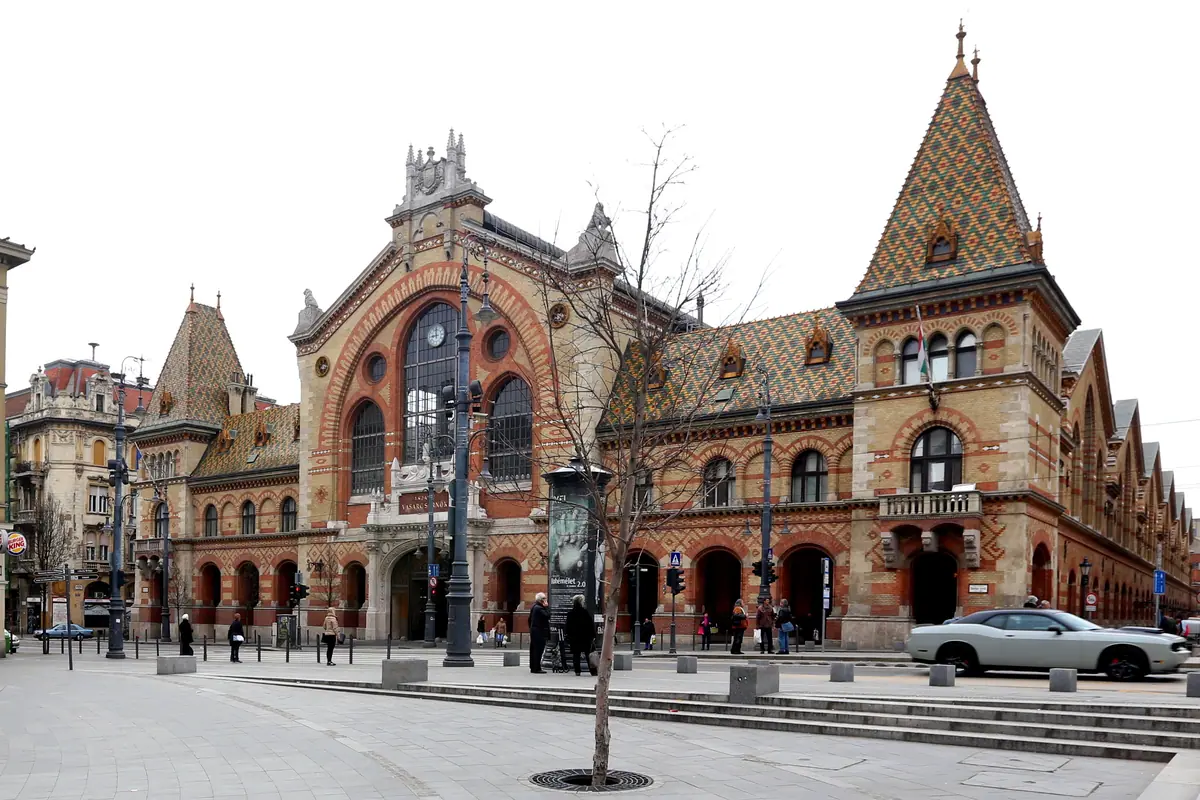
Start any food education at the Great Market Hall on Fővám tér, the neo-Gothic barn of a building at the Pest end of Liberty Bridge. The ground floor is a wall of colour: strings of paprika and garlic, horseshoe sausages, goose liver, barrels of pickles, and pyramids of apples from the Great Plain. Head upstairs for folk embroidery, carved wooden toys and a row of food counters where locals and visitors sit elbow to elbow over cabbage and dumplings. The basement holds fishmongers and pickle stalls. It closes on Sundays and shuts early on Saturdays, so plan a weekday morning before ten, when the produce is freshest and the aisles are still walkable.
Two smaller alternatives are worth knowing. The Hold Street market hall, a short walk from the basilica, is where office workers queue for lunch, and the sprawling Lehel market on the Pest fringe feels closer to everyday shopping than to tourism. Wherever you buy, ask for fűszerpaprika and specify édes (sweet) or csípős (hot); a sealed bag of each makes a better souvenir than anything on Váci Street. Vendors will usually let you taste before you commit.
After dark, the old Jewish Quarter in District VII changes character entirely. Crumbling courtyards have been colonised by mismatched furniture, fairy lights, street-food carts and craft beer taps, creating the ruin-bar scene that has become Budapest's living room. Kazinczy Street and the Gozsdu Courtyard are the busiest arteries. Arrive at seven for conversation and a quiet corner, or after ten when the courtyards fill and the music climbs.
The Landmarks You Cannot Skip: Castles, Bastions and Grand Squares
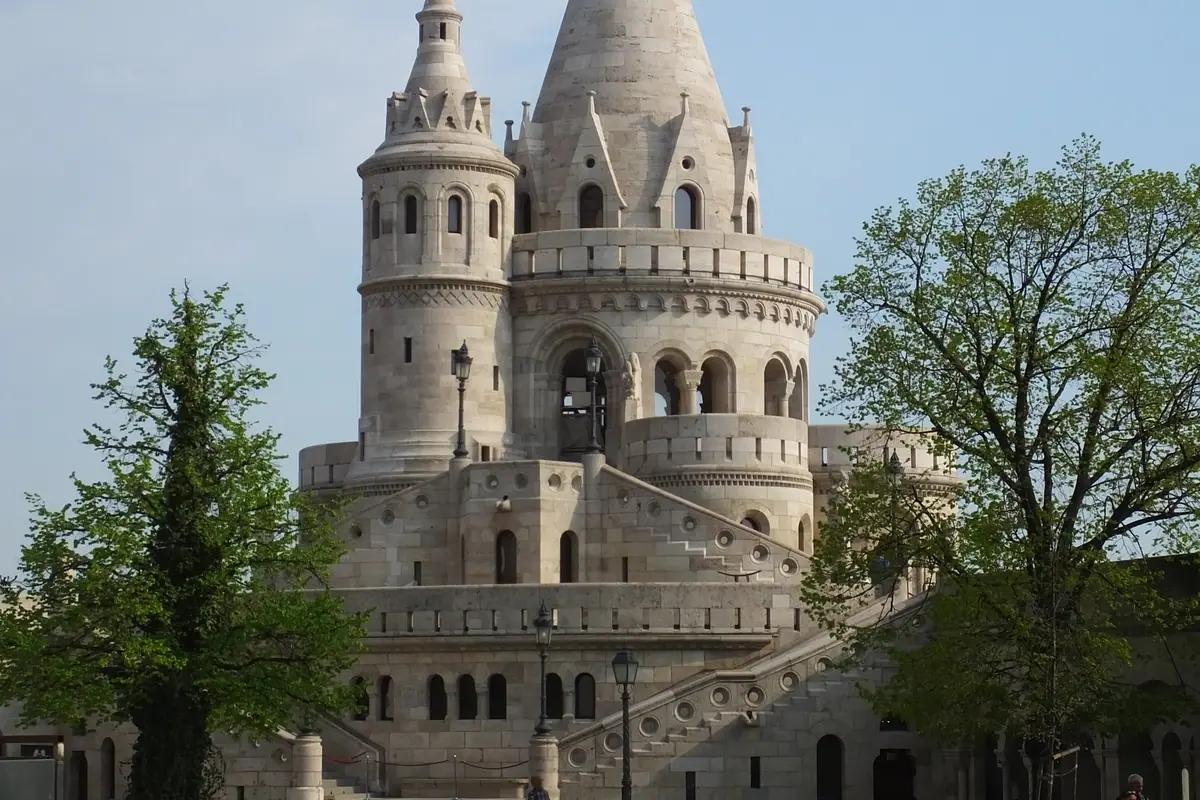
Budapest's essential sights are split by the river. On the Buda side, the Castle District crowns the hill: the Royal Palace, now home to galleries and a library, the old funicular, and the lace-like Matthias Church, its roof tiled in diamonds of green and orange. Behind it stands Fisherman's Bastion, seven conical towers representing the Magyar tribes, with the finest free panorama in the city across to the Parliament and down the Danube. Come at sunset for the light, or early morning to have the terraces almost to yourself; the walk up from Clark Ádám tér takes about fifteen minutes.
On the Pest bank, the Hungarian Parliament Building is the icon everyone photographs – a Gothic Revival fantasy of spires on Kossuth Square, best seen from a river boat or the Buda embankment at dusk, and best understood on a guided interior tour, which should be booked well ahead. Nearby, St Stephen's Basilica offers a lift and stairs to a dome terrace, Heroes' Square opens into the vast Millennium Monument flanked by the Museum of Fine Arts, and Andrássy Avenue runs back toward the river as a tree-lined World Heritage boulevard with the continent's oldest underground railway humming beneath it. The Dohány Street Synagogue, the largest in Europe, is a moving stop, its memorial garden marked by a metal weeping willow.
Allow two or three unhurried days for the city. Add the Danube promenade with its bronze shoes memorial, the climb to the Citadella on Gellért Hill for the classic postcard view, the musical fountain on Margaret Island in summer, and Vajdahunyad Castle in City Park, a playful pastiche of every architectural style in the country.
Thermal Waters and the Ritual of the Bath
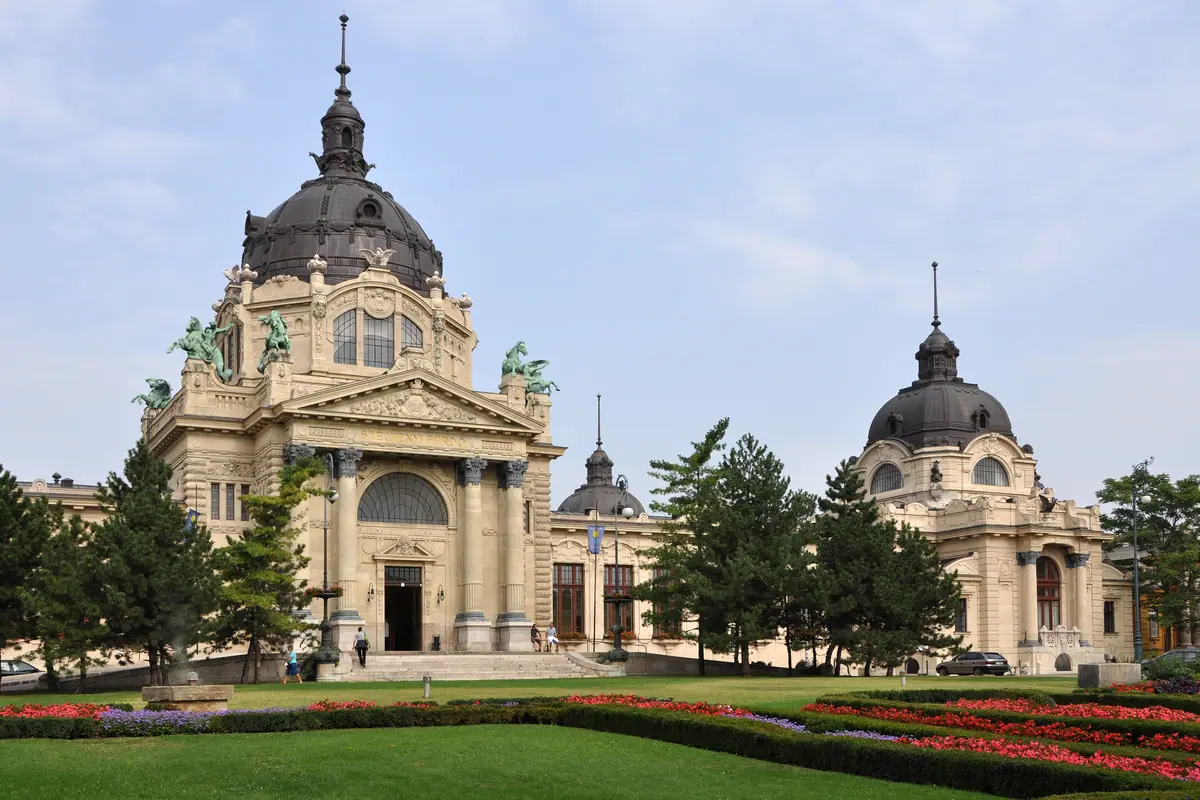
Hungary sits on a warm geological gift, and bathing here is a social institution rather than a spa treatment. Széchenyi, in City Park, is the grandest introduction: a butter-yellow neo-baroque palace of outdoor pools where steam rolls off the water in January and men play chess on a floating board. Gellért, on the Buda bank, is the ornate one, all mosaics, columns and stained glass. Rudas is the historic one – a sixteenth-century Ottoman octagonal pool under a domed skylight, with a rooftop hot tub looking over the river. Király, smaller and older still, hides behind an unremarkable facade near the boulevard.
Go with loose expectations and a few practicalities. Bring flip-flops and a towel if you want to avoid rental queues, use the lockers, and note that some pools require a swimming cap. Rudas keeps single-sex days through the week and opens to mixed bathing at weekends, so check before you go. Weekday mornings are calm; winter evenings, when the steam thickens and the air bites, are the most atmospheric of all. Outside Budapest, Lake Hévíz is the largest thermal lake in Europe, the cave bath at Miskolctapolca feels like swimming underground, and Eger retains Turkish-era baths from the same century as Rudas. Afterwards, do as locals do and eat soup.
Beyond Budapest: Wine Hills, the Great Plain and Ottoman-Tinged Towns
Two hours north-east, Eger is a baroque town of church towers, a slender Ottoman minaret and a castle that famously withstood siege in 1552. Below the vineyards lies the Valley of the Beautiful Women, a lane of rock cellars where growers pour Egri Bikavér straight from the barrel for a few coins. Further east, the Tokaj hills form a World Heritage wine landscape of volcanic slopes, towns like Mád and Tarcal, and damp stone cellars furred with a benign grey mould that helps make the famous sweet Aszú. Autumn harvest is the time to go, when the air smells of fermenting grapes.
Lake Balaton, Central Europe's largest lake, is Hungary's summer living room: shallow, warm, ringed with vineyards and volcanic cones. The Tihany peninsula on the north shore has an abbey on the hill and lavender fields in June, Badacsony produces crisp whites beneath its basalt peak, and the Festetics Palace at Keszthely anchors the western end. Come in June or September for swimming weather without August's crowds, and eat a fried lángos by the water like everyone else.
In the south, Pécs layers Roman tombs, a mosque converted into a church and the lustrous porcelain that bears its name; Szeged, further along the Tisza, is famous for its riverside fish soup and its domed square. East of the river, Hortobágy National Park is the country's great emptiness – a sweep of grassland and fish ponds with grey cattle, sweep wells, migrating cranes and some of the darkest night skies in Europe. Elsewhere, the basilica at Esztergom, the hilltop citadel at Visegrád and the palóc village of Hollókő, with its whitewashed cottages and Easter traditions, all make rewarding detours.
When to Go, What to Know and the Local Calendar
Late April to June and September to early October are the sweet spots: mild days, long light, wine festivals and no crush at the baths. July and August are genuinely hot, Budapest empties toward Balaton, and lake accommodation books out weeks ahead. Winter is cold and grey but rewarding – markets fill Vörösmarty Square and the plaza before St Stephen's Basilica with mulled wine and chimney cake, and the thermal pools are at their most magical. August 20 brings the country onto the riverbank for St Stephen's Day fireworks over the Danube, while September and October are given over to grape harvest celebrations in Eger, Tokaj and around the lake.
Practicalities are simpler than many visitors expect. The currency is the forint; cards work almost everywhere in cities, but keep cash for market stalls, village cellars and small-town bakeries. Tipping around ten to fifteen per cent is normal in restaurants. Hungarian is famously difficult, but jó napot (good day) and köszönöm (thank you) open doors. Trains and long-distance buses link the major towns comfortably, and Budapest itself is walkable, with the yellow metro line beneath Andrássy Avenue and trams rattling along both banks.
Give Budapest three days, then add a second base: Balaton and Tihany, or Eger with a Tokaj extension, or a night on the Great Plain. Book a castle-district walk, a cooking session built around goulash and stuffed cabbage, a wine cellar tasting in old stone, and at least one long, aimless soak in a thermal pool. That combination – kitchen, cellar, bathhouse, landmark – is the truest tour of Hungary you can assemble.
Frequently asked questions
Which Hungarian dishes should I try first?
Start with goulash soup (gulyás) and pörkölt with dumplings, then lángos from a market or lakeside stand, stuffed cabbage, fisherman's soup in Szeged or along the Danube, and chimney cake baked on a spit. Finish with dobos torta or somlói galuska, and try pálinka and a summer fröccs.
How many days do I need in Hungary?
Three full days cover Budapest's castle district, the Parliament area, the Great Market Hall and at least one thermal bath. A week lets you add Lake Balaton and Tihany, or Eger with the Tokaj wine hills. Ten days to two weeks allows Pécs, Szeged and Hortobágy National Park without rushing.
When is the best time to visit Hungary?
May, June and September are ideal for weather and wine festivals. July and August suit lake swimming but are hot and crowded at Balaton. December brings Christmas markets and beautifully steamy baths, and 20 August offers fireworks over the Danube in Budapest.
Do I need to book thermal baths in advance?
Not usually. Széchenyi, Gellért and Rudas accept walk-ins, though buying a timed ticket ahead saves queueing at weekends. Note that Rudas has single-sex days during the week and mixed bathing at weekends, and some pools require a swimming cap.
How do I get around Hungary without a car?
Trains and long-distance buses connect Budapest with Eger, Tokaj, Pécs, Szeged, Keszthely and the Balaton shore, generally in two to four hours. Within Budapest, trams, buses and the historic metro line 1 cover the main sights, and the city centre is easily walked.
Sort the rest of your trip
Everything for Hungary, in one place
Stay in Hungary
Hotels, guesthouses and apartments — compared in one search.
Search hotels
Transfer in Hungary
Private driver waiting on arrival — no queues, no surprises.
Book a transfer
Stay online in Hungary
Travel eSIM — data the moment you land, no roaming bills.
Get an eSIMMore guides in Hungary
Where to Stay in Hungary: Hotels and Must-See Sights from Budapest to Lake Balaton
Top Things to Do in Hungary: Must-See Landmarks and Sights
7 Days in Hungary: The Ultimate One-Week Itinerary from Budapest