Cameroon packs desert, rainforest, volcanic peaks and highland kingdoms into a single country, and where you sleep shapes what you get to see. This guide maps the country's main hotel bases, from the business towers of Douala to safari camps on the edge of Waza, and pairs each one with the landmarks worth building a trip around.
How Cameroon's Hotel Map Actually Works
Cameroon runs on two very different accommodation circuits. Douala and Yaoundé hold almost all of the international-standard hotels — the kind with reliable power, air conditioning, pools, business centres and Wi-Fi that mostly works. Everywhere else, you are choosing between family-run guesthouses, colonial-era rest houses, church-run lodgings, small coastal resorts and seasonal safari camps. That is not a problem, it is part of the appeal: the best nights of a Cameroonian trip are often in a simple highland auberge with a mountain view and a plate of grilled fish, not in a glass lobby.
The country divides geographically into distinctly useful bases. Douala is the commercial capital and main aviation gateway; Yaoundé is the political capital and the calmer, greener city; Kribi and Limbe are the coast, with volcanic black sand and waterfalls spilling into the sea; Buea is the launch pad for Mount Cameroon; the Grassfields towns of Bafoussam, Bamenda and Foumban are the kingdom-and-craft heartland; and Garoua and Maroua are the gateways to the Far North's savannah parks. Plan your route around these hubs rather than trying to see everything in one loop — internal road journeys are long and slow, so an overnight stop is usually smarter than a marathon drive.
When you book, ask three questions before committing: does the room have air conditioning, does the property run a backup generator, and does it have a water tank? In the south especially, rain and grid fluctuations can rattle an otherwise lovely hotel. Bring CFA francs in cash for anywhere outside the two big cities; card readers exist but may be offline. In the dry months from December to February, and during the Mount Cameroon race and the northern safari season, rooms in the popular spots sell out weeks ahead.
Douala: Business Hotels and the Colonial Waterfront
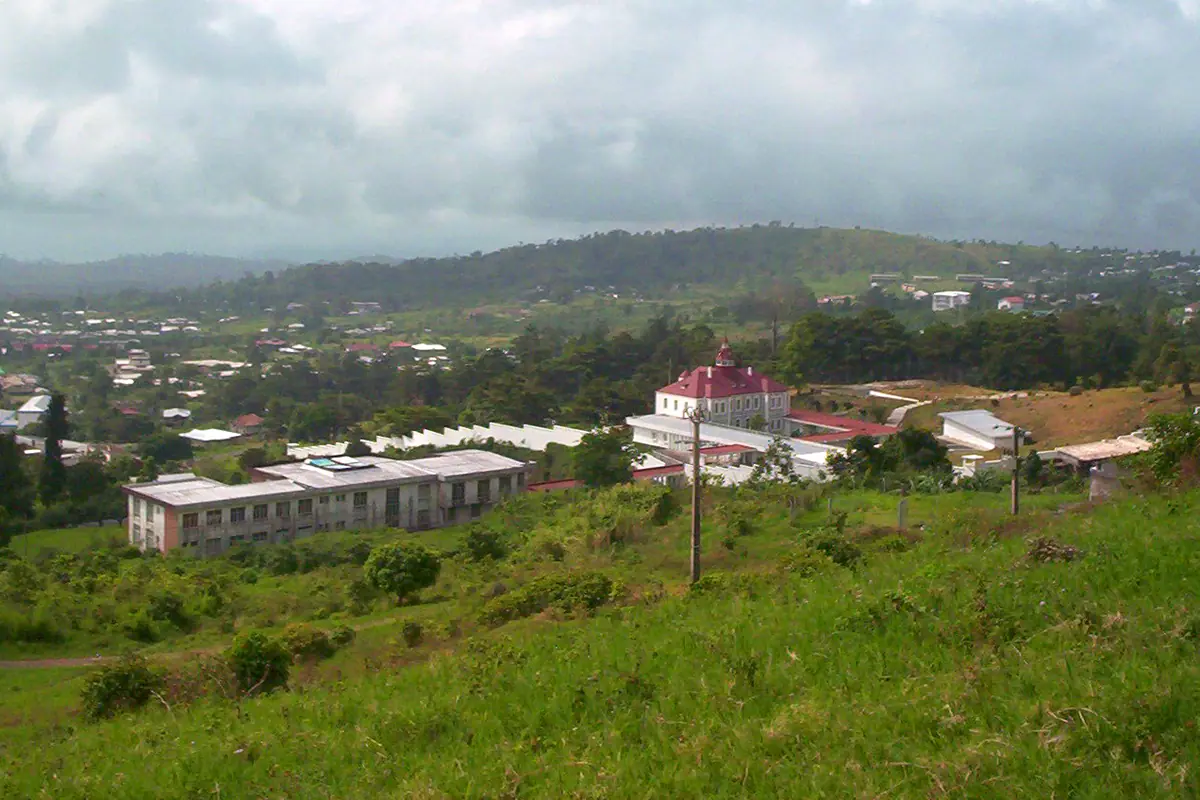
Most journeys begin in Douala, the humid, fast-moving port city where Cameroon does business. The choice of neighbourhood matters more than the hotel's star rating. Bonanjo, the old administrative quarter, has the most character — grand German-era buildings, wide avenues and the Palais des Rois Bell, the long-time seat of the powerful Bell kings, plus the city's maritime museum nearby. Bonapriso is the polished restaurant-and-boutique district, the most comfortable base for a short stay. Akwa, around the central market and the bus stations, is cheaper, noisier and much closer to how daily life actually works.
Douala rewards a half-day of wandering between meetings. Walk the Marché des Fleurs for spices, fabric and street food, cross to the Cathedral of Saints Peter and Paul, and drive out to Deïdo to see La Nouvelle Liberté, the towering scrap-metal sculpture that has become the city's emblem. The waterfront along the Wouri estuary is best at dusk, when the fishing boats come in and the heat finally breaks.
The city is also the best jumping-off point for the coast: Limbe and its botanical garden are roughly an hour and a half away by road, and Kribi about three hours. If you are heading south, consider spending your last Douala night near the airport to avoid the notorious bridge traffic. If you are heading inland, know that the Melong road towards Ekom-Nkam Falls and the western highlands is mountain scenery at its most dramatic.
Yaoundé: Hilltop Views, Museums and Calmer Rooms
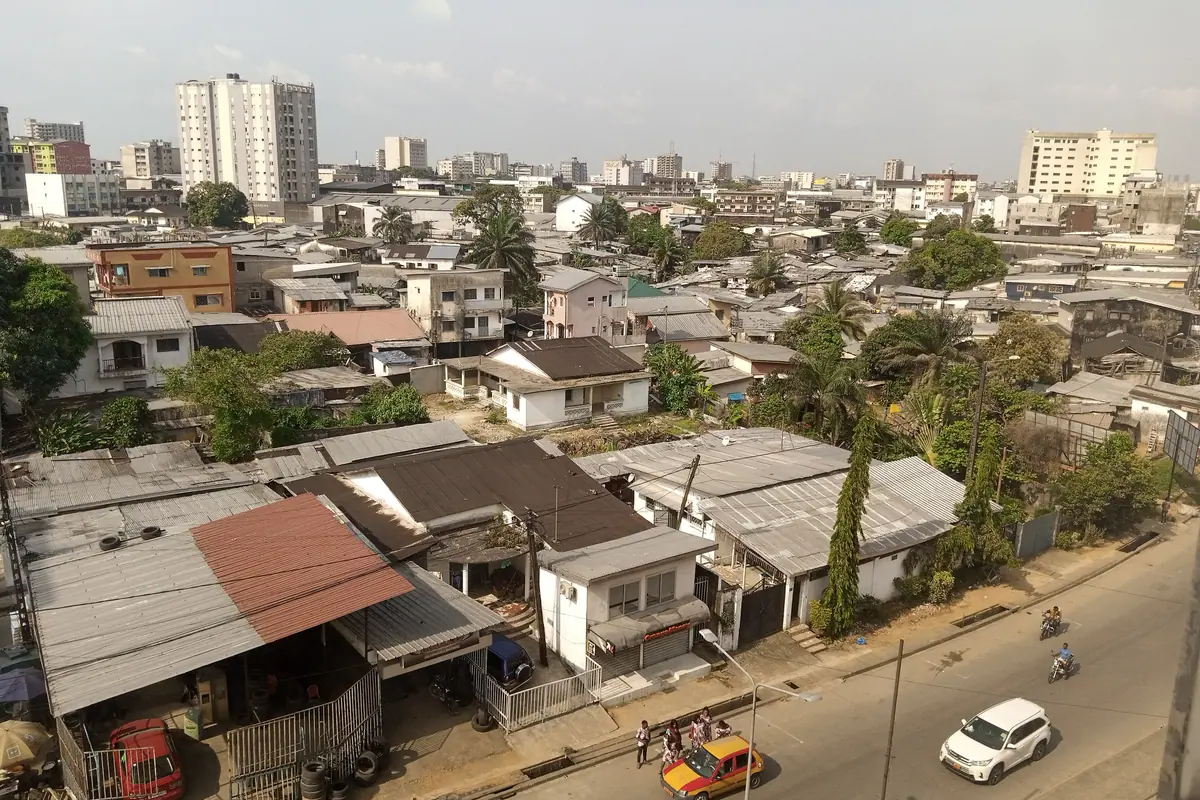
Yaoundé sprawls across seven hills and feels noticeably cooler and slower than Douala. The best hotel zones are the centre-ville, where you can walk to the main sights; Bastos, the leafy diplomatic quarter with the largest concentration of comfortable international hotels and good restaurants; and the hills around Mont Fébé, where the reward is an evening panorama over the whole city. Mvog-Ada and Nlongkak are the budget-friendly equivalents, handy for the bus stations and central markets.
Yaoundé's must-sees are close together. Start at the Musée National du Cameroun, housed in a former presidential palace, where the royal regalia, masks and Grassfields beadwork give you the cultural grounding for the rest of the trip. Then climb to Mvolyé for the Basilica of Mary Queen of Apostles, a landmark pilgrimage church with a sweeping view, and continue to the Mont Fébé lookout for the classic city panorama. In the centre, the Palais de l'Unification and the Bois Sainte Anastasie make an easy walking circuit, while Mvog-Betsi Zoo is a good introduction to the country's primates and forest species.
Markets are the other draw: Mokolo for sheer scale and noise, and the central market for produce and crafts. Day trips are worthwhile if you have a spare day — the Ekom-Nkam Falls near Melong, where the river drops more than 80 metres into a rainforest gorge, is one of the country's most cinematic sights, and the Nachtigal Falls are closer to the city.
Kribi, Limbe and Mount Cameroon: Coast and Volcanic Peaks
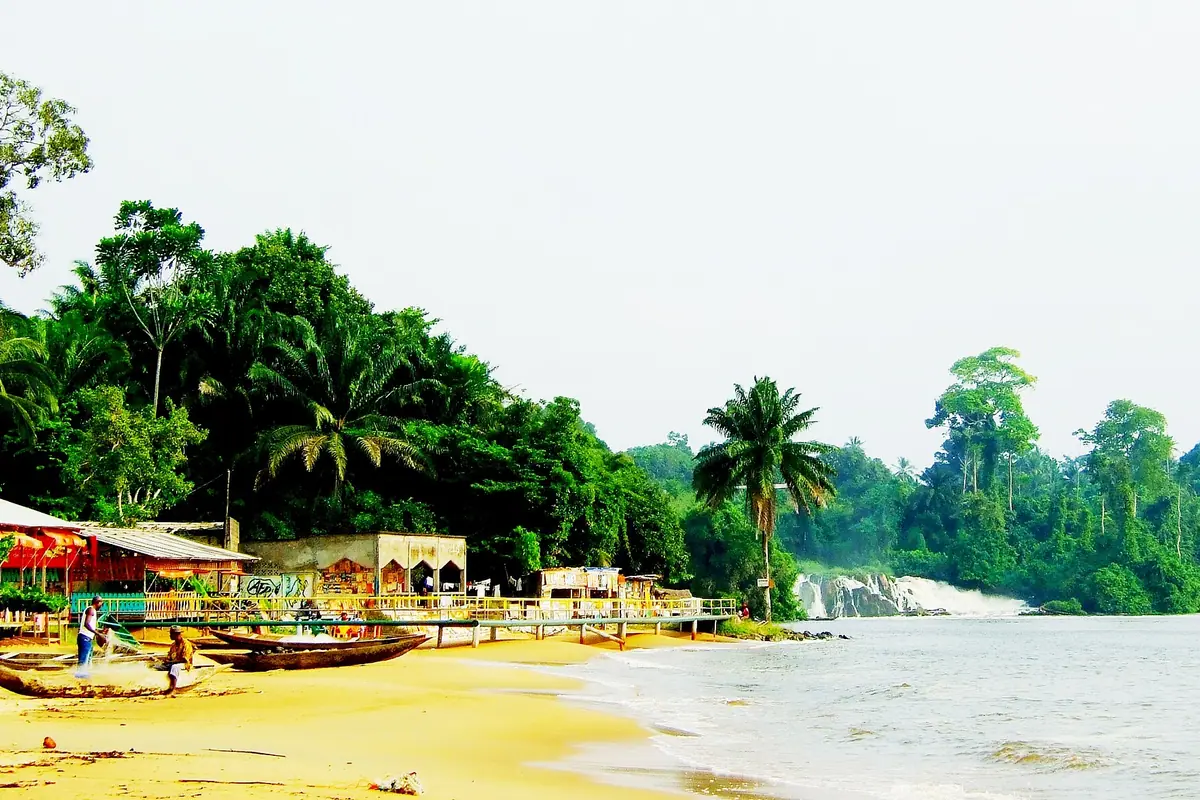
The southern coast is where Cameroonians go on holiday, and the hotel stock reflects it: small beach resorts strung along the sand at Kribi and its quieter neighbours Grand Batanga and Campo, plus a handful of rainforest lodges near Campo Ma'an National Park, where forest elephants and lowland gorillas still move through the trees. Kribi's signature sight is the Chutes de la Lobé, a waterfall that pours directly into the Atlantic — you can walk to the base when the water is low and eat grilled fish on the beach beside it. South of town, the Campo Ma'an reserve is best explored with a local guide and a 4x4.
Further west, Limbe sits beneath Mount Cameroon on black volcanic sand, with the Limbe Botanic Garden — laid out in the late nineteenth century and still a living collection of regional plants — as its gentlest attraction. Nearby Bimbia holds the remains of a historic slave-trading site, a sobering and important stop. Buea, perched on the mountain's lower slopes, is the base for climbing Mount Cameroon, a still-active volcano rising to around 4,095 metres. The standard ascent takes two to three days with a guide and porters, best from December through April; the annual race to the summit in February fills every room in town.
Expect simple comfort here rather than polish: ceiling fans, mosquito nets, cold beer on a terrace, and staff who will happily arrange a driver or a boat. Bring reef shoes for the volcanic sand and a light rain shell year-round. The heaviest rains arrive between June and October in the coastal southwest, which is also when room rates and crowds drop.
The Grassfields: Foumban, Bafoussam and Bamenda
The western highlands are Cameroon at its most culturally rich, a patchwork of kingdoms where each town has its own palace, its own dialects and its own festivals. Foumban is the standout: the Sultan's Palace and its attached museum hold throne rooms, ceremonial robes and centuries of royal craft, and the surrounding streets are full of workshops producing brass, embroidery and the famous Foumban gown. Bafoussam is the busy market hub and transport crossroads, while Bamenda, higher and cooler, has the best range of guesthouses in the region.
From Bamenda you can reach the Ring Road, a spectacular loop of mountain villages, and the traditional palace compound at Bafut, one of the best-preserved in the country. Lake Awing, Menchum Falls and the terraced hills around Ndop all make worthwhile day trips. The chief's palace at Bandjoun, between Bafoussam and Bafoussam's southern approach, adds another layer of royal architecture and carving to the itinerary.
Accommodation in the highlands is mostly modest: guesthouses, church-run rest houses and a few small hotels clustered around town centres. Nights are cool at this altitude, so ask for extra blankets, and confirm whether hot water is available — it often is not. The dry season from November to February offers the clearest views and the easiest road conditions, and the region's cultural festivals tend to fall in that window.
The Far North: Garoua, Maroua and Waza National Park
The Far North is Cameroon's safari country, a dry plain of acacia, floodplain and inselbergs that feels closer to the Sahel than to the rainforest south. Garoua is the main northern city and the most practical base for Bénoué National Park, where you can drive among hippos, antelope and rich birdlife along the river. Maroua, further north, is the gateway to Waza National Park, the country's flagship reserve and the best place in Cameroon to see elephants, giraffes and lions in the same day, particularly in the late dry season from February to April when wildlife concentrates around water.
Beyond the parks, the north holds landscapes that few visitors expect. The Kapsiki peaks around Rhumsiki rise in jagged volcanic plugs above terraced farms, with traditional diviners still practising in the villages and the distant Mandara Mountains forming the horizon. Lake Chad's Cameroonian shore, near Kousséri, adds a wholly different ecosystem of wetlands and fishing communities. Kalamaloué National Park, close to Maroua, is a compact introduction if your time is short.
Hotels here are straightforward — clean rooms, fans or air conditioning, a courtyard restaurant, and staff who know the park gates and can arrange a vehicle and guide. Book through your accommodation rather than turning up at the gates. Nights can be surprisingly cold in December and January, so pack a fleece alongside your sun hat. Because conditions in this border region can change, check current travel guidance before you commit and travel with a reputable local operator.
Frequently asked questions
When is the best time to visit Cameroon?
The dry season from November to March suits most of the country, and it is the only realistic window for the Far North's national parks such as Waza, where wildlife concentrates around water from February to April. The southern coast gets heavy rain between June and October. For climbing Mount Cameroon, aim for December through April.
Do I need to speak French to get around Cameroon?
Both English and French are official, but French dominates in Douala, Yaoundé, the west and the Far North, while English is widely spoken in the northwest and southwest regions. A few polite French phrases make a real difference with taxi drivers, market traders and hotel staff outside the anglophone areas.
How do I travel between Cameroon's cities and hotel bases?
Long-distance buses and shared taxis connect most towns, and domestic flights link the main southern cities with the north. Journeys are slow, so plan overnight stops rather than long single-day drives. For multi-stop itineraries, hiring a car with a local driver is the most comfortable and safest option.
What should I expect from hotel facilities in Cameroon?
In Douala and Yaoundé you can expect international-standard rooms, air conditioning, pools and reliable generators. Elsewhere, expect simple comfort: fans, mosquito nets, occasional water shortages and Wi-Fi that comes and goes. Cash in CFA francs is essential outside the big cities, and it is wise to confirm hot water and generator backup when booking.
How long should I spend in Cameroon to see the highlights?
Two weeks is a sensible minimum. A typical route gives three or four nights to Douala and Yaoundé combined, two to three nights on the Kribi or Limbe coast, three to four days in the Grassfields around Foumban and Bamenda, and four to five days in the north for Waza and Rhumsiki. Add extra days if you plan to climb Mount Cameroon.
Sort the rest of your trip
Everything for Cameroon, in one place
Transfer in Cameroon
Private driver waiting on arrival — no queues, no surprises.
Book a transfer
Things to do in Cameroon
Skip-the-line tickets, guided tours and standout experiences.
See experiences
Stay online in Cameroon
Travel eSIM — data the moment you land, no roaming bills.
Get an eSIM