Few places on earth pack so much into so little: a basilica that redefined architecture, a chapel ceiling that redefined painting, and a square built to embrace the world. Vatican City is small enough to cross on foot in twenty minutes and rich enough to fill a week. The trick is knowing what to see first — and when to walk through the doors.
St. Peter's Square and the Basilica: The Essential First Stop
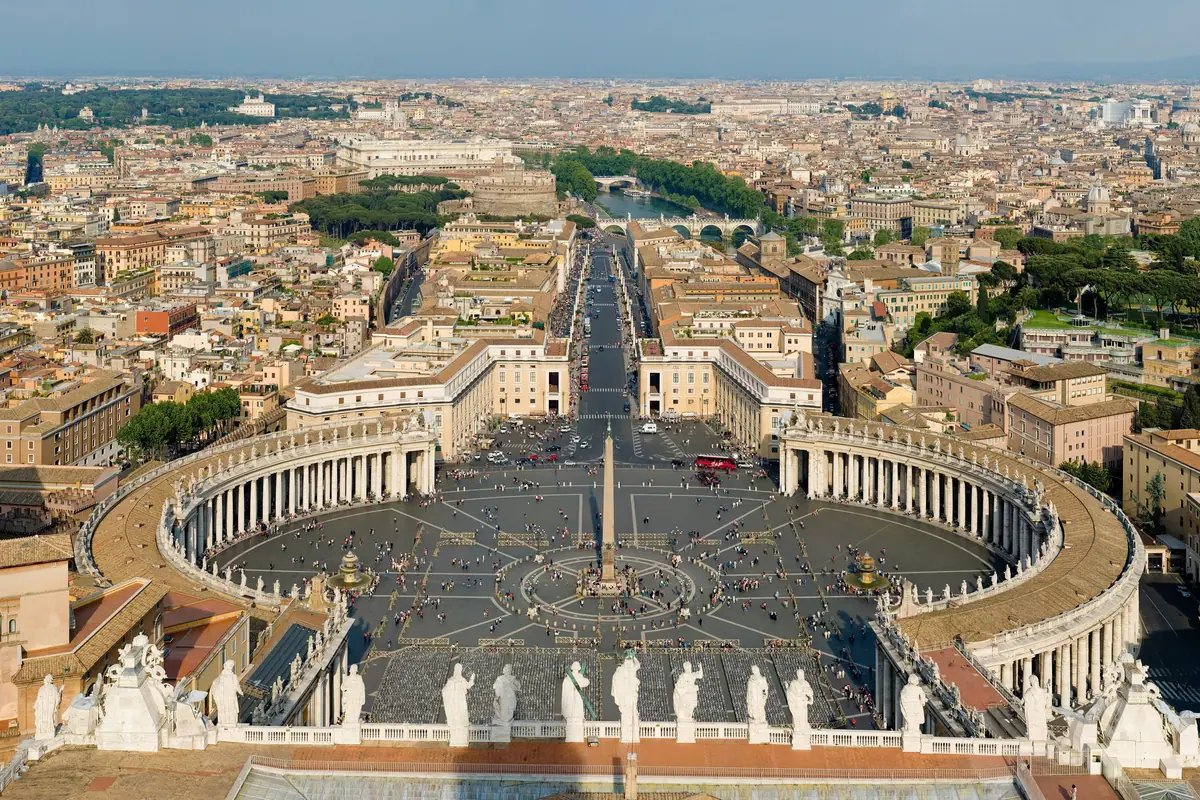
Bernini's colonnade wraps the square in four rows of travertine, 284 columns and 88 pilasters topped by 140 statues of saints, with the Vatican obelisk standing at the centre where it was raised in 1586. Two fountains face each other across the ellipse, and a pair of paving stones near the obelisk mark the focal points of the ellipse's geometry — stand on one and the colonnade appears as a single row of columns. Come before 8am and you get the square nearly empty, with the light raking across the basilica's facade and the cleaners still hosing the cobbles.
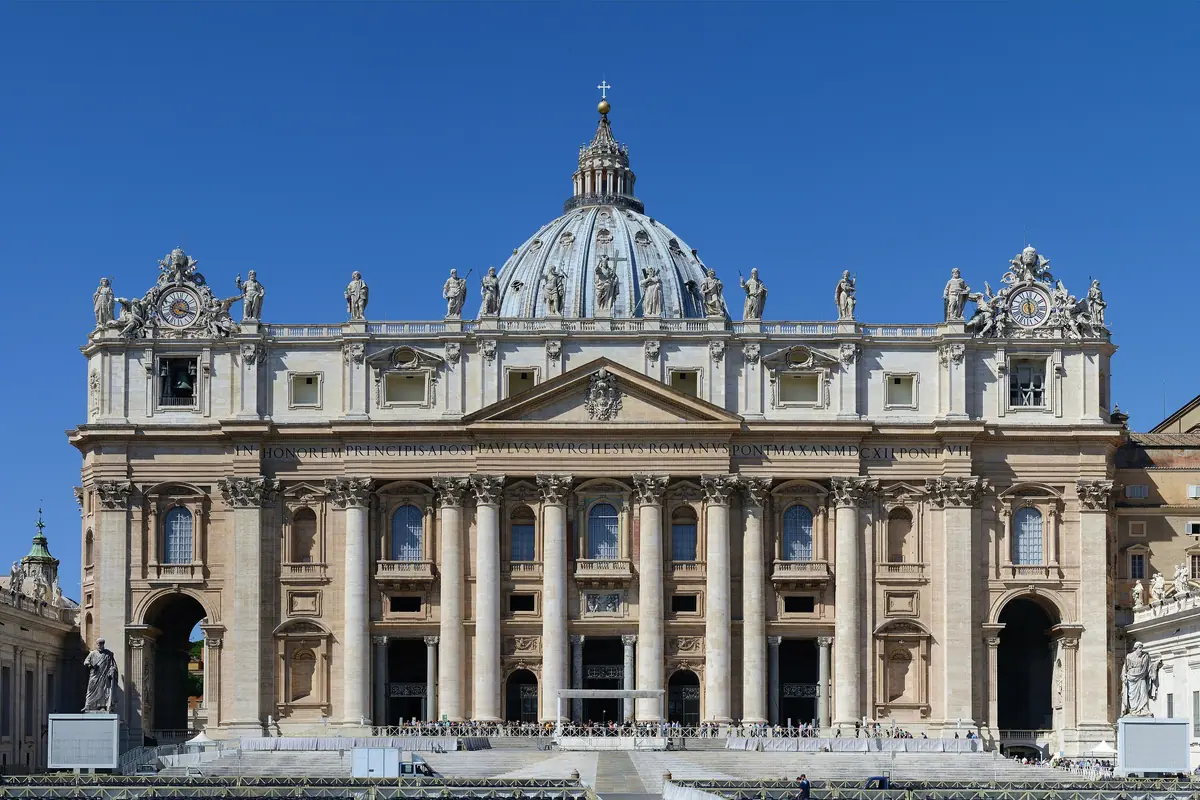
Inside St. Peter's, the scale takes a moment to register. Michelangelo's Pietà sits behind glass in the first chapel on the right, carved when he was in his early twenties. Above the papal altar rises Bernini's bronze baldachin, nearly 29 metres of twisted columns, and further back in the apse is his Chair of St. Peter, framed by alabaster and gilded stucco. Look for the brass markers on the floor showing how other great churches would fit inside — a reminder that this nave is taller than most cathedrals.
Entry to the basilica is free, and the doors generally open at 7am, closing around 7pm from April to September and 6:30pm from October to March. Everyone passes through a security screening, and the queue can stretch around the square by mid-morning. On Wednesday mornings the basilica closes to tourists during the papal audience, so plan around it. Downstairs, the Vatican Grottoes hold the tombs of recent popes, and the Treasury Museum adds vestments, reliquaries and a very old bronze chair.
The Vatican Museums: Raphael Rooms, the Gallery of Maps and the Sistine Chapel
The museums run through 54 galleries and roughly seven kilometres of displays, so treat them as a half-day at minimum. The Pio-Clementino collection sets the tone with the Laocoön and His Sons, the Apollo Belvedere and the muscular Belvedere Torso, while the long Museo Chiaramonti corridor stacks more than 3,000 sculptures along its walls. Most visitors rush the first stretch, then wonder why they are exhausted by the Raphael Rooms.
Raphael's frescoed chambers are the intellectual heart of the visit: the School of Athens, with Plato and Aristotle at the centre and a brooding Michelangelo in the foreground; the Disputa; Parnassus. Beyond them, the Borgia Apartments, the Gallery of Tapestries and the Gallery of Maps — forty painted panels of Italian regions and ports, commissioned in the 1580s — funnel visitors toward the Sistine Chapel.
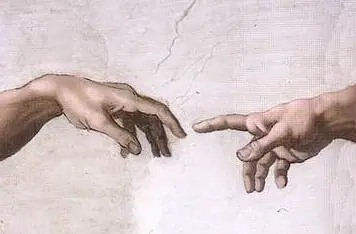
Michelangelo's ceiling, painted between 1508 and 1512, and the Last Judgment on the altar wall, completed in 1541, are best studied slowly: the Creation of Adam, the Delphic Sibyl, the ancestors of Christ along the lunettes. Earlier frescoes by Botticelli, Perugino and Ghirlandaio line the side walls at eye level. Photography is banned and silence is requested, enforced by guards who shush without much charm. Late afternoon entry is calmer than the opening rush; the free last-Sunday-of-the-month admission draws enormous queues, and Friday evening openings in the warmer months are the connoisseur's slot.
Climb Michelangelo's Dome for the Best View in the City
The dome is a separate climb from the basilica, and it is the single most rewarding effort in Vatican City. From ground level it is 551 steps; you can also take a lift to the roof, which trims the total to around 320 steps but does not skip the final spiral. Between the two shells of the dome you walk a curving corridor and pass close enough to the mosaics and the inscription band to read them, at an angle no photograph prepares you for.
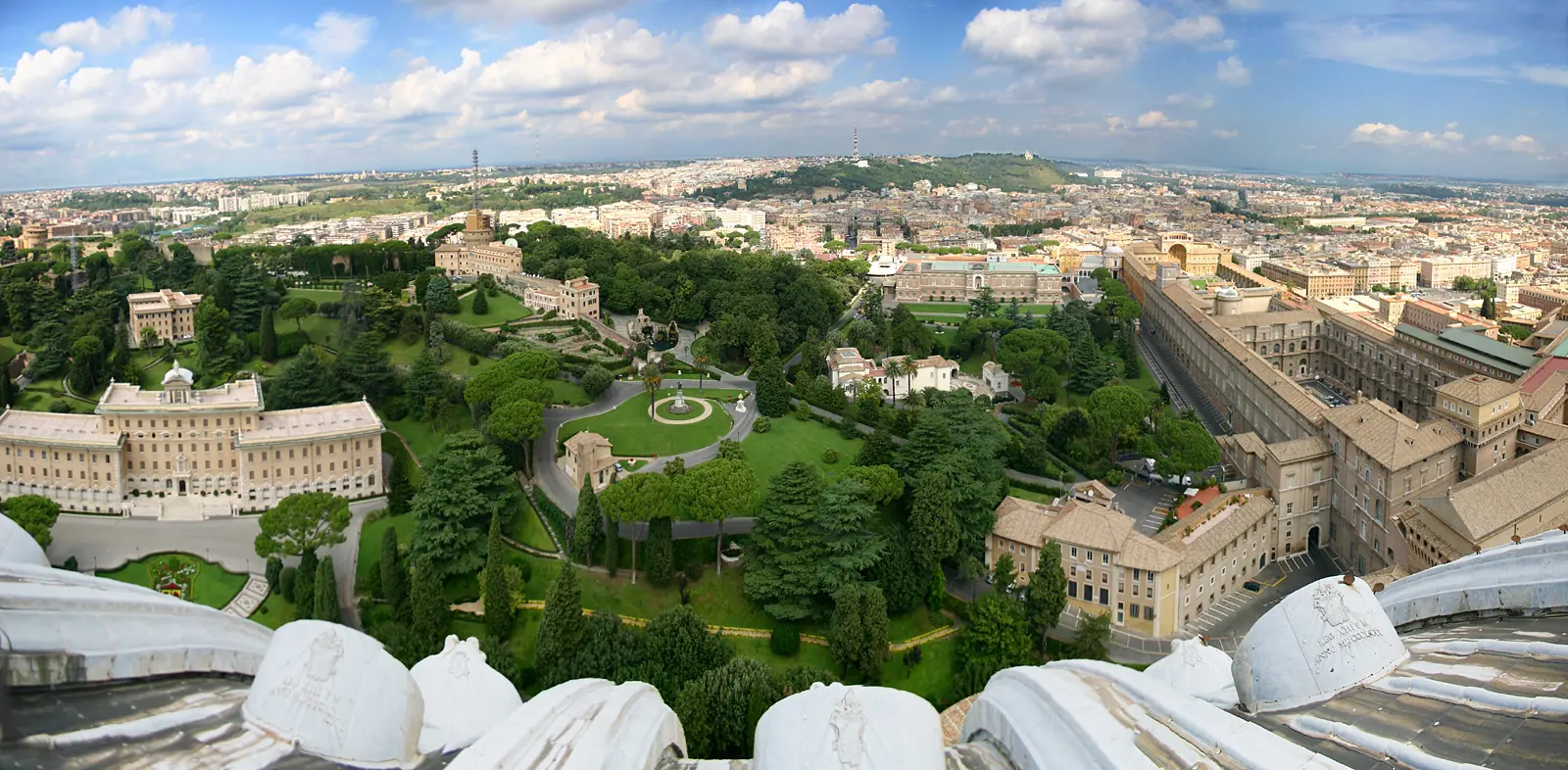
From the lantern at the top, the whole state unfolds below: St. Peter's Square like a keyhole, the Vatican Gardens with their clipped hedges and fountains, the Tiber, Castel Sant'Angelo, the Janiculum hill and, on clear days, the Alban Hills. The dome was finished after Michelangelo's death, and standing at its base you can see where later hands carried out his design.
Go at opening time or in the final hour before closing, when the light softens over the city. The stairways are narrow and lean with the curve of the dome, so anyone uneasy in tight spaces should think twice about the final stretch. There is no lift to the very top, and the climb closes in high wind or heavy rain.
Beneath the Floor: The Scavi and the Vatican Necropolis
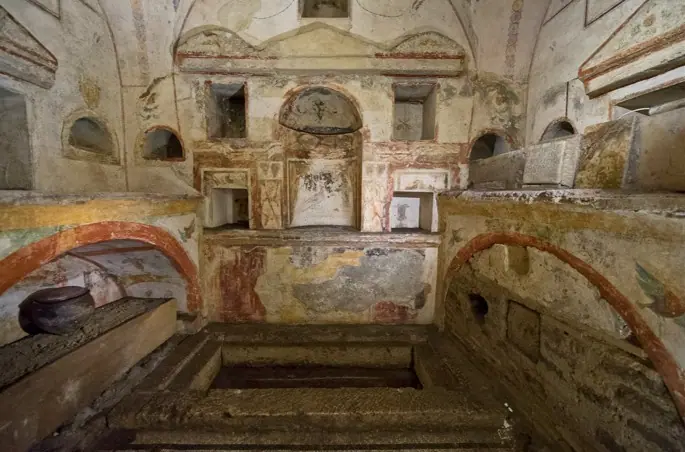
Under the basilica lies a Roman necropolis, uncovered during excavations begun in the 1940s. A side road once led toward Nero's circus, and along it wealthy families and freed slaves built tomb chambers between the first and third centuries — pagan mausoleums with stucco ceilings and mosaics, Christian burials with scratched prayers, all still standing in the dark. At the centre of it is the aedicula, the small monument traditionally identified as the tomb of St. Peter, built against a red-plastered wall carrying a Greek inscription.
Access is tightly controlled: small groups, roughly a couple of hundred visitors a day, and reservations made months ahead directly with the excavation office that administers the site. Visitors enter near the left side of the basilica's portico, descend about four metres, and walk on raised platforms through a warm, humid corridor. There is a minimum age for the visit, a strict dress code, and no photography.
If you cannot get a place, the Vatican Grottoes directly beneath the basilica floor are the fallback — a free, quiet passage past the tombs of recent popes and the Clementine Chapel, near the traditional site of the apostle's remains. Even without the archaeology, it is a striking way to leave the noise of the square behind.
Vatican Gardens, the Pinacoteca and the Collections Most People Skip
The Vatican Gardens cover nearly half the city-state, and they are only reachable on a guided tour — usually by open bus, sometimes on foot. The route passes the Fontana dell'Aquilone, the Casina Pio IV with its stuccoed facade, a replica of the Lourdes grotto, and the small railway station and track that make this the shortest national rail network in the world. It is the one corner of the Vatican where you get peace, trees and a view back at the dome from behind.
The Pinacoteca, or picture gallery, is the politely ignored gem. Eighteen rooms hold Raphael's Transfiguration, Caravaggio's Entombment, Leonardo's unfinished St. Jerome and Giotto's Stefaneschi Triptych, all in air-conditioned calm that most tour groups never reach because they are hurrying toward the Sistine Chapel. Give it an hour and you will have seen masterpieces without a single elbow in your back.
If you have time left, the Gregorian Egyptian Museum and the Etruscan Museum add a completely different register, and the carriage pavilion is a curious detour into papal transport. Then there is the Vatican post office, where you can send a postcard franked with Vatican stamps, and the Campo Santo Teutonico, a walled German cemetery and church just off the square that few visitors notice.
Timing, Dress Codes and Seeing the Pope
The best months are April to June and late September to October, when temperatures sit in the comfortable range and the light is good. July and August bring heat that turns the museums into a slow-moving queue, and November to February is quieter but often wet and cold. During a Holy Year, expect elevated crowds and occasional one-way routes through the basilica.
The museums close on most Sundays, reopening free of charge on the last Sunday of the month — a wonderful gesture and an exhausting experience, with queues that can wrap around the walls before opening. Catholic holidays also close the doors: New Year's Day, 6 January, 11 February, Easter Sunday and Monday, 1 May, 29 June, 15 and 16 August, 1 November, 8 December and Christmas. Tuesday and Thursday mornings after the first hour, or any afternoon after 3pm, are the sweet spots.
Wednesday mornings are devoted to the general audience, which takes place in St. Peter's Square in good weather and indoors in winter; free tickets are needed and the basilica stays shut to ordinary visitors until it ends. On Sundays at noon, the Angelus is led from a window above the square — no ticket, just turn up and stand with the crowd. Whatever the day, cover shoulders and knees, remove hats indoors, and leave large backpacks, tripods and anything with a spike at home; security screening is thorough.
Getting there is easy on the metro to Ottaviano or Cipro, followed by a ten- to fifteen-minute walk, or on foot along Via della Conciliazione from Castel Sant'Angelo, which gives you the classic approach — the dome growing larger with every step.
Frequently asked questions
How long do you need for the Vatican Museums and the Sistine Chapel?
Budget three to four hours as a bare minimum, and half a day if you want to include the Raphael Rooms, the Gallery of Maps and the Pinacoteca without sprinting. Many visitors split the Vatican over two days: museums and Sistine Chapel one morning, the basilica and dome the next.
Is St. Peter's Basilica free to enter?
Yes, entry to the basilica is free, though you still pass through a security queue. The dome climb, the Treasury Museum and the Vatican Grottoes are separate, and the Scavi tour beneath the basilica must be reserved well in advance with the excavation office.
What should I wear to visit Vatican City?
Shoulders and knees covered, for both men and women, and no hats inside the basilica or chapel. Sandals are fine, but beachwear, shorts above the knee, sleeveless tops and very short skirts can get you turned away at the door, particularly in summer.
What is the best day and time to visit?
Tuesday and Thursday are usually the calmest weekdays. Avoid Wednesday mornings, when the papal audience closes the basilica to tourists, and avoid the free last Sunday of the month unless you enjoy crowds. Enter the museums at opening or after 3pm for the lightest traffic.
Can you see the Pope without a formal tour?
Often, yes. The Wednesday general audience requires a free ticket requested in advance, while the Sunday noon Angelus from the window above St. Peter's Square is open to anyone who shows up. Arrive early for a spot near the front of the square.
Plan it — experiences in Vatican City
Live search, booked directly with trusted providers.
Sort the rest of your trip
Everything for Vatican City, in one place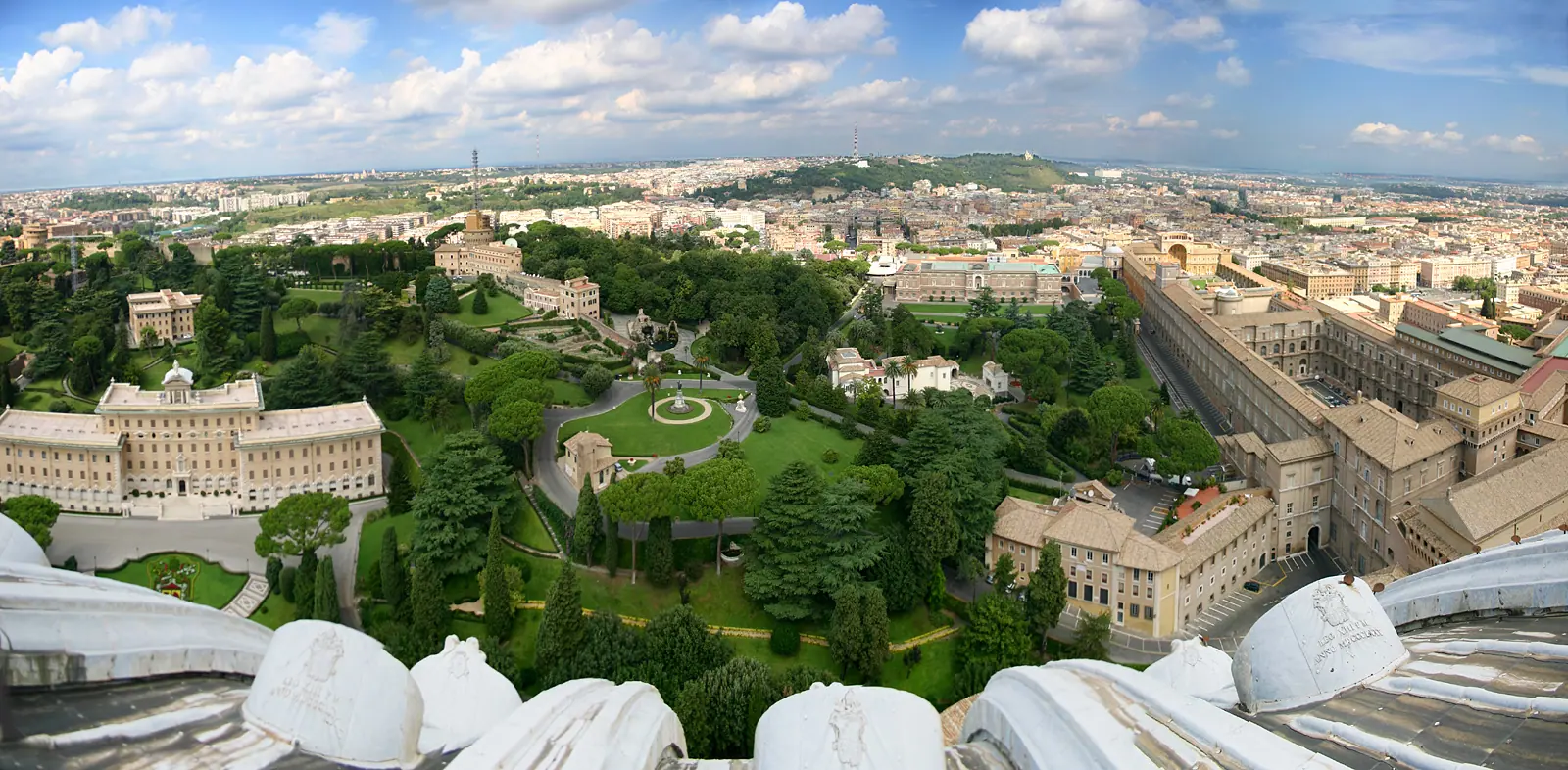
Stay in Vatican City
Hotels, guesthouses and apartments — compared in one search.
Search hotels
Transfer in Vatican City
Private driver waiting on arrival — no queues, no surprises.
Book a transfer
Stay online in Vatican City
Travel eSIM — data the moment you land, no roaming bills.
Get an eSIM