Chile is a country shaped like a dare: 4,300 km of coastline, deserts that bloom, glaciers that calve into milky lakes, and an island in the Pacific guarded by stone giants. The trick is not deciding whether to go, but accepting that you cannot see it all in one trip.
Santiago and the Central Valley: The Gateway Everyone Underestimates
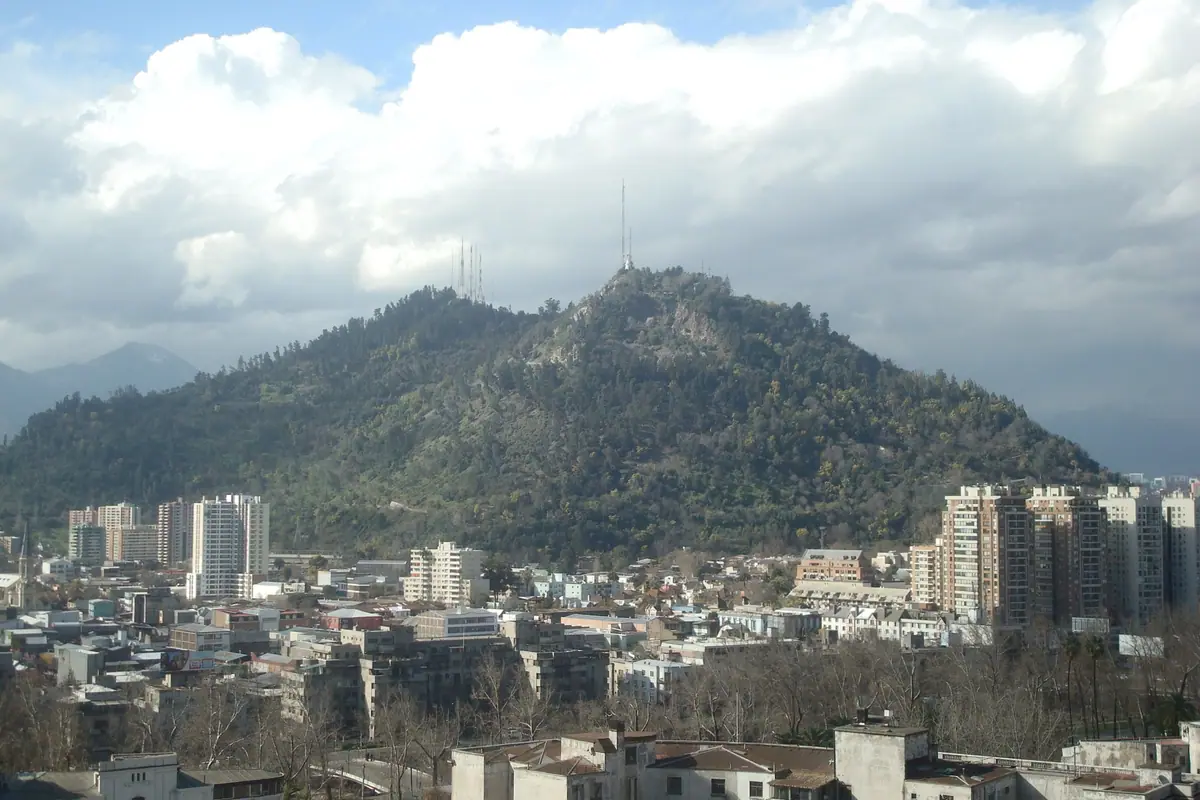
Most journeys begin in Santiago, a city wedged between the coastal range and the snow-capped Andes, where you can ski in the morning and drink cool-climate wine in the afternoon. Start at the Plaza de Armas, the colonial heart, and walk the few blocks to La Moneda, the presidential palace, then ride the historic funicular up Cerro San Cristóbal for the classic panorama of the city under the mountains. The Sky Costanera observation deck on the Gran Torre Santiago offers a sharper, glassier version of the same view, best about an hour before sunset.
Give the city two or three days, then use it as a launchpad. In Bellavista you can visit La Chascona, one of Pablo Neruda's wildly eccentric houses, and eat seafood at the Mercado Central. Day trips reach the Cajón del Maipo and the turquoise Embalse El Yeso reservoir, roughly two hours out, while the ski resorts of Valle Nevado and Portillo operate from June to August. The Maipo Valley wine estates south of town make an easy half-day, with harvest — roughly March to April — the most atmospheric time to go.
Spring (September to November) and autumn (March to May) are the sweet spots: mild days, clear air and fewer crowds than the hot, dry summer months of December through February.
Valparaíso and the Coast: Staircases, Street Art and Sea Air
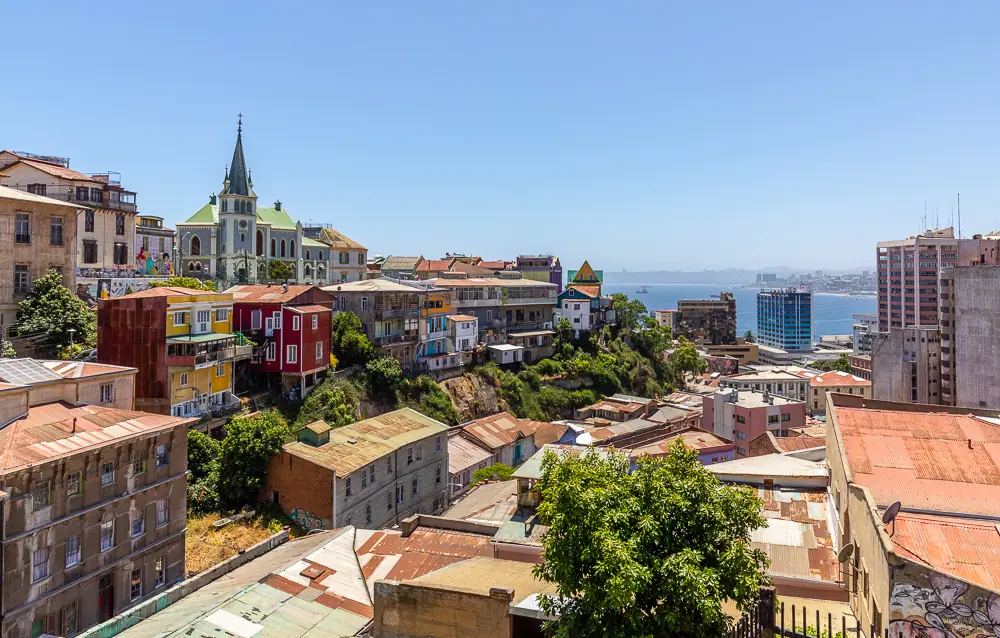
An hour and a half from the capital, Valparaíso tumbles down a series of steep hills toward the Pacific in a chaos of corrugated iron, murals and laundry lines. This is a port city built for wandering rather than ticking off: ride one of the old ascensores — the creaking funicular lifts — up to Cerro Alegre and Cerro Concepción, then follow the painted staircases between cafés, galleries and crumbling mansions. La Sebastiana, another Neruda home, sits high on Cerro Bellavista with a view that explains his obsession with the city.
Below, the bay is busy with fishing boats and container ships, and you can take a short launch tour of the harbour before heading along the coast to Viña del Mar and the sand dunes at Concón. Inland, the Casablanca Valley produces some of the country's best Sauvignon Blanc and Chardonnay, thanks to cool morning fog rolling in off the ocean; several estates welcome visitors for tastings without an appointment.
If you have time, continue down the coast to Isla Negra, where a third Neruda house faces the surf in a village of black rock and breakers. Stay overnight in Valparaíso rather than day-tripping — the city's faded, energetic evenings are the point.
The Atacama Desert: Salt Flats, Geysers and Impossible Skies
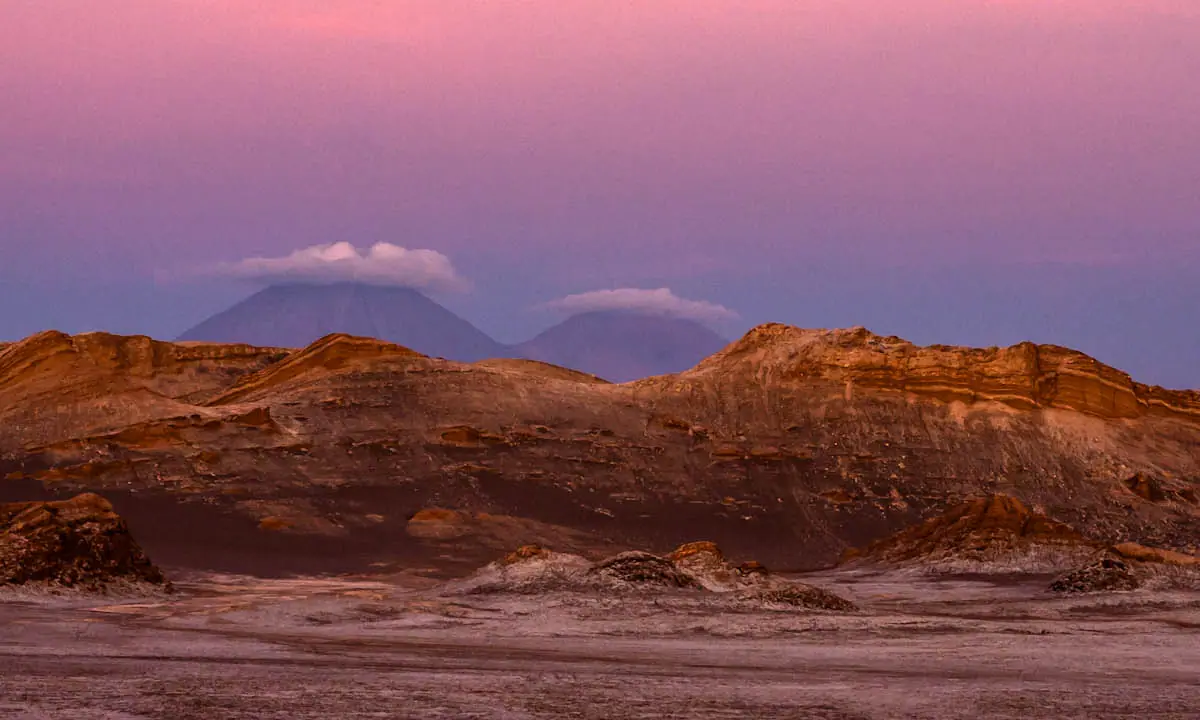
In the far north, San Pedro de Atacama is a low, whitewashed oasis town at around 2,400 m, and everything worth seeing radiates from it. Valle de la Luna delivers the landscape everyone comes for — salt ridges, sand dunes and jagged escarpments that turn pink and violet at sunset — while neighbouring Valle de la Muerte is the place for sandboarding on enormous dunes. The Salar de Atacama holds Laguna Chaxa, where flamingos feed in briny shallows against a backdrop of volcanoes.
Wake before dawn for El Tatio, one of the world's highest geyser fields at roughly 4,300 m, where columns of steam rise off the altiplano in the freezing early light. Further south lie the altiplano lakes: Laguna Miscanti and Laguna Miñiques, deep blue under snow-streaked peaks, and the rust-red flats of Piedras Rojas. Add the Puritama hot springs for an afternoon soak.
The desert is visitable year-round, but the altiplano sees occasional summer storms from January to February, so April to May and September to October are ideal. Take altitude seriously: spend your first day at low intensity, drink more water than feels necessary, and save the geysers for day two or three. Nights are cold all year — pack layers, and bring cash, since ATMs are scarce.
The Lake District and Chiloé: Volcanoes, Kuchen and Palafitos
South of Santiago, the Lake District looks like a piece of the Alps that drifted into the Andes. Base yourself in Puerto Varas, on the shore of Llanquihue Lake with the perfect cone of the Osorno volcano across the water, and explore Vicente Pérez Rosales National Park, where the Petrohué Falls roar through black volcanic rock and Todos los Santos Lake glows emerald. The German settler heritage shows up in shingled houses, craft breweries and a serious local devotion to kuchen and jam.
Continue north to Pucón for the Villarrica volcano, one of the most climbed in South America, with guided ascents and hot springs, plus the rainforest lodges of Huilo Huilo further south. But the highlight is Chiloé, an island of mist, mythology and stilted houses. In Castro, photograph the palafitos — brightly coloured homes perched on pilings over the water — and eat curanto, a shellfish, meat and potato feast cooked over hot stones. The island's wooden churches, scattered across villages like Nercón and Dalcahue, are protected as world heritage.
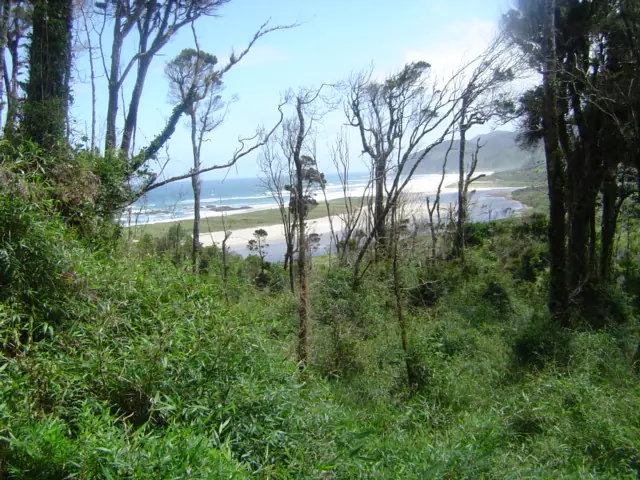
Near Puñihuil, boats run out to islets where Magellanic and Humboldt penguins nest side by side — one of the few places on earth where they do. The season here runs roughly December to March; outside it, expect rain, closed ferries and quiet towns.
Patagonia: Torres del Paine and the Carretera Austral
Torres del Paine is the image most people carry of Patagonia: granite towers, a turquoise lake, and wind that rearranges your plans. From Puerto Natales, the classic day hike climbs to the base of the towers — around 19 km return, eight to ten hours, with the final hour a scramble over glacial boulders. Serious walkers tackle the W circuit in four to five days, linking the towers, the French Valley and the Grey Glacier, or the full circuit in seven to nine.
This is the one part of Chile where you must plan months ahead. Park entry and the refugios and campsites along the trail fill up for the November-to-March season well in advance; outside that window, services close and weather turns genuinely dangerous. Expect four seasons in an afternoon, ferocious gusts, and reward: pumas at dawn, condors overhead, and icebergs the colour of cobalt.
South of the park, the Carretera Austral threads nearly 1,200 km of gravel through rainforest and fjords. Fly into Balmaceda or Punta Arenas, rent a car in Coyhaique, and slow down for Cerro Castillo, the Exploradores Glacier and the marble caves at Puerto Río Tranquilo, where boats slip into Cathedral, Chapel and Cave — pale blue chambers carved by the lake. It is remote, rough and unforgettable.
Easter Island: Rapa Nui and the Moai
Some 3,500 km off the coast, Easter Island is reachable only by a flight of around six hours from Santiago, and it feels like nowhere else. In Rano Raraku, the quarry where almost all the moai were carved, hundreds of statues stand half-buried in the hillside, and the largest still lies unfinished, attached to the bedrock. At Ahu Tongariki, fifteen moai line up on a coastal platform with the Pacific hammering behind them — go for sunrise, when there is nobody but you and the sea.
Don't miss Orongo, a ceremonial village of stone houses perched between the Rano Kau crater and a sheer cliff, Anakena beach, where a platform of moai stands over white sand and palm trees, or Ahu Akivi, whose seven statues face the ocean rather than inland. The island's national park entry covers the major sites and is valid for several days; some locations can only be visited with a local guide.
Plan three or four nights. Accommodation in Hanga Roa is limited, so book early, especially around the Tapati festival in February, when the island fills with dance and canoe competitions. The climate is mild year-round, though the southern winter brings more rain and wind.
Frequently asked questions
When is the best time to visit Chile?
It depends entirely on the region. Patagonia and the Lake District are at their best from November to March, when the trails and ferries operate. Santiago and the Central Valley are pleasant in spring (September to November) and autumn (March to May). The Atacama Desert works year-round, with April to May and September to October the most comfortable. Skiing runs from roughly June to August, and Easter Island is mild in every month.
How long do you need to see Chile properly?
Two weeks is the minimum for a satisfying trip covering Santiago, Valparaíso, the Atacama Desert and Torres del Paine, with at least one internal flight to cover the huge distances. Allow three to four weeks if you want to add the Lake District, Chiloé and Easter Island without rushing. Chile is over 4,300 km long, so bus-only itineraries eat up days.
Do you have to book Torres del Paine in advance?
Yes, and earlier than you think. For the November-to-March season, park entry and the refugios and campsites along the W and full circuit sell out months ahead; some travellers book six months out. Independent camping is restricted, so sort permits and beds before you book flights. Outside the season, many services close and conditions become serious.
How do you handle the altitude in the Atacama Desert?
San Pedro de Atacama sits at about 2,400 m and El Tatio geysers reach roughly 4,300 m, so give yourself a gentle first day. Drink plenty of water, go easy on alcohol, and schedule the geysers for your second or third morning rather than the day you arrive. Tours leave around 4–5 am to catch the steam at dawn, so dress for below-freezing temperatures.
Is Easter Island worth the extra flight?
For most travellers, yes. The flight from Santiago takes about six hours and three to four nights is enough to see Rano Raraku, Ahu Tongariki, Orongo and Anakena without rushing. Book flights and Hanga Roa accommodation early, buy the national park ticket on arrival, and remember that several sites require a local guide — which is also the best way to understand the island's history.
Plan it — experiences in Chile
Live search, booked directly with trusted providers.