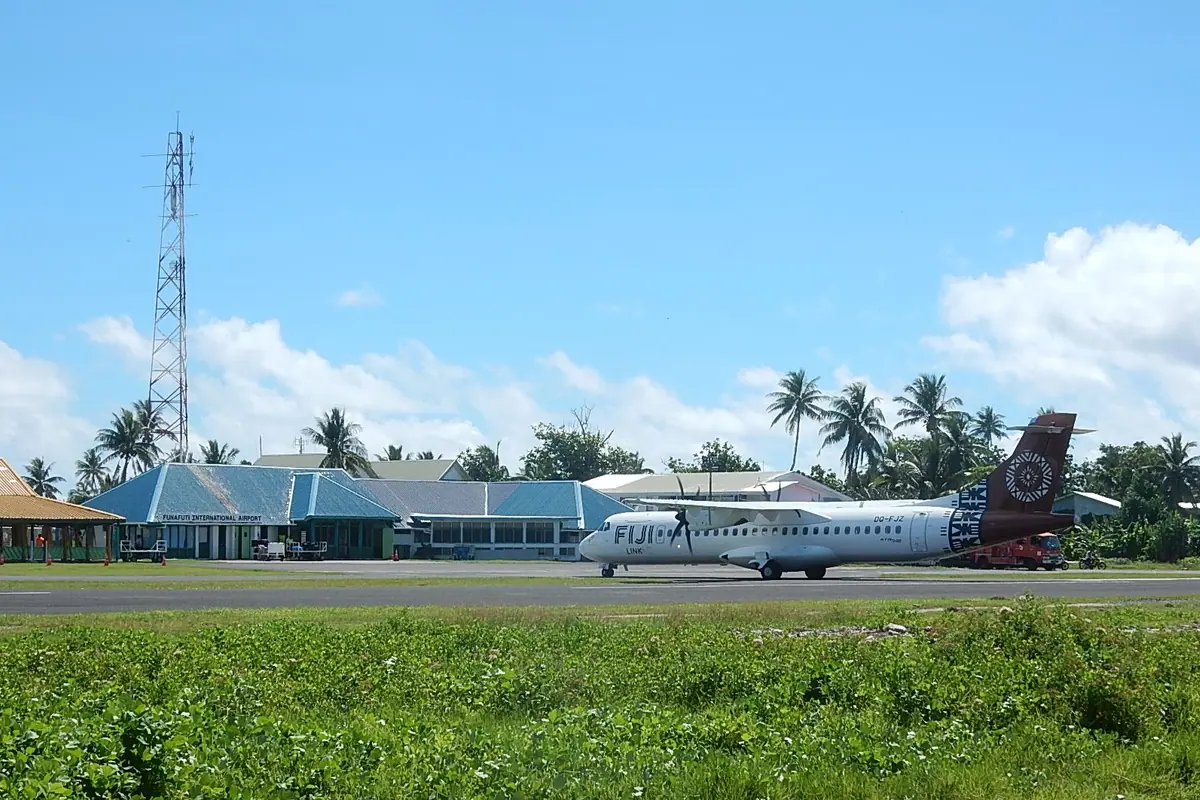
Tuvalu is the kind of country you don't pass through — you arrive by a twice-weekly flight, land on an airstrip that doubles as the national sports field, and discover that the entire lodging industry fits into a couple of villages. Here's how the hotels and guesthouses actually work, and which landmarks justify the long trip out.
What a Tuvalu Hotel Really Is
Nine islands strung across the central Pacific between Fiji and Kiribati, six of them true atolls, make up one of the smallest countries on earth — barely 26 square kilometres of land in total, with the highest point sitting a few metres above the sea. Almost every visitor lands on Fongafale, the main islet of Funafuti atoll, a ribbon of coral roughly 12 kilometres long and only a few hundred metres wide, with open ocean on one side and a pale turquoise lagoon on the other. Nearly half the country's population lives along that strip, which is also where the airport, the bank, the hospital, the government offices and virtually all the accommodation are found.
Understand one thing before you book: 'hotel' in Tuvalu is a flexible word. There is one property that genuinely operates as a full-service hotel, a small cluster of family-run lodges and guesthouses in Vaiaku village, and then island-council rest houses scattered across the outer atolls. You will not find international chains, high-rise towers, swim-up bars or sprawling resorts. What you will find are clean rooms in family compounds, lagoon views at dawn, home-cooked fish and taro, and a pace of life set by the tide and the church bell rather than by a concierge.
Supply is the real constraint. Across the whole country there are only a few dozen visitor beds, and demand spikes on the days planes land, so anyone with fixed dates should reserve months ahead. Online inventory is thin and often outdated, so it pays to confirm by email or phone, state your arrival flight, and ask explicitly about an airport pickup — the terminal is close enough to Vaiaku that most guests simply walk.
Vaiaku Lagi Hotel and the Funafuti Lodging Scene
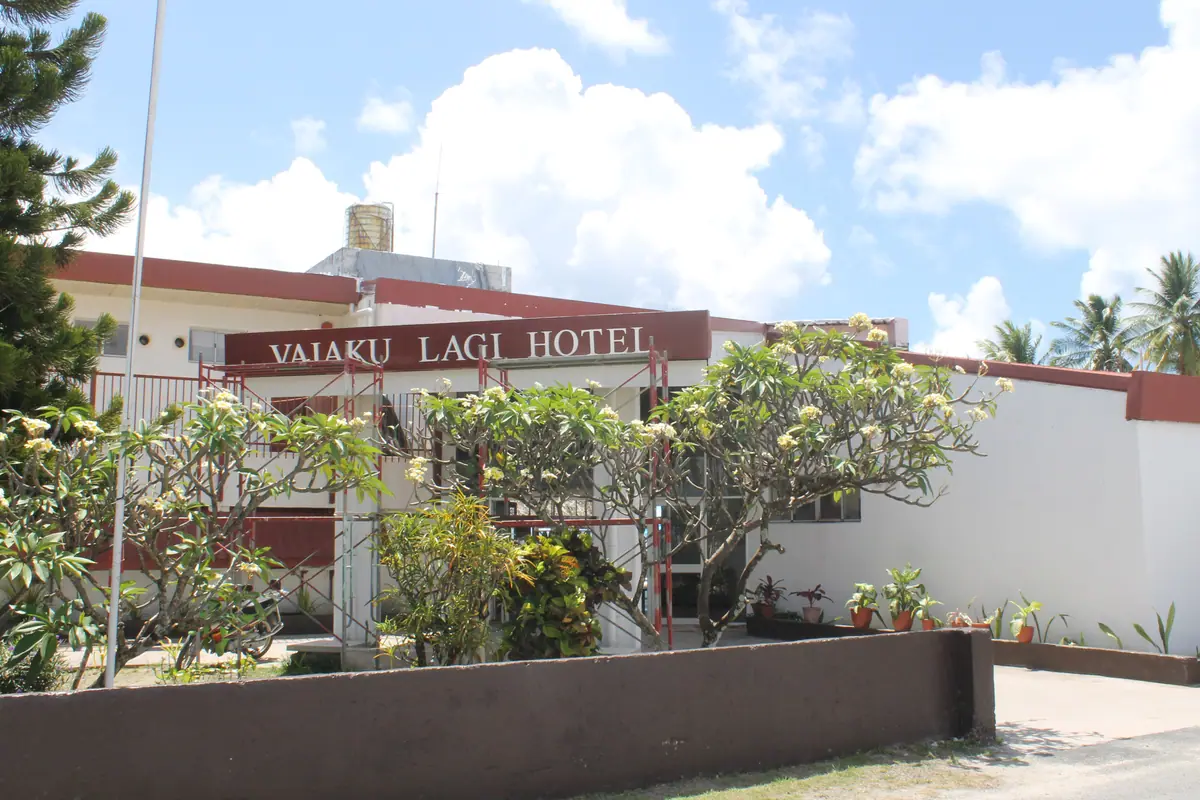
The Vaiaku Lagi Hotel is the country's flagship and its only true hotel, government-owned and set on the lagoon shore of Vaiaku, a two-minute walk from the airport terminal. It is where visiting delegations, officials and most first-time travellers stay. Rooms are simple but comfortable and come with air conditioning, private bathrooms and either lagoon or runway views; downstairs there is a restaurant serving the catch of the day with rice, taro and breadfruit, plus a bar that functions as the closest thing Funafuti has to a social hub on a Friday evening.
Expect island infrastructure rather than resort polish. Power comes from diesel generators, so there can be brief outages; water is collected from rainwater tanks, which means short showers are the norm rather than a request; and the wi-fi, when it works, is slow. None of this is a defect — it is simply how an atoll of eleven thousand people works. If you want a swimming pool or a spa, Tuvalu is not the destination for you. If you want to sit on a lagoon-front verandah at sunset with a cold drink and watch flying fish scatter across the water, it is hard to beat.
Fongafale's other standout feature is its runway. Built by American forces during the Second World War and still the country's only airstrip, it is used for football, jogging, cycling lessons and evening strolls whenever no plane is due. That single strip of tarmac is the spine of national life — a place to meet, exercise and watch the sunset — and staying anywhere in Vaiaku puts you right beside it.
Lodges and Guesthouses: Family-Run Rooms in Vaiaku and Beyond
Beyond the main hotel, the usual choice is one of the small family-run lodges in and around Vaiaku, such as Filamona Lodge or Esfam Lodge. These are typically a handful of rooms in a private compound, sometimes with a shared kitchen and living area, sometimes with private bathrooms and air conditioning, always with a host who knows exactly which boat is leaving and when. They suit longer stays, budget-conscious travellers and anyone who would rather eat with a Tuvaluan family than order from a menu. Rates are modest, breakfast is often included, and the walk to the lagoon takes about as long as boiling a kettle.
On the outer islands, lodging means a council rest house: a basic room with a mattress, a mosquito net, a fan and a shared bathroom, frequently without a kitchen or restaurant of any kind. Nanumea, Nukufetau, Vaitupu and Nui generally have somewhere for a visitor to sleep, arranged through the island council or through a contact in Funafuti, but the smaller reef islands often have nothing at all. If you go, go self-sufficient — carry rice, tinned food, drinking water, a torch, a first-aid kit and enough cash to cover the weeks you might be stranded by weather or a delayed ship.
Staying in someone's home comes with quiet obligations. Take your shoes off before entering, dress modestly with shoulders and knees covered, ask before photographing people or village buildings, and treat the maneapa — the traditional thatched meeting hall found on every island — as a community space rather than a sightseeing stop. Sunday is taken seriously across Tuvalu: most shops close, boats rarely move, and visitors are expected to keep the day calm.

Must-See Attractions on Funafuti
The single unmissable experience is the Funafuti Marine Conservation Area, a protected sweep of lagoon on the western side of the atoll that takes in six islets — Tepuka Savilivili, Fualopa, Fuafatu, Vasafua, Fuakea and Tefala. Small boats run out from the lagoon shore in around 30 to 45 minutes, and a day trip usually combines snorkelling over coral heads with a picnic on a palm-shaded motu that may have no one else on it. Inside the reserve fishing is banned, which is why the reef fish, green turtles, coconut crabs and nesting seabirds are unusually abundant and unusually unafraid. A small conservation fee applies, and it is worth every cent.
Back on land, Funafuti packs a surprising amount into a strip you can walk end to end. The Tuvalu Philatelic Bureau is a genuine national landmark: stamps have long been one of the country's few export earners, and collectors travel here specifically to buy first-day covers and colourful issues that never appear on ordinary mail. Nearby you'll find the Tuvalu National Library and Archives, the Women's Handicraft Centre where pandanus mats and fans are woven, and the whitewashed Church of Tuvalu, the national church whose hymns fill the atoll on Sunday mornings.
The Second World War left its own landmarks. American engineers built the airstrip in 1943 and dug the Borrow Pits, borrow pits of coral that later flooded and were reused as pulaka (swamp taro) gardens — pits that are now being poisoned by saltwater intrusion, a visible reminder of what rising seas mean here. Concrete bunkers, revetments and wreckage still sit along the ocean side, half-swallowed by vegetation, and the lagoon shore at dusk remains the country's favourite gathering place.
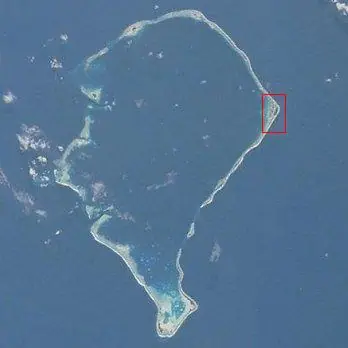
Beyond Funafuti: Outer Atoll Landmarks Worth the Voyage
Nanumanga holds Tuvalu's most intriguing archaeological site: the Fire Caves, submerged chambers off the reef where charcoal, shells and traces of ancient hearths have been found well below the waterline, hinting at human occupation thousands of years ago when sea levels were lower. Divers and confident snorkellers find them unforgettable, though access depends entirely on local boats and calm weather. Nanumea, further north, is scattered with wartime relics — the old airstrip, wrecked aircraft and landing craft rusting in the shallows — alongside enormous pulaka pits and one of the largest maneapa in the country.
Nukufetau's Motulalo islet was another wartime airfield, now overgrown and circled by empty beaches, while Vaitupu is home to Motufoua Secondary School, the national boarding school that draws teenagers from every island and makes the atoll feel busier and younger than the rest. Nui, a Polynesian outlier with strong Kiribati influence, is celebrated for its weaving and its imposing maneapa; further south, Nukulaelae and Niutao are quieter still, and tiny Niulakita is about as remote as the Pacific gets.
Getting out there is the hard part. A government ship links the islands on a schedule set by cargo, weather and fuel, and crossings can take anywhere from a few hours to several days. Passage is normally arranged with the island council, which also allocates the rest house, and you should plan on flexibility measured in weeks rather than days — bring supplies, cash, medication and patience, and treat a delayed sailing as part of the experience rather than a crisis.
When to Go, What to Bring and How to Behave
May to October is the sweet spot: the trade winds blow steadily, humidity drops, rain becomes occasional rather than constant, and lagoon crossings to the conservation area are at their calmest. November to April is the wet season, hot, sticky and punctuated by heavy downpours, with tropical cyclones most likely between January and March. December and February are typically the hottest, most humid months of the year. There is no bad month for a lagoon sunset, but there is a bad month for a small boat.
Money and logistics need forethought. The currency is the Australian dollar, there is a bank in Funafuti, and card acceptance outside the main hotel is rare — bring more cash than you think you need. Tap water comes from rainwater tanks, so drink bottled or filtered water, and pack a filter if you plan to travel to outer islands. Power is generated by diesel and the internet is slow and intermittent, so download everything you need in advance and treat connectivity as a bonus. Reef-safe sunscreen, insect repellent, reef shoes, a snorkel set, a light rain jacket and any prescription medicine should come with you, because none of it is reliably available locally.
Finally, etiquette matters more here than in most places. Cover shoulders and knees, especially in villages and near churches; ask permission before photographing people, maneapa or graves; never walk into a maneapa uninvited; and keep Sunday quiet, since inter-island travel, shops and most activity stop entirely. Most nationalities receive a visa on arrival for up to a month, but you will need proof of onward travel and accommodation, and travel insurance covering medical evacuation is genuinely important — the hospital on Funafuti is small and serious cases are flown out. Tipping is not expected, and a simple 'fakamolemole' and a smile will carry you a long way.
Frequently asked questions
Where should I stay in Tuvalu?
Almost all visitors stay on Fongafale in Funafuti atoll. The Vaiaku Lagi Hotel is the only full-service hotel, with a restaurant, bar and air-conditioned rooms a short walk from the airport. For a cheaper, family-run option, the lodges and guesthouses in Vaiaku village offer simple rooms, some with shared kitchens. On the outer atolls you rely on island-council rest houses, arranged in advance through the council or a local contact.
When is the best time to visit Tuvalu?
May to October brings the steadiest trade winds, lower humidity and the calmest lagoon conditions — ideal for boat trips to the Funafuti Marine Conservation Area. November to April is wet, humid and carries cyclone risk, peaking from January to March. December and February are the hottest months. Whatever the season, expect warm temperatures year-round and brief, heavy showers.
How do I get to Tuvalu and how far ahead should I book?
Tuvalu is served by a scheduled service from Fiji, usually around twice a week, landing at Funafuti International Airport. Because flights are infrequent and the country has only a few dozen visitor beds, book both flights and accommodation several months ahead, particularly for the drier season and the Christmas period. Most nationalities receive a visa on arrival for up to a month, with proof of accommodation and onward travel required.
Can I visit Tuvalu's outer islands?
Yes, but it takes planning. A government ship links the atolls on a schedule dictated by cargo, weather and fuel, and crossings can take hours or days. Arrange permission and a rest house through the island council first, and travel with your own food, drinking water, cash and medication. Highlights include the Nanumanga Fire Caves, the wartime relics and airstrips on Nanumea and Nukufetau's Motulalo islet, and Vaitupu's Motufoua Secondary School.
Do I need cash, and is there internet in Tuvalu?
Bring Australian dollars in cash — there is a bank in Funafuti and a limited number of ATMs, but card payment is mostly confined to the main hotel. Internet and mobile data are satellite-based, slow and intermittent, so download maps, tickets and documents before you fly. Tap water is rainwater, so drink bottled or filtered water, and expect generator-powered electricity with occasional short outages.
Sort the rest of your trip
Everything for Tuvalu, in one place
Transfer in Tuvalu
Private driver waiting on arrival — no queues, no surprises.
Book a transfer
Things to do in Tuvalu
Skip-the-line tickets, guided tours and standout experiences.
See experiences
Stay online in Tuvalu
Travel eSIM — data the moment you land, no roaming bills.
Get an eSIM