Gabon is the Africa that still feels half-drawn on the map: rainforest pressing in on both banks of the Ogooué, elephants walking the surf line at Loango, and waterfalls in Ivindo loud enough to hear from a bush plane. Where you sleep shapes the entire trip here, because the serious wildlife lodges sit inside the parks, while the polished city hotels sit an hour or more from the nearest trailhead. Choose your bed, and you have chosen your Gabon.
How Hotels in Gabon Actually Work: An Equatorial Primer
Gabon straddles the Equator on the Atlantic coast of Central Africa, and almost everything outside a handful of cities is forest. That geography dictates the accommodation. Lodging falls into three broad tiers: international-standard business hotels in Libreville and Port-Gentil, with air conditioning, pools and reliable generators; small independent hotels and family guesthouses in provincial towns such as Lambaréné, Franceville and Ndjolé; and full-board safari lodges or research-style camps inside or beside the national parks, where the nightly rate bundles meals, guiding, boat transfers and sometimes a charter flight.
French is the working language, the currency is the Central African franc, and cash rules almost everywhere outside the capital. Upmarket city hotels take major cards; guesthouses, park lodges, markets and taxi drivers generally do not, and ATMs thin out sharply once you leave Libreville and Port-Gentil. Electricity is 220 volts with occasional outages — generators cover the better properties — and internet is slow and intermittent. Bring a headlamp, drink bottled or filtered water, and expect the heat and humidity to make air conditioning feel less like a luxury and more like a necessity.
Most nationalities need a visa arranged online before flying, and a yellow fever vaccination certificate is checked on arrival. Malaria is present throughout the country, so prophylaxis and repellent are standard packing, not optional extras. Finally, book park lodges several months ahead: many take only a handful of guests, some are reachable only by light aircraft, and a few close entirely during the heaviest rains.
Libreville Hotels: Where the Capital Puts You Closest to the Action
Libreville spreads along the Gabon Estuary in a series of low hills, and your choice of neighbourhood changes your trip. The administrative and commercial heart around the Boulevard Triomphal and the Glass district suits business travellers, with the biggest hotels, conference rooms and the safest evening restaurants. Quartier Louis is livelier, with bars and a growing food scene; the seafront towards Pointe-Denis and Sablière trades convenience for ocean air and beach access. Near Léon-Mba International Airport you will find practical one-night options, while 40 minutes north at Cap Estérias the coastline turns into quiet sand and simple beach lodges.
The city rewards a day or two of sightseeing between flights. The Église Saint-Michel de Nkembo is the unmissable one — a modest church whose interior is held up by dozens of carved wooden columns, painted in vivid colours that blend Christian imagery with local symbolism. Nearby, the Marché Mont-Bouët is the country's biggest market, a dense, loud sprawl of fabric, produce, smoked fish and hardware. The Musée National des Arts et Traditions du Gabon holds masks, reliquary figures and musical instruments, the Arboretum de Sibang offers labelled forest trails in the city, and the Cathédrale Sainte-Marie and the old lighthouse ruins at Pointe-Denis round out an easy half-day.
Libreville also works as a launchpad. Boats cross the estuary to Pongara National Park in well under an hour, putting you on turtle-nesting beaches and mangroves without a domestic flight. North of the city, Akanda National Park protects tidal mudflats and mangroves that draw flamingos and migratory waders, and the Monts de Cristal range, with its waterfalls and cloud-forest hikes, is a long but doable day trip. Base in the capital for two nights, see the church and the market, then head for the forest.
Sleeping Inside the Wild: Lodges and Camps in Gabon's National Parks
Lopé National Park is the classic introduction, a UNESCO-listed cultural landscape where savannah fingers into rainforest along the Ogooué valley. Forest elephants, buffalo and enormous troops of mandrills move through it, and exposed rock faces carry thousands of years of engravings. A full-service lodge sits on the edge of the park with views over the river, while a simpler forest camp deeper in offers walking safaris with researchers. You can arrive on the Transgabonais railway or by a short domestic flight, which makes Lopé the most accessible of the great parks.
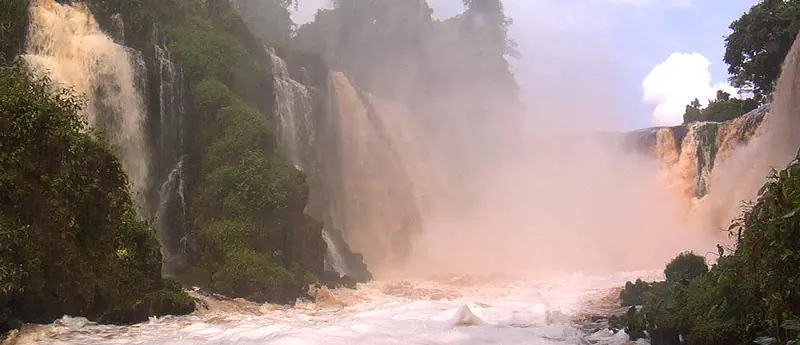
Ivindo National Park is the dramatic one. The Kongou Falls throw a wide curtain of black water and white spray across the Ivindo River, reached by boat and trail, and the forest clearing at Langoué Baï is one of the best places in Central Africa to watch forest elephants, gorillas and buffalo gather in the open. Access is by charter flight and then road, boat and foot, and the accommodation is deliberately simple — solar power, cold showers, early nights — so book far in advance and pack for genuine remoteness.
Loango National Park, south of Port-Gentil, is the famous 'land of the surfing hippos', where elephants, buffalo and hippos wander onto the beach between the Iguela Lagoon and the Tassi savannah. Lodges here are full-board and fly-in, with boat safaris along the lagoon and game drives across the grasslands. Further south, Mayumba National Park protects a long, wild shore where leatherback turtles nest between roughly November and February, while Moukalaba-Doudou near Gamba is the place for gorilla tracking. In every case, expect no air conditioning, limited power, full-board pricing and an early-morning rhythm set by the animals rather than the clock.
Port-Gentil, Lambaréné and Franceville: Hotels Beyond the Capital
Port-Gentil, the country's oil capital, sits on Île Mandji between the ocean and a maze of lagoons. Its hotels cater mainly to business travellers, which means dependable air conditioning, restaurants and secure parking rather than charm, but the town has good stretches of sand at Plage de la Pointe, the Cape Lopez peninsula nearby, and it is the jump-off point for Loango National Park via Omboué. If you are flying south to the parks, one night here is usually enough.
Lambaréné, an hour or two up the Ogooué from the coast, is the emotional heart of the interior. It is famous for the hospital founded by Albert Schweitzer, still operating on the riverbank, and for the Mission Sainte-Anne, a short boat ride away, whose chapel walls are covered in striking painted panels that fuse Christian and Bwiti imagery. Accommodation is simple — riverside hotels and guesthouses with fans, mosquito nets and views of pirogues sliding past — and boat trips to the lakes and forest islands around town are the main draw.
Franceville and nearby Moanda, at the end of the Transgabonais railway, have straightforward business hotels that serve as a base for the Chutes de Poubara waterfalls to the south, the wildlife park at Lékédi near Bakoumba, and the grassy Batéké Plateau, where a long-running gorilla reintroduction project works among savannah and forest. Smaller rail stops reward a night too: Lastoursville, with caves cut into the riverbank, and Fougamou, close to the Chutes de l'Impératrice on the Ngounié River. Rooms out here are plain, so book ahead and bring cash.
The Must-See Attractions That Should Shape Your Booking
If you plan your hotels around Gabon's headline sights, the itinerary almost writes itself. The Kongou Falls in Ivindo are the country's most spectacular natural monument. The Lopé-Okanda landscape combines ancient rock engravings with some of the best forest-elephant and mandrill viewing in Africa. Loango delivers wildlife on the beach and the surreal sight of hippos riding the surf. Mayumba and Pongara are turtle beaches of international importance, and Pongara is close enough to Libreville for a boat transfer and a night under canvas.
Closer to the capital, Akanda National Park's mangroves and mudflats fill with flamingos and migrant waders, and the Monts de Cristal hide waterfalls and orchids within a day's drive. In Libreville itself, the painted columns of the Église Saint-Michel de Nkembo, the Musée National des Arts et Traditions, and the roar and colour of the Marché Mont-Bouët are the essential city stops. Inland, the Mission Sainte-Anne at Lambaréné and its river setting deserve their reputation, while Lékédi Park and the Chutes de Poubara anchor the southeast.
The practical rule is that distances look tiny on a map and feel enormous on the ground. A sensible shape is two nights in Libreville, three or four nights in a single park — Lopé if you want comfort and rail access, Ivindo or Loango if you want remoteness — then a night or two in Lambaréné or Franceville before flying home. Trying to combine three parks in a week means spending most of it in transit.
When to Go and How to Book Your Gabon Stay
Gabon is hot and humid year-round, so the seasons matter mostly for access and wildlife. The long dry season from roughly June to September brings cooler, drier air, firmer roads, better forest walking and the peak season for mandrills at Lopé and humpback whales offshore at Loango and Mayumba. A shorter dry window arrives around December and January, coinciding with leatherback turtle nesting on the beaches of Pongara and Mayumba. Between these, two rainy periods from around mid-September to mid-December and February to mid-May turn tracks to soup, close some camps and offer lower rates and lush, dripping forest.
Getting around takes planning. Light aircraft charters connect Libreville with Omboué, Iguela, Gamba, Makokou and Franceville; the Transgabonais railway runs inland to Franceville via Ndjolé, Booué and Lastoursville; and everything else is a 4x4 with a driver or a pirogue on the water. Park lodges arrange their own transfers, usually included in the rate, but you must give them your flight details and travel light — soft bags, no hard suitcases in a four-seater.
Book park camps three to six months ahead for dry-season dates, and carry more cash than you think you need. Travel insurance with medical evacuation cover is genuinely worthwhile given how far the good forests are from good hospitals. Pack long sleeves, quick-dry trousers, a rain shell, high-strength repellent, a headlamp, binoculars and patience. Gabon rewards travellers who slow down: the country's finest hotel rooms are not its fanciest ones, but the ones with a lagoon, a forest clearing or a river outside the window.
Frequently asked questions
Do I need a visa and vaccinations to visit Gabon?
Most visitors need a visa, which can be applied for online before travel, and a yellow fever vaccination certificate is required for entry. Malaria is present throughout the country, so antimalarial medication and repellent are strongly recommended, and routine travel vaccines should be up to date.
When is the best time to visit Gabon?
The long dry season from around June to September offers the easiest travel, best forest walking and peak wildlife viewing, including mandrills at Lopé and whales offshore. December and January form a shorter dry window that overlaps with turtle nesting on the beaches of Pongara and Mayumba.
How do I reach Gabon's national park lodges?
Lopé National Park is the easiest, served by the Transgabonais railway and short domestic flights. Ivindo, Loango and Mayumba typically require a light aircraft charter from Libreville followed by road, boat or on-foot transfers, all of which the lodges usually arrange as part of a full-board package.
Are hotels in Gabon expensive, and can I pay by card?
City hotels in Libreville and Port-Gentil are reasonably priced by international standards, while park lodges look costly per night but include meals, guiding and transfers, which can be a large share of your overall budget. Cards work at upmarket city hotels; everywhere else, bring cash in Central African francs or euros to change.
Where should a first-time visitor base themselves?
Start with two nights in Libreville for the Église Saint-Michel de Nkembo, the Marché Mont-Bouët and the national museum, add a boat trip to Pongara National Park or a day in Akanda, then spend three or four nights in one park — Lopé for comfort and accessibility, Loango or Ivindo for real remoteness.
Sort the rest of your trip
Everything for Gabon, in one place
Transfer in Gabon
Private driver waiting on arrival — no queues, no surprises.
Book a transfer
Things to do in Gabon
Skip-the-line tickets, guided tours and standout experiences.
See experiences
Stay online in Gabon
Travel eSIM — data the moment you land, no roaming bills.
Get an eSIM